

Overview
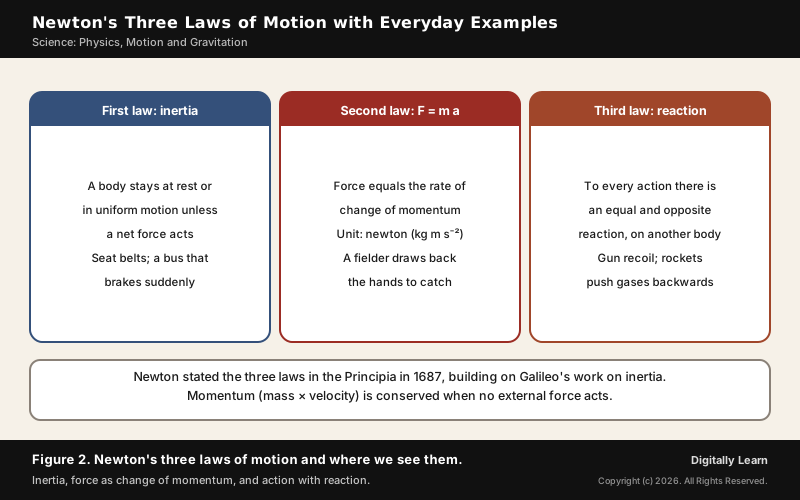
Newton's laws of motion describe how forces change the motion of bodies: a body keeps its state of rest or uniform motion unless a force acts, force equals the rate of change of momentum, and every action has an equal and opposite reaction. With his law of gravitation, they explain falling bodies, the orbits of the moon, planets and satellites, and the tides.
Motion: Distance, Displacement, Speed, Velocity and Acceleration
Scalars and Vectors: Distance, Displacement, Speed and Velocity
Motion is a change of position, and it is always described from a reference point. Distance is the total path covered and needs only a number, while displacement is the shortest distance from the starting point to the final position, measured in a straight line. A runner who finishes a lap at the starting line has covered a distance but has zero displacement.
- Uniform motion: Equal distances in equal intervals of time; a car in crowded traffic is in non-uniform motion.
- Speed: Distance covered per unit time, in metres per second; average speed is total distance divided by total time.
- Velocity: Speed in a definite direction; it changes if the speed, the direction or both change.
- Acceleration: The change in velocity per unit time, in metres per second squared; it is negative when it opposes the motion.
Equations of Motion and Distance-Time and Velocity-Time Graphs
When a body moves in a straight line with uniform acceleration, three equations link its velocity, acceleration and the distance it covers. A freely falling body is the everyday example of such uniformly accelerated motion.
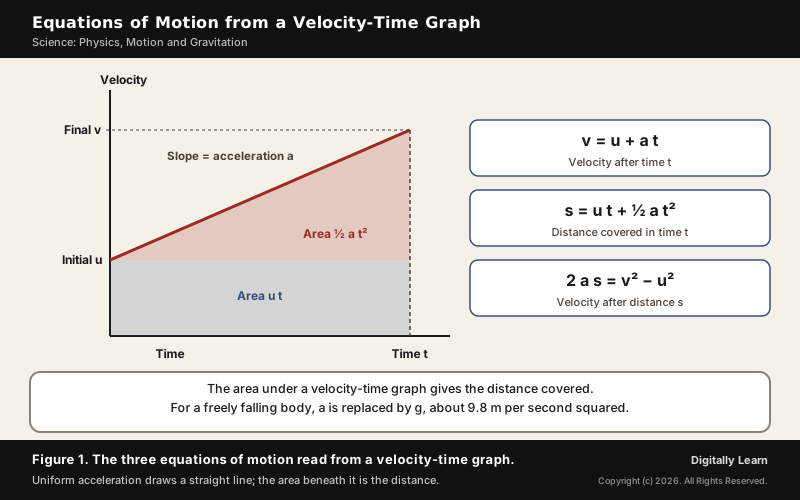
- Velocity-time relation: Final velocity v equals u plus at.
- Position-time relation: Distance s equals ut plus half at squared.
- Position-velocity relation: 2 times a times s equals v squared minus u squared.
Graphs show the same ideas at a glance. For uniform speed the distance-time graph is a straight line, and a curved one means non-uniform speed. On a velocity-time graph, uniform acceleration gives a straight line, and the area under the graph gives the distance covered.
Uniform Circular Motion and Centripetal Force
A body moving in a circle at constant speed is still accelerating, because its direction changes at every point. Motion in a circular path with uniform speed is called uniform circular motion; the moon and the earth, a satellite in a circular orbit and a cyclist on a circular track are examples.
The force that keeps a body on the circle acts towards the centre and is called the centripetal force, meaning centre-seeking. For a stone whirled on a string it is the tension in the string; if the string is released, the stone flies off along a straight line that is a tangent to the circle, as a hammer or discus does when an athlete lets go.
The centripetal force on a body of mass m moving at speed v in a circle of radius R is m v squared divided by R. For a car turning on a level road it is the static friction between tyres and road that supplies this force, which is why every curve has a safe maximum speed.
Newton's Laws of Motion: Force, Inertia and Momentum
Newton's First Law of Motion and Inertia
Galileo, watching marbles roll on inclined planes, deduced that objects keep moving at constant speed when no force acts on them. Newton turned this into the first law of motion: an object remains at rest or in uniform motion in a straight line unless an applied force compels it to change that state.
The tendency of a body to resist a change in its state of rest or motion is called inertia, so the first law is also called the law of inertia, and the mass of a body is the measure of its inertia. A passenger lurches forward when a car brakes suddenly and backwards when a bus starts; safety belts exert a force that slows the forward motion of the body.
Devices called accelerometers sense such sudden changes of motion. Cars use them to deploy airbags in a crash, a falling laptop uses one to park its hard disk head, and smartphones use them to sense tilt and turn the screen between portrait and landscape.
Newton's Second Law of Motion: F = ma and Momentum
Momentum is the product of a body's mass and velocity, measured in kilogram metres per second. The second law states that the rate of change of momentum of an object is proportional to the applied unbalanced force, in the direction of the force, which gives F = ma; a force of one newton gives a mass of 1 kg an acceleration of 1 metre per second squared.
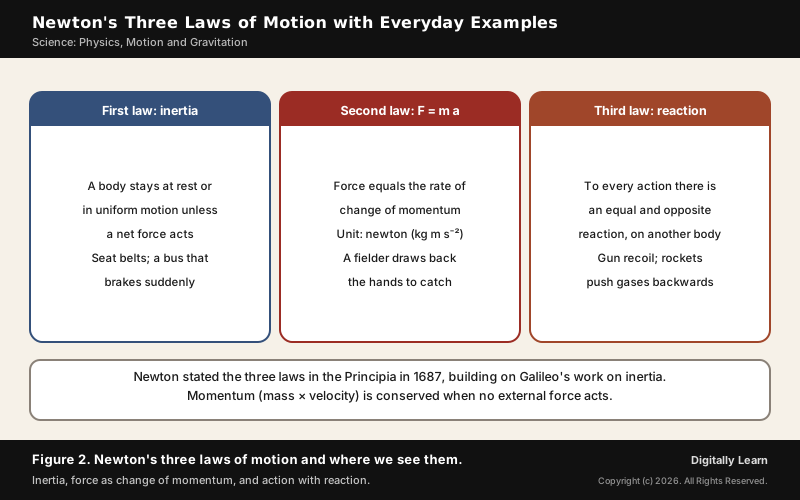
The law explains why stopping slowly hurts less. A fielder draws the hands back while catching a fast ball, which lengthens the time the ball takes to stop and so reduces the force on the palms; high jumpers land on a cushioned or sand bed for the same reason.
Newton's Third Law of Motion: Action, Reaction and Rockets
The third law says that when one object exerts a force on another, the second exerts an equal and opposite force back on the first, its reaction. The two forces act on different objects, never on the same one, which is why they do not cancel. To walk, we push the road backwards and the road pushes our feet forward.
- Recoil: A gun pushes the bullet forward and the bullet pushes the gun back; the heavier gun gets a much smaller acceleration.
- Boats: A sailor jumping forward pushes the boat backwards.
- Rockets: The engine accelerates exhaust gases backwards, and the reaction on the combustion chamber and nozzle is the thrust that drives the rocket forward.
Conservation of Momentum and Friction
When two bodies interact with no outside force acting, the total momentum before equals the total momentum after. This law of conservation of momentum explains recoil, and rockets use it too: the exhaust gains momentum one way and the rocket an equal momentum the other way. A person on a perfectly frictionless floor could move only by pushing something away, even air blown from the mouth.
- Static friction: Holds a body at rest against a small push, up to a limit.
- Kinetic or sliding friction: Acts once sliding begins, and is usually less than the maximum static friction; both are independent of the area of contact.
- Rolling friction: For the same weight it is much smaller, by two or three orders of magnitude, which is why the wheel mattered so much.
Friction always opposes motion, yet life depends on it. We are able to walk because of friction, brakes use kinetic friction to stop vehicles, and on a slippery road a car cannot move; lubricants and ball bearings reduce it in machines.
Work, Energy and Power in Mechanics
Work, Kinetic Energy, Potential Energy and Power
In science, work is done only when a force acts on an object and the object is displaced; work equals force times displacement, and its unit is the joule. Pushing a rock that does not move does no work, however tiring it is.
- Kinetic energy: The energy of a body due to its motion, equal to half m v squared; it rises with speed.
- Potential energy: Energy stored when work done on a body does not change its speed, as in a stretched rubber band or a raised stone (m g h).
- Conservation of energy: Energy only changes from one form to another; it can neither be created nor destroyed.
A falling stone shows the exchange. At the top its energy is all potential; as it falls, potential energy turns into kinetic energy, and the total stays the same at every height.
Power is the rate of doing work or of transferring energy, so it tells us how fast work is done. Two people of equal weight who climb the same rope do the same work, but the one who climbs faster develops more power.
- Watt: 1 watt is work done at the rate of 1 joule per second.
- Kilowatt: 1 kilowatt is 1,000 watts, used for larger rates of energy transfer.
- Average power: Total energy used divided by the total time taken.
How work turns into heat, and how far heat can be turned back into work, is the subject of Part 2: heat and thermodynamics.
Gravitational Force: Newton's Universal Law of Gravitation
Newton's Universal Law of Gravitation and Its Importance
Newton saw that the force pulling an apple to the ground also keeps the moon in its orbit. The moon moves round the earth because the earth's attraction supplies the centripetal force; without it the moon would move off in a straight line. Gravitation is a weak force unless large masses are involved, which is why we do not feel the pull of the person sitting next to us.
- What it explained: The force that binds us to the earth, the motion of the moon round the earth, the motion of planets round the Sun, and the tides caused by the moon and the Sun.
- Inverse square: If the distance grows six times, the force becomes thirty-six times smaller.
- Mutual pull: The apple also attracts the earth, but the earth’s huge mass makes its acceleration negligible.
- Four forces of nature: Gravitation is the weakest of the four fundamental interactions at the atomic scale; the weak force brings about radioactive decay, and the strong force binds quarks into protons and neutrons.
Gravitational Constant G and Acceleration due to Gravity g
Henry Cavendish first measured G with a sensitive balance in a 1798 experiment. The acceleration that gravity gives a falling body near the earth is g, about 9.8 metres per second squared; it does not depend on the mass of the body, so a stone and a sheet of paper would fall together in a jar with the air pumped out.
The value of g is not the same everywhere. Because the earth is not a perfect sphere and its radius grows from the poles to the equator, g is greater at the poles than at the equator, and it also falls with height. For standard use, g is defined as 9.806 65 metres per second squared.
Mass and Weight, Free Fall and Weightlessness
Mass measures inertia and stays the same on the earth, the moon or in space. Weight is the force with which the earth attracts a body, W = mg, measured in newtons, so it changes with place: a body's weight on the moon is about one-sixth of its weight on the earth, while its mass does not change.
| Feature | Mass | Weight |
|---|---|---|
| What it is | Measure of inertia | Force of the earth's attraction |
| Formula and unit | Kilogram (kg) | W = mg, newton (N) |
| Changes with place? | No, same everywhere | Yes, one-sixth on the moon |
- Free fall: A body falling under gravity alone.
- Weightlessness: In free fall there is no supporting force pushing back, so a spring balance reads zero and a person feels no weight.
- In orbit: Astronauts in a satellite feel weightless because the satellite and everything in it are falling freely round the earth together.
Kepler's Laws, General Relativity and Gravitational Lensing
Johannes Kepler drew three laws from the observations of planetary motion, published from 1609 to 1621. He described how planets move but could not explain why; Newton showed that the cause is the Sun's gravitational force, and used Kepler's third law to arrive at the inverse square rule.
- Law of orbits: The orbit of a planet is an ellipse with the Sun at one of the foci.
- Law of areas: The line joining a planet and the Sun sweeps out equal areas in equal intervals of time, so a planet moves faster when it is nearer the Sun.
- Law of periods: The cube of a planet’s mean distance from the Sun is proportional to the square of its orbital period.
Newton's law treats gravity as a force; Einstein's general relativity describes it as the curvature of spacetime by matter. Light follows that curvature, so when it passes a massive object it is bent, and a galaxy or cluster can act as a lens that distorts the image of a source behind it. This is gravitational lensing.
Einstein completed general relativity in 1915. The bending of starlight by the Sun was observed in 1919 by Arthur Eddington, and it confirmed general relativity: Newtonian physics predicts only half of the bending that Einstein's theory gives. Where the lensing mass is a whole galaxy cluster, the source behind it can appear as partial arcs.
Satellites, Escape Velocity, Tides and Buoyancy
Gravitational Potential Energy and Escape Velocity
The escape velocity is the minimum speed with which a body must be launched to escape the earth's gravity. For the earth it is about 11.2 km per second. For the moon it is about 2.3 km per second, roughly five times smaller, which is why the moon has no atmosphere: gas molecules there easily reach speeds that let them escape.
Close to the ground g hardly changes, so m g h works well. Far from the earth the pull weakens with the square of the distance, g = GM divided by d squared, which is why the energy needed to climb out of the earth's gravity is finite and an escape speed exists.
Orbits of Satellites: Geostationary and Polar
A satellite does not fall to the earth because the earth's attraction provides exactly the centripetal acceleration it needs to keep moving in its orbit. The height of the orbit sets its period: low satellites circle in about 100 minutes, while at about 36,000 km a satellite takes one day, the same as the earth's rotation.
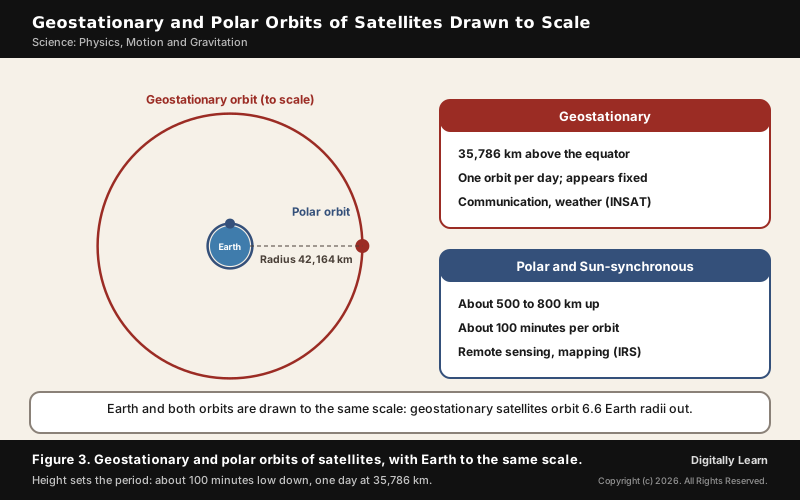
- Geostationary orbit: Circular, geosynchronous and directly above the equator at 35,786 km (22,236 miles), so the satellite appears fixed; India’s INSAT satellites use it for telecommunications.
- Polar orbit: Low altitude, about 500 to 800 km, passing roughly from pole to pole; the whole earth is covered strip by strip, which suits remote sensing and meteorology, as with India’s IRS satellites.
- Sun-synchronous orbit: A kind of near-polar orbit in which the satellite crosses the equator at the same local solar time every day, keeping the sunlight on the ground as uniform as possible.
Launch direction matters too. Rockets reach orbit most easily when launched near the equator towards the east, because they gain the earth's rotational speed of about 465 metres per second; Sriharikota's nearness to the equator benefits such eastward launches. That gain is small beside orbital speed, so it does not give a satellite escape velocity.
Tides, Thrust, Pressure and Archimedes' Principle
Tides are the periodic rise and fall of sea level caused mainly by the differential gravitational pull of the moon and the Sun, together with the effects of the earth's rotation and the orbital motion of the earth and moon. When the Sun, earth and moon are in line, the pulls combine to give spring tides; when they are at right angles, neap tides result.
- Thrust and pressure: Thrust is the force acting perpendicular to a surface, and pressure is thrust per unit area, measured in pascals; that is why knives have sharp edges and buildings wide foundations.
- Buoyancy: A fluid pushes up on any body immersed in it; a body less dense than the liquid floats, a denser one sinks.
- Archimedes’ principle: A body immersed fully or partly in a fluid feels an upward force equal to the weight of the fluid it displaces; ships, submarines, lactometers and hydrometers depend on it.
Previous Year UPSC-CSE Questions
Previous Year UPSC-CSE Questions By the end you will be able to draft model answers for the following UPSC questions. Each question carries a collapsible framework showing how to approach it in the exam.
- UPSC Prelims 2011 Prelims-GSAn artificial satellite orbiting around the Earth does not fall down. This is so because the attraction of Earth
How to approach this Prelims question
Approach: Ask what the earth's pull does for a body moving in a circle.
Trap to watch: Gravity does not vanish at orbital heights, and it does not supply speed.
Key facts to recall:
- Centripetal force keeps a body on a circle
- The earth's attraction supplies it for a satellite
Answer signal: It provides the necessary acceleration: option (d), the official answer.
- UPSC Prelims 2011 Prelims-GSSatellites used for telecommunication relay are kept in a geostationary orbit. A satellite is said to be in such an orbit when:
- The orbit is geosynchronous.
- The orbit is circular.
- The orbit lies in the plane of the Earth’s equator.
- The orbit is at an altitude of 22,236 km.
Select the correct answer using the codes given below:
How to approach this Prelims question
Approach: Check each condition against the definition of a geostationary orbit.
Trap to watch: 22,236 is the height in miles, not kilometres.
Key facts to recall:
- Geosynchronous, circular, above the equator
- 35,786 km or 22,236 miles
Answer signal: 1, 2 and 3 only: option (a), the official answer.
- UPSC Prelims 2002 Prelims-GSAssertion and Reason:
- Assertion (A): Artificial satellites are always launched from the earth in the eastward direction.
- Reason (R): The earth rotates from west to east and so the satellite attains the escape velocity.
How to approach this Prelims question
Approach: Test the assertion and the reason separately.
Trap to watch: The rotational boost is about 465 m/s, far below 11.2 km/s.
Key facts to recall:
- Eastward launch uses the earth's rotation
- Escape velocity is about 11.2 km/s
Answer signal: A true, R false: option (c), the official answer.
- UPSC Prelims 2015 Prelims-GSTides occur in the oceans and seas due to which among the following?
- Gravitational force of the Sun
- Gravitational force of the Moon
- Centrifugal force of the Earth
How to approach this Prelims question
Approach: List every force that shapes the tidal bulge.
Trap to watch: The Sun's pull is smaller than the moon's, but it is not absent.
Key facts to recall:
- Moon and Sun gravity
- Earth's rotation and the earth-moon orbital motion
Answer signal: 1, 2 and 3: option (d), the official answer.
- UPSC Prelims 2013 Prelims-GSThe known forces of nature can be divided into four classes, viz., gravity, electromagnetism, weak nuclear force and strong nuclear force. With reference to them, which one of the following statements is not correct?
How to approach this Prelims question
Approach: Recall the relative strength and role of each force.
Trap to watch: Gravity rules the heavens but is the weakest of the four at the atomic scale.
Key facts to recall:
- Gravity: weakest
- Weak force: radioactive decay
- Strong force: binds the nucleus
Answer signal: Gravity is not the strongest: option (a), the official answer.
- UPSC Prelims 2000 Prelims-GSAssertion and Reason:
- Assertion (A): A man standing on a completely frictionless surface can propel himself by whistling.
- Reason (R): If no external force acts on a system, its momentum cannot change.
How to approach this Prelims question
Approach: Apply conservation of momentum to the man and the air he blows out.
Trap to watch: No friction does not mean no motion; it means no external force.
Key facts to recall:
- Momentum is conserved when no external force acts
- Rockets move the same way
Answer signal: Both true and R explains A: option (a), the official answer.
- UPSC Prelims 2023 Prelims-GSConsider the following actions :
- Detection of car crash/collision which results in the deployment of airbags almost instantaneously
- Detection of accidental free fall of a laptop towards the ground which results in the immediate turning off of the hard drive
- Detection of the tilt of the smart-phone which results in the rotation of display between portrait and landscape mode
In how many of the above actions is the function of accelerometer required?
How to approach this Prelims question
Approach: Ask whether each action depends on sensing a change in motion or tilt.
Trap to watch: Screen rotation is sensed by an accelerometer too.
Key facts to recall:
- Airbag deployment
- Free-fall detection to park a hard disk head
- Orientation of phones
Answer signal: All three: option (c), the official answer.
Sources
- NCERT: Science (Class IX), Motion; Force and Laws of Motion; Gravitation; Work and Energy
- NCERT: Physics Part I (Class XI), Laws of Motion; Gravitation
- NASA Glenn Research Center: Newton's Laws of Motion
- NASA Earth Observatory: Catalog of Earth Satellite Orbits
- NOAA National Ocean Service: What Causes Tides?
- Wikipedia: Newton's laws of motion
- Wikipedia: Newton's law of universal gravitation
- Wikipedia: Gravitational constant
- Wikipedia: Standard gravity
- Wikipedia: Momentum
- Wikipedia: Friction
- Wikipedia: Rocket
- Wikipedia: Weightlessness
- Wikipedia: Kepler's laws of planetary motion
- Wikipedia: Gravitational lens
- Wikipedia: Escape velocity
- Wikipedia: Low Earth orbit
- Wikipedia: Geostationary orbit
- Wikipedia: Polar orbit
- Wikipedia: Spaceport
- Wikipedia: Satish Dhawan Space Centre
- Wikipedia: Tide
- Wikipedia: Archimedes' principle
- Wikipedia: Fundamental interaction
- Wikipedia: Accelerometer
- UPSC: Civil Services Examination question papers
Editorial Disclaimer
This article draws on the NCERT textbooks and the other sources listed on this page.


