


Overview
Recognition, skill training, toolkits and credit for 18 traditional trades
Launched on 17 September 2023 by the Ministry of MSME, PM Vishwakarma gives traditional artisans recognition, skill training with a stipend, a toolkit incentive, collateral-free credit and digital and marketing support, with a Rs 13,000 crore outlay to 2027-28.
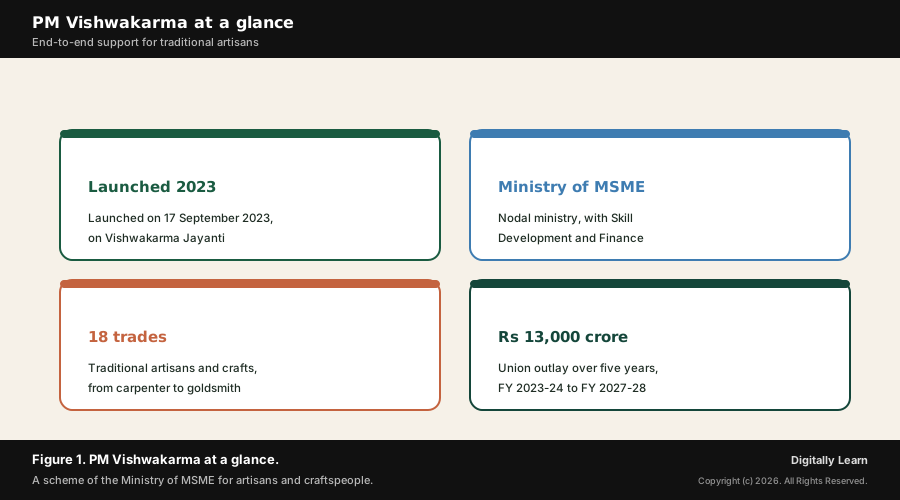
PM Vishwakarma, the Pradhan Mantri Vishwakarma scheme, is a central-sector scheme of the Ministry of Micro, Small and Medium Enterprises, launched on 17 September 2023 to give end-to-end support to traditional artisans and craftspeople who work with their hands and tools. It covers 18 family-based trades, from carpenter and blacksmith to potter, goldsmith and tailor, and offers recognition through a certificate and ID card, skill training with a stipend, a toolkit incentive, collateral-free credit at a concessional rate, and digital and marketing support. With an outlay of Rs 13,000 crore from 2023-24 to 2027-28, it is implemented jointly with the Ministry of Skill Development and the Department of Financial Services.
What PM Vishwakarma Is: The 17 September 2023 Ministry of MSME Scheme for Traditional Artisans
The 17 September 2023 launch on Vishwakarma Jayanti, the Ministry of MSME as nodal ministry, the joint implementation with Skill Development and Financial Services, the Rs 13,000 crore outlay and the six components
PM Vishwakarma, the Pradhan Mantri Vishwakarma scheme, is a central-sector scheme of the Ministry of Micro, Small and Medium Enterprises, launched on 17 September 2023 on Vishwakarma Jayanti. Its purpose is to give end-to-end support to traditional artisans and craftspeople who work with their hands and tools, so that an inherited craft can become a recognised and bankable livelihood. The scheme covers 18 family-based trades and treats the artisan, not the factory, as the unit of support.
The scheme is fully funded by the Union Government, with an outlay of about Rs 13,000 crore for the five years from 2023-24 to 2027-28. It is implemented jointly by the Ministry of MSME, the Ministry of Skill Development and Entrepreneurship and the Department of Financial Services under the Ministry of Finance. The artisan receives a graded set of benefits: recognition first, then skill training, a toolkit, credit and market support, each step building on the one before.
What is the significance of this design is that it treats the traditional artisan as a micro-entrepreneur worth investing in, not a relic to be subsidised. By combining recognition, skilling and collateral-free credit in one scheme, PM Vishwakarma tries to move the craftsperson from informal, hand-to-mouth work towards a formal, financed enterprise. The figure below sets out the scheme at a glance.
Why India's Traditional Artisans Need Support: Informal Work, No Collateral and a Weak Market Linkage
The absence of formal recognition and collateral, the dependence on moneylenders, the weak market linkage and outdated tools, and the strain on the family-based, guru-shishya craft economy
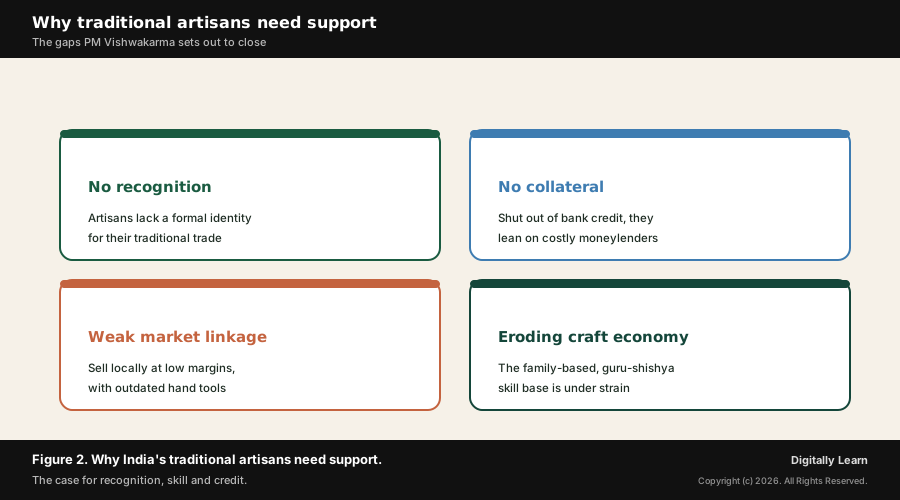
India's traditional artisans carry deep skill but little economic security. Most work in the unorganised sector, on a self-employment basis, with no formal record of their trade and no certificate to prove their craft. Without recognition, the carpenter, the potter or the weaver remains invisible to banks, government schemes and large buyers, so a lifetime of skill earns neither status nor a stable income.
Why it matters is that the artisan's biggest barrier is finance, not effort. Lacking land or assets to pledge as collateral, the craftsperson is shut out of cheap bank credit and leans on moneylenders charging punishing rates. Tools are often old and slow, products reach only the local market at thin margins, and the family-based, guru-shishya chain through which the craft once passed from parent to child is weakening as younger members leave for wage work.
What is the significance of these gaps is that they define what a credible scheme must do. The artisan needs four things at once: a recognised identity, an upgraded skill, modern tools and affordable credit, with a market to sell into. PM Vishwakarma is built to supply exactly this sequence, which is why its components map onto the problems. The figure below sets out why traditional artisans need support.
The 18 Traditional Trades Covered: Carpenter, Blacksmith, Potter, Goldsmith, Tailor and More
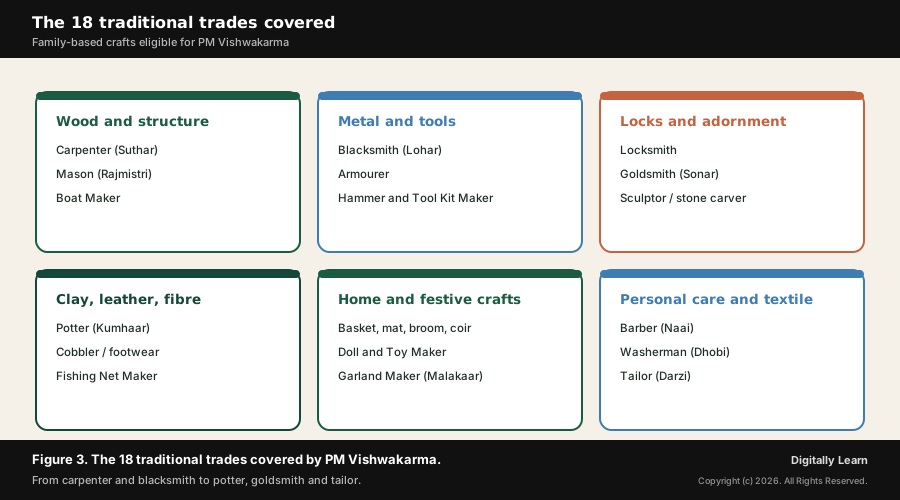
The 18 family-based traditional trades, from carpenter, mason and blacksmith to potter, goldsmith, sculptor, barber, washerman and tailor, grouped by craft family
PM Vishwakarma covers 18 traditional trades, chosen because they are practised with the hands and simple tools and are usually passed down within the family. They span work in wood, metal, clay, stone, leather, fibre and cloth, and include trades tied to daily village and town life. The common thread is a craft skill learned by doing, rather than through formal schooling or a factory line.
The trades range across crafts. They include the carpenter, boat maker and mason in wood and construction; the blacksmith, armourer, hammer and tool kit maker and locksmith in metalwork; the goldsmith, potter and sculptor in adornment and stone; the cobbler, fishing net maker and basket, mat and broom maker in leather and fibre; and the barber, garland maker, washerman, tailor and doll and toy maker in personal-care and household crafts. Each is a distinct, recognised trade under the scheme.
What is the significance of naming 18 trades is that it fixes the scheme's boundary and its target group. By listing specific crafts, the scheme directs recognition, skilling and credit to artisans who have long fallen between the policies for farm and factory. A craftsperson must belong to one of these trades to enrol, which keeps the benefit focused on the traditional artisan. The figure lists the 18 trades by craft family.
The Six Components: Recognition, Skill Training, Toolkit Incentive, Collateral-Free Credit and Digital and Marketing Support
Recognition through a certificate and ID card, basic and advanced skill training with a stipend, the toolkit e-voucher, collateral-free credit at a concessional rate, and the digital-transaction and marketing incentives
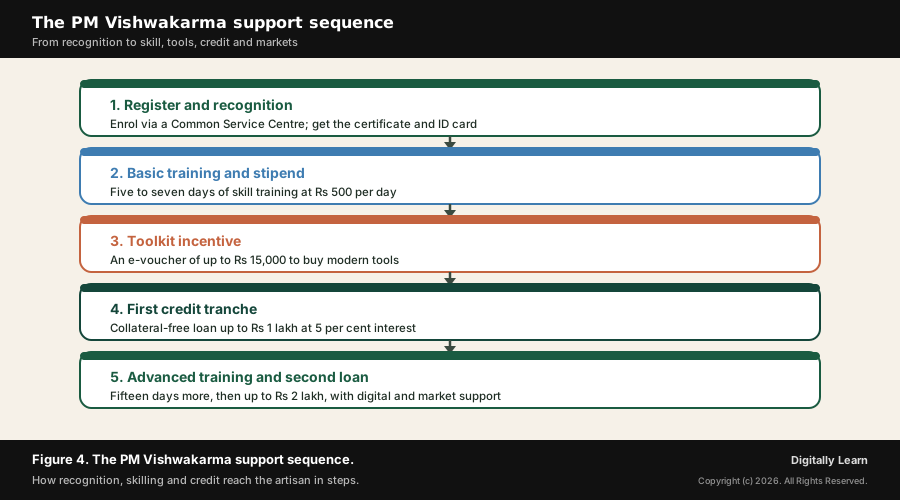
PM Vishwakarma works through six components that reach the artisan in sequence. The first is recognition: every enrolled artisan receives a PM Vishwakarma certificate and an ID card, a formal acknowledgement of the trade that, for many, is the first official proof of their craft. Recognition is the gateway, because it is what later unlocks the training, the toolkit and the credit.
The next components build capacity and finance. Skill training comes in two stages, a basic course of five to seven days and an advanced course of fifteen days or more, each paying a stipend of Rs 500 per day. A toolkit incentive of up to Rs 15,000, given as an e-voucher, lets the artisan buy better tools. Collateral-free credit, the Enterprise Development Loan, is offered up to Rs 3 lakh in two tranches of Rs 1 lakh and Rs 2 lakh at a concessional 5 per cent interest, with an 8 per cent government interest subvention.
What is the significance of the last two components is that they push the artisan towards modern markets. A digital-transaction incentive pays Re 1 for each digital payment, up to 100 a month, to draw the craftsperson into cashless trade. Marketing support adds quality certification, branding, advertising and onboarding onto e-commerce platforms such as the Government e-Marketplace. The table and figure below set out the components and the order in which they reach the artisan.
| Component | What the artisan receives | Value or detail |
|---|---|---|
| Recognition | A PM Vishwakarma certificate and an ID card | Formal recognition of the artisan and the traditional trade |
| Skill training | Basic and advanced training with a daily stipend | Basic 5 to 7 days, advanced 15 days or more, at Rs 500 per day |
| Toolkit incentive | An e-voucher to buy modern hand tools | Up to Rs 15,000 at the start of basic training |
| Credit support | Collateral-free Enterprise Development Loans in two tranches | Up to Rs 1 lakh, then up to Rs 2 lakh, at 5 per cent interest |
| Digital incentive | A reward for each digital transaction | Re 1 per transaction, up to 100 transactions a month |
| Marketing support | Quality certification, branding and e-commerce onboarding | Includes platforms such as the Government e-Marketplace |
Eligibility and Registration: Common Service Centres, Aadhaar Biometrics and the Three-Stage Verification
The eligibility conditions of age, trade and one member per family, the Common Service Centre registration with Aadhaar biometrics, and the three-stage verification by the Gram Panchayat or urban local body, the District Implementation Committee and the Screening Committee
Eligibility is defined narrowly to keep the scheme on the traditional artisan. The applicant must work with hands and tools in one of the 18 family-based trades, in the unorganised sector and on a self-employment basis, and must be at least 18 years old on the date of registration. The benefit is limited to one member per family, where a family means a husband, a wife and unmarried children.
There is also a credit condition: the applicant must not have taken a loan under a similar credit-based scheme of the central or state government for self-employment or business development in the past five years. Registration is done free of charge at a Common Service Centre, where an agent enrols the artisan on the PM Vishwakarma portal using Aadhaar-based biometric authentication, so that each beneficiary is uniquely identified.
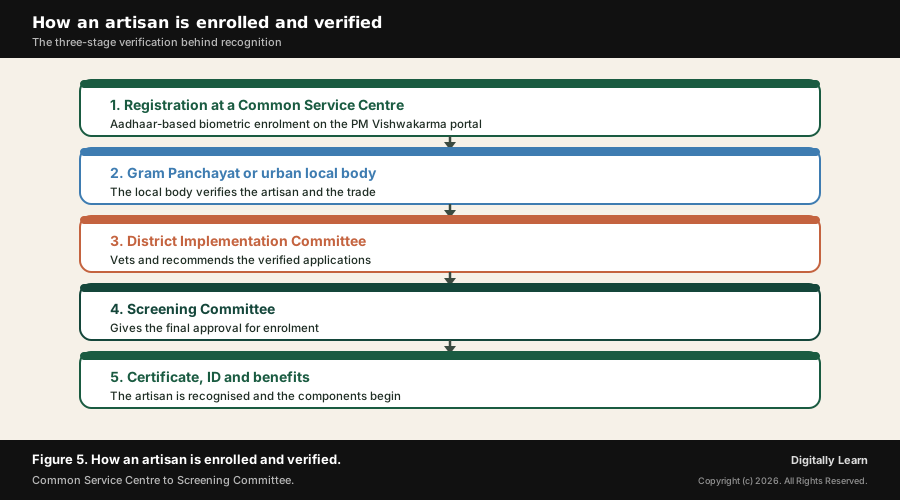
What is the significance of the verification is that it guards the scheme against false claims while keeping enrolment local. Every registration passes through three stages: first the Gram Panchayat or urban local body verifies the artisan and the trade; then the District Implementation Committee vets and recommends the application; and finally the Screening Committee approves it. Only then do recognition and the rest of the support follow. The figure traces the enrolment and verification chain.
Who Runs and Funds PM Vishwakarma: The MSME, Skill Development and Financial Services Partnership
The Ministry of MSME as nodal ministry with the Ministry of Skill Development and the Department of Financial Services, and the scheduled commercial banks, regional rural banks, cooperative banks and other lenders that extend the credit
PM Vishwakarma is run by a partnership of three arms of government, each handling what it does best. The Ministry of MSME is the nodal ministry, owning the scheme and its budget. The Ministry of Skill Development and Entrepreneurship organises the basic and advanced training through master trainers and assessors, and the Department of Financial Services under the Ministry of Finance steers the credit side with the banks.
The credit itself flows through the regular banking system. The Enterprise Development Loans are extended by scheduled commercial banks, regional rural banks, cooperative banks, small finance banks and non-banking lenders, not by the ministry directly. Because the loans are collateral-free, the government uses an interest subvention and a credit-guarantee cover to reassure lenders, in the same spirit as the Reserve Bank's norm that micro and small enterprise loans up to Rs 10 lakh need no collateral.
What is the significance of this architecture is that delivery depends on every arm working together. The district machinery, the training providers and the lending banks must each perform, or the artisan is recognised on paper but never trained, equipped or financed in practice. Common Service Centres handle the front-end enrolment, while the district and state committees keep the list clean. The scheme is therefore as strong as its weakest local link.
How PM Vishwakarma Complements Mudra, PM SVANidhi, Skill India and ODOP Market Linkage
How recognition, skill and credit for artisans sit alongside Mudra micro-credit, PM SVANidhi for street vendors, the Skill India skilling system, and One District One Product and e-commerce market linkage
PM Vishwakarma does not stand alone; it fills a specific gap in India's web of livelihood schemes. Where the Pradhan Mantri Mudra Yojana offers collateral-free micro-credit to a broad range of non-farm enterprises, PM Vishwakarma adds recognition, skilling and tools tailored to the traditional artisan. It is narrower and deeper, aimed at 18 named crafts rather than at micro-enterprise in general.
Other schemes cover neighbouring groups and needs. PM SVANidhi serves urban street vendors with working-capital micro-loans; the Skill India mission and the Pradhan Mantri Kaushal Vikas Yojana run the wider skilling system into which Vishwakarma training fits; and market-linkage efforts such as One District One Product and onboarding onto the Government e-Marketplace help the artisan sell beyond the village. Together they form a ladder from recognition to skill, credit and markets.
What is the significance of this complementarity is that no single scheme can carry the artisan alone. A craftsperson may hold a PM Vishwakarma certificate, take a first loan, then graduate to a larger Mudra loan as the enterprise grows, while selling through e-commerce. Read this way, PM Vishwakarma is the entry rung of a longer climb. The table contrasts it with the neighbouring schemes.
| Scheme (lead ministry) | Whom it mainly serves | Distinctive support |
|---|---|---|
| PM Vishwakarma (Ministry of MSME) | Traditional artisans and craftspeople in 18 trades | Recognition, skill training, a toolkit and collateral-free credit up to Rs 3 lakh at 5 per cent |
| PM Mudra Yojana (Department of Financial Services) | Non-corporate, non-farm micro and small enterprises | Collateral-free institutional micro-credit through banks |
| PM SVANidhi (Ministry of Housing and Urban Affairs) | Urban street vendors | Collateral-free working-capital micro-loans with a digital incentive |
| Skill India and PMKVY (Ministry of Skill Development) | Youth and workers across sectors | Short-term skilling, certification and recognition of prior learning |
PM Vishwakarma at Scale: Registration, Training and Outlay by Late 2025
The registration and training progress as on 1 December 2025, the Rs 13,000 crore five-year outlay, and the spread across 18 trades and the country
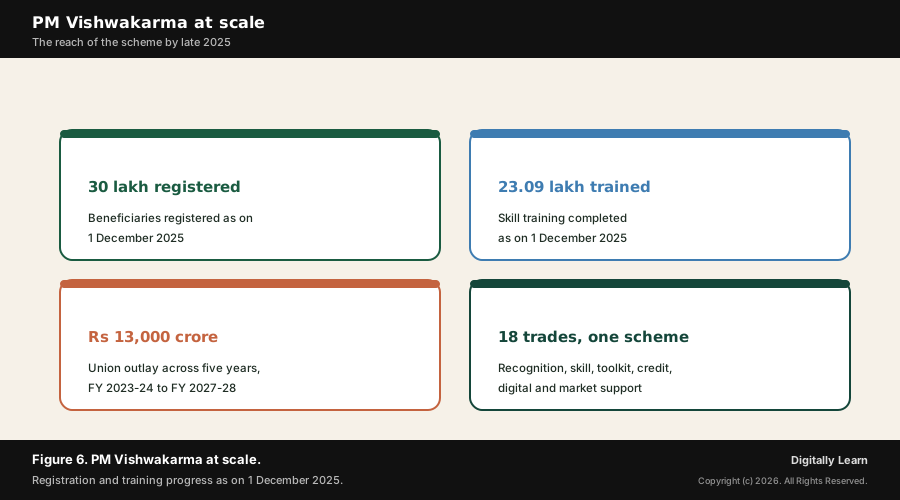
The scheme has scaled quickly. As on 1 December 2025, about 30 lakh beneficiaries had been registered under PM Vishwakarma, of whom about 23.09 lakh had completed skill training. The numbers show strong early demand for recognition and skilling among artisans, and a training effort that has reached the large majority of those registered within roughly two years of launch.
Behind the headline figures lies a wide spread. Enrolment runs across all 18 trades and across States, handled through a dense network of Common Service Centres that bring registration to the village. The five-year outlay of Rs 13,000 crore funds the stipends, toolkit vouchers, interest subvention and training, so the scale of money roughly tracks the scale of artisans the scheme aims to cover.
What is the significance of the numbers is that registration and training are running well ahead of credit. Recognising and skilling an artisan is faster than persuading a cautious craftsperson to take a loan, so the count of trained beneficiaries outpaces the count who have borrowed and built an enterprise. The real test is not enrolment but whether trained artisans turn skill into lasting income. The figure sets out the scale.
Limits and Criticisms: Reaching Informal Artisans, Credit Uptake and Market-Linkage Gaps
The difficulty of reaching undocumented informal artisans, the lag between registration and credit uptake, the one-member-per-family limit, and the gaps in training quality and market linkage
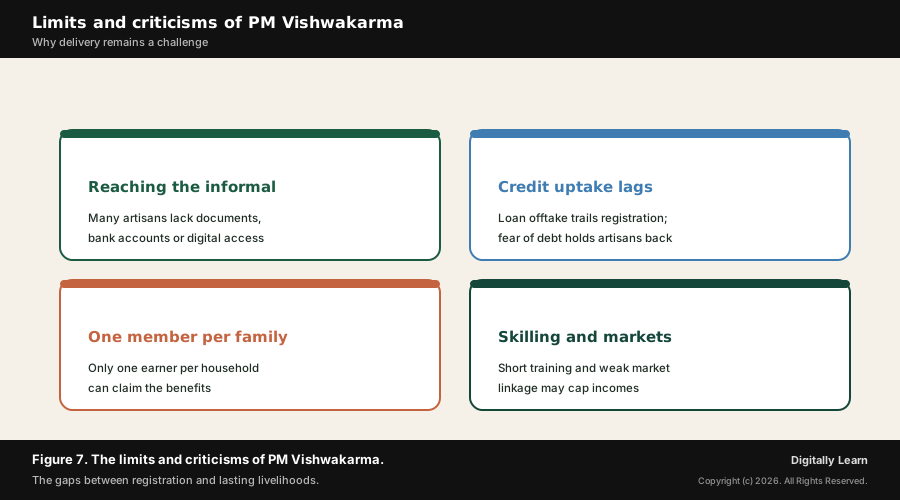
Judged honestly, PM Vishwakarma faces real limits. The hardest is simply reaching the informal artisan: many lack the documents, bank accounts or digital access that registration assumes, and rely on a Common Service Centre agent to enrol them correctly. The poorest and most remote craftspeople, who need the scheme most, are often the hardest to find and verify.
Two further gaps stand out. Credit uptake lags far behind registration, because an artisan with an uncertain income is wary of debt, even at 5 per cent, so the loan component reaches fewer people than the certificate. The one-member-per-family rule, meant to spread the benefit, can exclude a second artisan in the same household. Critics also question whether a short training course and limited market linkage can lift incomes durably.
What is the significance of these criticisms is that recognition alone does not change a livelihood. A certificate and a brief course are easy to deliver and easy to count, but a lasting rise in income needs the harder pieces: working capital actually borrowed, tools actually upgraded, and a market that pays better prices. The scheme's success will be measured by enterprises built, not cards issued. The figure sets out the main limits.
Significance for the Informal Economy: Turning Inherited Craft Skill into a Bankable Livelihood
How recognition, skilling and collateral-free credit lift the artisan from informal, low-paid work, and how the scheme links the inherited skill of the unorganised workforce to secure employment
The deeper purpose of PM Vishwakarma, and the heart of the skill-development debate, is to turn inherited craft skill into a secure livelihood. The traditional artisan already holds a skill, learned at home through the guru-shishya chain rather than in a classroom. The scheme's task is to recognise that skill, upgrade it, and connect it to tools, credit and markets, so that competence finally translates into income.
This is where education, skill and employment meet. Many artisans have little formal schooling, yet carry a valuable craft skill; PM Vishwakarma shows that skilling, backed by recognition of prior learning, can link such workers to employment even where formal education is thin. By adding a toolkit, collateral-free credit and market access, the scheme converts an upgraded skill into self-employment and a micro-enterprise, the employment outcome the skilling is meant to produce.
What is the significance of this for the informal economy is that it offers a model for the millions who work outside the organised sector. The scheme treats the artisan as human capital to be developed, not merely relieved, and tries to formalise the unorganised craftsperson step by step. Whether it succeeds depends on the employment that follows the skilling, but the approach, recognise, skill, finance and link to markets, is the right sequence for the informal worker.
The Way Forward: Deeper Skilling, Stronger Credit Absorption and Durable Market Linkage
Deepening skilling and certification quality, strengthening credit absorption, building durable market linkage, easing the family limit and tracking livelihood outcomes
The task ahead is to make sure recognition and training actually become income, by strengthening the harder pieces of credit, skilling quality and market linkage. The measures below set out a balanced way to deepen PM Vishwakarma without diluting its focus on the traditional artisan.
- Deepen and lengthen skilling beyond the short basic course, with trade-specific advanced training, design inputs and certification that buyers and lenders trust.
- Close the gap between registration and credit by hand-holding artisans through the first loan, easing fear of debt and ensuring the interest subvention and guarantee cover reach the smallest borrowers.
- Build durable market linkage through quality certification, branding, e-commerce onboarding and public procurement, so that better tools and skills earn better prices.
- Reach the most informal artisans by taking enrolment camps to craft clusters, simplifying documentation and supporting those without bank accounts or digital access.
- Reconsider the one-member-per-family limit where two artisans genuinely run separate trades in the same household.
- Connect PM Vishwakarma with Mudra, PM SVANidhi, One District One Product and the Skill India system, so that an artisan can graduate from recognition to a larger, financed enterprise.
- Track livelihood outcomes, not just registration and training counts, by following whether trained artisans raise their incomes and sustain their enterprises.
UPSC Relevance: GS-II Skill Development, the Prelims Pointers and the Education-Skill-Employment Framing
The GS-II and GS-III fit, the Prelims facts on the launch, trades, components and credit terms, and the education-skill-employment Mains framing of the 2023 skill-development question
For the examination, PM Vishwakarma sits across GS-II and GS-III. It is a welfare and skilling scheme for a vulnerable group, which places it in GS-II, and it is also an MSME and employment measure for the informal economy, which places it in GS-III. The facts worth fixing for Prelims are the 17 September 2023 launch, the Ministry of MSME as nodal ministry, the 18 trades, the six components and the credit terms.
For Mains, the scheme is a ready example for any answer on skill development, the informal sector or artisan livelihoods. The 2023 GS-II question on the linkages between education, skill and employment maps directly onto it: a student can explain how PM Vishwakarma recognises an artisan's inherited skill, upgrades it through training, and links it to employment through credit and markets, then weigh the limits of credit uptake and market linkage.
Contemporary linkages place PM Vishwakarma within a wider push to formalise and finance the informal economy. It works alongside Mudra micro-credit, PM SVANidhi for street vendors, the Skill India mission and One District One Product, and it speaks to debates on jobless growth, the recognition of unorganised workers and the revival of traditional crafts. Read this way, the scheme is one strand of India's effort to make skill yield secure work.
Previous Year UPSC-CSE Questions By the end you will be able to draft model answers for the following UPSC questions. Each question carries a collapsible framework showing how to approach it in the exam.
- UPSC Mains 2023 GS-IISkill development programmes have succeeded in increasing human resources supply to various sectors. In the context of the statement analyse the linkages between education, skill and employment.
How to structure the answer in the exam
Introduction: Open by noting that skill development programmes have raised the supply of skilled human resources to manufacturing, services and the crafts, and that the real question is how education, skill and employment connect, with PM Vishwakarma a good illustration for the informal workforce.
Body (sub-themes to develop):
- The meaning of the nexus: education builds foundational literacy and aptitude, skill development converts it into job-ready competence, and employment is the outcome; programmes like Skill India, the Pradhan Mantri Kaushal Vikas Yojana and PM Vishwakarma have raised the supply of skilled human resources.
- PM Vishwakarma as evidence of the skill-to-employment link for the informal workforce: it recognises the inherited, guru-shishya skill of traditional artisans, often acquired outside formal education, and upgrades it through basic training of five to seven days and advanced training of fifteen days with a Rs 500 daily stipend, then certifies it.
- From skill to employment: the toolkit incentive of up to Rs 15,000, the collateral-free credit of up to Rs 1 lakh then Rs 2 lakh at 5 per cent, and the market linkage through e-commerce and digital payments convert upgraded skill into self-employment and a micro-enterprise, the employment the skilling is meant to yield.
- The education leg and complementarity: low formal education among artisans means recognition of prior learning and vocational skilling are the bridge to employment; PM Vishwakarma complements formal education, the wider skilling system and credit schemes such as Mudra, so the three legs reinforce one another.
- The limits to acknowledge: short training duration, uneven certification quality, weak placement and market linkage, and credit uptake lagging registration mean skilling does not automatically translate into productive employment.
Conclusion: Conclude that the education, skill and employment chain holds only when skilling is quality-assured and tied to markets and credit, and that PM Vishwakarma shows the chain working for the informal artisan when recognition, skill and finance move together.
Relevance to this topic. The body teaches how PM Vishwakarma upgrades the artisan's inherited skill through basic and advanced training, then links that skill to employment by means of recognition, a toolkit, collateral-free credit and market access, illustrating the education, skill and employment chain.
Sources and Further Reading
- Ministry of MSME: PM Vishwakarma scheme document, components, eligibility and the 18 trades
- Press Information Bureau: salient features and guidelines of the PM Vishwakarma scheme
- Press Information Bureau: PM Vishwakarma support to artisans, skill training, toolkit and collateral-free credit terms
- Press Information Bureau: PM Vishwakarma progress, beneficiaries registered and trained
- NITI Aayog: an impact assessment of skilling under the Pradhan Mantri Kaushal Vikas Yojana
- Reserve Bank of India: Master Direction on Priority Sector Lending and collateral-free loans for micro and small enterprises
- World Bank: financial inclusion and closing the credit gap for micro, small and medium enterprises
- Wikipedia: Pradhan Mantri Vishwakarma Kaushal Samman Yojana
Editorial Disclaimer
This briefing is for UPSC preparation. Verify the scheme components, the credit terms and the progress figures against the official PM Vishwakarma portal, the Ministry of MSME and Press Information Bureau sources before relying on them.


