


Overview
India's vocational training architecture and the demographic dividend
The Skill India Mission, launched on 15 July 2015 on World Youth Skills Day under the Ministry of Skill Development and Entrepreneurship, with its flagship Pradhan Mantri Kaushal Vikas Yojana, is India's effort to turn a vast young population into a skilled and employable workforce.
The Skill India Mission is the Government of India's umbrella effort to give young people employable skills, launched on 15 July 2015 on World Youth Skills Day by the Ministry of Skill Development and Entrepreneurship, created on 9 November 2014. Its core scheme is the Pradhan Mantri Kaushal Vikas Yojana, or PMKVY, which trains youth through short-term training and certifies existing skills through Recognition of Prior Learning. Around these sit a wider machinery: the National Skill Development Corporation that funds training partners, the National Skills Qualifications Framework that grades every qualification by competence, the regulator NCVET, the Industrial Training Institutes under the Directorate General of Training, and the industry-led Sector Skill Councils. The mission's deeper purpose is to convert India's demographic dividend from a promise into real productivity.
The Demographic Dividend: Why a Young Population Makes Skilling Urgent
India's youth bulge and why it must be skilled to become a dividend
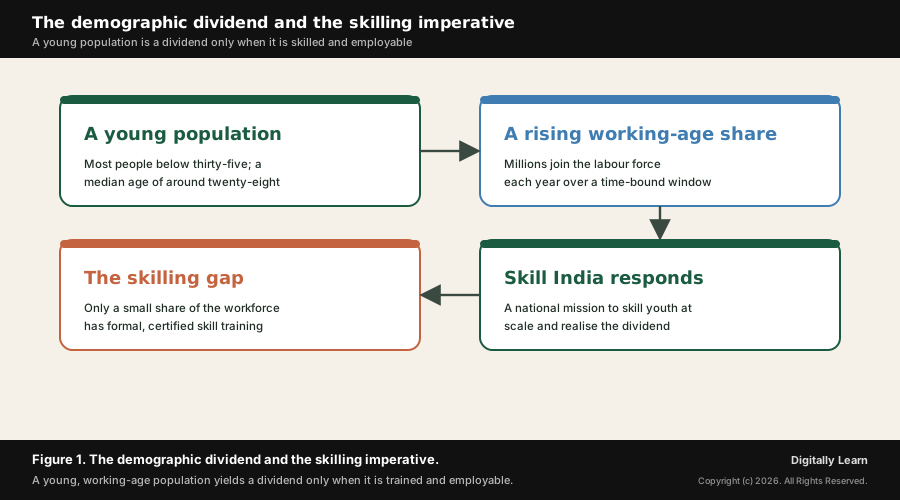
The case for the Skill India Mission begins not with a scheme but with a fact of demography. India has one of the youngest populations in the world, with a large majority of its people below the age of thirty-five and a median age of around twenty-eight years. This produces what economists call a demographic dividend, a window in which the share of people of working age is large relative to dependent children and the elderly, so that the economy can, in principle, produce and save more.
That dividend is a possibility, not a guarantee. A young person becomes an asset to the economy only when she has the skills an employer will pay for; without them, a youth bulge can turn into a burden of unemployment and unrest. The share of India's working-age population has been rising, and several million young people join the labour force each year, which means the country must create not only jobs but a workforce able to fill them. The window is also time-bound, expected to last only a few decades before the population begins to age.
Why it matters is that India's stock of formally skilled labour has historically been small, with only a low single-digit share of the workforce having received formal, certified skill training, far below the levels seen in advanced economies. Much of the workforce learns on the job in the informal sector, with no certificate to show for it. The Skill India Mission is the state's attempt to close this gap at scale, so that the demographic dividend is realised rather than missed. The figure below sets out this rationale.
The Skill India Mission and the National Skill Development Mission of 2015
The 2015 launch, the new Ministry and the National Skill Development Mission
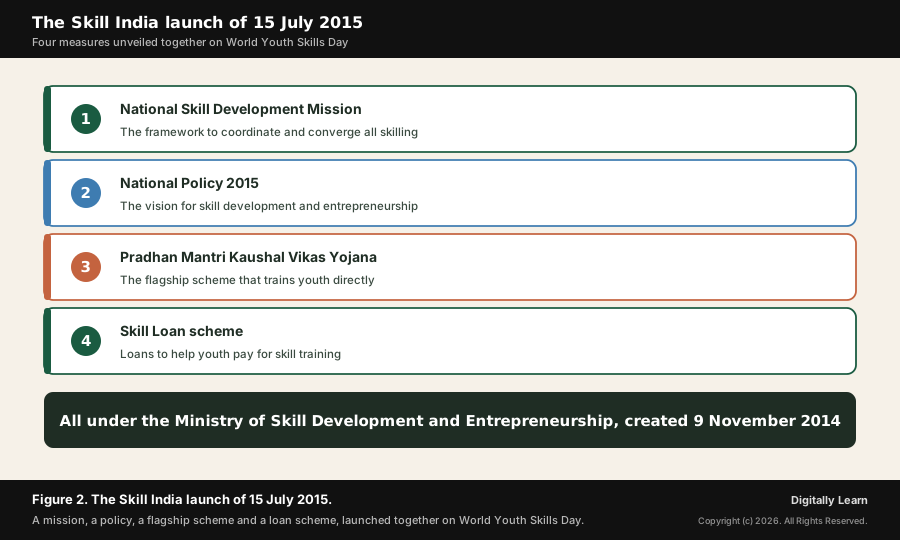
The Skill India Mission was launched on 15 July 2015, deliberately chosen because it is World Youth Skills Day, signalling that skilling the young would be a national priority. On that day the government unveiled the Skill India brand and launched a cluster of measures together: the National Skill Development Mission, the National Policy for Skill Development and Entrepreneurship 2015, the Pradhan Mantri Kaushal Vikas Yojana and a Skill Loan scheme. The aim, in plain terms, was to skill, re-skill and up-skill India's youth on a very large scale.
Behind this lay an institutional change made a few months earlier. The Ministry of Skill Development and Entrepreneurship, the country's first dedicated ministry for skilling, was created on 9 November 2014, pulling together skilling functions that had until then been scattered across many ministries. The new ministry gave the effort a single home, a single budget line and a clear mandate to coordinate skill development across the government, which is why most of the schemes discussed here are run or steered by it.
The National Skill Development Mission, approved by the Cabinet and launched the same day, supplied the institutional spine. It set out to provide a strong framework to drive and coordinate all skilling efforts, to converge the many separate schemes, and to build the standards, the trainers and the assessment systems that quality skilling requires. The mission therefore had two faces: a flagship training scheme in PMKVY that reached individuals directly, and a governance mission that tried to knit the wider system together. The figure below sets out the launch.
PMKVY from 1.0 to 4.0: Short-Term Training, RPL and On-Demand Skilling
What PMKVY does: short-term training, Recognition of Prior Learning and special projects
The Pradhan Mantri Kaushal Vikas Yojana is the flagship scheme of the Skill India Mission, run by the Ministry of Skill Development and Entrepreneurship since 2015 to give young people industry-relevant skills, usually free of cost. It works through a network of training centres and training partners spread across the country, and it certifies those who complete a course against a recognised national standard, so that the certificate carries weight with employers rather than being a mere participation slip.
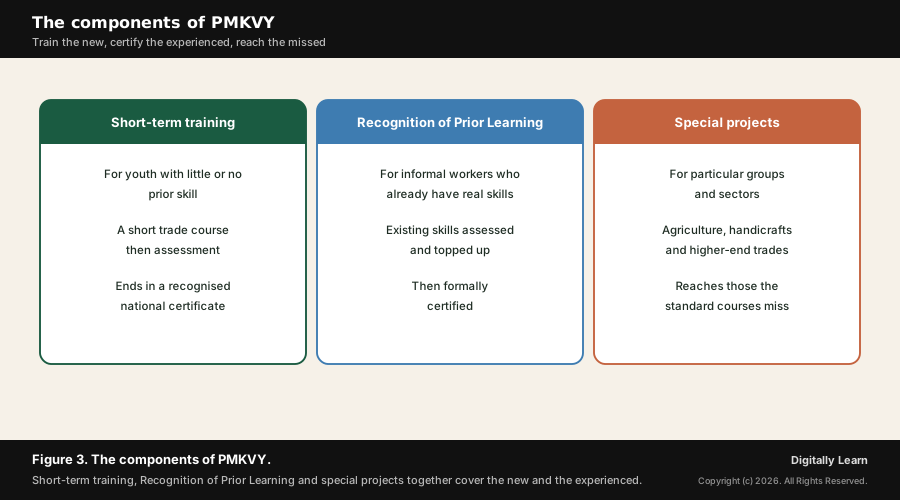
PMKVY runs on a few distinct components. The first is short-term training, in which a young person with little or no prior skill is trained in a trade over a course of a few weeks or months and then assessed and certified. The second is Recognition of Prior Learning, which addresses the millions who already work in the informal economy and have real skills but no certificate: their existing competence is assessed, topped up through a short bridge course, and then formally certified. The third is a set of special projects for particular groups and sectors, such as work in agriculture, handicrafts and higher-end trades.
These components reflect a deliberate strategy. Short-term training builds new skills among the young; Recognition of Prior Learning dignifies and documents the skills the informal workforce already has, which is important in a country where so much learning happens outside any classroom; and special projects reach groups that the standard courses would miss. Read together, the design tries to cover both the school-leaver seeking a first skill and the experienced worker seeking a certificate. The figure below sets out the components.
From PMKVY 1.0 to PMKVY 4.0: what changed across the versions
PMKVY has run in successive versions, each correcting the last. PMKVY 1.0, from 2015, was a pilot-scale launch that proved the model of demand-driven, certified short-term training but was criticised for thin placement and uneven quality. PMKVY 2.0, over the following years, scaled the scheme up sharply, brought in Recognition of Prior Learning in a big way, tightened standards through better assessment, and tried to align courses more closely with what industry actually needed.
PMKVY 3.0 shifted the centre of gravity toward the districts and the States. It moved delivery closer to the ground through district skill committees, sought to make skilling more demand-led and locally relevant, and leaned more on apprenticeship and on the future of work. The most recent version, PMKVY 4.0, running from the financial year 2022-23, emphasises on-the-job training embedded in courses, newer trades in areas such as digital skills, drones and green jobs, and skilling that is flexible and learner-driven rather than one-size-fits-all.
One change in PMKVY 4.0 is worth singling out because it sits at the heart of the scheme's biggest debate. In the first three versions, placement after training was formally tracked, and the modest placement rate became the scheme's most-cited weakness. In PMKVY 4.0, placement was delinked from the scheme's core design, with the stated logic that a trained person may choose self-employment, further study or a varied career path rather than a single tracked job. Whether this is a sensible recognition of how labour markets work, or a quiet retreat from the harder test of employment, is exactly the kind of question a strong answer weighs. The table below contrasts the versions.
| Version | Period | Defining shift |
|---|---|---|
| PMKVY 1.0 | From 2015 | Pilot of demand-driven, certified short-term training |
| PMKVY 2.0 | Following years | Scaled up, Recognition of Prior Learning expanded, standards tightened |
| PMKVY 3.0 | Later phase | Delivery pushed to districts and States, more apprenticeship |
| PMKVY 4.0 | From 2022-23 | On-the-job training, new-age trades, placement delinked |
Reading the versions together shows a scheme that has learned: from a centralised pilot toward district-led delivery, from classroom courses toward on-the-job training, and from older trades toward digital and green skills. The shift is not only administrative but about the very meaning of success, moving from counting certificates toward asking what a trainee can actually do and earn afterward.
The Institutional and Regulatory Architecture: MSDE, NSDC, NCVET, NSQF and Sector Skill Councils
MSDE, NSDC, the regulator NCVET and the National Skills Qualifications Framework
Skill India runs on a layered architecture in which delivery and regulation are kept separate. At the policy apex sits the Ministry of Skill Development and Entrepreneurship, which frames schemes, sets the budget and coordinates the system. Beneath it, the National Skill Development Corporation drives delivery: it is a not-for-profit public-private company, set up by the Finance Ministry and incorporated in 2008, in which the government holds a minority share and industry bodies the majority, and it funds and supports the private training partners who actually run many of the courses.
The system's regulator is the National Council for Vocational Education and Training, or NCVET, created by merging two earlier bodies, the National Council for Vocational Training and the National Skill Development Agency, into a single watchdog under MSDE. NCVET recognises and oversees the awarding and assessment bodies, approves qualifications and sets minimum standards, so that a certificate means the same thing wherever it is earned. Keeping the regulator separate from the delivery agency is meant to guard against the conflict of interest in which the body that runs the training also judges it.
Binding the system together is the National Skills Qualifications Framework, notified on 27 December 2013. It is an outcome-based and competency-based framework that arranges every qualification, whether gained in a college, a training centre or on the job, on a ladder of levels defined by what a person knows and can do. Because it recognises learning however it was acquired, the framework lets the certificate from a short course, an Industrial Training Institute or Recognition of Prior Learning be compared and stacked, and it underpins the idea that informal learning can be formally recognised. The figure below maps this architecture.
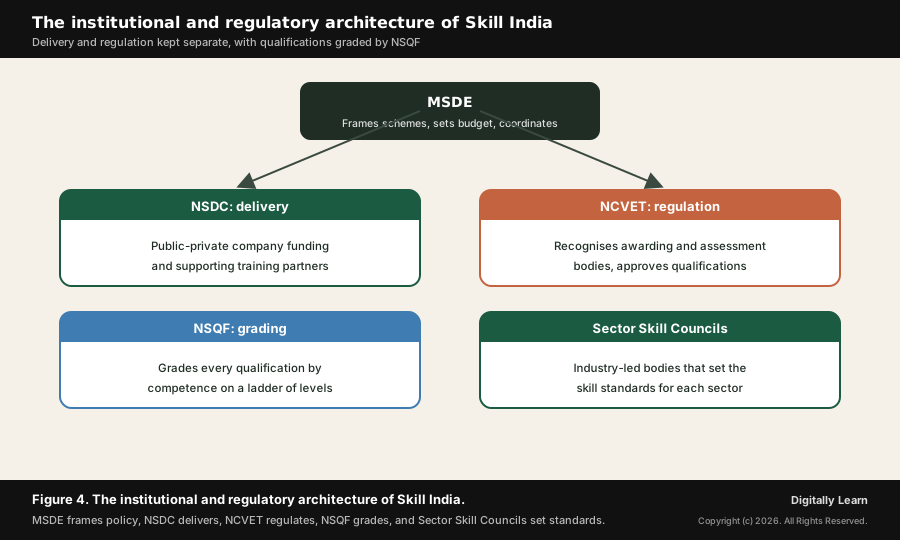
The fourth pillar is the network of Sector Skill Councils, industry-led bodies set up for sectors such as information technology, retail, construction, healthcare and many others. Because they are run by the employers themselves, they define the skill standards and qualifications for their sector, telling the system what competencies a job actually demands. They are the formal channel through which industry shapes what is taught, which is meant to keep training aligned with real hiring needs rather than with what a training centre finds convenient to teach.
The ITI and apprenticeship ecosystem: DGT, Craftsmen Training and NAPS
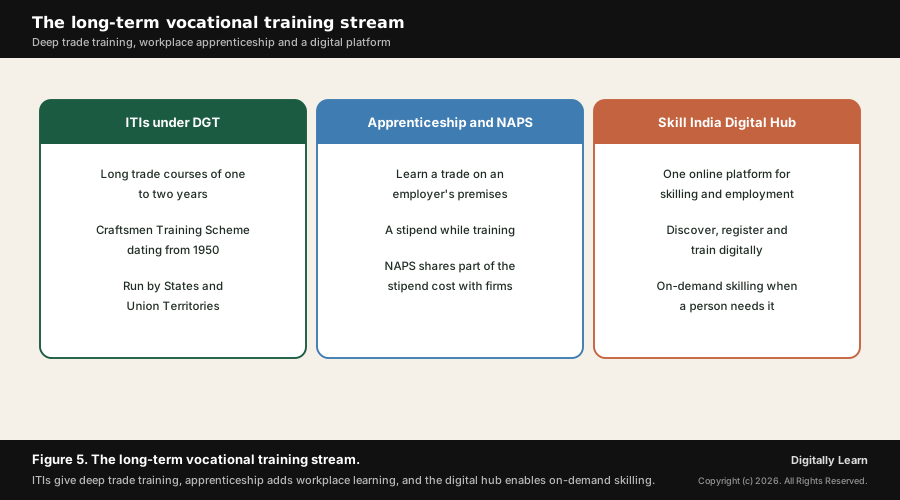
Alongside the newer short-term schemes runs a much older and more formal stream of vocational training. The Industrial Training Institutes, the ITIs, deliver long-duration trade courses, typically of one to two years, under the Craftsmen Training Scheme that dates back to 1950. They are coordinated nationally by the Directorate General of Training within MSDE, while the institutes themselves are run under the State and Union Territory administrations, so this stream too reflects the federal sharing of responsibility.
The ITIs supply the deep, formal vocational training that a few weeks of short-term work cannot, producing welders, electricians, fitters, mechanics and other tradespeople through courses graded on the National Skills Qualifications Framework. They are complemented by apprenticeship, in which a young person learns a trade on an employer's premises while earning a stipend. The National Apprenticeship Promotion Scheme, or NAPS, encourages firms to take on apprentices by sharing part of the stipend cost, so that learning happens at the actual workplace rather than only in a classroom.
The most recent layer is the Skill India Digital Hub, a single online platform launched to bring skilling, education, employment and entrepreneurship together in one place. It lets a learner discover courses, register, take training and find work-linked opportunities digitally, and it points toward a model of on-demand skilling in which a person can pick up a skill when she needs it, rather than only through a fixed batch in a centre. Together, the short-term schemes, the ITIs and apprenticeship, and the digital platform make up a system meant to cover the full range from a quick certificate to a deep trade. The figure below sets out this long-term stream.
Understanding the Significance: Realising the Demographic Dividend and Formalising Skills
Employability, the formalising of informal skills and India's place in the global workforce
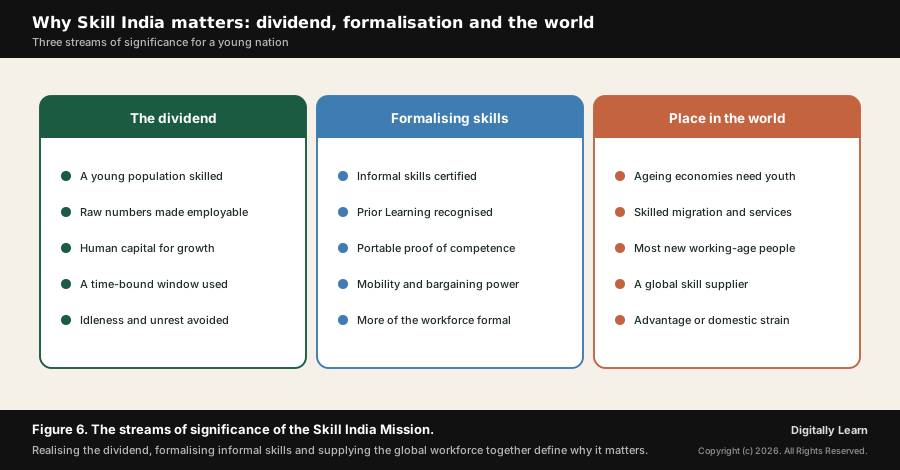
What is the significance of the Skill India Mission lies first in realising the demographic dividend. India's young population is its single greatest economic asset, but only if those young people can find productive work. By training school-leavers and the unemployed in marketable trades, the mission tries to convert raw numbers into employable human capital, so that the dividend becomes growth and incomes rather than frustration and idle hands during the few decades the window stays open.
Its second significance is the formalising of skills. A vast part of India's workforce labours in the informal economy with genuine skills that no certificate records, which limits their mobility, their bargaining power and their access to better-paid work. Through Recognition of Prior Learning and the National Skills Qualifications Framework, the mission lets these workers earn a recognised certificate for what they already do, giving the informal worker a portable proof of competence and pulling more of the workforce into the formal, documented economy.
Its third significance is India's place in the world. As advanced economies age and face shrinking workforces, a young, skilled India could supply not only its own industries but also the wider world, both through migration and through services delivered from India. Bodies such as the World Bank and the United Nations stress that India will add more working-age people than any other country in the coming years, so that skilling determines whether this becomes a global advantage or a domestic strain. The figure below maps these strands.
Challenges and Debates: Placement, Training Quality, Industry Linkage and Informal Reach
The certification-versus-employment gap, quality concerns and the mismatch with industry
A balanced reading must weigh the debates around the mission, and the sharpest concerns the gap between certification and employment. Independent observers have long noted that being trained and certified is not the same as getting a job, and that the placement rates reported under the early versions of PMKVY were modest. Because PMKVY 4.0 has delinked placement from the scheme's core, critics ask whether this honestly reflects varied career paths or simply lowers the bar by no longer measuring the outcome that matters most to a trainee.
A second debate is the quality of training itself. With much delivery contracted out to private training partners paid by results, there have been recurring worries about short courses that are too thin to impart a real skill, about weak assessment and about irregularities. An independent audit by the Comptroller and Auditor General, the constitutional auditor, has flagged problems in the verification of beneficiaries and outcomes under the scheme, a finding the government has responded to with tighter monitoring. Whether the system can guarantee genuine competence, not just a certificate, remains a live question.
A third cluster of concerns is industry linkage and reach. Employers often report a mismatch between the skills the system produces and the skills they actually need, which is precisely the gap the Sector Skill Councils are meant to close but have not fully closed. Equally, much of the training reaches those already near the formal economy, while the hardest-to-reach in the deep informal sector, in remote areas, and among women and disadvantaged groups, are harder to enrol and retain. On the central question, whether Skill India can convert training into lasting, good employment at scale, a careful answer presents both sides and treats the issue as open rather than settled.
The Way Forward: From Counting Certificates to Quality Skilling and Real Employment
Industry-led standards, stronger ITIs and skilling tied to genuine employment
The way forward for the mission follows directly from its central tension. The first priority is to tie skilling firmly to employment, by deepening the role of industry in designing courses through the Sector Skill Councils, expanding apprenticeship and on-the-job training so that learning happens where the work is, and tracking what trainees actually earn, rather than retreating from the measurement of outcomes altogether.
The second priority is to raise the quality of training and to widen its reach: to strengthen the long-term ITI and apprenticeship stream rather than rely only on short courses, to invest in better trainers, assessment and curricula, and to make a real effort to enrol and retain women, the rural poor and those in the deep informal sector. The third priority is to keep the system future-ready, equipping young people for digital, green and care-economy jobs through platforms such as the Skill India Digital Hub, so that India skills not only for today's economy but for tomorrow's. Pursued together, these shift the mission from counting certificates toward delivering competence and genuine work.
UPSC Relevance and Exam Focus
Where Skill India and PMKVY fit in the UPSC-CSE syllabus
This topic maps most directly to General Studies Paper II: government policies and interventions for development in various sectors, and issues arising out of their design and implementation, since Skill India is a flagship welfare and development programme. It links strongly to General Studies Paper III, on growth, development and employment, and on the mobilisation of human resources, and to General Studies Paper I, on population and associated issues, through the demographic dividend that gives the whole effort its urgency.
For Prelims, hold the high-yield facts: the Ministry of Skill Development and Entrepreneurship was created in 2014 and the Skill India Mission was launched on 15 July 2015, World Youth Skills Day; PMKVY is the flagship scheme, working through short-term training and Recognition of Prior Learning; the NSDC is the public-private delivery body and NCVET the regulator; the National Skills Qualifications Framework grades qualifications by competence; and the ITIs sit under the Directorate General of Training, with apprenticeship promoted through NAPS.
For Mains, the recurring framing is to assess the mission against the demographic dividend: how government measures can make a young population more productive and employable, how far the skilling system has closed the gap between training and jobs, and what reforms would make it work. A strong answer treats Skill India as a case study in turning demography into development, balancing the genuine architecture the state has built against the unresolved questions of quality, placement and reach.
Recurring linked concepts an aspirant should keep in working memory:
- Demographic dividend: The growth potential that arises when a country’s working-age population is large relative to its dependents, realised only if that population is healthy, educated and skilled.
- Recognition of Prior Learning: The assessment and certification of skills a person already has, often gained informally on the job, which formalises the competence of the informal workforce.
- National Skills Qualifications Framework: The outcome-based ladder of levels that grades every qualification by what a learner knows and can do, letting formal and informal learning be compared.
- Sector Skill Councils: Industry-led bodies that define the skill standards and qualifications for each sector, the channel through which employers shape what is taught.
A common Prelims trap is to confuse the bodies: the NSDC funds and supports training delivery, while NCVET is the separate regulator, and the NSQF is the grading framework, not an agency; hold these three apart, and remember that ITIs run under the States while their national coordination is by the Directorate General of Training.
A common Mains trap is to recite scheme names and training numbers alone. The exam value lies in a balanced judgment: the genuine institutional architecture built since 2014, set honestly against the open questions of training quality, the gap between certification and employment, industry mismatch and the reach into the deep informal sector.
Previous Year UPSC-CSE Questions By the end you will be able to draft model answers for the following UPSC questions. Each question carries a collapsible framework showing how to approach it in the exam.
- UPSC Mains 2016 GS-IIAssess the statement that India's demographic dividend stays theoretical unless its workforce becomes educated, aware, skilled and creative, and describe the measures the government has taken to make the population more productive and employable.
How to structure the answer in the exam
Body (sub-themes to develop):
- The problem the statement names: a large young population becomes a dividend only when skilled, and India's stock of formally skilled, certified labour has been small, so unskilled numbers risk unemployment rather than growth.
- The institutional measure: the Ministry of Skill Development and Entrepreneurship (2014) and the launch of the Skill India Mission and National Skill Development Mission on 15 July 2015, with the National Policy 2015 and the Skill Loan scheme.
- The flagship training measure: PMKVY, with short-term training for new skills, Recognition of Prior Learning to certify the informal workforce, and special projects, evolving from 1.0 to 4.0 with on-the-job training and new-age trades.
- The architecture that makes skilling credible: the NSDC delivery body, the regulator NCVET, the National Skills Qualifications Framework grading qualifications by competence, the Sector Skill Councils setting industry standards, and the ITI and apprenticeship stream (DGT, NAPS) and the Skill India Digital Hub.
- The honest assessment: weighing the formalising of informal skills and the realising of the dividend against the open gaps in training quality, the certification-versus-employment gap, industry mismatch and the reach into the deep informal sector.
Sources and Further Reading
- Press Information Bureau: Prime Minister Launches Skill India on the Occasion of World Youth Skills Day
- Press Information Bureau: Launch of Skill India Campaign on 15 July 2015
- Ministry of Skill Development and Entrepreneurship: National Skill Development Mission
- Ministry of Skill Development and Entrepreneurship: National Skill Development Corporation (NSDC)
- Ministry of Skill Development and Entrepreneurship: National Council for Vocational Education and Training (NCVET)
- Ministry of Skill Development and Entrepreneurship: NSQF
- Press Information Bureau: National Skills Qualifications Framework is an outcome and competency-based framework
- Ministry of Skill Development and Entrepreneurship: Guidelines for Pradhan Mantri Kaushal Vikas Yojana 4.0
- Directorate General of Training: About DGT
- Directorate General of Training: Apprenticeship Training
- Press Information Bureau: Cabinet approves merger of NCVT and NSDA to establish NCVET
- NITI Aayog: Transforming Industrial Training Institutes
- United Nations in India: Skilling, Entrepreneurship and Job Creation
- World Bank: Education and Employment, the big push needed for India's youth
- Ministry of Skill Development and Entrepreneurship: Pradhan Mantri Kaushal Vikas Yojana since 2015
- Wikipedia: Skill India
- Wikipedia: Pradhan Mantri Kaushal Vikas Yojana
Editorial Disclaimer
This briefing is for UPSC preparation. Verify the facts and provisions against the official MSDE, DGT and PIB sources before relying on them.


