


Overview
India's flagship crop insurance scheme
Launched in 2016 by the Ministry of Agriculture and Farmers Welfare, Pradhan Mantri Fasal Bima Yojana (PMFBY) is India's flagship crop insurance scheme. It protects food, oilseed and commercial crops from prevented sowing to post-harvest at a farmer premium of just 2 per cent for Kharif and 1.5 per cent for Rabi, the balance subsidised.
Pradhan Mantri Fasal Bima Yojana, or PMFBY, is India's flagship crop insurance scheme, launched on 13 January 2016 by the Ministry of Agriculture and Farmers Welfare in place of the older NAIS and MNAIS schemes. It insures notified food, oilseed and commercial or horticultural crops against non-preventable natural risks across the whole crop cycle, from prevented sowing through the standing crop to post-harvest losses. The farmer pays a low, fixed premium of 2 per cent for Kharif and 1.5 per cent for Rabi food crops and oilseeds, and 5 per cent for annual commercial and horticultural crops, while the balance is met by central and state subsidy.
What PMFBY Is: The 2016 Launch, the Crop Insurance Mandate and the Schemes It Replaced
The 13 January 2016 launch by the Ministry of Agriculture and Farmers Welfare, the replacement of NAIS and MNAIS, and the four objectives of the scheme
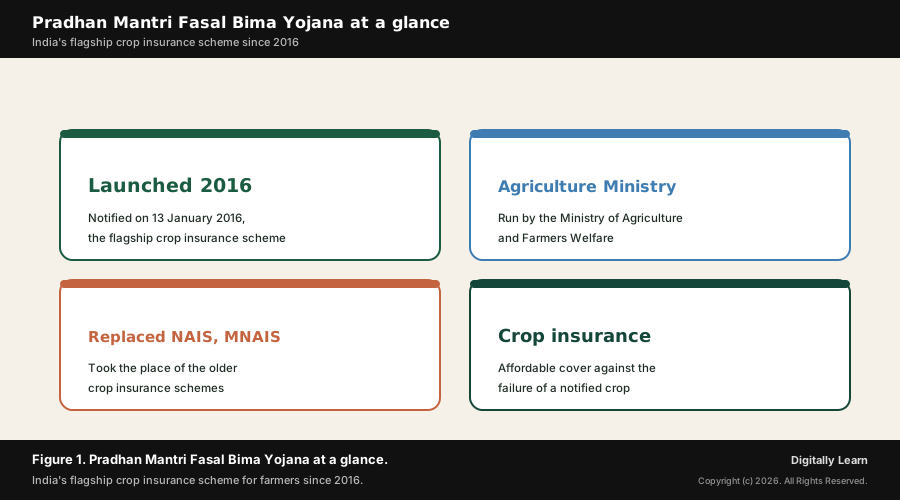
The Pradhan Mantri Fasal Bima Yojana, almost always shortened to PMFBY, is India's flagship crop insurance scheme. It was launched on 13 January 2016 by the Ministry of Agriculture and Farmers Welfare to give farmers an affordable shield against the failure of a notified crop. In place of a patchwork of older covers, it offered a single national scheme with low, fixed farmer premiums and the financial backing of both the central and the state governments.
PMFBY did not begin from a blank slate. It replaced the National Agricultural Insurance Scheme and the Modified National Agricultural Insurance Scheme, two earlier covers seen as costly and slow, while the weather-based cover was recast in the same year as the Restructured Weather Based Crop Insurance Scheme. The aim was a simpler, cheaper and more uniform scheme that ordinary farmers could actually understand and use across every state.
Why it matters is that the scheme rests on four clear objectives: to protect farmers against yield loss from natural risks, to stabilise farm incomes, to encourage farmers to adopt modern practices, and to keep the flow of institutional credit to agriculture. By tying these goals to one affordable cover, PMFBY treats crop insurance not as a favour but as basic protection for a farm economy exposed to the weather. The figure below sets out the scheme at a glance.
The Need for Crop Insurance: Indian Agriculture's Vulnerability to the Vagaries of Nature
Monsoon dependence and rainfed farming, the burden on small and marginal farmers and the debt trap, and insurance as a tool of welfare and growth
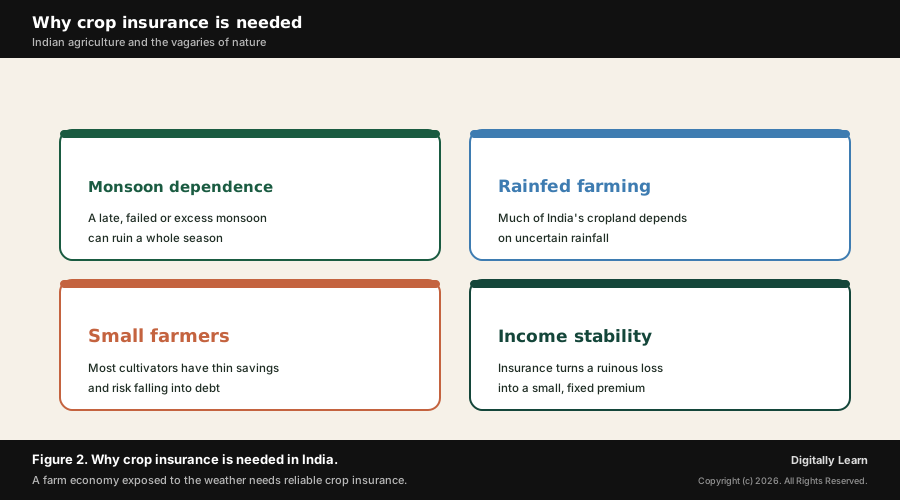
Indian agriculture is famously exposed to the vagaries of nature. A large share of cropland is rainfed and depends on a monsoon that arrives early or late, fails in some years and floods in others. Drought, unseasonal rain, hailstorms, pests and disease can wipe out a season's work in days, and the farmer, not the weather, bears the whole loss. This exposure is the first reason a country of small cultivators needs reliable crop insurance.
The burden falls hardest on the small and marginal farmers who make up most of India's cultivators. With little savings and thin access to formal credit, a single failed harvest can push such a household into debt to traders and moneylenders, and in the worst cases into deep distress. Crop insurance breaks this chain by turning an unpredictable, ruinous loss into a predictable, bearable premium, so that one bad year does not undo years of patient effort.
What is the significance of this vulnerability is that it makes insurance a tool of both welfare and growth. A farmer who knows a failed crop will be compensated is more willing to invest in better seed, fertiliser and methods, and lenders are more willing to advance crop loans. Insurance therefore stabilises incomes and, at the same time, encourages the very modernisation that raises yields. The figure below sets out why crop insurance is needed.
Coverage Under PMFBY: Crops Insured and Risks Across the Crop Cycle
The food, oilseed and commercial-horticultural crops covered, the risks from prevented sowing to post-harvest and localised calamities, and the exclusions
PMFBY covers a wide range of notified crops chosen by each state. These fall into three groups: food crops, meaning cereals, millets and pulses; oilseeds; and annual commercial and horticultural crops such as cotton, sugarcane and many fruits and vegetables. A crop is insured only where the state government notifies it for a season, so the exact basket varies from place to place, but the design reaches the staples on which most farm incomes depend.
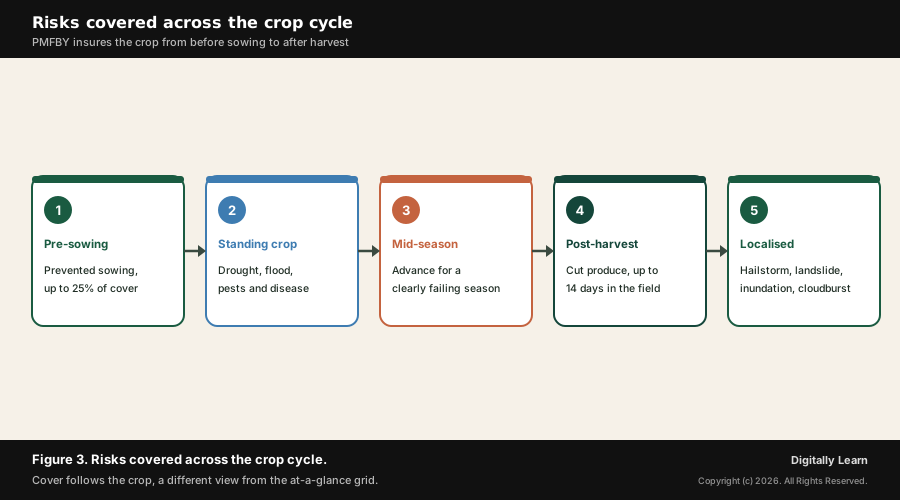
The real strength of the scheme is that it insures the crop across the whole crop cycle, not just at one moment. Cover begins before sowing, with prevented sowing when adverse weather stops planting, for which a farmer can receive up to 25 per cent of the sum insured. It then runs through the standing crop stage against drought, flood, pests and disease, and continues to post-harvest losses for up to 14 days for produce left to dry in the field.
Two further layers complete the cover. Localised calamities such as hailstorm, landslide, inundation and cloudburst are assessed on each affected farm, and mid-season adversity allows an advance payment when a season is clearly failing. A short list of risks stays excluded, among them war, nuclear perils, riots, malicious damage, theft and damage by wild animals. The timeline below traces how the cover follows the crop from before sowing to after harvest.
The Premium and Subsidy Structure: The 2, 1.5 and 5 Percent Farmer Share
The fixed farmer premium caps by crop category, the central and state subsidy that meets the actuarial premium, and the 2020 subsidy cap of 30 and 25 percent
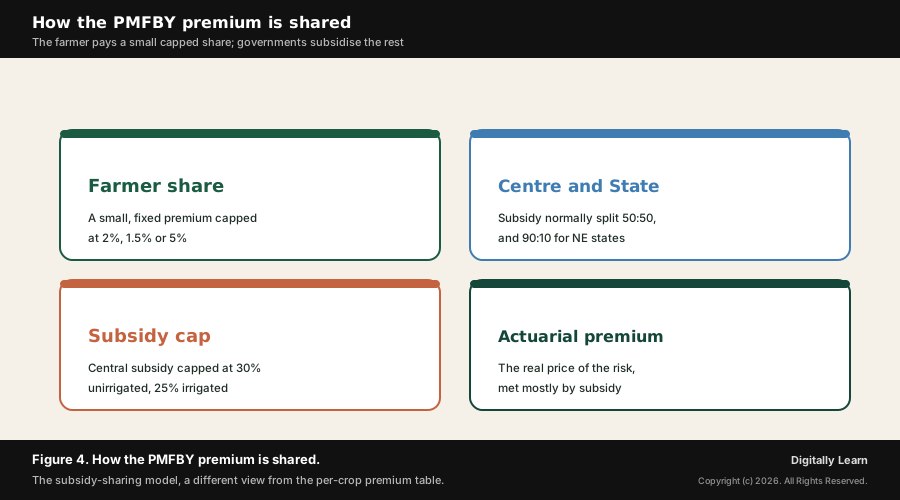
The feature that makes PMFBY attractive is its low, fixed farmer premium. A farmer pays at most 2 per cent of the sum insured for Kharif food crops and oilseeds, 1.5 per cent for Rabi food crops and oilseeds, and 5 per cent for annual commercial and horticultural crops. These caps are the same across the country, so even a crop with a high actuarial risk costs the farmer only this small, predictable share of the sum insured.
The gap between this small farmer share and the full actuarial premium, the real price of the risk, is met by government subsidy. The balance is shared between the centre and the states, normally 50:50, and on a 90:10 basis for the North Eastern states, so that the cover stays cheap for the farmer while the cost is borne publicly. This subsidy is the heart of the scheme and its single largest expense.
The 2020 revamp placed a limit on this generosity. The central subsidy is now capped at 30 per cent of the premium for unirrigated areas and 25 per cent for irrigated areas; where the premium is higher, the state must meet the extra cost or drop the crop. The table below sets out the farmer premium by crop category, while the figure shows how the premium is shared between the farmer and the governments.
| Crop category | Maximum farmer premium share | Crops covered |
|---|---|---|
| Kharif food crops and oilseeds | 2 per cent of the sum insured | Cereals, millets, pulses and oilseeds grown in the Kharif season |
| Rabi food crops and oilseeds | 1.5 per cent of the sum insured | Cereals, millets, pulses and oilseeds grown in the Rabi season |
| Annual commercial and horticultural crops | 5 per cent of the sum insured | Notified commercial and horticultural crops such as cotton and sugarcane |
The 2020 Revamped PMFBY: Voluntary Enrolment, Faster Settlement and the National Crop Insurance Portal
Cover made voluntary for all farmers including loanee farmers, the two-month and 21-day settlement timelines with a 12 percent penalty, and the online portal
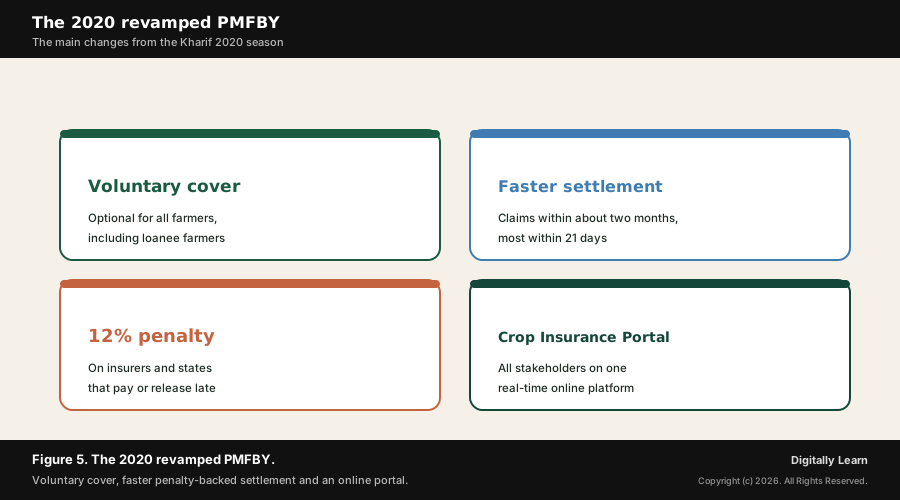
By 2020 the scheme had run for four years and faced real complaints, so the government approved a revamped PMFBY from the Kharif 2020 season. The biggest change made cover voluntary for all farmers. Earlier it was compulsory for those who took crop loans; now even these loanee farmers may opt out, so a farmer now chooses the cover rather than having the premium deducted automatically from a loan account.
The revamp also attacked the worst grievance, delay. Insurers are required to settle claims within about two months of harvest, and most are settled within 21 days of receiving the yield data. To enforce this, an insurer that pays late now bears a 12 per cent penalty interest, and a state that releases its premium subsidy late bears the same charge, so the cost of delay falls on those who actually cause it.
A third change was to put the whole scheme online. The National Crop Insurance Portal brings farmers, states, banks and insurers onto a single platform, where enrolment, premium, land records and claims are tracked in real time. States also gained flexibility to choose which risks to insure and how to share the cost, so the scheme could fit very different farm conditions. The figure below sets out the main changes of the 2020 revamp.
Technology in PMFBY: YES-TECH, WINDS, CROPIC and Doorstep Enrolment
The Crop Cutting Experiment and area approach, satellite yield estimation through YES-TECH and weather data through WINDS, and CROPIC, the AIDE app and the technology fund
Because PMFBY pays on the basis of crop yield, the credibility of the scheme rests on measuring yield honestly and fast. The traditional method, the Crop Cutting Experiment, harvests sample plots and uses an area approach, treating a village or block as one insurance unit so that all its farmers share the assessed loss. This is fair for a widespread calamity but slow, and it is the part of the scheme that technology is now transforming.
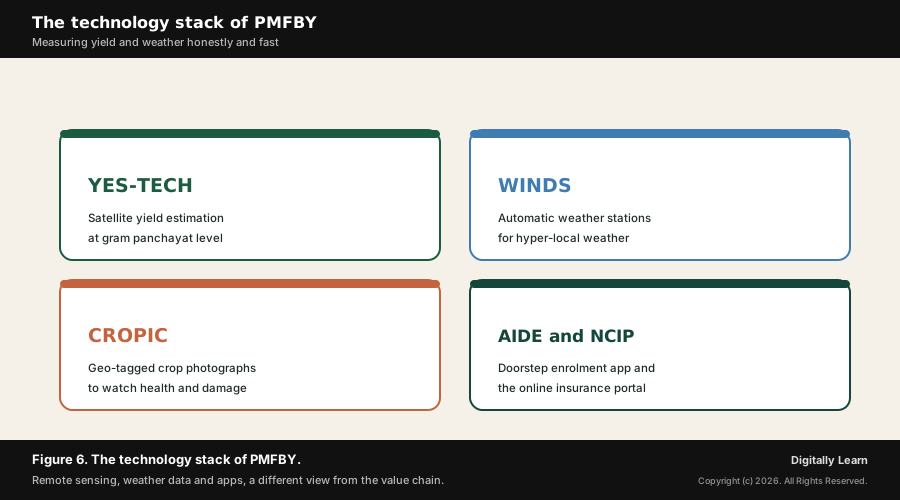
Two systems lead this shift. YES-TECH, the Yield Estimation System based on Technology, uses satellite remote sensing to estimate yields at the gram panchayat level and cut the dependence on manual sampling. WINDS, the Weather Information Network and Data System, builds a dense network of automatic weather stations and rain gauges to capture hyper-local weather. Together they let claims be calculated from data rather than from disputed field reports.
Other tools reach the farmer directly. CROPIC reads geo-tagged photographs of crops to watch their health and damage through the season, while the AIDE app lets intermediaries enrol farmers at their doorstep. To fund this drive, the government created a Fund for Innovation and Technology with a corpus of about Rs 824.77 crore for YES-TECH, WINDS and related research. The figure below sets out the technology stack behind the scheme.
How PMFBY Is Delivered: The Implementing Architecture and Empanelled Insurers
The Department of Agriculture and Farmers Welfare and the states, the empanelled insurers led by the Agriculture Insurance Company of India and the lowest-bid cluster model, and the banks and Common Service Centres
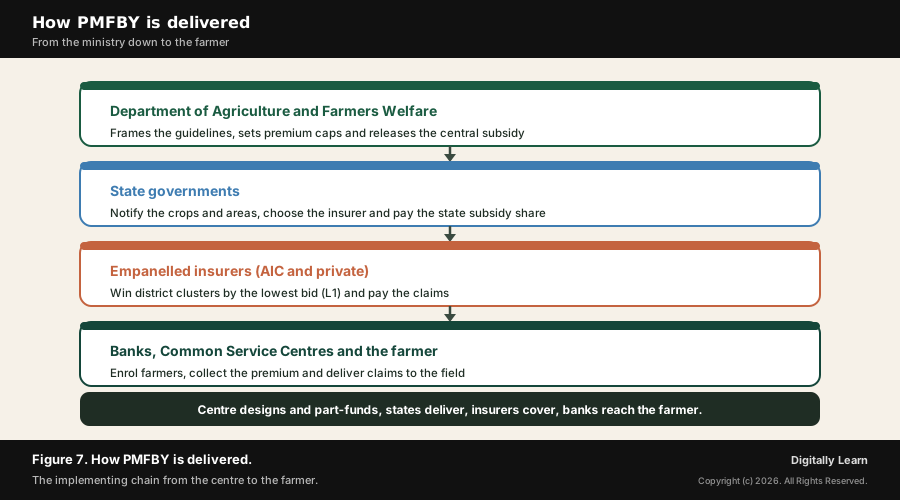
PMFBY is run by the Department of Agriculture and Farmers Welfare within its ministry, which frames the guidelines, sets the premium caps and releases the central subsidy. Below it, the state governments notify the crops and areas to be insured each season, choose the insurer and pay their share of the subsidy. The scheme is therefore a genuine partnership in which the centre designs and part-funds the cover while the state tailors and delivers it.
The cover itself is provided by empanelled insurance companies. These include the public Agriculture Insurance Company of India and several private insurers such as ICICI Lombard, HDFC ERGO, IFFCO Tokio and Bajaj Allianz. States group their districts into clusters and award each cluster to the insurer that bids the lowest premium, the L1 bidder, for a fixed term, which is meant to hold down the cost of cover through open competition.
The farmer meets the scheme through the banks that disburse crop loans, the Common Service Centres and the AIDE app, all of which can enrol a farmer and collect the premium. Claims for a widespread loss are settled on the area approach using yield data, while losses from localised calamities and after harvest are assessed on the individual farm. The figure below sets out how the scheme is delivered from the ministry down to the farmer.
Performance and Criticism: Scale of Coverage, Claims Paid and the Gaps That Remain
The scale of farmer applications, claims paid and the rise of voluntary cover, and the criticism of delays, basis risk, states opting out and low awareness
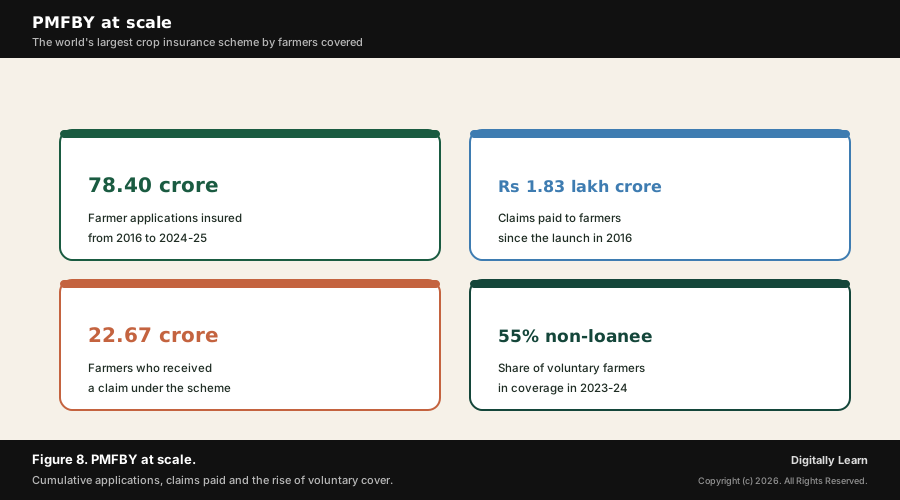
PMFBY has grown into the largest crop insurance scheme in the world by the number of farmers it covers. From its launch in 2016 up to 2024-25, it had insured about 78.40 crore farmer applications and paid claims of about Rs 1.83 lakh crore to roughly 22.67 crore farmers. Yearly coverage rose from about 371 lakh farmer applications in 2014-15 to about 1,510 lakh in 2024-25, a clear sign of rising demand for the cover.
That so many farmers now join even though cover is voluntary is itself a measure of trust; non-loanee farmers, who choose the scheme freely, made up about 55 per cent of those covered in 2023-24. Yet PMFBY is not without serious criticism. The most common complaint is still delay in settling claims and in releasing the government's share of the premium, which leaves farmers waiting for money they were promised.
Other concerns run deeper. The area approach can leave an individual whose field failed without a payout if the wider unit did not, a mismatch known as basis risk. Several states, among them Bihar, West Bengal, Telangana, Jharkhand and Gujarat, have opted out at various times over cost or design, though Andhra Pradesh rejoined in 2022. Critics also point to low awareness among farmers and to the profits earned by insurers in some seasons.
The Way Forward: Strengthening Crop Insurance for Indian Farmers
Individual-field assessment through technology, timely claim and subsidy release, wider reach to tenant and sharecropper farmers, grievance redress and financial literacy
The path ahead is to keep the scale of PMFBY while fixing the faults that farmers feel most. That means using technology to move from the village-level area approach toward assessment closer to the individual field, so that basis risk shrinks and a farmer whose own crop failed is actually paid. It also means making both insurers and governments pay on time, since a delayed claim defeats the very purpose of insurance.
Reach and trust must grow together. The scheme should be carried to the tenant farmers, sharecroppers and small cultivators who are often left out, backed by stronger grievance redress and by financial literacy so that farmers understand what they are buying. The measures below set out a balanced path for strengthening crop insurance in India.
- Use satellite imagery and smart sampling under YES-TECH to move from the area approach toward assessment closer to the individual field, reducing basis risk.
- Ensure insurers settle claims within the stipulated period and that the centre and states release their premium subsidy on time, enforced by the penalty interest.
- Extend cover actively to tenant farmers, sharecroppers and landless cultivators, who bear the risk of a failed crop but are often left outside the scheme.
- Strengthen grievance redress and a single window for complaints so that a farmer can track and contest a claim without travelling far.
- Build financial literacy and awareness so that farmers understand the premium, the risks covered and the exclusions before a season begins.
- Deepen the use of WINDS weather data and CROPIC crop photographs so that claims are settled from evidence rather than from disputed manual reports.
- Keep premiums affordable while widening the basket of notified crops, so that horticulture and commercial growers are not priced out of cover.
UPSC Relevance: Prelims Pointers, the Mains Framing and Linked Schemes
The GS-III economy and agriculture fit, the Prelims facts, the need-and-features Mains framing of the 2016 PYQ, and the linked schemes (NAIS, MNAIS, RWBCIS and the Kisan Credit Card) to distinguish
For the examination, PMFBY sits mainly in GS-III, under the economy, agriculture and inclusive growth. The facts worth fixing for Prelims are the launch in 2016 under the Ministry of Agriculture and Farmers Welfare, the farmer premium caps of 2, 1.5 and 5 per cent, the cover across the crop cycle from prevented sowing to post-harvest, the 2020 revamp making the cover voluntary, and the technology tools of YES-TECH, WINDS, CROPIC and the National Crop Insurance Portal.
For Mains, PMFBY is the standard example for any answer on crop insurance and agricultural risk. It lets a student first establish the need for insurance, given Indian agriculture's exposure to the vagaries of nature and the burden on small farmers, and then set out the salient features of the scheme: its low premiums, its cover across the crop cycle, its subsidy design and its use of technology. It also serves answers on farm income stability and rural distress.
PMFBY should be distinguished from the schemes around it. It replaced the older NAIS and MNAIS and runs beside the Restructured Weather Based Crop Insurance Scheme, which pays on a weather index rather than on measured yield. It also works with the Kisan Credit Card and crop loans, since insurance and credit together protect the farm economy. Read this way, PMFBY is the central instrument of India's approach to agricultural risk, the form most useful in the examination.
Previous Year UPSC-CSE Questions By the end you will be able to draft model answers for the following UPSC questions. Each question carries a collapsible framework showing how to approach it in the exam.
- UPSC Mains 2016 GS-IIIGiven the vulnerability of Indian agriculture to vagaries of nature, discuss the need for crop insurance and bring out the salient features of the Pradhan Mantri Fasal Bima Yojana (PMFBY).
How to structure the answer in the exam
Body (sub-themes to develop):
- The need for crop insurance: dependence on the monsoon and rainfed farming, the burden of crop failure on small and marginal farmers, the resulting debt and distress, and the role of insurance in stabilising incomes and encouraging investment and credit.
- Salient feature one, launch and coverage: launched on 13 January 2016 by the Ministry of Agriculture and Farmers Welfare in place of NAIS and MNAIS, insuring notified food, oilseed and commercial crops across the crop cycle from prevented sowing through the standing crop to post-harvest and localised calamities.
- Salient feature two, premium and subsidy: a low fixed farmer premium of 2 per cent for Kharif, 1.5 per cent for Rabi food crops and 5 per cent for commercial crops, with the balance of the actuarial premium subsidised by the centre and states on a 50:50 basis and 90:10 for the North Eastern states.
- Salient feature three, the 2020 revamp: cover made voluntary for all farmers including loanee farmers, settlement within about two months with a 12 per cent penalty for delay, and the National Crop Insurance Portal that brings all stakeholders onto one platform.
- Salient feature four, technology and delivery: YES-TECH satellite yield estimation, WINDS weather data, CROPIC crop photographs and the AIDE doorstep app, delivered by the Department of Agriculture and Farmers Welfare, the states and empanelled insurers led by the Agriculture Insurance Company of India.
Relevance to this topic. The article first explains why Indian agriculture, dependent on the monsoon and rainfed farming, needs crop insurance, then sets out the salient features of PMFBY (its 2016 launch, the 2, 1.5 and 5 per cent farmer premiums, the cover across the crop cycle, the central and state subsidy, the 2020 revamp and the technology), so a student who reads only this article can attempt the question in full.
Sources and Further Reading
- Pradhan Mantri Fasal Bima Yojana: official crop insurance portal, scheme guidelines and premium rates
- Department of Agriculture and Farmers Welfare: agricultural credit and crop insurance
- Press Information Bureau: Cabinet approves revamping of PMFBY and RWBCIS
- Press Information Bureau: benefits to farmers and premium structure under PMFBY
- Press Information Bureau: Pradhan Mantri Fasal Bima Yojana turns nine, coverage and claims
- NITI Aayog: enhancing the use of technology in agriculture insurance
- FAO: insurance of crops in developing countries and the case for agricultural insurance
- Wikipedia: Pradhan Mantri Fasal Bima Yojana
- World Bank: Agriculture Risk Resilience and Insurance Access Program, supporting the scale-up of PMFBY
Editorial Disclaimer
This briefing is for UPSC preparation. Verify the figures against the official PMFBY portal, the Department of Agriculture and Farmers Welfare and Press Information Bureau sources before relying on them.


