


Overview
India's Anganwadi system for the young child
A centrally sponsored scheme launched in 1975 and run by the Ministry of Women and Child Development, ICDS delivers an integrated package of six services to children below six years, pregnant women and lactating mothers through the Anganwadi, making it India's frontline response to child malnutrition and a builder of human capital.
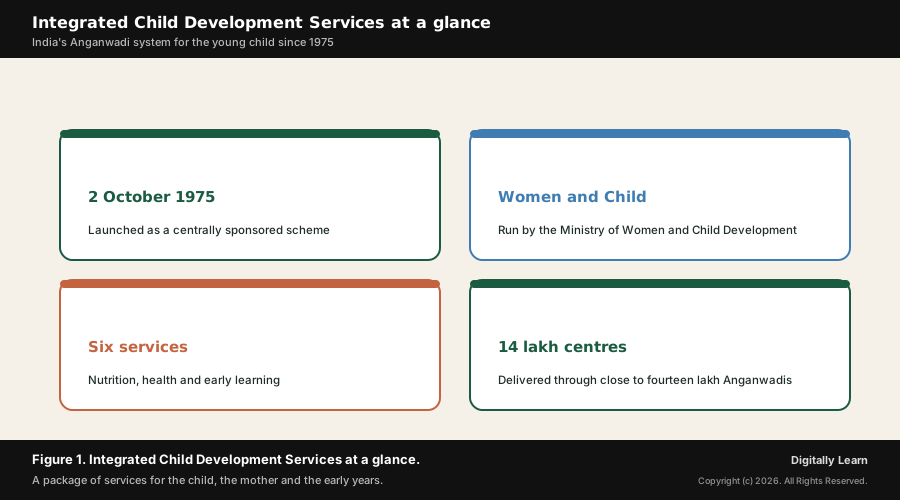
Integrated Child Development Services, or ICDS, is a centrally sponsored scheme launched on 2 October 1975 and run by the Ministry of Women and Child Development to support the care, nutrition and early development of the young child. Through close to fourteen lakh Anganwadi centres it delivers a package of six services, supplementary nutrition, immunization, health check-up, referral services, pre-school education and nutrition and health education, to children below six years, pregnant women and lactating mothers. Universalised by the right to food case and backed by the Food Security Act, ICDS is India's frontline answer to child malnutrition.
What ICDS Is: The 1975 Launch and India's Anganwadi System for Early Childhood
The 2 October 1975 launch, the Ministry of Women and Child Development mandate and the world's largest early childhood programme
The Integrated Child Development Services scheme, almost always known by its short form ICDS, is India's flagship programme for the care, nutrition and early development of the young child. It was launched on 2 October 1975 and is run today by the Ministry of Women and Child Development. Its single, ambitious purpose is to reach the child in the first six years of life, along with the pregnant woman and the nursing mother, with an integrated package of services delivered close to home through a village centre called the Anganwadi.
Why it matters is that the early years decide a great deal of what a person can later become. The period from conception to a child's second birthday, often called the first 1,000 days, shapes the brain, the body and the immune system in ways that are very hard to reverse. A child who is underfed, unprotected from disease or starved of stimulation in these years may carry the damage for life. ICDS exists to guard exactly this window of opportunity, which is why it is treated as one of the world's largest programmes for early childhood development.
The scale of the effort is enormous. ICDS works through a national network of close to fourteen lakh Anganwadi centres, each staffed by an Anganwadi Worker and a helper drawn from the local community, government figures report. Through these centres the scheme serves children below six years, pregnant women and lactating mothers, with priority to the poorest and most remote families. The figure below sets out ICDS at a glance, after which the briefing turns to the deeper question of why child malnutrition is so stubborn a problem.
Why Child Malnutrition Is a Human Development Challenge, Not Merely a Shortage of Food
The multi-dimensional roots of malnutrition, the first 1,000 days and why food availability alone does not end hunger
It is tempting to think that hunger and malnutrition are simply a shortage of food, to be solved by growing or distributing more grain. The evidence tells a more complicated story. India became broadly self-sufficient in foodgrain decades ago, yet child malnutrition has remained widespread, which shows that putting calories within reach is necessary but far from sufficient. A narrow focus on the availability of food can even draw attention away from the deeper failures of health, care and sanitation that keep children undernourished.
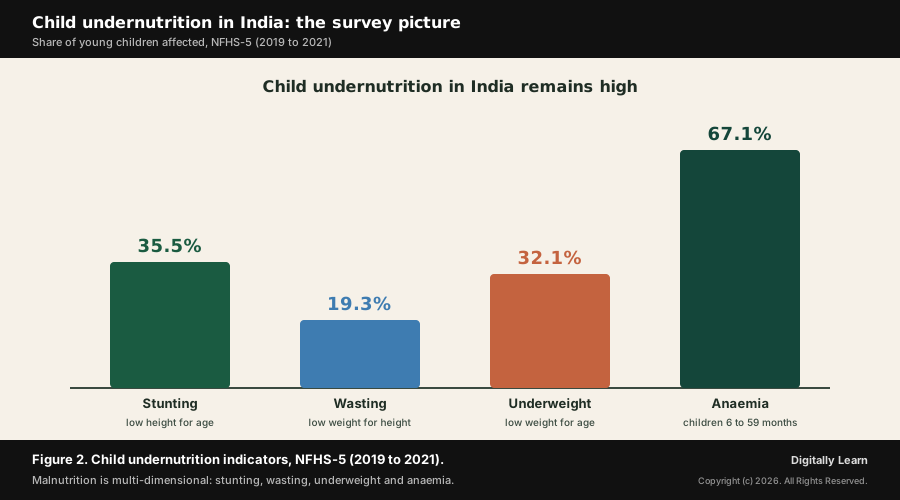
Malnutrition is in truth a multi-dimensional outcome. The World Health Organization describes undernutrition through three measures: stunting, or low height for age; wasting, or low weight for height; and underweight, or low weight for age. These arise not from empty plates alone but from repeated infection, poor maternal health, unsafe water, weak sanitation and a lack of care and stimulation in early life. Because the causes sit across many sectors, the cure must be a human development effort and not a food handout alone.
The stakes are measured in lost human capital. The World Bank notes that childhood stunting is among the best predictors of a person's future capability, because a child stunted in the first two years suffers lasting harm to brain and body that lowers learning and earnings for life. The most recent National Family Health Survey still records high levels of stunting, wasting, underweight and anaemia among young children. The figure below shows these indicators, and the rest of this briefing explains how ICDS is built to attack each of these human development gaps.
The Six ICDS Services: An Integrated Package That Reaches Beyond the Plate
Supplementary nutrition, immunization, health check-up, referral services, pre-school education and nutrition and health education
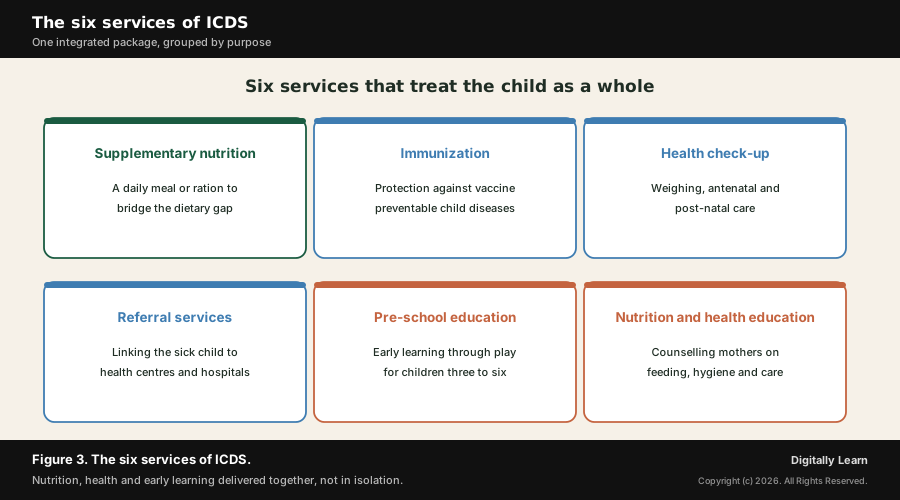
The heart of ICDS is a single, integrated package of six services, designed so that nutrition, health and learning are delivered together rather than in isolation. The first is supplementary nutrition: a daily meal or take-home ration given to children from six months to six years and to pregnant and lactating mothers, meant to bridge the gap between what they need and what they actually eat. The second is immunization, which protects mothers and infants against vaccine-preventable diseases that are major causes of child death and lasting malnutrition.
The next three services link the child to the wider health system. Health check-ups cover the weighing and monitoring of children, antenatal care for expectant mothers and post-natal care for nursing mothers. Referral services connect a sick or severely malnourished child to a primary health centre or hospital when the Anganwadi cannot cope. These three, along with immunization, are provided in partnership with the public health machinery, so that the Anganwadi acts as the first point of contact that draws families into formal healthcare.
The remaining two services build knowledge and readiness. Pre-school non-formal education gives children of three to six years their first structured learning through play, song and activity at the Anganwadi, preparing them for primary school and improving the chance that they stay there. Nutrition and health education teaches mothers and adolescent girls about feeding, hygiene, breastfeeding and care, so that good practice continues inside the home. Taken together, the six services treat the child as a whole, which is what makes ICDS an instrument of human development and not merely a feeding scheme.
The Anganwadi Centre and Its Workers: The Frontline Unit of Delivery
The Anganwadi Centre, the Anganwadi Worker and Helper, and the beneficiary groups they serve
Every service of ICDS reaches the family through one small institution: the Anganwadi Centre, a name that means courtyard shelter. Usually a single room with a small open space, the Anganwadi sits within the village or urban slum it serves, so that a mother and child rarely have to travel far. It is at once a creche, a pre-school, a nutrition kitchen, a growth-monitoring post and a meeting point for health workers, which is why it is the true frontline of India's nutrition effort.
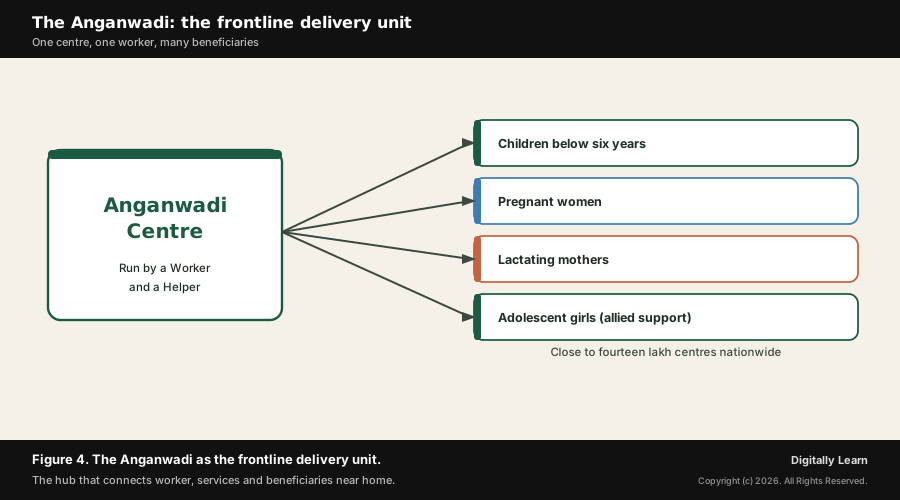
The centre is run by an Anganwadi Worker, almost always a woman chosen from the local community, supported by an Anganwadi Helper. The worker keeps the records, weighs the children, serves the meals, runs the pre-school, mobilises mothers and links them to health services, all for a modest honorarium rather than a regular salary. The country has close to fourteen lakh such workers and over ten lakh helpers, government figures report, making them one of the largest community workforces anywhere in the world.
The Anganwadi serves a clear set of beneficiaries. These are children below six years, who receive nutrition, immunization, health checks and pre-school learning; pregnant and lactating mothers, who receive supplementary nutrition, antenatal care and counselling; and, through allied components, adolescent girls, who are reached with nutrition and health support. By placing all of these groups under one roof, the centre can follow the child across the whole first 1,000 days and beyond. The figure below shows the Anganwadi as the hub that connects worker, services and beneficiaries.
Institutional Architecture: From the Ministry of Women and Child Development to the Anganwadi
The Ministry of Women and Child Development nodal role, the state and district machinery, the project officer and the 60:40 fund-sharing
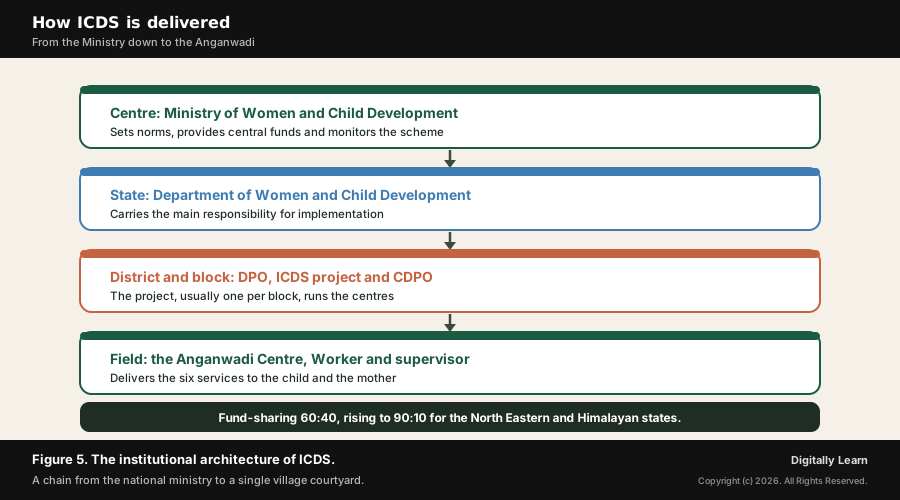
ICDS is delivered through a structure that runs from the national capital down to the village courtyard. At the top sits the Ministry of Women and Child Development, which frames the scheme, sets the norms, provides the central funds and monitors progress. Below it, each state and union territory carries the main responsibility for putting the scheme into practice through its own department of women and child development, because nutrition and child care are subjects that only state and local machinery can manage on the ground.
The work then flows through the district and the project. A district programme officer oversees the scheme across the district, while the basic operating unit is the ICDS project, usually one for each development block, headed by a Child Development Project Officer. A cluster of Anganwadi centres is guided by a supervisor who supports the workers, checks the records and oversees growth monitoring. This chain, from ministry to state to district to project to centre, is what allows a national scheme to reach a single child in a remote hamlet.
The money follows a shared pattern. As a centrally sponsored scheme, the Anganwadi Services component of ICDS is funded jointly by the Centre and the states, generally in a 60:40 ratio, rising to 90:10 for the North Eastern and Himalayan states and met fully by the Centre for union territories without a legislature, government guidelines state. This higher central share for the hill and frontier states reflects their difficult terrain and weaker finances. The figure below sets out this architecture from the ministry down to the Anganwadi.
From Scheme to Entitlement: The Right to Food Case and the Food Security Act
The People's Union for Civil Liberties right to food case, the universalisation of ICDS and the legal guarantee under the National Food Security Act, 2013
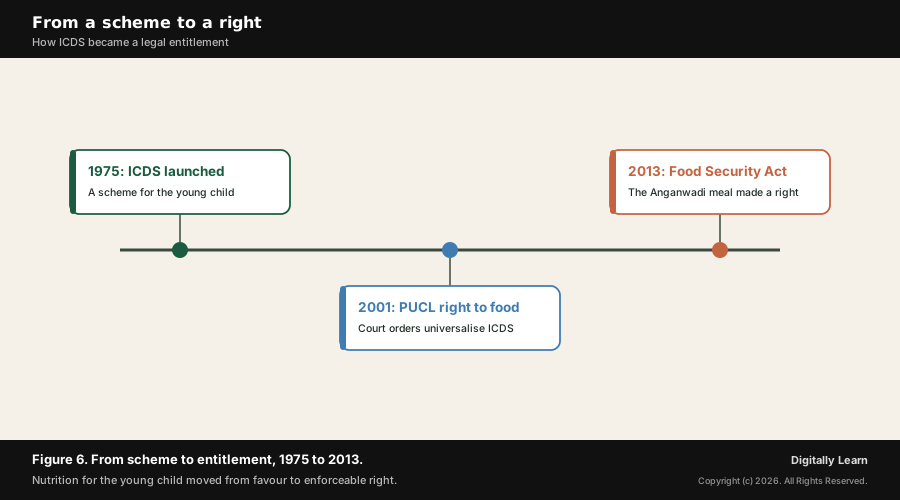
For its first quarter century ICDS was a government scheme, something the state chose to provide and could expand or shrink at will. That changed with a landmark case. In 2001 the People's Union for Civil Liberties brought the right to food petition before the Supreme Court, arguing that the right to life under Article 21, read with the Directive Principles, includes a right to be free from hunger. The Court agreed and issued a series of orders that turned nutrition promises into enforceable directions.
The orders reshaped ICDS. The Court directed the universalisation of the scheme, so that an Anganwadi was to be provided in every settlement that needed one and the services were to reach every eligible child rather than a chosen few. The same case drove the spread of the midday meal in schools. Together these directions moved India from a model of discretionary welfare towards one in which nutrition for the young child was recognised as a matter of basic right, monitored by court-appointed commissioners.
The shift was completed in law by the National Food Security Act, 2013. The Act gives pregnant women and lactating mothers and children from six months to six years a legal entitlement to a free meal of prescribed nutritional standard through the local Anganwadi, with higher norms for the malnourished, and a maternity benefit of not less than six thousand rupees. By writing the ICDS meal into statute, the Act made child nutrition a justiciable entitlement rather than a favour. The figure below traces this journey from scheme to right.
The Reform Layer: Poshan Abhiyaan, the Poshan Tracker and Saksham Anganwadi and Poshan 2.0
Poshan Abhiyaan, real-time monitoring through the Poshan Tracker and the realignment into Saksham Anganwadi and Mission Poshan 2.0
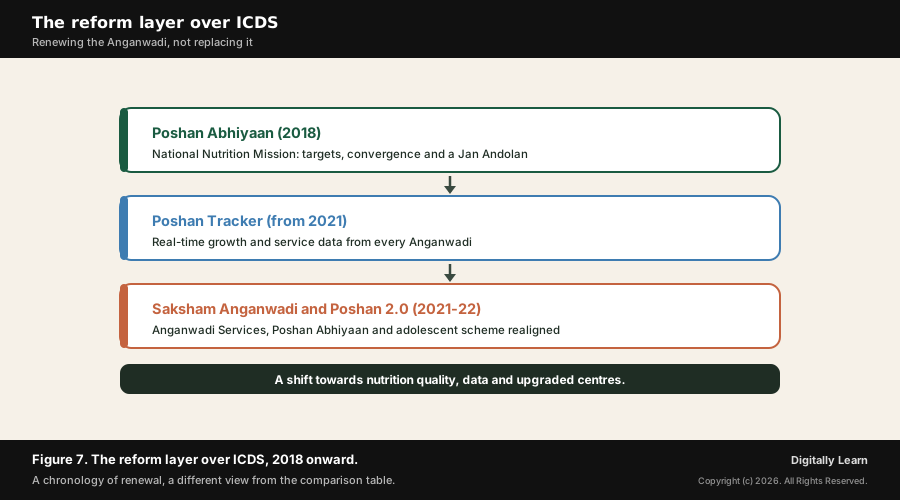
By the late 2010s it was clear that ICDS needed not replacement but renewal. The answer was Poshan Abhiyaan, the National Nutrition Mission, launched by the Prime Minister on 8 March 2018 from Jhunjhunu in Rajasthan. Rather than create a parallel scheme, it works as an umbrella mission that ties ICDS to other nutrition efforts and sets time-bound targets to reduce stunting, under-nutrition, anaemia and low birth weight, with overall direction from a National Council on India's nutritional challenges. Its method rests on better technology, convergence between departments and a people's movement, the Jan Andolan.
A central reform was real-time monitoring. The Anganwadi's paper registers were replaced by the Poshan Tracker, a mobile application rolled out from 2021 on which the worker records attendance, growth measurement and service delivery for each beneficiary. This gives administrators a live picture of nutrition across the country and helps flag a severely malnourished child for action. By digitising the frontline, the Tracker aims to cut leakages, improve accountability and turn the vast ICDS network into a measurable, data-driven nutrition system.
The latest step folded these efforts together. Announced in the 2021-22 Budget, Saksham Anganwadi and Mission Poshan 2.0 realigns the Anganwadi Services, the Poshan Abhiyaan and the Scheme for Adolescent Girls into a single integrated nutrition support programme. It also upgrades selected centres into Saksham Anganwadis, better-equipped centres with improved infrastructure and clean energy, and shifts the focus towards the quality of nutrition and dietary diversity. The table compares classic ICDS with this reformed regime, and the figure traces the reform timeline.
| Dimension | Classic ICDS (Anganwadi Services) | Saksham Anganwadi and Poshan 2.0 |
|---|---|---|
| Primary focus | Delivering the six services to children and mothers | Improving nutrition outcomes and dietary quality |
| Monitoring | Paper registers kept at the Anganwadi | Real-time data through the Poshan Tracker |
| Coverage | Anganwadi Services as a standalone scheme | Anganwadi Services, Poshan Abhiyaan and the adolescent-girls scheme realigned together |
| Infrastructure | Standard Anganwadi centres | Upgraded Saksham Anganwadis with better facilities |
| Driving idea | Universal early childhood services | Mission-mode delivery, convergence and a Jan Andolan |
Challenges Before the Anganwadi System: Honoraria, Infrastructure and Persistent Malnutrition
Worker honoraria and workload, infrastructure gaps, the persistence of stunting and anaemia and delivery leakages
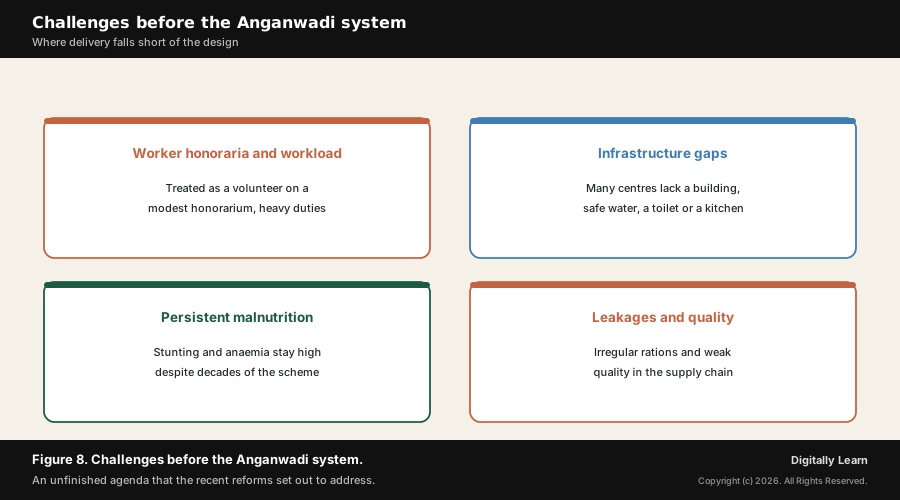
For all its reach, the Anganwadi system carries real strains. The most debated is the position of the Anganwadi Worker, who is treated as an honorary volunteer rather than a regular employee and paid a modest honorarium well below a formal wage, even as she is asked to deliver an ever longer list of duties and digital records. The resulting workload and insecurity feed periodic protests and make it harder to retain trained workers, which directly weakens the quality of service at the centre.
Infrastructure is a second gap. A large share of Anganwadis still lack their own building, a safe water supply, a working toilet or a proper kitchen, and many run from rented or borrowed rooms. Without adequate space and facilities the pre-school and the cooking suffer, and the centre cannot become the clean, welcoming place that a young child needs. The supply of supplementary nutrition can also be uneven, with reports of irregular rations, weak quality and leakages in the distribution chain.
The hardest truth is that malnutrition persists. Despite decades of ICDS, the latest survey still finds more than a third of young children stunted and around two-thirds anaemic, a reminder that delivery on the ground has not matched the scheme's design. The causes lie partly outside ICDS, in sanitation, women's status and poverty, which is exactly why nutrition needs convergence across sectors. These gaps do not deny the scheme's value; they define the unfinished agenda that the reforms now try to address.
The Way Forward and Why ICDS Matters for Human Capital and the Exam
Strengthening the Anganwadi, convergence across sectors and the human capital case for early childhood investment
The way forward builds on what ICDS already is. The priority is to strengthen the Anganwadi itself: fair and timely pay for workers, their gradual recognition as skilled staff, pucca buildings with water and toilets, and reliable, diverse supplementary nutrition. Alongside this, the scheme must deepen convergence, joining hands with health, drinking water, sanitation and women's programmes, because a child's nutrition is decided as much by clean water and a healthy mother as by the meal at the centre.
Equally important is to use the new data well. The Poshan Tracker can only improve nutrition if its records are accurate and acted upon, with attention focused on the severely malnourished child and on districts that lag. The deeper case for all this effort is economic. Investing in the first 1,000 days yields one of the highest returns in public policy, because a well-nourished child learns more, earns more and stays healthier, strengthening the human capital on which India's demographic dividend depends.
For the examination, ICDS is a rich, cross-cutting topic. In Prelims, the testable facts are the 2 October 1975 launch, the Ministry of Women and Child Development, the six services and the legal backing of the Food Security Act. In Mains, it anchors answers on malnutrition, child rights, hunger and welfare delivery, where the key argument is that hunger is not merely a shortage of food but a human development challenge, and that ICDS, for all its gaps, is India's central institutional response to it.
Previous Year UPSC-CSE Questions By the end you will be able to draft model answers for the following UPSC questions. Each question carries a collapsible framework showing how to approach it in the exam.
- UPSC Mains 2018 GS-IIHow far do you agree with the view that the focus on lack of availability of food as the main cause of hunger takes the attention away from ineffective human development policies in India?
How to structure the answer in the exam
Introduction: Open by conceding that food availability matters, then state the central claim that treating food scarcity as the main cause of hunger distracts from the human development failures that actually keep Indians, especially children, undernourished.
Body (sub-themes to develop):
- Establish that food availability alone does not end hunger: India is broadly self-sufficient in foodgrain, yet stunting, wasting, underweight and anaemia remain high, so calories within reach are necessary but not sufficient.
- Show that malnutrition is multi-dimensional and rooted in human development: the World Health Organization frames undernutrition as stunting, wasting and underweight driven by infection, unsafe water, weak sanitation, poor maternal health and lack of early care, while the World Bank ties childhood stunting to lost human capital.
- Argue that the answer therefore lies in human development policy and convergence: health, immunization, clean water, sanitation, maternal nutrition, women's status and early childhood care, not food supply alone.
- Position ICDS as India's institutional human development response: its six services deliver supplementary nutrition together with immunization, health check-ups, referral, pre-school education and nutrition counselling, guarding the first 1,000 days, reinforced by the right to food case, the Food Security Act and Poshan Abhiyaan.
- Offer a balanced way forward: keep food entitlements like the Food Security Act, but fix the human development gaps by strengthening Anganwadis, sanitation and maternal care and by using Poshan Tracker data for convergence.
Conclusion: Conclude that food availability is a necessary foundation but a misleading single explanation, that hunger in India is largely a human development challenge, and that strengthening ICDS and its convergence with health and sanitation is the surest way to break it.
Relevance to this topic. The article teaches that India became self-sufficient in foodgrain yet malnutrition persisted, that the World Health Organization and World Bank frame undernutrition as a multi-sectoral human development and human capital problem, and that ICDS attacks exactly these non-food determinants through health, care, immunization and early education.
Sources and Further Reading
- Ministry of Women and Child Development: Integrated Child Development Services (ICDS) Scheme
- Ministry of Women and Child Development: Anganwadi Services (cost-sharing and the six services)
- Press Information Bureau: Aims and Objectives of the ICDS Scheme
- Press Information Bureau: Budget allocation for Saksham Anganwadi and Poshan 2.0
- NITI Aayog: National Council on India's Nutritional Challenges (POSHAN Abhiyaan)
- Ministry of Health and Family Welfare: National Family Health Survey-5 (2019-21) findings
- World Health Organization: Malnutrition fact sheet (stunting, wasting, underweight)
- World Bank: India, Investing in a Child's Early Years for a Stronger Economy
- Wikipedia: Integrated Child Development Services
- Wikipedia: National Food Security Act, 2013
Editorial Disclaimer
This briefing is for UPSC preparation. Verify the figures against the official Ministry of Women and Child Development, PIB and National Family Health Survey sources before relying on them.


