


Overview
India's national campaign against the declining child sex ratio
A 2015 tri-ministerial campaign launched from Panipat in Haryana to halt the fall in the child sex ratio and to value the girl child, joining strict enforcement of the law against prenatal sex determination, nationwide advocacy, district-level action and the education of girls.
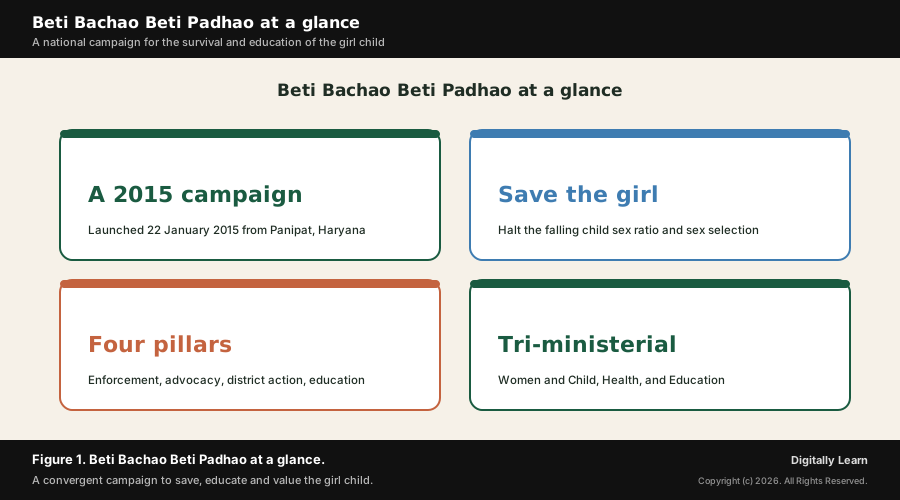
Beti Bachao Beti Padhao, which translates as save the daughter and educate the daughter, is India's national campaign to halt the steady fall in the number of girls being born and to raise the value placed on the girl child. It was launched on 22 January 2015 from Panipat in Haryana, the state with the country's lowest child sex ratio, and runs as a joint effort of three ministries, with the Ministry of Women and Child Development as the nodal authority alongside the Ministries of Health and Family Welfare and of Education. It is a convergent campaign rather than a cash transfer, joining enforcement of the law against prenatal sex determination, a nationwide advocacy drive against son preference, district-level multi-sectoral action and an arm for the schooling of girls. Its legal backbone is the Pre-Conception and Pre-Natal Diagnostic Techniques Act of 1994.
What Beti Bachao Beti Padhao Is: A National Campaign to Save and Educate the Girl Child
The 2015 launch from Panipat, the falling child sex ratio and why a behavioural-change campaign was needed
Beti Bachao Beti Padhao, meaning save the daughter and educate the daughter, is the national campaign through which the Indian state set out to halt the steady fall in the number of girls being born and to raise the value placed on the girl child. It was launched on 22 January 2015 from Panipat in Haryana, the state with the country's lowest child sex ratio, and it is run as a joint effort of three ministries: the Ministry of Women and Child Development as the nodal authority, with the Ministry of Health and Family Welfare and the Ministry of Education. Its purpose is not to hand out a benefit but to change a mindset that has long preferred sons to daughters.
The problem the campaign attacks is the declining child sex ratio, the number of girls aged nought to six years for every thousand boys of the same age. This figure fell from 927 in the 2001 Census to 919 in the 2011 Census, a decline that exposes a quiet and widespread practice of sex-selective abortion. Why it matters is that a shortage of girls is not a statistic alone: it distorts the marriage market, fuels trafficking and the buying of brides, and signals a society that values a daughter less than a son, so the missing girls measure a deep failure of gender justice that no amount of economic growth had cured.
Beti Bachao Beti Padhao is best understood as a convergent campaign rather than a cash scheme. It carries no direct cash transfer to a girl as its core; instead it joins law enforcement against sex determination, a nationwide awareness drive, district-level multi-sectoral action and an arm to keep girls in school. The aim is to attack the problem at its roots, the preference for a son and the devaluation of a daughter, while a set of linked schemes such as the Sukanya Samriddhi small-savings account add a financial limb. The figure below sets out the headline features before the detail that follows.
The Declining Child Sex Ratio: Son Preference, Dowry and the Prosperity Paradox
Why the wealthiest regions show the most adverse sex ratio, and the mechanism behind sex-selective abortion
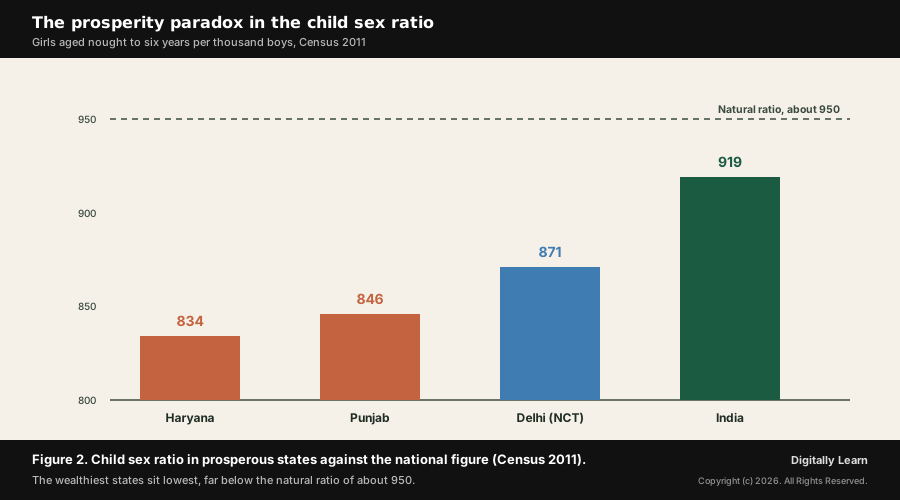
The most striking feature of India's sex-ratio crisis is the prosperity paradox: the worst child sex ratios are found not in the poorest regions but in some of the wealthiest and most agriculturally advanced ones. In the 2011 Census the lowest figures sat in prosperous Haryana, at about 834 girls per thousand boys, in Punjab at about 846, and in the Delhi capital region at about 871, all well below the national 919. These are states of high per-capita income, irrigation and urbanisation, which makes plain that rising wealth, on its own, has not secured the survival of the girl child.
The explanation lies in the meeting of an old son preference with new means. In a patrilineal order the son inherits the land, carries the family name and supports the parents in old age, while the daughter is seen as paraya dhan, wealth that departs to another household on marriage. The expectation of dowry turns a daughter into a perceived economic liability, and that burden tends to rise with the family's own wealth and status. As prosperity and education spread the small-family norm, couples want fewer children, so the wish to still have a son in two births or fewer sharpens the pressure to ensure that the few who are born are male.
What turns this preference into missing girls is access to technology. The prosperous regions have more ultrasound clinics and the money to pay for an illegal prenatal sex determination, so the means of sex selection are most available exactly where the bias is strongest. The lesson is that economic prosperity does not equal gender equality: wealth without a change in patriarchal attitudes can deepen the bias rather than dissolve it. Beti Bachao Beti Padhao is built to break this chain at every link, cutting the supply of sex determination through strict law, attacking son preference and the dowry mindset through advocacy, and raising the worth of the daughter through education. The figure below compares the child sex ratio across these prosperous states.
The Pre-Conception and Pre-Natal Diagnostic Techniques Act, 1994
The 1994 law, its 2003 amendment and the legal backbone against prenatal sex selection
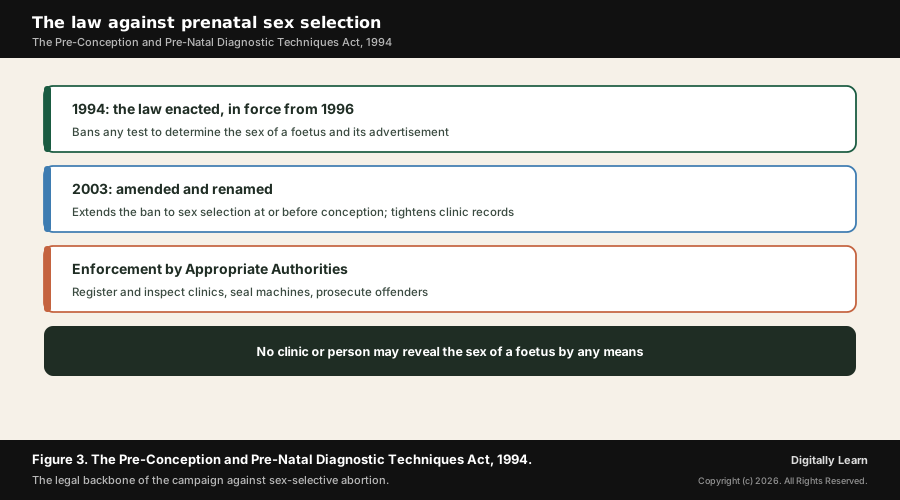
The legal foundation on which Beti Bachao Beti Padhao rests is the Pre-Conception and Pre-Natal Diagnostic Techniques Act, first enacted in 1994 and administered by the Ministry of Health and Family Welfare. The law was a direct response to the spread of ultrasound in the early 1990s, which had given families a cheap way to learn the sex of a foetus and to abort it if female. The Act makes it a criminal offence to conduct or advertise any test for the purpose of determining the sex of an unborn child, and it forbids anyone, including the doctor, from communicating that sex to the pregnant woman or her family by any means.
The statute was first passed as the Pre-natal Diagnostic Techniques Act of 1994 and came into force in 1996. It was then amended in 2003 and renamed the Pre-Conception and Pre-Natal Diagnostic Techniques (Prohibition of Sex Selection) Act, a change that widened its reach to cover the newer techniques of sex selection at or before conception, not merely the testing of an existing foetus. The amended law tightened the registration of ultrasound clinics, required every machine and centre to be recorded, and strengthened the duty to keep and produce records, so that a clinic could be held to account for every scan it performed.
Enforcement rests on a chain of Appropriate Authorities at the district and state level, who register and inspect clinics, seal machines used for sex determination and prosecute offenders. By the official reporting up to December 2017, the Act had produced thousands of court cases, the sealing of large numbers of ultrasound machines and hundreds of convictions, with the suspension of offending doctors' licences. Yet the same record shows the gap between law and practice, since convictions remain few against the scale of the trade. This is why Beti Bachao Beti Padhao treats the strict enforcement of the Act, not its mere existence, as one of its central tasks. The figure below sets out the law and its workings.
The Four Pillars of BBBP: Enforcement, Advocacy, District Action and Girls' Education
Strict PC and PNDT enforcement, nationwide advocacy, multi-sectoral district action and the education arm
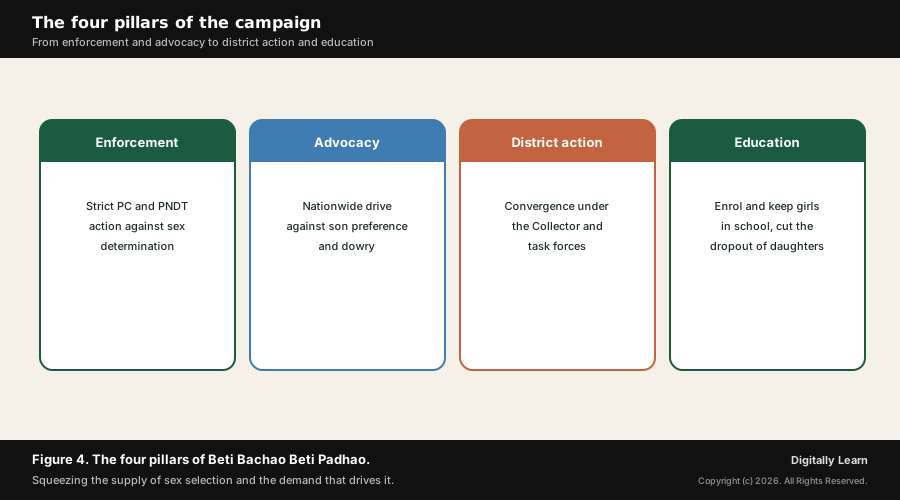
Beti Bachao Beti Padhao works through four connected lines of action that together attack both the killing of girls before birth and their neglect after it. The first is the enforcement of the Pre-Conception and Pre-Natal Diagnostic Techniques Act, tightening the registration and inspection of ultrasound clinics and the prosecution of those who offer sex determination, so that the supply of the practice is squeezed. The second is a sustained advocacy and awareness drive, a nationwide effort to change the social attitudes of son preference and dowry that create the demand for sex selection in the first place, carried through campaigns, community events and the public celebration of the girl child.
The third line is multi-sectoral action at the district level, the convergence on the ground of the health, education and child-development machineries under the lead of the District Collector, with district task forces that monitor the sex ratio and run local interventions. The fourth is the education of the girl child, the padhao half of the name, which works to enrol girls, keep them in school, improve facilities such as separate toilets for girls, and reduce the dropout that pulls daughters out of class early. Through these four lines the campaign moves from saving the girl to schooling and valuing her. The table below sets out the key facts of the scheme, and the figure that follows maps the four pillars.
| Parameter | Detail |
|---|---|
| Launched | 22 January 2015, from Panipat in Haryana |
| Type | A convergent campaign for the girl child, not a cash transfer |
| Nodal ministry | The Ministry of Women and Child Development |
| Partner ministries | Health and Family Welfare, and Education |
| Legal backbone | The Pre-Conception and Pre-Natal Diagnostic Techniques Act, 1994 |
| Coverage | 100 low-ratio districts at launch, later widened to all districts |
| Four pillars | Enforcement, advocacy, district action and girls' education |
Implementation Architecture: The MWCD Nodal Role and Tri-Ministerial Convergence
The Ministry of Women and Child Development as nodal, convergence with Health and Education, and the district task force
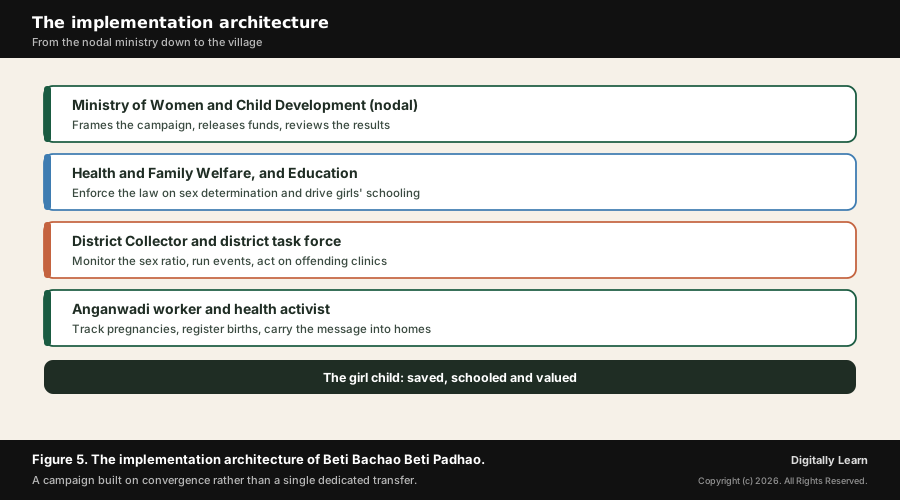
Beti Bachao Beti Padhao is delivered not by a single department spending its own money but by the convergence of several arms of government around a shared goal. At the centre stands the Ministry of Women and Child Development, the nodal ministry that frames the campaign, sets its guidelines, releases funds to the states and reviews the results. Beside it work the Ministry of Health and Family Welfare, which carries the enforcement of the diagnostic-techniques law and the registration of births, and the Ministry of Education, which drives the schooling of girls. The campaign's design assumes that no one ministry can save the girl child alone.
The real work happens in the district, which is why the campaign is built around the District Collector or Magistrate as the local leader of a district task force. This task force brings together the officers of health, education, the police and the child-development service, monitors the local sex ratio at birth month by month, runs awareness events, and acts against clinics that flout the law. The frontline reach into homes comes through the Anganwadi worker and the accredited social health activist of the village, who track pregnancies, register births and carry the campaign's message into the community.
Funding flows from the centre to the states and districts through the nodal ministry, and the campaign began as a focused effort in 100 districts chosen for their low child sex ratio. It was later widened in stages to cover additional districts and finally all districts of the country, turning a targeted start into a nationwide programme. Because the campaign relies on convergence rather than a large dedicated transfer, its success depends on whether the separate machineries actually coordinate on the ground, which is both its strength and, as the critics argue, its weakness. The figure below maps the implementation chain from the centre to the village.
Outcomes and the Sex Ratio at Birth Trend Since 2015
The reported rise in the sex ratio at birth, district-level gains and the change in social attitudes
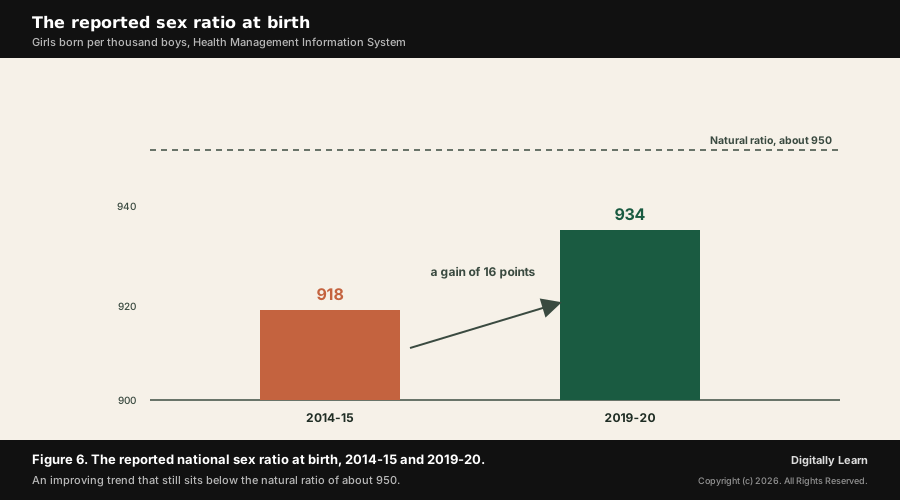
The headline outcome the government reports is an improvement in the sex ratio at birth, the number of girls born for every thousand boys, measured through the Health Management Information System. According to that data, the national figure rose by sixteen points, from 918 in 2014-15 to 934 in 2019-20, and of the 640 districts covered, a majority, some 422 districts, showed an improving trend between 2014-15 and 2018-19.
Beyond the numbers, the campaign claims a quieter gain in attitudes. By making the birth of a daughter an occasion to celebrate, by honouring families and villages that improve their sex ratio, and by placing the girl child at the centre of public messaging, it has worked to shift the social value placed on daughters. Improvements in the enrolment of girls and in school facilities such as separate toilets are cited as evidence on the education side. These behavioural changes are real but hard to measure, and the campaign's own framing treats mindset change as its deepest and slowest objective.
These reported gains must be read with care. The sex ratio at birth, even at 934, remains below the natural level of about 950, so a deficit of girls persists; the figures are drawn from administrative health records rather than a full census, and they move with each report; and an improving ratio in many districts sits beside a worsening one in others. The campaign's defenders read the trend as proof that sustained advocacy and enforcement can turn the tide, while its critics question how much of the change can be credited to the campaign itself rather than to wider social and economic shifts. The figure below charts the reported trend.
The Criticisms: Advertising-Heavy Spend, Fund Under-Utilisation and Thin Education Gains
The CAG and parliamentary findings on media-advocacy spend, unspent funds and weak schooling outcomes
A balanced reading sets the gains against serious criticisms, raised by the national auditor and a parliamentary committee. The sharpest concerns the pattern of spending. A report of the Parliamentary Standing Committee found that of the funds released to the states in the period from 2016 to 2019, the great majority, about 78.91 per cent, was spent on media advocacy and advertising rather than on direct interventions in the health and education of girls. Separate accounting showed a large share of the campaign's funds going to publicity over its first years, prompting the committee to urge a rethink of the advertising-heavy approach.
A second criticism is the under-utilisation of funds. Audits found that much of the money set aside for the campaign was never released to or spent by the districts and states that were meant to use it, so that the effort fell short not only in how it spent but in whether it spent at all. The Comptroller and Auditor General, examining the early years in states such as Haryana, reported weak record-keeping, the diversion of funds to items outside the guidelines, and task-force meetings that did not take place as required, all of which blunted the campaign on the ground.
A third concern is the thinness of the education outcomes against the campaign's name. Critics argue that the padhao, or educate, half of the promise has been the weaker arm, with too little of the spend reaching the schooling, retention and scholarship support that would keep girls in class, and too much resting on slogans and events. There is also a worry that an approach built on awareness alone cannot, by itself, shift a bias as deep as son preference without harder gains in women's employment, inheritance and safety. On the central question, whether the campaign has truly turned the tide for the girl child, a careful answer treats the matter as open.
Linked Schemes for the Girl Child: Sukanya Samriddhi, One Stop Centre and the Welfare Net
The Sukanya Samriddhi savings account, the One Stop Centre and the wider women and child welfare architecture
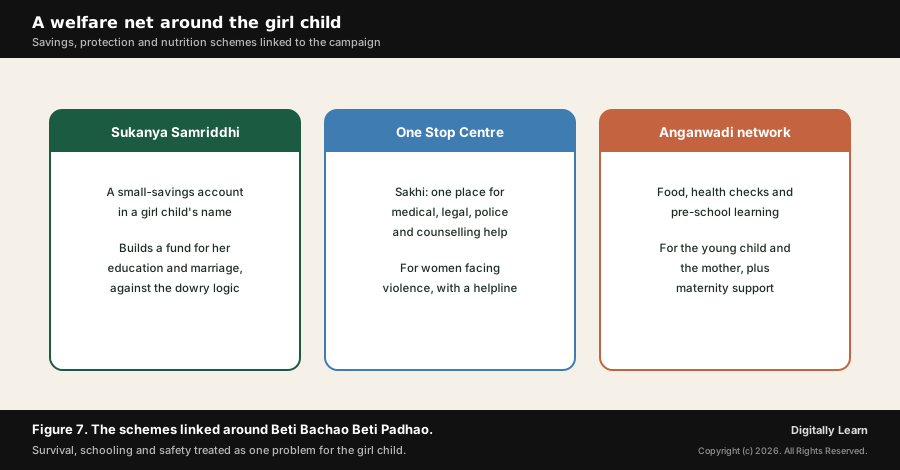
Beti Bachao Beti Padhao does not stand alone; it sits at the centre of a wider architecture of schemes for the girl child and for women, several of them launched alongside it. The most closely linked is the Sukanya Samriddhi account, a small-savings scheme introduced in 2015 under which a parent or guardian opens a deposit account in the name of a girl child, earns a high rate of interest and builds a fund for her education and marriage. By turning a daughter into a saver and an asset rather than a perceived liability, the account works directly against the dowry logic that helps drive son preference.
Other schemes address the woman the girl will become. The One Stop Centre, often called Sakhi, gives a woman affected by violence a single place for medical, legal, police and counselling help, while a women's helpline offers round-the-clock support. Schemes for maternity support and child nutrition reach the mother and the infant, and the wider work of the Ministry of Women and Child Development on the Anganwadi network carries food, health checks and pre-school learning to the young child. Together these form a net in which the campaign's message about the value of the girl is matched by concrete services for her and her mother.
The logic of joining these schemes is that the survival, the schooling and the safety of the girl child are one problem, not three. A daughter who is allowed to be born must also be kept in school, protected from violence and given a financial stake, or the bias against her will simply reappear in a new form. By linking the campaign to savings, protection and nutrition schemes, the state tries to make the value of the girl child real across her whole life rather than only at birth. The figure below maps the campaign and the schemes that surround it.
Understanding the Significance: Survival, Education and a Shift in Social Attitudes
Protecting the girl child's right to be born, to be schooled and to be valued
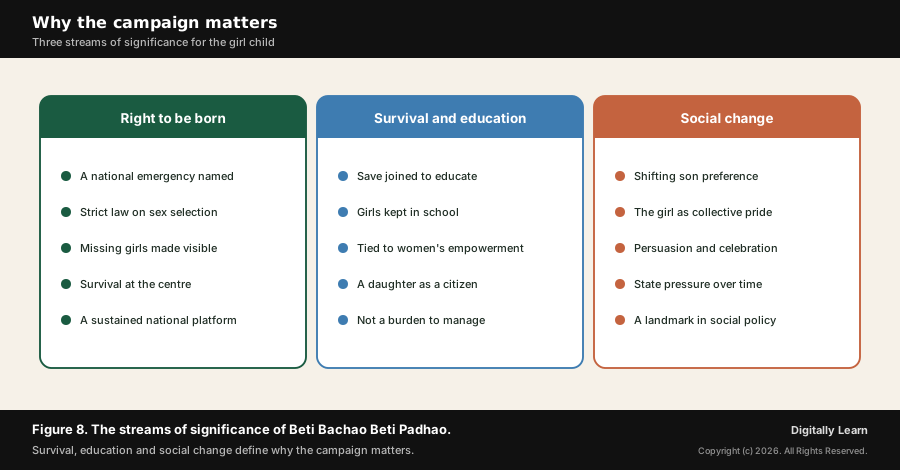
What is the significance of Beti Bachao Beti Padhao lies first in its defence of the girl child's right to be born. By treating the falling child sex ratio as a national emergency and by joining strict enforcement of the diagnostic-techniques law to mass advocacy, the campaign placed the survival of the girl at the centre of public policy, and it gave the long fight against sex-selective abortion a visible and sustained national platform. Whatever its measured results, it made the missing girls a subject the country could no longer ignore.
Its second significance is the link it draws between survival and education. By naming the campaign for both saving and educating the daughter, the state insisted that protecting a girl's life means little unless she is also schooled, valued and allowed to thrive, and it tied the cause of the girl child to the wider project of women's empowerment. This framing lifts the effort above a narrow demographic target into a statement about the kind of society India wishes to be, one in which a daughter is not a burden to be managed but a citizen to be raised.
Its third significance is the attempt at social change itself. The campaign rests on the difficult premise that a bias as old as son preference can be shifted by persuasion, celebration and the steady pressure of the state, and it makes the girl child a matter of collective pride rather than private shame. Read together, the defence of survival, the link to education and the effort to change attitudes are why the campaign is treated as a landmark in India's social policy, even as the debates over its spending and its results qualify how far it has reached. The figure below maps these strands.
The Way Forward: From Advocacy to Outcomes, Stronger Enforcement and Real Education Gains
Rebalancing spend towards health and education, enforcing the PC and PNDT Act and measuring real outcomes
The way forward follows directly from the criticisms. The first priority is to rebalance the spending from advertising towards the substance of the campaign, putting more of the money into the health and education interventions that change a girl's life rather than into publicity, and ensuring that the funds set aside actually reach and are used by the districts. A campaign judged by the share spent on slogans will struggle to convince; one judged by girls retained in school and clinics held to the law will carry weight.
The second priority is to make enforcement of the Pre-Conception and Pre-Natal Diagnostic Techniques Act real and certain. Stronger registration and inspection of ultrasound clinics, faster prosecution and conviction of those who offer sex determination, and the use of birth-registration data to spot the districts where girls are going missing would close the gap between the law on paper and the practice on the ground. Enforcement that is sure rather than occasional is what shrinks the supply of sex selection.
The third priority is to attack the roots of son preference beyond awareness alone. Advancing women's inheritance rights so that daughters share in family property, widening women's employment so that a daughter is an earner and not only a cost, curbing dowry, and improving women's safety would change the calculation that makes families prefer a son. Measuring the campaign by hard outcomes, the sex ratio at birth, girls' school completion and women's work, rather than by events held, would keep it honest. Pursued together, these measures would move Beti Bachao Beti Padhao closer to its promise: a country where the daughter is genuinely saved, schooled and valued.
UPSC Relevance and Exam Focus
Where Beti Bachao Beti Padhao fits in the UPSC-CSE syllabus
This topic maps most directly to General Studies Paper I: the role of women and women's organisations, population and associated issues, and social empowerment, since Beti Bachao Beti Padhao addresses the declining child sex ratio, son preference and the place of the girl child in Indian society. It also links strongly to General Studies Paper II, government policies and interventions for development and welfare schemes for vulnerable sections, where the design, convergence and audit findings of the campaign are examined, and it supplies rich material on gender, social justice and the gap between a law and its enforcement.
For Prelims, hold the high-yield facts: Beti Bachao Beti Padhao is a 2015 campaign launched from Panipat in Haryana, run by the Ministry of Women and Child Development together with Health and Family Welfare and Education; it is a convergent advocacy and enforcement effort, not a cash transfer; it rests on the Pre-Conception and Pre-Natal Diagnostic Techniques Act of 1994, amended in 2003; the child sex ratio fell from 927 in 2001 to 919 in 2011; and the linked Sukanya Samriddhi account is the small-savings limb for the girl child. Distinguish the campaign from the law it enforces.
For Mains, the recurring framing is to ask why a problem as grave as the missing girls persists in a growing economy, and whether a campaign of advocacy and enforcement can shift it. A strong answer treats Beti Bachao Beti Padhao as a case study in social change through the state, weighing its real placing of the girl child on the national agenda and the reported rise in the sex ratio at birth against the audit findings of advertising-heavy spend, unspent funds and thin education outcomes, and locating the deeper cure in women's inheritance, work and safety.
Recurring linked concepts an aspirant should keep in working memory:
- Child Sex Ratio: The number of girls aged nought to six years per thousand boys, which fell from 927 in 2001 to 919 in 2011 and is the central measure the campaign tracks.
- Pre-Conception and Pre-Natal Diagnostic Techniques Act, 1994: The law, amended in 2003, that bans prenatal sex determination and forms the legal backbone of the campaign.
- Sex Ratio at Birth: The number of girls born per thousand boys, measured through health records, which the campaign reports rising from 918 in 2014-15 to 934 in 2019-20.
- Sukanya Samriddhi: The 2015 small-savings account for a girl child that builds a fund for her education and marriage and works against the dowry logic.
A common Prelims trap is to confuse the campaign with the law and the ministries; hold that Beti Bachao Beti Padhao is a campaign run by the Ministry of Women and Child Development, that the legal ban on sex determination comes from the separate Pre-Conception and Pre-Natal Diagnostic Techniques Act under the Health ministry, that the child sex ratio measures the nought-to-six age group while the sex ratio at birth measures newborns, and that the campaign carries no direct cash transfer of its own, the savings limb being the separate Sukanya Samriddhi account.
A common Mains trap is to praise the campaign's slogans and stop there. The exam value lies in a balanced judgment: the real gain in placing the girl child on the national agenda and the reported rise in the sex ratio at birth, set honestly against the audit findings on spending and the thin education results, with the lasting cure located in the harder work of women's inheritance, employment and safety.
Previous Year UPSC-CSE Questions By the end you will be able to draft model answers for the following UPSC questions. Each question carries a collapsible framework showing how to approach it in the exam.
- UPSC Mains 2014 GS-IWhy do some of the most prosperous regions of India have an adverse sex ratio for women? Give your arguments.
How to structure the answer in the exam
Body (sub-themes to develop):
- Establish the fact with data: the lowest child sex ratios in 2011 sit in the wealthy, agriculturally advanced regions of Haryana, Punjab and Delhi, well below the national 919, so prosperity coincides with a more adverse, not a less adverse, ratio.
- Explain the persistence of son preference: patriliny that makes the son the heir, the name-bearer and the support in old age, against the daughter seen as paraya dhan who departs on marriage, a cultural attitude untouched by rising income.
- Explain the role of dowry and the small-family norm: the dowry burden that rises with family wealth turns a daughter into a perceived economic liability, while prosperity and education spread the wish for fewer children, sharpening the pressure to ensure a son in two births or fewer.
- Explain the role of access to technology: prosperous regions have more ultrasound clinics and the money to pay for illegal prenatal sex determination, so the means of sex selection are most available exactly where the bias is strongest, the conclusion being that economic prosperity does not equal gender equality.
- Point to the policy response and the deeper cure: Beti Bachao Beti Padhao with strict PC and PNDT enforcement, advocacy against son preference and dowry, the education of girls and the Sukanya Samriddhi savings limb, while noting that women's inheritance, employment and safety are the lasting correction.
Relevance to this topic. The adverse sex ratio in prosperous regions is the exact problem Beti Bachao Beti Padhao was created to solve. The article supplies both the causal explanation the question demands, son preference, dowry and access to sex-determination technology in wealthy regions, and the state's response.
Sources and Further Reading
- Ministry of Women and Child Development: Beti Bachao Beti Padhao scheme page
- Press Information Bureau: Beti Bachao Beti Padhao, achievements and the sex ratio at birth trend
- Census of India 2011: Sex Ratio and Child Sex Ratio (0-6 years)
- Ministry of Health and Family Welfare: Pre-Conception and Pre-Natal Diagnostic Techniques Act portal
- NITI Aayog: SDG India Index, gender and health indicators
- Ministry of Finance: Union Budget, allocations for women and child development
- Wikipedia: Beti Bachao Beti Padhao
- Wikipedia: Pre-Conception and Pre-Natal Diagnostic Techniques Act, 1994
Editorial Disclaimer
This briefing is for UPSC preparation. Verify the facts and figures against the official Ministry of Women and Child Development, Census of India and PIB sources before relying on them.


