


Overview
India's micro-credit scheme to revive urban street-vendor livelihoods
A 2020 COVID-19 micro-credit scheme of the Ministry of Housing and Urban Affairs that gives urban street vendors collateral-free working-capital loans in escalating tranches, an interest subsidy on timely repayment and a digital cashback.
PM SVANidhi, the Pradhan Mantri Street Vendor's AtmaNirbhar Nidhi, is a micro-credit scheme launched on 1 June 2020 by the Ministry of Housing and Urban Affairs as a COVID-19 response, to give urban street vendors affordable working-capital credit. Its core offer is a collateral-free loan in escalating tranches, a first loan of ten thousand rupees, then twenty thousand and then fifty thousand, each unlocked by timely repayment of the last. It adds a seven per cent interest subsidy on timely repayment and a monthly cashback for digital transactions. Eligibility runs to vendors vending on or before 24 March 2020, identified by a Certificate of Vending or a Letter of Recommendation from the urban local body or the Town Vending Committee, while the SVANidhi se Samriddhi component profiles vendors and their families for other welfare schemes.
What PM SVANidhi Is: A COVID-19 Micro-Credit Scheme for the Urban Street Vendor
The street-vendor livelihood, the moneylender trap and why the 2020 lockdown forced a credit response
The Pradhan Mantri Street Vendor's AtmaNirbhar Nidhi, known as PM SVANidhi, is the scheme through which the Indian state set out to put affordable working-capital credit into the hands of the country's urban street vendors. It was launched on 1 June 2020 by the Ministry of Housing and Urban Affairs, the ministry that handles urban development, as a direct response to the COVID-19 pandemic and the lockdown that had stalled the smallest urban trades. Its target is the vendor who sells from a cart, a stall or a basket, the fruit-seller, the cobbler, the hawker and the food-cart owner, who earns a daily income but had never qualified for a formal loan.
The problem the scheme attacks is old and specific to the urban informal economy, the sector in which, by NITI Aayog's roadmap for Sustainable Development Goal 8, almost ninety-two per cent of India's working population is employed. A street vendor runs on working capital, the small sum needed each morning to buy the day's stock, yet holds no land, no collateral and no credit record that a bank will read, so the formal system had always passed the vendor over. Why it matters is that the vendor, denied a bank loan, was left to the moneylender, who lent the daily float at punishing rates and took back much of the earnings, holding the vendor in a cycle of debt that effort alone could not break.
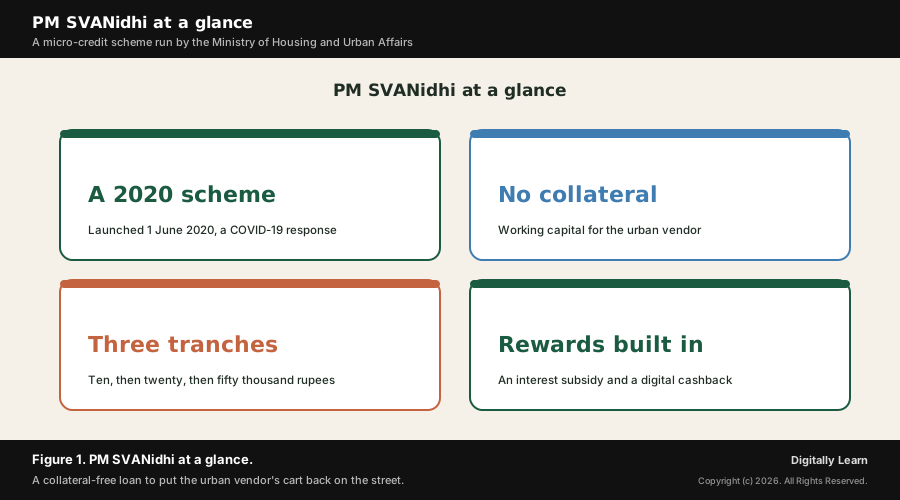
The COVID-19 lockdown of March 2020 turned this chronic weakness into an emergency. With markets shut and footfall gone, vendors lost their daily takings overnight, exhausted what little they had saved and could not even repay the informal lender, so when trade slowly reopened many had no float left to buy stock and restart. The scheme was framed to meet exactly this moment, to give the vendor a small collateral-free loan to put the cart back on the street, and to do so through the formal banking system rather than the moneylender. The figure below sets out the headline features before the detail that follows.
The Loan Design: Escalating Tranches, the Interest Subsidy and the Digital Cashback
The three escalating working-capital loans of ten, twenty and fifty thousand rupees and the repayment-linked ladder
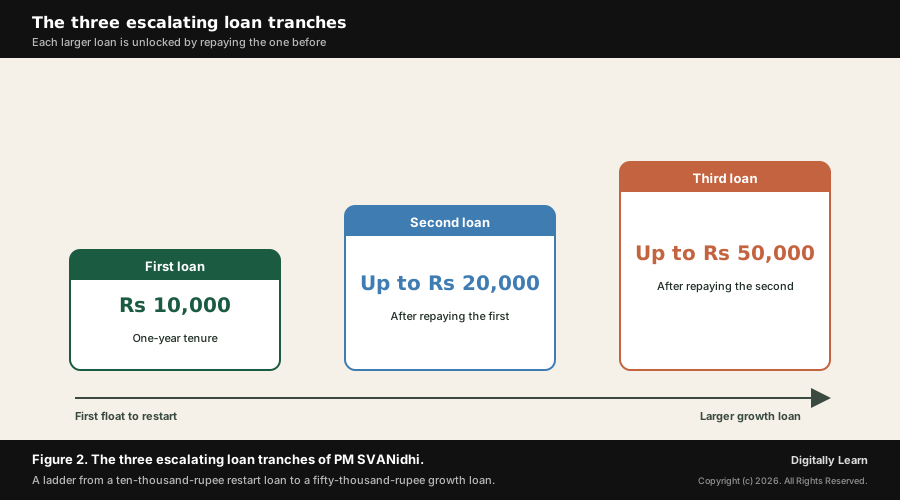
The heart of PM SVANidhi is a working-capital loan built as a ladder of escalating tranches, so that the vendor who repays well can borrow more. The first loan is of ten thousand rupees, advanced for a tenure of one year and repaid in monthly instalments, a sum meant to put the cart back on the street and the stock back on the cart. On the timely repayment of this first loan, the vendor becomes eligible for a second loan of up to twenty thousand rupees, and on repaying that, for a third loan of up to fifty thousand rupees, so the credit grows with the borrower's record.
This repayment-linked design does two things at once. It manages the lender's risk, since each larger loan is unlocked only by the proven repayment of the smaller one, so the bank lends more only where the vendor has shown the discipline to repay; and it builds the borrower's credit history, since each repaid tranche is a record that lifts the vendor towards larger and cheaper formal finance in future. The loan is collateral-free, demanding no security or guarantee, which is what lets the vendor with nothing to pledge enter the formal system at all. The figure below sets out the escalating ladder of the three loans.
| Loan stage | Loan amount | How it is unlocked |
|---|---|---|
| First loan | Ten thousand rupees, for a one-year tenure repaid in monthly instalments | Available to every eligible street vendor at the entry stage |
| Second loan | Up to twenty thousand rupees | Granted on the timely repayment of the first loan |
| Third loan | Up to fifty thousand rupees | Granted on the timely repayment of the second loan |
The seven per cent interest subsidy on timely repayment and the monthly cashback for digital transactions
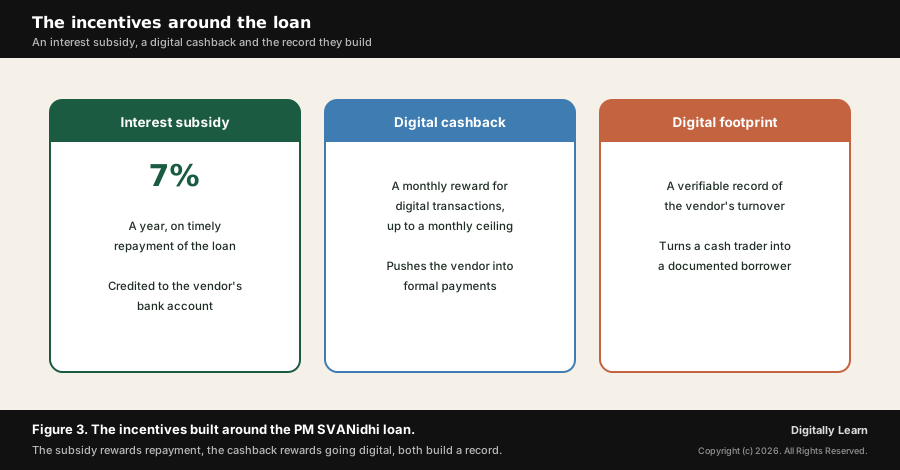
Around the loan the scheme builds two incentives that reward the vendor for good behaviour. The first is an interest subsidy of seven per cent a year, given on the timely repayment of the loan and credited directly into the vendor's bank account. The subsidy lowers the real cost of the loan for the disciplined borrower, and because it is conditional on prompt repayment it nudges the vendor towards a steady repayment habit, the very habit that builds a usable credit record and unlocks the next, larger tranche.
The second incentive promotes digital payments. The scheme offers a monthly cashback to vendors who accept and make payments through approved digital channels, a small reward credited for each eligible digital transaction up to a monthly ceiling. The purpose runs deeper than the cash. By drawing the vendor into accepting payment by digital wallet, card or instant transfer, the scheme builds a verifiable record of the vendor's turnover, a digital footprint that a lender can read, so that the vendor moves from an invisible cash trader into a documented borrower whose business the formal system can see and finance. The figure below sets out how the incentives reinforce the loan.
Eligibility and Identification: The 24 March 2020 Cutoff, the Certificate of Vending and the Letter of Recommendation
The vending-before-24-March-2020 condition, the survey by urban local bodies and the route for the uncertified vendor
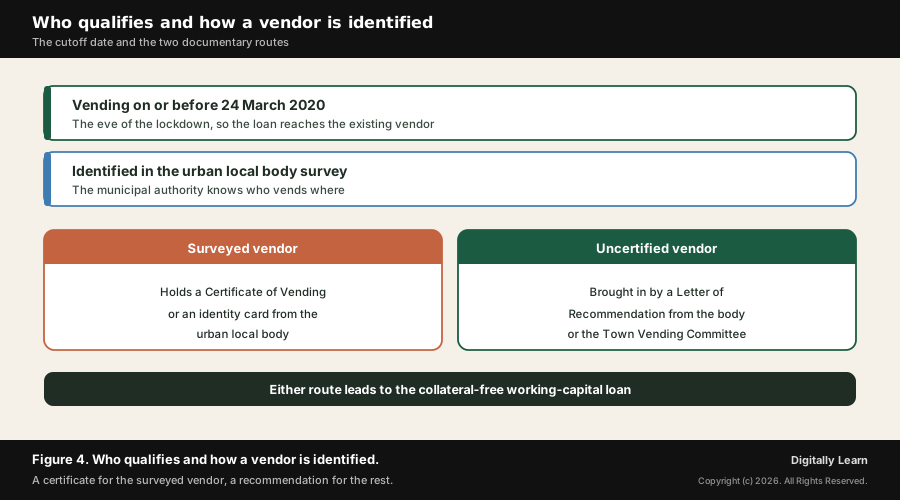
The scheme defines its beneficiary with care, since it set out to reach the established vendor hit by the lockdown rather than to fund newcomers. The basic condition is that the applicant must have been a street vendor vending in an urban area on or before 24 March 2020, the eve of the national lockdown, so that the loan reaches the vendor whose existing trade the pandemic disrupted. The eligible vendor is one identified in the survey of street vendors conducted by the urban local body, the municipal authority of the town or city, which is the body that knows who vends where.
Identity is established through one of two documents. A vendor already surveyed holds a Certificate of Vending or an identity card issued by the urban local body, which is direct proof of eligibility. A vendor who was vending but had not yet been surveyed, or who vends in a place not covered by a survey, is not shut out: such a vendor can be brought in through a Letter of Recommendation issued by the urban local body or the Town Vending Committee, on the strength of membership of a vendor association, supporting documents or a local enquiry. The two routes together were designed to keep the genuinely working vendor from falling through the gap of an incomplete survey.
This identification design carries real weight, because it ties the credit scheme to the wider law that governs street vending. The Certificate of Vending and the Town Vending Committee are not creations of PM SVANidhi; they come from the Street Vendors Act of 2014, examined in the next section, and the scheme leans on that legal machinery to know who its borrowers are. The reliance has a flip side: a vendor who has never been surveyed and cannot obtain a recommendation can struggle to qualify, which is among the criticisms taken up later. The figure below sets out the eligibility and identification routes.
The Delivery Architecture: MoHUA, Urban Local Bodies, the Street Vendors Act and the Lending Channels
The Ministry of Housing and Urban Affairs, the urban local bodies and Town Vending Committees, the Street Vendors Act of 2014 and the banks and the portal
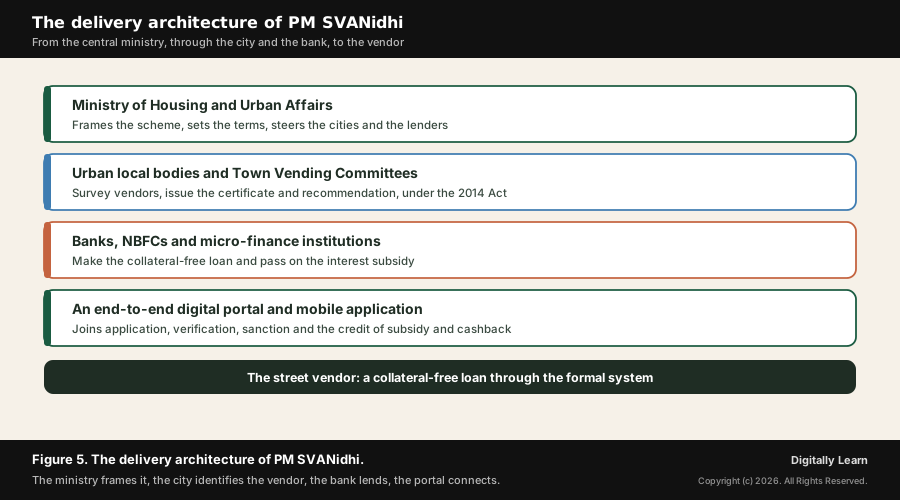
PM SVANidhi is delivered through a chain that joins the central government, the city and the bank. At the top sits the Ministry of Housing and Urban Affairs, which frames the scheme, sets its terms and steers the lenders and the cities that carry it out; the Department of Financial Services in the Ministry of Finance supports the credit side. The scheme runs through the formal banking system, so the actual loan is made by a lending institution. The loan is made through any of the formal lending channels that reach the urban poor:
- The scheduled commercial banks, which carry the largest share of the lending.
- The regional rural banks, which serve smaller towns and the urban fringe.
- The small finance banks, built to bank low-income and informal borrowers.
- The cooperative banks rooted in local urban communities.
- The non-banking financial companies that lend beyond the traditional bank counter.
- The micro-finance institutions that already reach the urban poor.
The seven-per-cent interest subsidy is routed back to the borrower through this same lending channel.
The city end of the chain rests on the urban local body and its Town Vending Committee. The urban local body conducts the survey of vendors, issues the Certificate of Vending and the Letter of Recommendation, and links the borrower to the welfare schemes described below; the Town Vending Committee, a body in which the vendors themselves are represented, is the forum that regulates vending in the town. These institutions are not improvised for the scheme; they are the machinery of the Street Vendors Act of 2014, the law whose full name is the Street Vendors (Protection of Livelihood and Regulation of Street Vending) Act, which set out to protect the vendor's right to a livelihood and to regulate where and how vending happens. PM SVANidhi is, in effect, the credit limb grafted onto that protective law.
Holding the chain together is a digital platform. The scheme runs on an end-to-end information-technology portal and a mobile application through which the vendor applies, the urban local body verifies, the lender sanctions and the subsidy and cashback are credited, so the whole process is meant to move without the vendor queueing at a counter or paying a middleman. This portal is what makes a scheme aimed at lakhs of tiny borrowers administrable at all, and it is the same digital track that turns the cash vendor into a documented one. The figure below maps the delivery architecture from the ministry down to the vendor.
SVANidhi se Samriddhi: Profiling Vendors and Families for Wider Welfare
The socio-economic profiling of vendors and their families and the link to other central welfare schemes
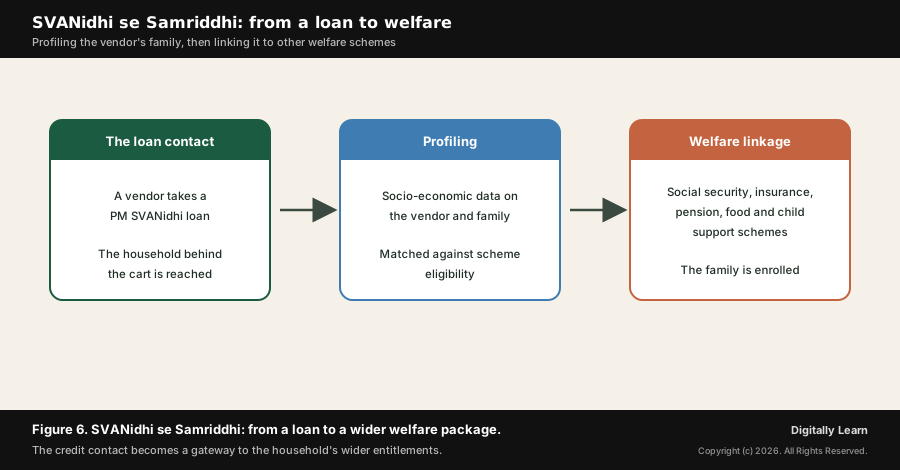
PM SVANidhi was designed to be more than a loan, and the bridge from credit to wider welfare is the SVANidhi se Samriddhi component, a phrase that means from SVANidhi to prosperity. Its method is socio-economic profiling: when a vendor takes a loan, the scheme gathers basic information about the vendor and the vendor's family, their circumstances and their needs, so that the household behind the cart becomes visible to the state. This profiling treats the vendor not as an isolated borrower but as the head of a poor urban family whose other deprivations can be addressed.
On the strength of that profile, the component links the vendor and the family to other welfare schemes of the central government for which they are eligible but which they had never claimed. The schemes it connects them to span social security, insurance, pension, food security and maternity and child support, the spread of benefits the poor are entitled to yet often miss for want of information and paperwork. By using the credit contact as the moment to enrol the family in this wider set of entitlements, the scheme turns a single loan into a gateway to the welfare system, addressing the household's vulnerability and not merely the vendor's working capital.
This linkage is the feature that lifts PM SVANidhi from a narrow credit programme into an instrument of holistic development. It rests on the same digital base as the loan, since the profile is recorded on the portal and matched against the eligibility of the welfare schemes, and it is carried into the community through outreach events where vendors are helped to apply. The approach reflects a wider shift in welfare delivery, from the citizen chasing scattered benefits towards the state reaching out with a connected set of entitlements once a household is known. The figure below sets out how the profiling leads to the welfare linkages.
The Outcomes: Loans Disbursed, Digital Adoption and a Move into Formal Finance
Mass collateral-free credit to street vendors, rising digital adoption and the pull into the formal financial system
The first outcome of PM SVANidhi is the scale of credit it has carried to a class of borrower the formal system had never served. Tens of lakhs of street vendors have received collateral-free loans under the scheme since 2020, and many have moved up the ladder from the first tranche to the second and third, which shows the repayment-linked design working as intended. The precise totals of loans and disbursement move with each official report and are best read as indicative of magnitude rather than as fixed figures, but the direction is plain: institutional working-capital credit now reaches the urban street vendor on a mass scale.
A second outcome lies in digital adoption. Drawn by the cashback and the convenience, large numbers of vendors began to accept and make payments through digital channels, and many have become regular digital transactors, a striking change for traders who had dealt only in cash. This shift matters beyond the convenience, since each digital payment leaves a record of turnover that builds the vendor's credit profile, so the cashback does quiet structural work, turning the cash economy of the street a step towards the formal, recorded economy that finance can reach.
A third outcome is the pull towards formal finance and dignity. A vendor who holds a bank loan, repays it and earns a subsidy gains a bank relationship and a credit record, the documents and history that open the door to larger and cheaper credit, and is drawn out of dependence on the moneylender whose rates once consumed the day's earnings. Alongside the credit, the SVANidhi se Samriddhi linkages pull the vendor's family into the welfare net. Read together, mass collateral-free credit, rising digital adoption and the move into formal finance are the principal gains the scheme is credited with, even as the debates examined next qualify how deep each gain runs.
The Critiques and Debates: Repeat-Loan Sustainability, Exclusion and the Small Loan Size
The sustainability of repeat loans, the exclusion of un-surveyed vendors, digital and last-mile barriers, the small loan size and the risk of defaults
A balanced reading sets the gains against persistent critiques, presented here as they are argued by independent economists, researchers and the lenders themselves. The first concerns repeat-loan sustainability. Because the loan funds working capital rather than an asset that earns, some vendors borrow each tranche to keep the cart running rather than to grow the trade, and critics ask whether a ladder of repeat loans can be sustained, or whether it simply rolls the same precarious vendor through ever-larger debts without building a stronger enterprise underneath. Supporters reply that graduation to the larger tranches is itself evidence of a strengthening business.
A second debate is over exclusion. Because eligibility leans on the urban local body's survey and the Certificate of Vending, a vendor who was never surveyed, who vends in a town that has not notified the Street Vendors Act machinery, or who is a migrant new to a city, can find it hard to qualify, so the scheme may miss the most marginal and mobile vendors it most wishes to reach. A related digital and last-mile barrier compounds this, since vendors with low literacy, no smartphone or weak digital skills struggle with the portal, the application and the digital-payment requirement, and the very design that rewards going digital can leave the least equipped vendor behind.
Further concerns cluster around the loan size and asset quality. Critics argue that even the third tranche is small against the working-capital needs of a real livelihood, so the loan eases the daily float without funding a genuine step up, and that the scheme finances survival more than enterprise growth. On the lenders' side, there is caution about non-performing loans, since collateral-free credit to thin-record borrowers carries a default risk that can strain the banks if repayment falters. On the central question, whether PM SVANidhi has turned a relief loan into a durable route out of informality, a careful answer treats the matter as open and weighs the real expansion of credit and dignity against these honest doubts about depth, reach and repayment.
Understanding the Significance: Livelihood Revival, Financial Inclusion and Formalisation
A revival of urban livelihoods, the credit-side inclusion of the urban informal worker and a route to formalisation
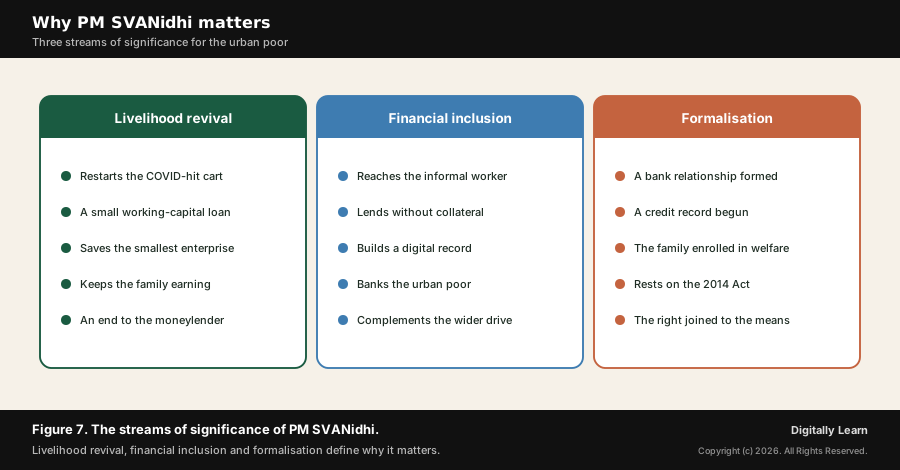
What is the significance of PM SVANidhi lies first in its character as a revival of urban livelihoods. By putting a small collateral-free loan into the hand of a vendor whose trade the lockdown had stalled, the scheme let the cart go back on the street and the family go back to earning, turning a relief measure into a working livelihood. This rescue of the smallest urban enterprises, at the precise moment they were most at risk, is its most immediate contribution: it kept a vast class of self-employed urban poor from sliding into destitution.
Its second significance is as an instrument of financial inclusion on the credit side for the urban informal worker. The street vendor is among the hardest of all groups for the formal system to reach, holding no collateral and leaving no paper trail, and by lending without security and building a digital record the scheme drew this excluded worker into the banked, formal economy. This makes PM SVANidhi the urban, vendor-specific complement to the wider inclusion drive, extending to the cart and the stall the access to formal credit that earlier efforts had built around bank accounts.
Its third significance is for formalisation and the family. Through the credit record, the digital footprint and the SVANidhi se Samriddhi linkages, the scheme draws the once-invisible vendor and the vendor's household into the formal economy and the welfare net at once, addressing not only the working capital of the trade but the wider deprivations of the family behind it. Resting on the protective frame of the Street Vendors Act, it joins the right to vend with the means to vend. Read together, livelihood revival, financial inclusion and formalisation are why PM SVANidhi is treated as a landmark in India's urban welfare and micro-finance policy. The figure below maps these strands.
The Way Forward: Deeper Reach, From Working Capital to Enterprise and Sound Repayment
Widening identification, pairing the loan with skill and market support and keeping the repeat-loan ladder sound
The way forward follows directly from the critiques. The first priority is to widen the reach so that identification ceases to be a barrier. Completing the surveys of street vendors in every town, encouraging more states and cities to notify the Street Vendors Act machinery, and easing the route for the un-surveyed and the migrant vendor through a recommendation would draw in the most marginal vendors the scheme still misses, while simpler digital onboarding and last-mile help would close the gap for the vendor with no smartphone or low literacy.
The second priority is to move from working capital to enterprise. Pairing the loan with skill support, market linkage, better vending sites and the wider SVANidhi se Samriddhi welfare package would help the vendor build a stronger trade rather than only refloat the daily cart, so that the repeat loans fund a rising business and not a treadmill of debt. Linking vendors to digital markets and steadier supply chains would turn the credit into a genuine ladder out of precarity rather than a recurring rescue.
The third priority is to keep the repeat-loan ladder sound. Guarding asset quality through careful appraisal and steady repayment, using the data the scheme generates to lend more wisely, and protecting the vendor from over-borrowing would keep defaults in check without slamming the door the scheme worked to open. Pursued together, a deeper reach, a shift from working capital to enterprise and a sound repayment ladder would move PM SVANidhi closer to its founding promise: not merely a relief loan for the lockdown, but a durable, dignified place for the street vendor in the formal economy.
UPSC Relevance and Exam Focus
Where PM SVANidhi fits in the UPSC-CSE syllabus
This topic maps most directly to General Studies Paper III: inclusive growth and issues arising from it, and the mobilisation of resources, since PM SVANidhi is a micro-credit instrument for the urban informal sector whose design and credit channels are core to financial inclusion. It also links strongly to General Studies Paper II, government policies and interventions for development and welfare schemes for vulnerable sections, where the reach of the scheme to the urban poor and the SVANidhi se Samriddhi welfare linkages are examined, and it supplies rich material on the urban informal economy, the Street Vendors Act of 2014 and urban livelihoods.
For Prelims, hold the high-yield facts: PM SVANidhi is a 2020 micro-credit scheme run by the Ministry of Housing and Urban Affairs, launched as a COVID-19 response for urban street vendors; it gives collateral-free working-capital loans in escalating tranches of ten thousand, then twenty thousand, then fifty thousand rupees, each unlocked by repaying the last; it carries a seven per cent interest subsidy on timely repayment and a monthly cashback for digital transactions; eligibility runs to vendors vending on or before 24 March 2020, identified by a Certificate of Vending or a Letter of Recommendation; and the SVANidhi se Samriddhi component profiles vendors and families to link them to other welfare schemes, the whole resting on the Street Vendors Act of 2014 and its Town Vending Committees.
For Mains, the recurring framing is to assess whether a credit scheme can secure the urban informal worker against exclusion: how collateral-free escalating loans and the welfare linkages brought the vendor into formal credit and the welfare net, and how far the survey-based eligibility, the digital barriers and the small loan size have limited the depth and reach of the gains. A strong answer treats PM SVANidhi as a case study in urban livelihood policy and credit-side financial inclusion, weighing its real revival of livelihoods against the unresolved questions of exclusion and enterprise building.
Recurring linked concepts an aspirant should keep in working memory:
- Street Vendors Act of 2014: The law, formally the Street Vendors (Protection of Livelihood and Regulation of Street Vending) Act, that protects the vendor’s livelihood and sets up the survey, the Certificate of Vending and the Town Vending Committee on which PM SVANidhi rests.
- Town Vending Committee: The local body, with vendors represented on it, that surveys vendors and regulates vending in a town and issues the Letter of Recommendation.
- SVANidhi se Samriddhi: The component that profiles the vendor and the family and links them to other central welfare schemes.
- Urban informal economy: The vast unorganised urban sector of vendors, hawkers and self-employed workers that the scheme seeks to reach and formalise.
A common Prelims trap is to confuse the ministry and the numbers; hold that PM SVANidhi is run by the Ministry of Housing and Urban Affairs and not the Ministry of Finance or Rural Development, that the tranches are ten, twenty and fifty thousand rupees in that order, that the interest subsidy is seven per cent on timely repayment, that the cutoff for eligibility is vending on or before 24 March 2020, and that the scheme is a loan with incentives rather than a cash grant.
A common Mains trap is to praise the loan count and stop there. The exam value lies in a balanced judgment: the real revival of livelihoods, the credit-side inclusion of the street vendor and the welfare linkages, set honestly against the open problems of survey-based exclusion, digital and last-mile barriers, the small loan size and the sustainability of repeat lending.
Previous Year UPSC-CSE Questions By the end you will be able to draft model answers for the following UPSC questions. Each question carries a collapsible framework showing how to approach it in the exam.
- UPSC Mains 2014 GS-IIDo government’s schemes for up-lifting vulnerable and backward communities by protecting required social resources for them, lead to their exclusion in establishing businesses in urban economies?
How to structure the answer in the exam
Body (sub-themes to develop):
- State the apparent paradox the question poses: that schemes meant to uplift vulnerable and backward communities, by protecting resources for them, may inadvertently exclude them from establishing businesses in urban economies.
- Show the inclusion side with PM SVANidhi: a government scheme that puts the vulnerable urban street vendor into self-run business through collateral-free escalating loans, an interest subsidy, a digital cashback and welfare linkages, reviving urban livelihoods and banking the excluded.
- Show the exclusion side: how survey-and-certificate eligibility, the dependence on the urban local body and the Street Vendors Act notification, and the digital and last-mile barriers can shut out the un-surveyed, the migrant and the least-equipped vendor, so a protective design can exclude in practice.
- Reach a reasoned judgment: that such schemes are not inherently exclusionary, but their identification and delivery design decides whether protection becomes inclusion or exclusion, and suggest the corrective measures (wider survey coverage, easier recommendation, simpler digital onboarding, skill and market support).
Relevance to this topic. PM SVANidhi is a welfare-cum-credit scheme for a vulnerable urban community (street vendors) aimed at sustaining their businesses in the urban economy, while its survey-based eligibility and digital requirements raise exactly the exclusion concern the question asks about; the article both shows the inclusion purpose and analyses the exclusion risk on attribution.
Sources and Further Reading
- Ministry of Housing and Urban Affairs: PM SVANidhi scheme portal
- Ministry of Housing and Urban Affairs: PM Street Vendor's AtmaNirbhar Nidhi (PM SVANidhi) Frequently Asked Questions
- Press Information Bureau: PM SVANidhi Scheme facilitates collateral-free working capital loans to street vendors
- Press Information Bureau: PM SVANidhi, Empowering Street Vendors, Reviving Livelihoods
- Ministry of Finance: Aatma Nirbhar Bharat package and the Union Budget framework for urban livelihoods
- World Bank: Inclusive cities for informal workers and the urban informal economy
- NITI Aayog: India's Roadmap for SDG 8, on decent work and the informal sector
- Wikipedia: Pradhan Mantri SVANidhi Scheme
- Wikipedia: Street Vendors Act, 2014
Editorial Disclaimer
This briefing is for UPSC preparation. Verify the facts and figures against the official Ministry of Housing and Urban Affairs, PM SVANidhi portal and PIB sources before relying on them.


