


Overview
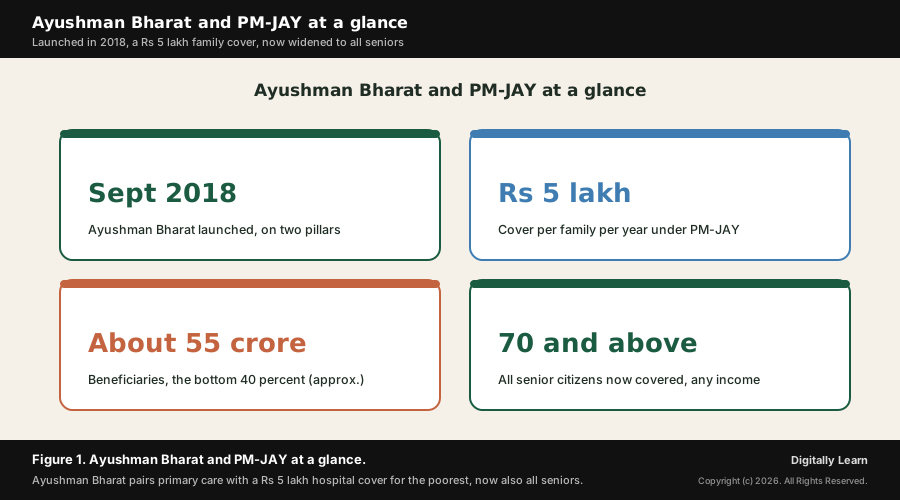
Ayushman Bharat is India's flagship health initiative, launched in September 2018 to move the country towards Universal Health Coverage. It rests on two inter-related pillars. The first is the Ayushman Arogya Mandirs, formerly Health and Wellness Centres, which deliver Comprehensive Primary Health Care free and close to communities. The second is the Pradhan Mantri Jan Arogya Yojana (PM-JAY), a health-assurance scheme that gives a cover of Rs 5 lakh per family per year for secondary and tertiary hospitalisation. PM-JAY targets about 12 crore poor and vulnerable families, roughly 55 crore beneficiaries (figures as reported), is cashless and portable across empanelled public and private hospitals, and is run by the National Health Authority. In 2024 it was widened to cover all senior citizens aged 70 and above, irrespective of income.
What Ayushman Bharat Is: Two Pillars Launched in September 2018
Ayushman Bharat: a continuum-of-care approach to Universal Health Coverage
Ayushman Bharat is the Government of India's flagship health initiative, launched in September 2018 to carry the country towards Universal Health Coverage. Its core idea is a continuum of care: a person should be able to get help close to home for everyday illness, and a financial shield when a serious illness needs a hospital. It is built, therefore, on two inter-related pillars working at different levels of the health system.
The first pillar is the Ayushman Arogya Mandirs, formerly the Health and Wellness Centres, which strengthen primary care on the supply side. The second is the Pradhan Mantri Jan Arogya Yojana, or PM-JAY, which provides hospital cover on the demand side, financing treatment that the poor could otherwise never afford. Together they aim to make essential care both reachable and affordable for those who need it most. The figure below sets out the scheme at a glance.
Why it is called the world's largest health-assurance scheme
Ayushman Bharat is widely described as the world's largest government-funded health-assurance scheme because of the sheer number of people it sets out to protect. PM-JAY alone targets about 12 crore families, roughly 55 crore individuals, the figures reported as the bottom 40 per cent of the population by deprivation. No other publicly funded scheme attempts to give a hospital shield to a population on that scale.
The word assurance, rather than insurance, matters. The Government itself stands behind the promised cover, rather than simply buying a commercial policy, so the entitlement does not depend on a private insurer's willingness to pay. This is what lets the scheme reach families that no market insurer would choose to cover, and it is central to its claim to advance health equity.
Why Ayushman Bharat Is in the News: Cover for All Senior Citizens
The 2024 extension to all citizens aged 70 and above
Why it matters now is a major widening of the scheme. The Union Cabinet approved health cover under AB PM-JAY for all senior citizens aged 70 years and above, irrespective of income. For the first time, eligibility is decided by age alone, not by poverty, marking a clear step away from a strictly means-tested design and towards more universal cover for the old.
The extension is reported to benefit about 4.5 crore families with about 6 crore senior citizens (figures as announced). Each eligible senior receives a cover of Rs 5 lakh on a family basis; where a family is already covered under PM-JAY, the seniors get an additional top-up of up to Rs 5 lakh reserved for them. Beneficiaries are issued a distinct card so the new entitlement can be tracked separately.
The change is significant because the elderly carry a heavy burden of illness yet often have the least income to meet it. By covering every older citizen regardless of wealth, the State treats old-age health security as a shared social responsibility, a politically and fiscally notable broadening of the original promise.
Understanding the Significance of Ayushman Bharat for India
Why it is a test of public health and the welfare State
What is the significance of Ayushman Bharat lies first in the financial protection it offers. In India, families pay a large share of health costs directly from their own pockets, and a single hospital stay can push a household into debt or poverty. By financing hospital care for the poorest, PM-JAY directly attacks this catastrophic out-of-pocket spending, the surest way illness deepens deprivation.
Its second significance is what it shows about the welfare State. A strong primary-health structure and a public hospital shield are not charity but a precondition for development: a healthy population is the basis of a productive economy, so investing in health is also investing in growth. Ayushman Bharat treats access to care as an entitlement of citizenship rather than a privilege of the market, the moral core of a welfare State.
Third, the scheme is a model of mission-mode government that pairs supply-side primary care with demand-side financing. It links directly to nutrition, to poverty reduction and to the goal of Universal Health Coverage, making it a lens through which the wider strength of Indian public health, and the State's role within it, can be judged.
Pillar One: Ayushman Arogya Mandirs and Comprehensive Primary Health Care
The Arogya Mandirs and the primary-health structure
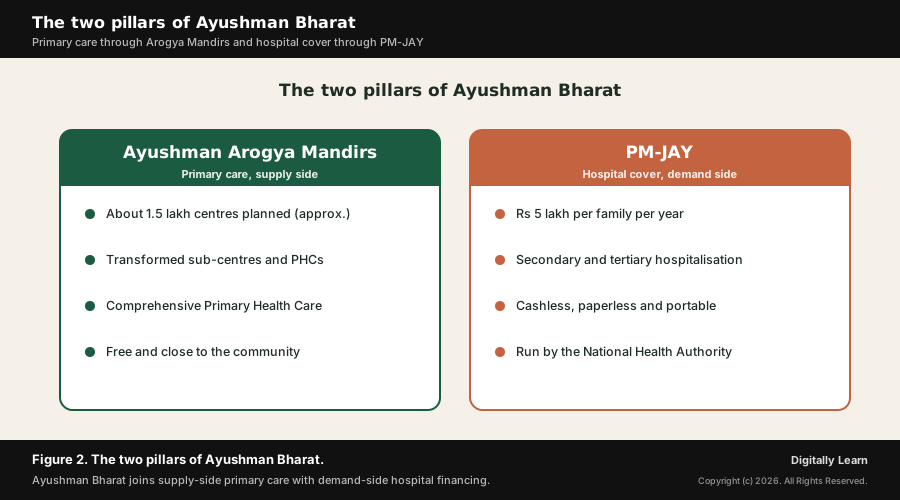
The first pillar of Ayushman Bharat is the Ayushman Arogya Mandirs, the renamed Health and Wellness Centres. They are created by upgrading existing sub-centres and primary health centres into a stronger network that brings care close to where people live, the foundation layer of the public-health system. About 1.5 lakh such centres were planned (the operational count as reported has since risen above that target).
Their purpose is to deliver Comprehensive Primary Health Care, free at the point of use. This goes well beyond the old focus on mother-and-child services to include screening and care for non-communicable diseases such as diabetes, hypertension and cancers, along with mental health, eye, ear, nose, throat and oral care, palliative and rehabilitative care, free essential drugs and basic diagnostics, and first-level emergency care.
This pillar is why Ayushman Bharat is more than an insurance scheme. By strengthening the primary-health structure, it tries to keep people well and to catch illness early and cheaply, near home, rather than waiting for a costly hospital admission. A robust primary tier is the precondition that makes the whole continuum of care, and Universal Health Coverage, workable. The figure below contrasts the two pillars.
Pillar Two: PM-JAY, the Rs 5 Lakh Cover, Eligibility and the National Health Authority
The Rs 5 lakh cover, cashless and portable hospital care
The second pillar, the Pradhan Mantri Jan Arogya Yojana (PM-JAY), is the health-assurance scheme most people mean when they say Ayushman Bharat. It gives each entitled family a cover of Rs 5 lakh per year for secondary and tertiary hospitalisation, that is, for specialist and advanced hospital care, not for routine outpatient visits.
The defining feature is that care is cashless and paperless at the point of treatment. An eligible patient walks into an empanelled hospital, the treatment is approved and paid through the scheme, and the family is not asked for money upfront. The cover is also portable: a beneficiary from one state can be treated at an empanelled hospital in another, which matters greatly for migrant workers far from home.
Hospitals are drawn from both the public and the private sectors through empanelment, so the network reaches beyond the often-stretched government system. Care is delivered against defined treatment packages, each with a fixed rate the scheme will pay, which keeps the public money predictable but, as later sections note, raises its own questions of adequacy and quality.
Eligibility, the SECC database and the National Health Authority
Eligibility for the core scheme is not chosen by the beneficiary but drawn from existing data. Families qualify on the basis of deprivation and occupational criteria taken from the Socio-Economic Caste Census (SECC) 2011 and other notified lists, so the cover is targeted at those identified as poor and vulnerable rather than offered on application to all.
The scheme is implemented by the National Health Authority (NHA) at the centre, working with State Health Agencies that run it on the ground. The NHA sets the rules, manages the IT platform on which claims are processed, and oversees the empanelment of hospitals, while the states adapt and deliver the scheme within their own health systems, a clear instance of cooperative federalism in health.
The Senior-Citizen Extension and the Distinct Ayushman Bharat Digital Mission
Cover for all citizens aged 70 and above, irrespective of income
The 2024 widening of the scheme deserves a closer look because it changes who the State chooses to protect. Until then, PM-JAY was strictly means-tested, reaching only families identified as poor. The extension to all senior citizens aged 70 and above, regardless of income, adds an age-based universal layer on top of the poverty-based core.
In practice this means two routes. A poor senior already inside a PM-JAY family receives an additional top-up of up to Rs 5 lakh reserved for the elderly, so the family's shared cover is not eaten up by one member's illness. A senior in a household above the poverty line, never covered before, gets a fresh Rs 5 lakh family cover. A distinct card identifies these beneficiaries and keeps the new entitlement separate.
The Ayushman Bharat Digital Mission as a separate pillar
It is important not to confuse PM-JAY with the Ayushman Bharat Digital Mission (ABDM), a related but distinct initiative launched in 2021. ABDM is not an insurance scheme at all; it builds the country's digital health backbone, so that records, providers and facilities can be linked securely and with consent.
Its best-known element is the Ayushman Bharat Health Account (ABHA), a unique digital health identity that lets a citizen store and share their medical records across providers. ABDM is a separate pillar of the wider Ayushman Bharat vision: PM-JAY pays for hospital treatment, the Arogya Mandirs deliver primary care, and ABDM digitises the health ecosystem that connects them. Keeping the three distinct is a common point tested in the exam, as the table below sets out.
| Component | What it is | Core function |
|---|---|---|
| Ayushman Arogya Mandirs | Upgraded primary-care centres | Free Comprehensive Primary Health Care close to the community |
| PM-JAY | Health-assurance scheme | Rs 5 lakh family cover for secondary and tertiary hospitalisation |
| Ayushman Bharat Digital Mission | Digital health backbone | The ABHA account and a linked records ecosystem, not insurance |
Impact and Challenges: Out-of-Pocket Costs, Empanelment, Fraud and Access
The financial protection the scheme delivers
The clearest benefit is financial protection. By paying for hospital care that families would otherwise fund from savings, loans or sold assets, PM-JAY is designed to cut catastrophic out-of-pocket health spending, the kind that pushes households into poverty, and reported assessments credit it with reducing such spending among the covered poor.
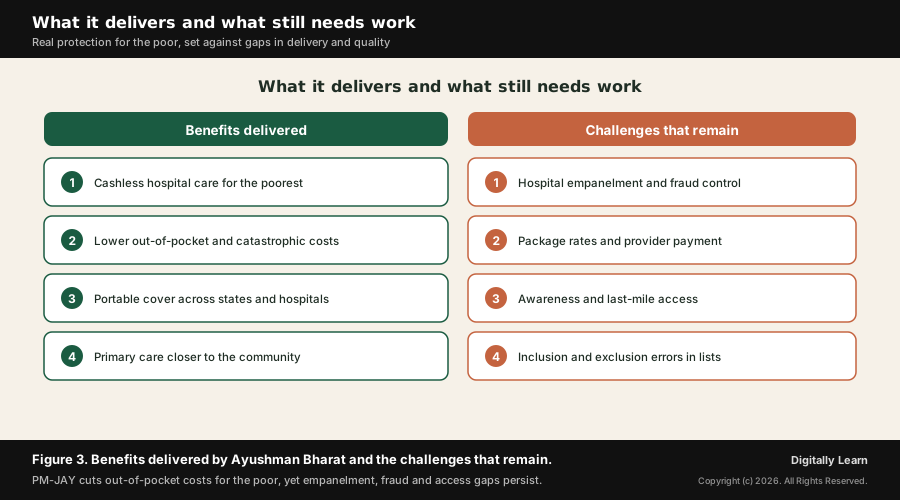
Beyond money, the scheme widens access. Cashless, portable cover lets the poor use private as well as public hospitals, and the Arogya Mandirs bring primary care nearer to home. Together with the senior-citizen extension, this represents a real broadening of the reach of public health to groups the system once served poorly. The figure below pairs the benefits with the challenges.
Empanelment, fraud, package rates and last-mile access
Yet the challenges are real and an honest assessment must weigh them. A recurring concern is empanelment and fraud: getting enough quality private hospitals to join, and policing those that game the system through unnecessary procedures or false claims. The National Health Authority runs a National Anti-Fraud Unit, with hospitals penalised and de-empanelled, but vigilance against abuse is a continuing task.
A second concern is the package rates the scheme pays. If rates are set too low, good hospitals may decline to treat scheme patients or may cut corners; if too high, public money is wasted. Balancing fair provider payment against fiscal limits, while protecting quality of care, is a standing difficulty of any large purchaser of health services.
Other gaps lie in awareness and last-mile access, since the poorest may not know they are eligible or how to use the cover, and in inclusion and exclusion errors in beneficiary lists drawn from older census data, which can leave deserving families out and let others in. There is also a deeper limit: an insurance cover is not the same as health-system capacity.
- (a) Empanelment and fraud. Attracting quality private hospitals while policing unnecessary procedures and false claims is a continuing task.
- (b) Package rates and payment. Rates set too low deter good hospitals or invite corner-cutting; set too high they waste public money.
- (c) Awareness and last-mile access. The poorest may not know they are eligible or how to claim cashless care.
- (d) Inclusion and exclusion errors. Lists drawn from older census data can omit deserving families and admit others.
- (e) Cover is not capacity. Financing hospital care does not, by itself, build the doctors, beds and quality the system still needs.
Reading the gains and the gaps together gives the fair verdict: Ayushman Bharat offers genuine protection to millions who had none, yet the work of empanelment, fraud control, fair rates and building real health-system capacity means the promise of Universal Health Coverage is still some way off.
Ayushman Bharat in Context: SDG 3, Universal Health Coverage and Welfare
How the scheme connects to global goals and Indian welfare
Contemporary linkages tie Ayushman Bharat to wider goals. It is a central plank of India's pursuit of Universal Health Coverage, the principle that all people should get the health services they need without financial hardship, and so of Sustainable Development Goal 3, good health and well-being, with its pledge to leave no one behind.
The scheme connects, too, to the architecture of welfare and Direct Benefit Transfer. The same digital tools and targeting logic that run India's wider welfare state, from cash transfers to ration entitlements, underpin the identification of beneficiaries and the cashless settlement of claims, placing health within a larger system of social protection.
It links as well to the fight against non-communicable diseases. Through the Arogya Mandirs, the State screens for diabetes, hypertension and cancers at the primary level, addressing the growing share of India's disease burden that comes from lifestyle and ageing rather than infection, a shift every health policy now has to face.
Finally, the scheme sits within the debate on health financing itself: whether India should expand a tax-funded assurance model, raise public health spending as a share of national income, and strengthen public hospitals, rather than relying on purchasing care from private providers. Ayushman Bharat is the live test case in that wider argument.
UPSC Relevance and Exam Focus
Where this fits in the UPSC-CSE syllabus
This topic maps most directly to General Studies Paper II: issues relating to health, and government policies and interventions for development in the health sector, with strong links to governance and to welfare schemes for vulnerable sections. It is a ready example for any question on the welfare State, on Universal Health Coverage, or on the State's role in public health.
For Prelims, hold the high-yield facts: Ayushman Bharat, launched in 2018, has two pillars, the Ayushman Arogya Mandirs and PM-JAY; PM-JAY gives a Rs 5 lakh family cover for secondary and tertiary hospitalisation; eligibility draws on the SECC 2011; the National Health Authority implements it; in 2024 cover was extended to all citizens aged 70 and above; and the ABHA digital health account is part of the separate Ayushman Bharat Digital Mission.
For Mains, the recurring framing is the primary-health structure as a moral imperative of the welfare State and a precondition for sustainable development: how a national programme can deliver free primary care and a hospital shield, cut out-of-pocket costs, and reach the poorest at the grassroots. Ayushman Bharat is a strong example of mission-mode public health to use in any health or governance answer.
Recurring linked concepts an aspirant should keep in working memory:
- Universal Health Coverage: Ensuring all people can use the health services they need without financial hardship, the wider goal Ayushman Bharat serves.
- Out-of-pocket expenditure: The share of health costs paid directly by households, which PM-JAY is designed to reduce for the poor.
- Comprehensive Primary Health Care: The expanded, free primary-care package delivered through the Ayushman Arogya Mandirs.
- Cooperative federalism: The centre-state sharing of design and delivery, with the NHA and State Health Agencies running the scheme together.
A common Prelims trap is to confuse PM-JAY with the Ayushman Bharat Digital Mission, or the Arogya Mandirs with PM-JAY. PM-JAY is the hospital-cover scheme, the Arogya Mandirs deliver primary care, and the ABHA account belongs to the separate digital mission. Another trap is to treat the senior-citizen cover as means-tested; since 2024 it reaches all citizens aged 70 and above, irrespective of income.
A common Mains trap is to praise the scheme without testing it. Its exam value lies in a balanced judgment: the genuine financial protection and the model of welfare-State public health, set honestly against empanelment and fraud risks, package-rate and quality concerns, beneficiary-list errors, and the gap between an insurance cover and real health-system capacity.
Previous Year UPSC-CSE Questions By the end you will be able to draft model answers for the following UPSC questions. Each question carries a collapsible framework showing how to approach it in the exam.
- UPSC Mains 2021 GS-II“Besides being a moral imperative of a Welfare State, primary health structure is a necessary precondition for sustainable development.” Analyze.
How to structure the answer in the exam
Body (sub-themes to develop):
- Primary health structure as a moral imperative of the welfare State: free, accessible primary care treats health as a right of citizenship, not a market privilege, and counters the catastrophic out-of-pocket spending that impoverishes the poor; the Ayushman Arogya Mandirs deliver Comprehensive Primary Health Care free and close to communities.
- Primary health structure as a precondition for sustainable development: a healthy population is the foundation of productivity and human capital, so investment in primary care underpins long-run growth and reduces the development losses caused by preventable illness.
- How the structure is built and financed: upgrading sub-centres and primary health centres into Arogya Mandirs (supply side) and adding a Rs 5 lakh hospital shield through PM-JAY (demand side), implemented through cooperative federalism by the National Health Authority and State Health Agencies.
- Link to global goals and equity: the effort advances Universal Health Coverage and Sustainable Development Goal 3, with the senior-citizen extension widening the State's promise to the elderly irrespective of income.
- A balanced judgment: acknowledge the gaps, empanelment and fraud risks, package-rate and quality concerns, beneficiary-list errors, and the gap between an insurance cover and real health-system capacity, so that the primary-health structure can actually deliver on its moral and developmental promise.
Sources and Further Reading
- National Health Authority: About Pradhan Mantri Jan Arogya Yojana (PM-JAY)
- Press Information Bureau: Transforming Healthcare, Six Years of Ayushman Bharat PM-JAY
- Press Information Bureau: Cabinet approves health coverage to all senior citizens aged 70 and above under AB PM-JAY
- Ministry of Health and Family Welfare: Update on Ayushman Arogya Mandir
- Press Information Bureau: Ayushman Bharat Digital Mission marks a transformative three-year journey
- Ministry of Health and Family Welfare: Steps taken by the Government to reduce Out-of-Pocket Health Expenditure
- NITI Aayog: Health Insurance for India's Missing Middle (PM-JAY, the largest government health-protection scheme)
- World Health Organization: Universal Health Coverage (UHC)
- Wikipedia: Ayushman Bharat Yojana
Editorial Disclaimer
This briefing is for UPSC preparation. Beneficiary, family and centre numbers are stated as reported and approximate; verify the figures and scheme details against the official NHA, MoHFW and PIB sources before relying on them.


