

Overview
Caste enumeration in the Census means counting the caste of every individual during India's regular decadal headcount, the Census of India. In April 2025 the Union Cabinet decided to include such enumeration in the upcoming Census 2027, the first time since Independence that caste, beyond the Scheduled Castes and Scheduled Tribes that have always been counted, will be recorded for all individuals in the main Census. Detailed caste data for the whole population was last gathered in the 1931 Census, after which the regular Census stopped counting other castes. The Census is a Union subject, conducted under the Census Act, 1948 by the Office of the Registrar General and Census Commissioner of India, with individual records protected by law. The decision has reopened a long debate, with arguments both for and against, over whether counting caste serves social justice or hardens caste identity.
The Cabinet Decides to Enumerate Caste in the Census of India
A decision to count caste in the regular Census
India has decided to count caste in its regular national headcount for the first time since Independence. In April 2025 the Union Cabinet, through the Cabinet Committee on Political Affairs, decided to include caste enumeration in the upcoming decadal Census, the Census of India. Until now the regular Census has recorded only the Scheduled Castes and Scheduled Tribes, the groups named in the Constitution, and not the wider field of castes across the population.
The Government chose to carry the count in the main Census rather than as a separate survey. The stated reason was to keep the exercise within the Census's tested machinery and legal protections, so that the social fabric is not, in the Government's words, placed under outside pressure. Caste data will be gathered alongside the rest of the Census questions rather than through a parallel exercise.
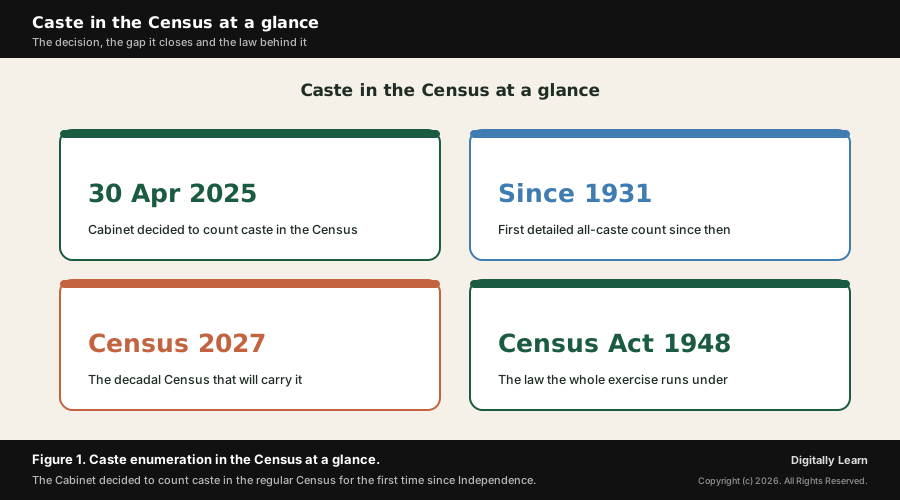
This marks a clear break from the practice of the past seven decades. Caste, beyond the Scheduled Castes and Scheduled Tribes, has not been counted for all individuals in the regular Census since the colonial era, so the decision returns a question to the schedule that has been absent from it since Independence. The figure below sets out the change at a glance.
Why Caste Enumeration Is in the News: Census 2027 and a First Since 1931
The first such count in the Census since Independence
Why it matters now is that the decision attaches to a live exercise, Census 2027, which has already been notified. The reference date for most of the country is the first day of March 2027, while for Ladakh and the snow-bound areas of Jammu and Kashmir, Himachal Pradesh and Uttarakhand it is the first day of October 2026. The count of caste will therefore happen on a fixed and near horizon, not as a distant promise.
The change is historic because detailed caste data for the whole population was last collected in the 1931 Census. For more than ninety years, policy that turns on caste has leaned on those colonial-era figures or on estimates drawn from them. A fresh, official count in the regular Census is what makes the decision so closely watched across politics, administration and the social-justice debate.
Understanding the Significance of Caste Enumeration for India
Data for policy and a reopened debate on caste
What is the significance of caste enumeration lies first in the data it would create. Proponents argue that welfare schemes, scholarships and reservation policy presently rest on dated or estimated figures, and that an official count would let the State target benefits and measure deprivation with far greater accuracy. In a country whose social policy is organised around caste groups, better numbers are, on this view, the foundation of fairer policy.
Its second significance is political and social. The decision speaks directly to the demand for proportional representation and to the question of whether existing reservation matches the size of the groups it serves. Supporters frame it as a step towards social justice, while critics fear it could sharpen caste consciousness.
Backed by the authority of the Census, the count carries weight that surveys do not. That same authority is why the decision is contested: a figure produced by the Census becomes a settled fact in public life, and both sides understand that what is counted shapes what is claimed, which is why the move is read as much as a political event as a statistical one.
The History of Caste in the Indian Census, from the Colonial Counts to SECC 2011
The colonial caste censuses and the 1931 count
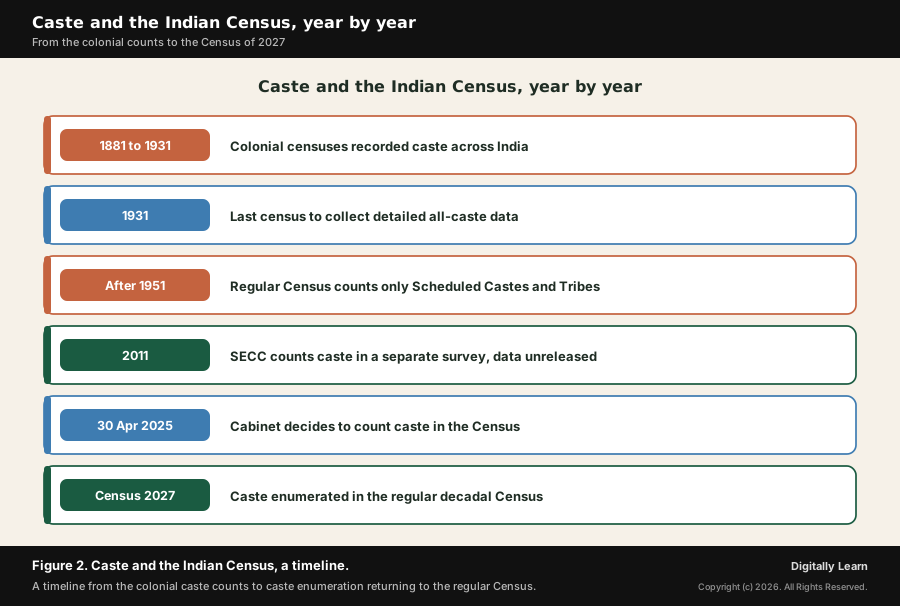
Caste counting in India began under colonial rule. From the late nineteenth century, the censuses of British India recorded caste alongside religion and occupation, and successive enumerators tried to list and even rank the many castes of the subcontinent. The exercise was vast and contested, and the act of classifying castes itself shaped how people understood their own place in the order.
The 1931 Census was the last in which detailed caste-wise data for the whole population was collected. It recorded thousands of distinct castes, and its figures became the standard reference for caste numbers in India. The 1941 Census, taken during the Second World War, gathered some caste information but did not publish it in the same detailed form.
Because the 1931 figures were the last complete set, they cast a long shadow. The Mandal Commission, which in 1980 recommended reservation for the Other Backward Classes, had no fresh national count of those groups and leaned on the 1931 data, extrapolated with sample studies, to estimate their share. The absence of newer numbers is central to the present demand for a fresh count.
Why the regular Census stopped counting caste after 1951
After Independence, the Government decided that the regular Census would no longer enumerate caste for the general population, and would record only the Scheduled Castes and Scheduled Tribes. The Census of 1951, the first of the republic, set this pattern, and every decadal Census since has followed it.
The choice reflected the outlook of the time. Counting caste was seen by many in the early republic as reinforcing a hierarchy the new nation hoped to move beyond, and as inviting division rather than the unity the Constitution sought. So the State counted the groups it was constitutionally bound to protect, the Scheduled Castes and Tribes, and left the wider field of castes uncounted.
That settled practice is exactly what the 2025 decision reverses. For seventy years the regular Census has carried no all-caste count, which is why a decision to add one is treated not as a routine change to a questionnaire but as a shift in how the State chooses to see its own society.
The Socio-Economic and Caste Census of 2011
There was one major attempt in between. The Socio-Economic and Caste Census (SECC) of 2011 set out to gather caste data along with social and economic detail, and it was the first caste count of any kind since 1931. Crucially, it was conducted as a separate survey, run outside the regular Census and not under the same legal framework.
Its caste data, however, was never released in usable form. The Government cited problems of classification: the survey had thrown up an unmanageable number of caste names, synonyms and spellings, which could not be reconciled into a clean, reliable count. The social and economic findings of the SECC were used for welfare targeting, but the caste tables were not published.
The SECC experience frames the present decision in two ways. It shows both the strong demand for caste data and the real difficulty of collecting it, and it explains the Government's choice to place the 2027 count inside the main Census, under the Census Act, rather than in another standalone survey. The table below contrasts the three landmark efforts to count caste.
| Exercise | Nature | What happened to the caste data |
|---|---|---|
| 1931 Census | Part of the regular colonial Census | Detailed all-caste data collected and published; still the standard reference |
| SECC 2011 | A separate survey outside the Census Act | Caste data not released in usable form, owing to classification problems |
| Census 2027 | Caste counted in the main Census under the Census Act | Caste to be enumerated for all individuals in the Population Enumeration phase |
Read across the rows, the contrast is clear: the strength of the 2027 approach is that it returns caste to the main Census and its legal framework, rather than to a parallel survey whose caste tables, as in 2011, may never see the light of day. The timeline below traces this whole arc.
How the Indian Census Works: The Census Act, the Registrar General and the Process
A Union subject under the Census Act, 1948
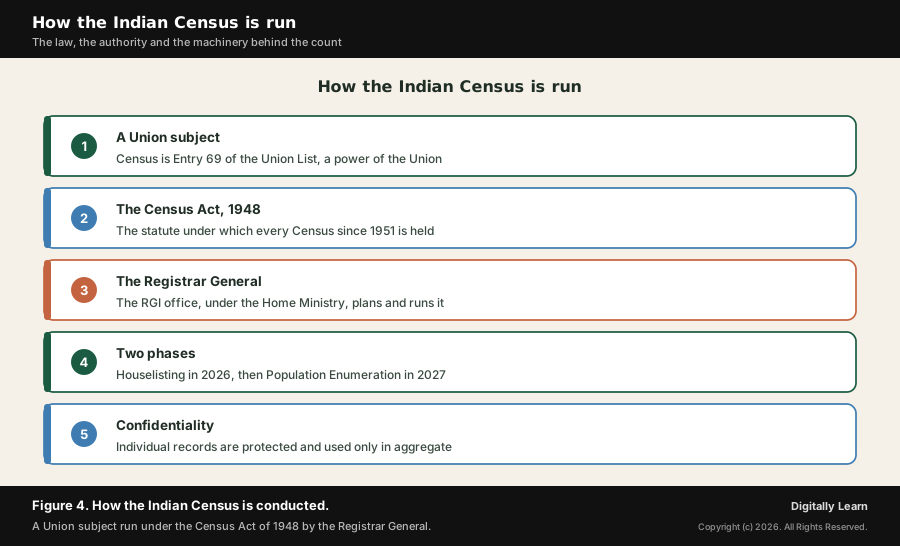
The Census is, in constitutional terms, a Union subject. It appears as Entry 69 of the Union List in the Seventh Schedule of the Constitution, which means the power to legislate on and to conduct the Census rests with the Union, not the States. This is why a national caste count in the Census is a decision of the Union Government.
Every Census since 1951 has been held under the Census Act, 1948. The Act provides the legal basis for the count, lays down the duties of census officers, makes it an offence to refuse to answer or to give false information, and, importantly, protects the confidentiality of the individual records, which may be used only to produce aggregate statistics and are not open to inspection.
The exercise is run by the Office of the Registrar General and Census Commissioner of India, the RGI, which works under the Ministry of Home Affairs and is the nodal authority for the decennial Census. Field operations are carried out through Directors of Census Operations in the States and Union Territories, with lakhs of enumerators reaching every household.
The two phases and where caste fits in
Census 2027 is being conducted in two phases. The first is the Houselisting and Housing Census, scheduled across 2026, which records buildings, households and their amenities. The second is the Population Enumeration, scheduled for early 2027, in which the personal particulars of every individual are recorded, and it is here that caste is to be captured.
Census 2027 is also planned as India's first digital Census, with data collected on mobile devices and an option for households to fill the form themselves, which the Government expects to speed up processing and release. The notification for the Census was issued under the Census Act well ahead of the count, as the law requires.
Placing caste in the main Census rather than a separate survey is the central design choice. It means the count carries the legal force and confidentiality of the Census Act, draws on the Census's established field machinery, and produces a single, official dataset rather than a parallel one. The figure below sets out how the Census is run.
The Debate over Caste Enumeration: The Arguments For and the Concerns Against
The case made by those who support enumeration
Those who support the count make several connected arguments. The first is evidence-based policy: they hold that welfare schemes, scholarships and budgets should be set against actual numbers, and that an official count would let the State target benefits and measure backwardness far more accurately than dated estimates allow.
A second argument concerns the Backward Classes. Supporters point out that, unlike the Scheduled Castes and Tribes, the Other Backward Classes have not been officially counted in the regular Census since 1931, so the reservation and welfare extended to them rest on estimates rather than a current figure. A fresh count, they argue, would put that policy on firmer ground.
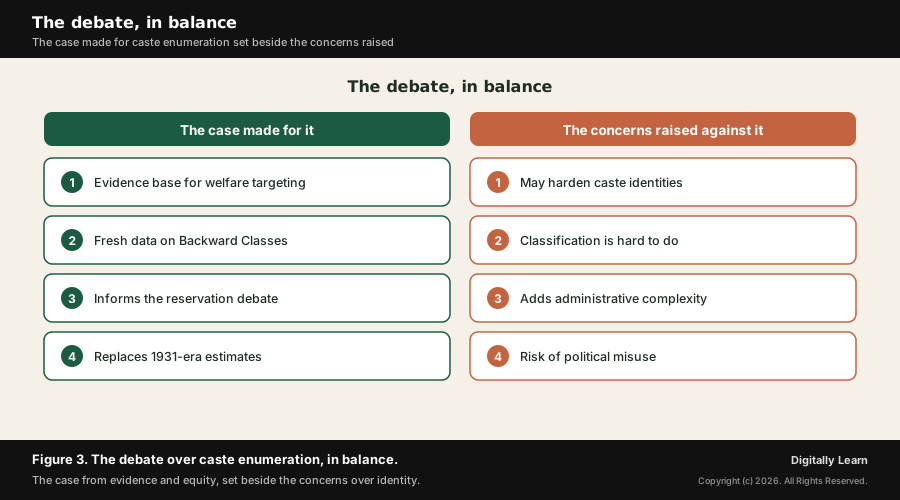
A third argument is one of social justice and representation. Proponents frame the count as a tool to reveal which groups remain under-represented in education, employment and public life, and so to inform the wider debate on equity. The figure below sets the case for the count beside the concerns raised against it.
- Evidence-based welfare: Accurate, current numbers would let the State target benefits and measure deprivation more precisely.
- Data on the Backward Classes: The Other Backward Classes have not been officially counted since 1931, so policy for them rests on estimates.
- Social justice and representation: A count could reveal under-representation and inform the equity debate.
- Replacing 1931-era figures: Fresh data would retire the colonial-era estimates that policy still leans on.
The concerns raised by those who are critical
Critics raise concerns of their own, which a balanced reading must weigh fairly. The most-cited is the fear that an official count could harden caste identities: by recording and tabulating caste for everyone, the State may, on this view, entrench and even sharpen a division that policy elsewhere hopes to dissolve.
A second concern is methodological. India has thousands of castes, sub-castes, synonyms and regional spellings, and, as the 2011 SECC showed, reconciling them into a clean and accurate count is genuinely hard. Critics warn that an inaccurate count could mislead policy rather than improve it, and that the administrative burden is heavy.
A further set of concerns is about use and privacy. Critics fear the data could be put to political use, deepening caste-based mobilisation, and they raise questions about the privacy of recording each person's caste, even though the Census Act protects individual records. Both sets of arguments, for and against, are set out below.
- Hardening of identity: Counting caste for all may entrench and sharpen caste consciousness rather than dissolve it.
- Classification difficulty: Thousands of castes, sub-castes and synonyms make an accurate count technically hard, as the 2011 SECC showed.
- Administrative complexity: The scale and accuracy demands add a heavy operational burden to the count.
- Political misuse and privacy: The data could deepen caste-based mobilisation, and recording each person’s caste raises privacy questions.
Set against each other, the two sides reflect a genuine tension rather than a simple right and wrong. The balanced view, and the one an exam answer should reach, is that the value of the count will depend on how accurately it is done and how responsibly its results are used, a judgment that the article leaves open rather than settling for either camp.
The reservation and the fifty-per-cent-ceiling context
The debate is bound up with India's framework of reservation. Caste-based reservation for the Scheduled Castes, Scheduled Tribes and Other Backward Classes is a central instrument of social justice, and the size of each group is directly relevant to how that reservation is justified and demanded.
A key legal backdrop is the fifty-per-cent ceiling. In the Indra Sawhney judgment of 1992, the Supreme Court upheld reservation for the Other Backward Classes while ruling that total reservation should ordinarily not exceed fifty per cent. Demands to raise or rework reservation, and arguments about proportional representation, often turn on what an accurate caste count would show, which is part of why the count is so contested.
Several States have, in recent years, conducted their own caste surveys to fill the data gap. These state-level exercises sit alongside the national decision and feed the same debate, though their figures and methods have themselves been contested. A national count in the Census is, in part, a response to this patchwork of state surveys.
Caste Enumeration in Context: Social Justice, Data for Policy and Federalism
How the decision connects to wider themes in governance
Contemporary linkages place the decision within several wider currents. The clearest is the theme of data for policy: the modern State increasingly governs through numbers, and the count belongs to a broader push for evidence-based welfare in which schemes are designed and measured against hard data rather than assumption.
It connects, too, to the long arc of social justice in India, from the constitutional provisions for the Scheduled Castes, Tribes and Backward Classes to the reservation framework and the work of bodies such as the National Commission for Backward Classes. The count is read as the next move in that arc, supplying the numbers on which that machinery turns.
There is a federal dimension as well. Although the Census is a Union subject, several States have run their own caste surveys, and the relationship between a national count and these state exercises raises questions of data, jurisdiction and the sharing of findings between the Union and the States.
- Data for policy: The count belongs to the wider shift towards evidence-based, numbers-driven welfare governance.
- Social-justice framework: It links to constitutional protections, the reservation system and bodies for the Backward Classes.
- Federalism: The Census is a Union subject, yet several States run their own caste surveys, raising questions of jurisdiction and data-sharing.
- Identity and nation-building: It revives the old question of whether the State should count caste at all, set against the goal of a casteless ideal.
It sits, finally, within the enduring question of caste and modern India. Caste has neither disappeared nor stayed fixed: it has taken new associational and political forms even as old hierarchies have weakened. The decision to count it is, in that sense, an admission that caste remains a live force in Indian society that the State must reckon with through data and policy.
UPSC Relevance and Exam Focus
Where this fits in the UPSC-CSE syllabus
This topic maps most directly to General Studies Paper I: salient features of Indian society, diversity, and social empowerment, where caste, its persistence and its changing forms are core themes. It also reaches into General Studies Paper II, under governance, the welfare of vulnerable sections, and the bodies and policies built around social justice and reservation.
For Prelims, hold the high-yield facts: caste enumeration is being added to Census 2027; the last detailed all-caste count was the 1931 Census; the regular Census after 1951 records only the Scheduled Castes and Tribes; the SECC of 2011 was a separate survey whose caste data was not released; the Census is a Union subject under the Census Act, 1948, run by the Registrar General of India.
For Mains, the recurring framing is to weigh the count as a tool of social justice against the risk of hardening caste identity, and to assess the value of caste data for evidence-based policy. A strong answer is balanced: it presents the arguments for and against fairly, attributes them, and judges the move on the accuracy of the count and the use of its results rather than taking a political side.
Recurring linked concepts an aspirant should keep in working memory:
- The 1931 Census: The last census with detailed all-caste data, still the reference behind many caste estimates.
- SECC 2011: The separate Socio-Economic and Caste Census whose caste data was not released, owing to classification problems.
- Census Act, 1948: The law under which the Census is conducted, with confidentiality of individual records.
- Indra Sawhney and the fifty-per-cent ceiling: The 1992 judgment that upheld OBC reservation and capped total reservation.
A common Prelims trap is to confuse the SECC of 2011 with the regular Census. The SECC was a separate survey outside the Census Act; the 2027 exercise places caste inside the main Census itself, which is the key distinction.
A common Mains trap is to argue only one side. The exam value of this topic lies in a balanced judgment: the genuine case for better social-justice data, set honestly against the concern that counting caste may entrench it, with no fabricated figures and no political position taken.
Previous Year UPSC-CSE Questions By the end you will be able to draft model answers for the following UPSC questions. Each question carries a collapsible framework showing how to approach it in the exam.
- UPSC Mains 2018 GS-IComment on whether caste, assuming new identities and associational forms, can be eradicated in India.
How to structure the answer in the exam
Body (sub-themes to develop):
- New identities and associational forms: caste today appears less as a ritual hierarchy and more as political mobilisation, caste associations, reservation blocs and demands for proportional representation, all of which the count speaks to.
- Forces that entrench caste: reservation and welfare organised around caste groups, electoral mobilisation, and state acts such as enumeration that record and tabulate caste, which critics fear may harden identity.
- Forces that weaken caste: urbanisation, education, inter-group mobility and the constitutional ideal of a casteless, equal society that led the early republic to stop counting caste after 1951.
- The enumeration debate as a test case: the arguments that counting caste serves evidence-based social justice, set against the concern that it deepens caste consciousness, illustrating why eradication is contested.
- A reasoned judgment: caste is unlikely to be eradicated in the near term because it is embedded in politics, policy and identity, but its forms are changing, and how the State counts and uses caste data will shape whether it hardens or eases.
Sources and Further Reading
- Press Information Bureau: Cabinet approves Caste enumeration in the upcoming Census
- Press Information Bureau: Population Census-2027 to be conducted in two phases along with enumeration of castes
- Press Information Bureau: Cabinet approves scheme of Conduct of Census of India 2027
- Ministry of Home Affairs: Registrar General and Census Commissioner, India
- Census of India (Office of the Registrar General): official portal
- Department of Social Justice and Empowerment: Welfare of the Other Backward Classes
- National Portal of India: Census of India 2027
- Wikipedia: Caste census
- Wikipedia: 2011 Socio Economic and Caste Census
- Wikipedia: Mandal Commission
- Wikipedia: Indra Sawhney and Others v. Union of India
Editorial Disclaimer
This briefing is for UPSC preparation. Verify the dates and provisions against the official PIB, Census of India and Ministry of Home Affairs sources before relying on them.