

Overview
The LaQshya programme (Labour Room Quality Improvement Initiative) is a programme of the Ministry of Health and Family Welfare that improves the quality of care in the labour rooms and maternity operation theatres of public health facilities. The Ministry launched it on 11 December 2017 under the National Health Mission. It concentrates on care during labour and in the hours just after birth, the period known as intrapartum and immediate postpartum care. Its goal is to reduce preventable maternal and newborn deaths, illness and stillbirths linked to that care, and to give every woman respectful maternity care. A labour room or maternity operation theatre that meets the National Quality Assurance Standards (NQAS) is certified as a LaQshya facility.
Why Care at Childbirth Needs a Quality Programme
Deaths Concentrated Around the Day of Delivery
Institutional deliveries rose substantially after the launch of the National Health Mission (NHM), but the key maternal and newborn health indicators did not improve in proportion. About 46 per cent of maternal deaths, over 40 per cent of stillbirths and 40 per cent of newborn deaths are estimated to take place on the day of delivery. The risk is therefore concentrated in a few hours and in one place, the labour room and the maternity operation theatre.
Deliveries in institutions are now the norm. In the National Family Health Survey (NFHS), the share of institutional births rose from 78.9 per cent in NFHS‑4 (2015‑16) to 88.6 per cent in NFHS‑5 (2019‑21) and 90.6 per cent in NFHS‑6 (2023‑24). Caesarean births rose over the same rounds, from 17.2 per cent in NFHS‑4 to 27.2 per cent in NFHS‑6.
More medically assisted deliveries and better post-natal care are among the changes that have brought maternal and infant mortality rates down. When nine in ten births happen in a facility, the quality of care in that facility decides most of the outcome. A woman who reaches a hospital still faces haemorrhage, eclampsia or infection if the staff, drugs and protocols are not ready.
Maternal Mortality Ratio: Trend and the SDG Target
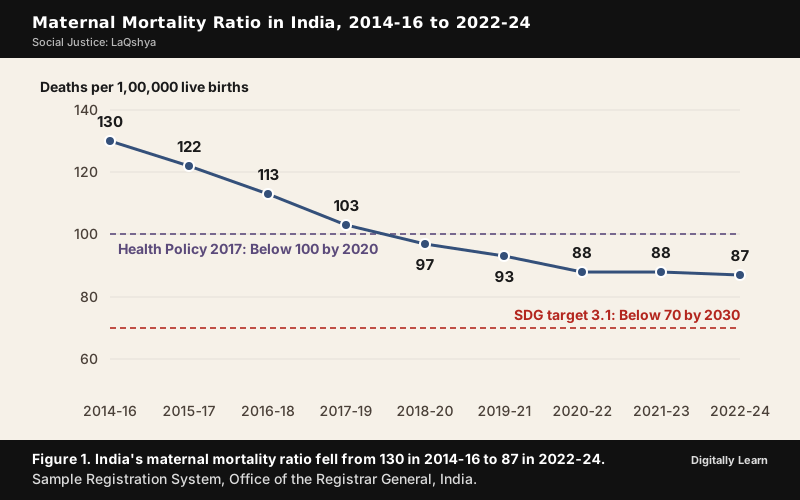
India's maternal mortality ratio has fallen steadily. Sample Registration System estimates put it at 301 in 2001‑03 and 167 in 2011‑13. It then fell from 130 in 2014‑16 to 97 in 2018‑20 and 88 in 2020‑22, stayed at 88 in 2021‑23 and reached 87 in 2022‑24, the latest estimate, published in May 2026. The ratio is estimated over three pooled years because maternal deaths are rare events that need a very large sample.
Two targets frame this trend. The National Health Policy, 2017, set a target of an MMR below 100 by 2020, which India has met. Target 3.1 of the Sustainable Development Goals (SDG) aims to reduce the global ratio to less than 70 per 1,00,000 live births by 2030. The national average hides wide gaps between regions and States, from 154 in Uttar Pradesh to 24 in Kerala among the larger States in 2022‑24.
| State group or State | MMR 2022‑24 |
|---|---|
| India | 87 |
| Empowered Action Group States and Assam | 116 |
| Southern States | 41 |
| Other States | 75 |
| Uttar Pradesh (highest among the larger States) | 154 |
| Madhya Pradesh | 135 |
| Tamil Nadu | 25 |
| Kerala (lowest among the larger States) | 24 |
Goal, Objectives and Coverage of LaQshya
LaQshya Goal and Its Three Objectives
The goal of LaQshya is to reduce preventable maternal and newborn mortality, morbidity and stillbirths associated with care around delivery in the labour room and maternity operation theatre, and to ensure respectful maternity care. The guidelines turn this goal into three objectives:
- Fewer deaths from known complications: To reduce maternal and newborn deaths and illness due to antepartum haemorrhage (APH), postpartum haemorrhage (PPH), retained placenta, preterm birth, preeclampsia and eclampsia, obstructed labour, puerperal sepsis, newborn asphyxia and newborn sepsis.
- Better care at and after delivery: To improve the quality of care during delivery and the immediate postpartum period, stabilise complications, ensure timely referral and keep an effective two-way follow-up system.
- Satisfied and respected mothers: To raise the satisfaction of women who use public health facilities and provide respectful maternity care to every pregnant woman who attends them.
The programme also strengthens critical care for complicated pregnancies. Dedicated obstetric intensive care units (ICUs) are run at medical college hospitals and obstetric high dependency units (HDUs) at district hospitals. By March 2023, 283 obstetric HDUs and ICUs had been approved in high caseload tertiary care facilities across the country.
Facilities Covered Under LaQshya
LaQshya works in the public facilities that handle the largest caseloads and the complicated pregnancies. The guidelines give priority to four kinds of public facility:
- Medical colleges: All government medical college hospitals.
- District hospitals: All district hospitals and equivalent health facilities.
- First Referral Units: All designated First Referral Units (FRUs).
- High caseload Community Health Centres (CHCs): Those with over 100 deliveries a month, or over 60 a month in hill and desert areas.
In its operational guidance of February 2018, the Ministry asked each State to select 25 to 35 per cent of its districts, including every district that NITI Aayog lists as an Aspirational District. In each selected district two facilities were to be chosen, preferably the district hospital and one FRU, sub-district hospital or high caseload CHC, and every medical college was taken up in addition. The guidance note asked States to be selective, because the programme depends on intensive work in each chosen labour room.
Strategies and Interventions in the Labour Room
Structural Improvement: Space, Staff, Equipment and Drugs
LaQshya uses a multi-pronged strategy that begins with the structure of care. The labour room and maternity operation theatre are reorganised in layout and workflow in line with the Labour Room Standardisation Guidelines and the Maternal and Newborn Health Toolkit of the Ministry. The structural work brings infrastructure up to the prescribed norms for the actual caseload, adds staff and raises their skills, provides functional and calibrated equipment, and strengthens the supply chain so that drugs and consumables stay in stock.
Staffing has a fixed floor. The guidelines set minimum staff for labour rooms by monthly caseload, and a facility with labour-delivery-recovery units (rooms in which a woman labours, delivers and recovers) needs four staff nurses for each unit, one for each shift and one as back-up. Staff posted in the labour room are not to be rotated out of it, and all normal deliveries in a district hospital are to be conducted by staff nurses, with obstetricians and anaesthetists on call. All labour room staff of LaQshya facilities were to complete skills-laboratory training, under the Ministry's Dakshata or Daksh programmes, within six months, and their skills are tested through an objective structured clinical examination.
Process Improvement and Clinical Protocols
Process improvement changes what the staff do at each step of a delivery. The guidelines list assessment and triage on arrival, management of labour including active management of the third stage of labour, management of complications and high-risk pregnancies, referral, perioperative care for caesarean section, newborn care and resuscitation, and sensitisation of staff on respectful care. Several tools support these steps:
- Checklists and records: The safe birth checklist in the labour room, the surgical safety checklist in the theatre, and a real-time partograph (a chart of the progress of labour), with a move to the electronic partograph.
- Audits: A facility-level audit of every maternal and neonatal death, stillbirth and maternal near miss, and an audit of caesarean sections so that they are done only on sound clinical grounds.
- Feedback: The views of women collected through the Mera-Aspataal system, manual records or a grievance help desk.
- Quality tools: Plan-Do-Check-Act cycles, root cause analysis, run charts, Pareto charts and mistake-proofing.
The improvement work runs as six rapid improvement cycles of two months each, one month to roll out a theme and one to sustain it. The six themes are taken in this order:
- Real-time partograph, the safe birth and surgical safety checklists, and better records.
- A birth companion during delivery, respectful maternity care and patient satisfaction.
- Assessment, triage and timely management of complications, with stronger referral protocols.
- Management of labour by protocol, including active management of the third stage and rational use of oxytocin, since shortening labour with oxytocic drugs without clinical need disturbs the natural hormones of labour.
- Essential and emergency care of newborns and preterm babies, including care of newborn asphyxia and early breastfeeding.
- Infection prevention, including biomedical waste management.
Respectful Maternity Care in the Labour Room
Respectful maternity care means care that respects a woman's autonomy, dignity, feelings, privacy and choices, keeps her free from ill-treatment and coercion, and considers her preferences, including the option of a companion. Women in labour often meet rudeness or neglect in health facilities, which is why the guidelines make respect a part of care. Respectful care also supports good outcomes for mother and child, including the later cognitive development of the baby.
| Practice | Do | Do not |
|---|---|---|
| Privacy and dignity | Give privacy during labour through a separate labour room or at least a private cubicle | Abuse a woman verbally or physically |
| Companion and position | Allow a birth companion and let the woman choose a comfortable birthing position (squatting, standing) | Insist on the conventional lithotomy position for delivery |
| Clinical practice | Follow clinical protocols for routine care and procedures; use labour beds instead of tables | Induce or augment labour without sound clinical indications |
| Care of the newborn | Place the baby on the mother's abdomen and start breastfeeding within one hour of birth | Clamp and cut the cord immediately or separate the baby from the mother |
The guidelines also forbid out-of-pocket spending by families on drugs and diagnostics, and any demand by staff for payment to celebrate the birth of a baby.
Institutional Arrangement and Phases of LaQshya
Quality Structures from National to Facility Level
LaQshya runs through the quality assurance bodies that the National Health Mission had already created, and adds a group at each level to drive the work. The Maternal Health Division of the Ministry coordinates the programme with support from the Child Health Division and the National Health Systems Resource Centre (NHSRC), which coordinates quality certification.
| Level | Quality structure | Quality driver under LaQshya |
|---|---|---|
| National | Central Quality Supervisory Committee | National Mentoring Group |
| State | State Quality Assurance Committee (SQAC) | State Mentoring Group, chaired by the Mission Director of the NHM |
| District | District Quality Assurance Committee | Coaching team |
| Facility | Quality team, headed by the Medical Superintendent or facility in-charge | Quality circle for the labour room and the operation theatre |
The quality circle, the working unit of the programme, is an informal group of the gynaecologist, paediatrician, matron, nursing staff and support staff of a labour room, with an anaesthetist added in the operation theatre. It checks adherence to protocols, assesses the department against NQAS checklists, plans the closure of gaps and runs the improvement cycles. The district coaching team, an external multidisciplinary team, visits the quality circles every month, gives hands-on training and verifies the indicators they report.
Four Phases of Implementation and Time-Bound Targets
LaQshya was designed as a fast-track programme meant to show tangible results within 18 months, in four phases:
- Preparatory phase (2 months): Launch, formation of the National Mentoring Group and the State Mentoring Groups, listing of facilities, training of quality coaches and formation of quality circles.
- Assessment phase (2 months): Baseline assessment of labour rooms and theatres against NQAS, gap analysis, action plans, and funds sought through the State's NHM Programme Implementation Plan.
- Improvement phase (12 months): The six rapid improvement cycles, standard operating procedures, monthly coaching visits and analysis of patients' feedback.
- Evaluation phase (2 months): Evaluation of quality indicators, external assessment and certification, and awards to the best quality circles and coaching teams.
The targets were staged in the same way. Within 8 months, 50 per cent of deliveries were to take place with a birth companion present and 60 per cent were to use the safe birth checklist and a real-time partograph. Within 12 months, the guidelines sought a 30 per cent fall in deaths from APH and PPH and from preeclampsia and eclampsia, a 20 per cent fall in the stillbirth rate, and 80 per cent of beneficiaries satisfied or highly satisfied. The long-term target, within 18 months, was quality certification of 60 per cent of labour rooms against NQAS. After 18 months the programme was to continue through sustained mentoring.

LaQshya Certification Under NQAS
NQAS Assessment and LaQshya Certification Criteria
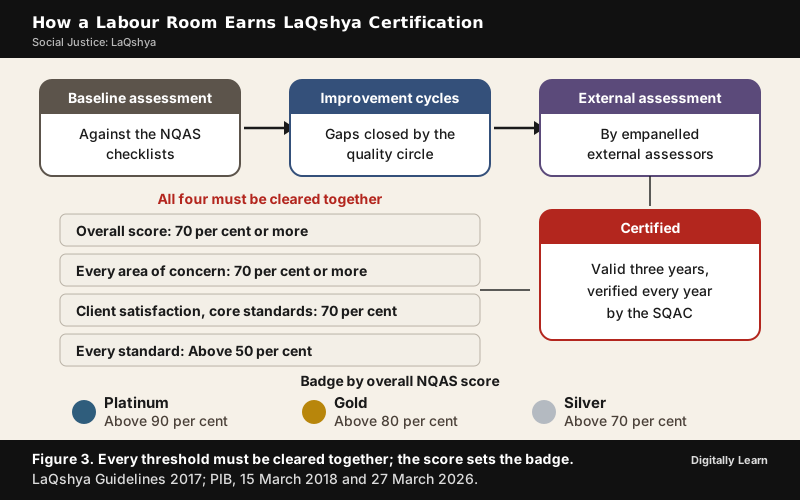
The National Quality Assurance Standards (NQAS) are the Ministry's standards for the quality of care in public health facilities, and LaQshya uses their labour room and maternity operation theatre checklists as its assessment tools. The assessment covers over 200 measurable elements across 70 standards, grouped into eight areas of concern: Service Provision, Patient Rights, Inputs, Support Services, Clinical Care, Infection Control, Quality Management and Outcome. External assessors empanelled with NHSRC carry out the assessment.
A facility is certified only if it clears several thresholds at once:
- Overall score: At least 70 per cent for both the labour room and the maternity operation theatre.
- Each area of concern: At least 70 per cent in every one of the eight areas.
- Client satisfaction and core standards: At least 70 per cent in client satisfaction and in the core standards on privacy, confidentiality and dignity and on care during delivery.
- Each standard: More than 50 per cent in every individual standard.
Certification is valid for three years, subject to annual verification of the scores by the State Quality Assurance Committee. As on February 2026, 151 labour rooms and 107 maternity operation theatres had undergone recertification.
Badges, Incentives and Their Conditions
Certification brings recognition and an incentive grant. The recognition gives the staff pride in their work and gives the community confidence in public hospitals. A certified department may be given a badge, the LaQshya Medal, matching its NQAS score: Platinum for a score above 90 per cent, Gold for above 80 and up to 90 per cent, and Silver for above 70 and up to 80 per cent. Care providers wear the badge and the hospital displays it.
Certified departments can also receive an incentive of ₹6 lakh for each department in a medical college, ₹3 lakh in a district hospital and ₹2 lakh in a sub-district hospital or CHC. It is paid only when three conditions are met together: NQAS certification of the labour room or theatre, attainment of at least 75 per cent of the facility-level targets as verified by the State Quality Assurance Committee, and at least 80 per cent of beneficiaries satisfied or highly satisfied.
The incentive is paid once in the three-year validity of a certificate. A quarter of it goes to the department's branding and badges, a quarter to cash incentives and welfare for the staff, and half to improvement work in the department.
Progress, Gaps and Related Maternal Health Schemes
LaQshya Certification Progress up to February 2026
As on February 2026, 1,244 labour rooms and 917 maternity operation theatres in public health facilities were LaQshya certified. Certification is uneven across States. Madhya Pradesh had the most certified labour rooms (198), followed by Karnataka and Tamil Nadu (130 each); in maternity operation theatres Tamil Nadu (125) and Karnataka (124) led. Sikkim had one certified labour room and one theatre.
The guidelines set a long-term target of certifying 60 per cent of labour rooms within 18 months of the launch. As on February 2026, more than eight years after the launch, the 1,244 certified labour rooms were fewer than half of the 2,660 that had been identified for certification by March 2023.
NQAS certification as a whole has spread much faster. The number of public health facilities of all kinds certified under NQAS rose from 10 in 2016 to 64,671 by 2026.
Health is a State subject, so staffing, recruitment and the deployment of staff in labour rooms lie with each State; the Ministry supports them through the National Health Mission and checks progress through supportive supervision, review meetings and Common Review Missions.

JSY, JSSK and PMMVY: Money and Free Care at Delivery
LaQshya is one of several maternal health schemes, and each answers a different barrier. The Janani Suraksha Yojana (JSY), launched on 12 April 2005, is a safe motherhood intervention under the National Health Mission and a centrally sponsored scheme. Its objective is to reduce maternal and neonatal mortality by promoting institutional delivery among poor pregnant women. It gives cash assistance to the mother and to the Accredited Social Health Activist (ASHA) who brings her to the facility.
The scheme gives special attention to ten Low Performing States: Uttar Pradesh, Uttarakhand, Bihar, Jharkhand, Madhya Pradesh, Chhattisgarh, Assam, Rajasthan, Odisha and Jammu and Kashmir; the rest are called High Performing States. In the Low Performing States, every woman delivering in a government facility qualifies; a rural mother receives ₹1,400. In the High Performing States the benefit goes to women from below-poverty-line, Scheduled Caste and Scheduled Tribe households.
The Janani Shishu Suraksha Karyakaram (JSSK), launched on 1 June 2011, removes out-of-pocket costs. It entitles every pregnant woman delivering in a public institution to a free delivery, including caesarean section, with free drugs, diagnostics, blood, diet and transport from home and back. In 2014 the same entitlements were extended to complications before and after delivery and to sick newborns and infants up to one year of age.
Wage loss is the subject of a third scheme. The Pradhan Mantri Matru Vandana Yojana (PMMVY) of the Ministry of Women and Child Development, in force from 1 January 2017, pays ₹5,000 for the first child as partial compensation for the wage loss so that the woman can rest before and after delivery. Since its revision under Mission Shakti, it also pays ₹6,000 for a second child who is a girl.
PMSMA, SUMAN and MusQan: Antenatal Care, Assurance and Child Care
The Pradhan Mantri Surakshit Matritva Abhiyan (PMSMA), launched on 9 June 2016, provides free and assured antenatal care on the 9th of every month at designated government facilities to women in the second or third trimester of pregnancy. Each woman receives at least one check-up by a specialist or a doctor trained in emergency obstetric care, with blood and urine tests, ultrasonography and counselling, and is screened for 25 high-risk conditions; a high-risk pregnancy is linked to the nearest FRU for a safe delivery. Specialists from the private sector volunteer their services at government facilities on the 9th of the month. More than 7.50 crore pregnant women had received antenatal care under PMSMA by June 2026.
The Surakshit Matritva Aashwasan (SUMAN), launched in 2019, promises assured, dignified, respectful and quality care at no cost, with zero tolerance for denial of services, to every woman and newborn who visits a public health facility. MusQan, launched on 17 September 2021, applies the NQAS framework to the care of children. It aims to reduce preventable deaths and illness among children up to 12 years of age by improving their care in public health facilities.
Together these schemes cover the path from pregnancy to childhood: Care in pregnancy (PMSMA), money and free entitlements (JSY, JSSK, PMMVY), an assurance of service (SUMAN), quality in the labour room (LaQshya) and quality of care for the child (MusQan).
| Scheme | Year launched | Ministry | What it addresses |
|---|---|---|---|
| Janani Suraksha Yojana (JSY) | 2005 | Health and Family Welfare | Cash assistance to promote institutional delivery among poor pregnant women |
| Janani Shishu Suraksha Karyakaram (JSSK) | 2011 | Health and Family Welfare | Free delivery, drugs, diagnostics, diet, blood and transport; sick infants up to one year since 2014 |
| Pradhan Mantri Surakshit Matritva Abhiyan (PMSMA) | 2016 | Health and Family Welfare | Free assured antenatal care on the 9th of every month in the second and third trimesters |
| Pradhan Mantri Matru Vandana Yojana (PMMVY) | 2017 | Women and Child Development | ₹5,000 for the first child as partial compensation for wage loss; ₹6,000 for a second child who is a girl |
| LaQshya | 2017 | Health and Family Welfare | Quality of care in labour rooms and maternity operation theatres |
| Surakshit Matritva Aashwasan (SUMAN) | 2019 | Health and Family Welfare | Assured, free and respectful care with zero tolerance for denial of services |
| MusQan | 2021 | Health and Family Welfare | Quality of care for children up to 12 years of age in public facilities |
Significance of LaQshya for Health and Social Justice
Quality of Care as a Question of Equity
JSY and JSSK bring poor women into public institutions for delivery. These women therefore depend on the public labour room for safe care. When the quality of that labour room is poor, the gain is lost at the last step. LaQshya addresses that step, which makes it a measure of social justice as much as of health.
The programme also widens what counts as quality. Its certification asks for respectful care, privacy and dignity alongside clinical safety, and it measures the satisfaction of the women themselves. The regional gap in maternal mortality, 116 in the Empowered Action Group States and Assam against 41 in the southern States in 2022‑24, shows where the work matters most. The national ratio of 87 is still above the SDG target of 70.
Previous Year UPSC‑CSE Questions
Each Prelims question is explained option by option, and each Mains question comes with an answer outline.
- UPSC Prelims 2024With reference to the 'Pradhan Mantri Surakshit Matritva Abhiyan', consider the following statements :
- This scheme guarantees a minimum package of antenatal care services to women in their second and third trimesters of pregnancy and six months post-delivery health care service in any government health facility.
- Under this scheme, private sector health care providers of certain specialities can volunteer to provide services at nearby government health facilities.
Which of the statements given above is/are correct?
How to approach this Prelims question
Approach: Check what the scheme guarantees, where and when.
- Statement 1: PMSMA provides free antenatal care to women in the second and third trimesters at designated government facilities on the 9th of every month; it does not guarantee six months of post-delivery care in any government facility, so the statement is incorrect.
- Statement 2: Specialists from the private sector, such as obstetricians, radiologists and physicians, volunteer at government facilities on the 9th of the month; correct.
Only statement 2 is correct.
Trap to watch: Statement 1 opens with the true antenatal package and then adds six months of post-delivery care in any facility; students who stop reading at the familiar first half mark it correct.
Why each option is right or wrong:
- (a) 1 only: Wrong. PMSMA is an antenatal programme at designated facilities and does not guarantee post-delivery care for six months.
- (b) 2 only: Correct. Private specialists volunteer at government facilities on the 9th of every month, and statement 1 adds care the scheme does not offer.
- (c) Both 1 and 2: Wrong. Statement 1 is incorrect.
- (d) Neither 1 nor 2: Wrong. The volunteer system for private specialists is part of PMSMA.
Answer: (b) 2 only. PMSMA gives antenatal care on the 9th of each month in the second and third trimesters, with private specialists volunteering; it promises no six-month post-delivery package.
- UPSC Prelims 2023Consider the following statements in relation to Janani Suraksha Yojana :
- It is a safe motherhood intervention of the State Health Departments.
- Its objective is to reduce maternal and neonatal mortality among poor pregnant women.
- It aims to promote institutional delivery among poor pregnant women.
- Its objective includes providing public health facilities to sick infants up to one year of age.
How many of the statements given above are correct?
How to approach this Prelims question
Approach: Test each statement against the scheme's own description and against JSSK, the scheme it is most often confused with.
- Statement 1: JSY is a safe motherhood intervention under the National Health Mission and a centrally sponsored scheme, not an intervention of the State Health Departments; incorrect.
- Statement 2: Its objective is to reduce maternal and neonatal mortality among poor pregnant women; correct.
- Statement 3: It pursues that objective by promoting institutional delivery among poor pregnant women; correct.
- Statement 4: Free care for sick infants up to one year of age belongs to the Janani Shishu Suraksha Karyakaram, extended in 2014; incorrect.
Statements 2 and 3 are correct.
Trap to watch: Students who know that States implement JSY mark statement 1 correct, and those who merge JSY with JSSK accept statement 4; the scheme is under the National Health Mission, and infant care is a JSSK entitlement.
Why each option is right or wrong:
- (a) Only one: Wrong. Statements 2 and 3 are both correct.
- (b) Only two: Correct. Statements 2 and 3 are correct; statements 1 and 4 are not.
- (c) Only three: Wrong. Statement 1 is incorrect because JSY runs under the National Health Mission, and statement 4 describes JSSK.
- (d) All four: Wrong. Statements 1 and 4 are incorrect.
Answer: (b) Only two. JSY is a National Health Mission scheme to cut maternal and neonatal deaths through institutional delivery, while free care for sick infants comes from JSSK.
- UPSC Prelims 2012The endeavour of 'Janani Suraksha Yojana' Programme is
- To promote institutional deliveries
- To provide monetary assistance to the mother to meet the cost of delivery
- To provide for wage loss due to pregnancy and confinement
Which of the statements given above is/are correct?
How to approach this Prelims question
Approach: Separate the cash JSY gives for delivery from the maternity benefit that compensates for lost wages.
- Statement 1: JSY promotes institutional delivery among poor pregnant women; correct.
- Statement 2: It gives the mother cash assistance for delivering in an institution, ₹1,400 to a rural mother in a Low Performing State; correct.
- Statement 3: Compensation for wage loss is the aim of the Pradhan Mantri Matru Vandana Yojana, which pays ₹5,000 for the first child; incorrect.
Statements 1 and 2 are correct.
Trap to watch: Statement 3 attracts students because JSY money reaches the same mothers; wage-loss compensation is a separate maternity benefit under the PMMVY.
Why each option is right or wrong:
- (a) 1 and 2 only: Correct. JSY promotes institutional delivery and gives the mother cash assistance for it.
- (b) 2 only: Wrong. Promoting institutional delivery is the core aim of JSY, so statement 1 is also correct.
- (c) 3 only: Wrong. Wage-loss compensation is the purpose of the PMMVY, not JSY.
- (d) 1, 2 and 3: Wrong. Statement 3 describes the PMMVY.
Answer: (a) 1 and 2 only. JSY pays cash to promote institutional delivery; wage-loss compensation is the work of the PMMVY.
- UPSC Mains 2024 GS‑IIIn a crucial domain like the public healthcare system the Indian State should play a vital role to contain the adverse impact of marketisation of the system. Suggest some measures through which the State can enhance the reach of public healthcare at the grassroots level.
Answer outline
The outline sets out what the question asks, the main arguments, relevant examples and the direction of the conclusion; it is not a full model answer.
Introduction: About nine in ten births in India now take place in health facilities (90.6 per cent in NFHS‑6), and the public labour room is where poor women depend on the State for safe and affordable care.
Body (sub-themes to develop):
- Removing costs: JSSK entitles every pregnant woman delivering in a public institution to free delivery, drugs, diagnostics, blood, diet and transport, and LaQshya forbids out-of-pocket spending on drugs and diagnostics.
- Bringing women in: JSY pays cash to the mother and to the ASHA who brings her to the facility, and PMSMA offers free antenatal care on the 9th of every month.
- Using private capacity for public care: Private specialists volunteer at government facilities under PMSMA.
- Assuring quality: LaQshya certifies public labour rooms against NQAS, with coaching teams, quality circles and badges and incentives for certified units.
- Assuring dignity: SUMAN promises respectful care at no cost with zero tolerance for denial of services, and LaQshya makes privacy and dignity a core standard.
Conclusion: Free entitlements, community health workers and certified quality together let the public system compete on cost and trust, which is what limits the harm of a market in care.
Sources
- Ministry of Health and Family Welfare: LaQshya, Labour Room Quality Improvement Initiative, Guidelines (2017)
- Ministry of Health and Family Welfare: LaQshya operational guidance note to the States (February 2018)
- National Health Systems Resource Centre: Guidance note for incentives under the LaQshya programme
- National Health Systems Resource Centre: MusQan, Ensuring Child Friendly Services in Public Health Facilities
- PIB, Ministry of Health and Family Welfare: LaQshya program will benefit every pregnant woman and newborn delivering in public health institutions (15 March 2018)
- PIB, Ministry of Health and Family Welfare: LaQshya Programme (24 March 2023)
- PIB, Ministry of Health and Family Welfare: Update on LaQshya Scheme (27 March 2026)
- PIB, Ministry of Health and Family Welfare: Saving Mothers, Strengthening Futures (21 March 2025)
- PIB, Ministry of Health and Family Welfare: Pradhan Mantri Surakshit Matritva Abhiyaan, A Decade of Inclusive Maternal Healthcare Delivery (8 June 2026)
- PIB, Ministry of Women and Child Development: Enrolments under PMMVY (29 July 2022)
- National Health Mission: Janani Suraksha Yojana
- National Health Mission: Janani Shishu Suraksha Karyakaram
- NCERT: Class XII Biology, Chapter 3, Reproductive Health
- Registrar General of India: Special Bulletin on Maternal Mortality in India 2022‑24, Sample Registration System (May 2026)
- Consulate General of India (Sao Paulo): NFHS‑6 (2023‑24), Key Findings and Long-Term Trends, Ministry of Health and Family Welfare release (13 June 2026)
- UPSC: Civil Services Examination question papers
Editorial Disclaimer
This article draws on the LaQshya Guidelines, the Ministry of Health and Family Welfare's releases, the Sample Registration System and the other sources listed. Certification counts are given as on the date stated in the text.
See more of our UPSC articles in Google Search
Add to Preferred Sources

