


Overview
The Digital Rupee, written as the e-Rupee, is the Central Bank Digital Currency, or CBDC, issued by the Reserve Bank of India. A CBDC is sovereign currency in digital form: a direct liability of the central bank and legal tender, the same money as a banknote but held electronically. The RBI runs it as two pilots, a wholesale version (e-W) launched on 1 November 2022 and a retail version (e-R) launched on 1 December 2022. The retail e-Rupee is a digital token, distributed through banks, that carries cash-like trust and settlement finality, earns no interest and can be converted back into bank deposits. It is distinct both from UPI, a payment system, and from private cryptocurrency, which is not legal tender.
What the Digital Rupee Is: India's Central Bank Digital Currency
The e-Rupee as sovereign currency in digital form
The Digital Rupee, or e-Rupee, is the Reserve Bank of India's Central Bank Digital Currency, a CBDC. In plain terms, it is the same rupee that circulates as notes and coins, but issued and held in digital form. It is sovereign money, not a private product, and it is legal tender, which means it must be accepted to settle a debt across the country.
Two features define it. First, the e-Rupee is a direct liability of the central bank, just as a banknote is. The money in an ordinary bank account is a claim on that commercial bank; the e-Rupee is a claim on the Reserve Bank of India itself, which makes it as safe as cash. Second, it is the digital form of the national currency, issued in the same denominations as the rupee notes and coins people already use.
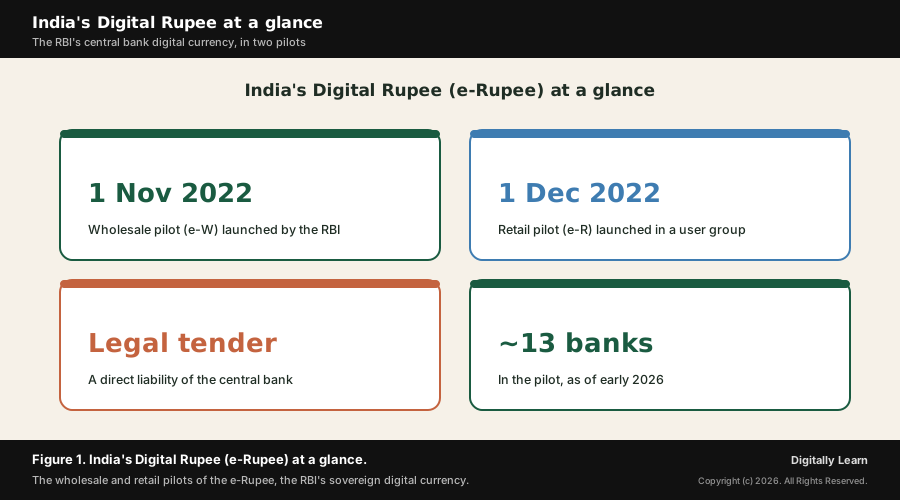
Because it is central-bank money in digital form, the e-Rupee is meant to combine the trust and finality of cash with the convenience of a digital payment. The RBI runs it through two separate pilots, a wholesale track for banks and financial institutions and a retail track for the public, which the figure below sets out at a glance.
Why the Digital Rupee Is in the News: A Widening Pilot
From a small closed group to a wider rollout
Why it matters now is that the e-Rupee has grown from a small experiment into a steadily widening pilot. The retail version began on 1 December 2022 inside a closed user group, with just four banks and a handful of cities, as a careful, controlled test of a brand-new form of money.
As of the RBI's Digital Rupee FAQs updated in early 2026, that pilot had spread considerably. The figures are best read as approximate and as-of-date, because a live pilot changes month to month, but the FAQs describe the e-Rupee reaching about thirteen banks and twenty-six locations, with more than 1.75 million users and merchants taking part, and around nineteen banks offering CBDC wallets.
The pilot has also deepened in function, not only in scale. The RBI has been testing offline use and programmable payments, and has begun allowing certain non-bank platforms to offer e-Rupee wallets to widen distribution. This steady expansion, of reach, of participants and of features, is why the Digital Rupee keeps returning to the news.
Understanding the Significance of the Digital Rupee for India
Sovereign digital money and a public payment option
What is the significance of the Digital Rupee lies first in what it adds to the monetary system. For the first time, an Indian can hold central-bank money directly in digital form, rather than only as a claim on a commercial bank. That gives the public a risk-free, sovereign form of digital money that does not depend on any single bank remaining solvent.
Its second significance is as a public alternative in a payment landscape now dominated by private platforms and challenged by private crypto. A central-bank-issued digital currency lets the State offer a trusted, stable option of its own, and keeps the anchor of the system in sovereign money rather than private tokens.
Beyond that, the e-Rupee carries the promise of a cheaper and more efficient currency system: less physical cash to print, move and secure, a new tool for reaching the unbanked, and, in the wholesale track, faster and safer settlement between financial institutions. These are the gains the pilots are designed to test.
How the Digital Rupee Works: Wholesale e-W, Retail e-R and Two-Tier Issuance
The wholesale (e-W) and retail (e-R) pilots
The RBI issues the Digital Rupee in two forms for two different uses. The wholesale e-Rupee, written e-W, was launched on 1 November 2022 and is meant for banks and large financial institutions. Its first use case was the settlement of secondary-market transactions in government securities, where settling in central-bank money removes the need for extra settlement-guarantee arrangements.
The retail e-Rupee, written e-R, was launched a month later, on 1 December 2022, for ordinary people and merchants. It began inside a closed user group of selected customers and shops, so the RBI could watch how a public digital currency behaves before opening it more widely. The retail pilot is the one that touches the everyday user.
| Form | Launched | Who uses it | Main use case |
|---|---|---|---|
| Wholesale e-Rupee (e-W) | 1 November 2022 | Banks and financial institutions | Settling government-securities trades in central-bank money |
| Retail e-Rupee (e-R) | 1 December 2022 | People and merchants (a closed group) | Everyday payments, like digital cash |
Read together, the two rows show the design: the wholesale track upgrades how institutions settle large transactions, while the retail track gives the public a digital form of cash. Both are the same sovereign currency, issued by the same central bank, for different layers of the economy.
A digital token, two-tier issuance and cash-like features
The retail e-Rupee is built as a digital token that represents legal tender, issued in the same denominations as the rupee notes and coins in circulation. A user holds these tokens in a digital wallet offered by a bank, and can send, receive and pay with them much as with a physical note.
Crucially, the RBI does not hand the currency to the public itself. It uses a two-tier model, an indirect issuance: the central bank creates the e-Rupee and then distributes it through banks, which act as intermediaries and put it into users' wallets. This keeps banks at the centre of the system, much as they distribute physical cash today, rather than the RBI dealing with every citizen directly.
The e-Rupee is designed to feel like cash. It carries cash-like features of trust, safety and settlement finality, so a payment, once made, is final. Like a banknote, it earns no interest, and it can be converted into other forms of money, such as a deposit in a bank account. These choices are deliberate: the e-Rupee is meant to be digital cash, not a savings product that might pull money out of bank deposits.
Digital Rupee vs UPI vs Cryptocurrency: The Key Distinctions
How the e-Rupee differs from UPI
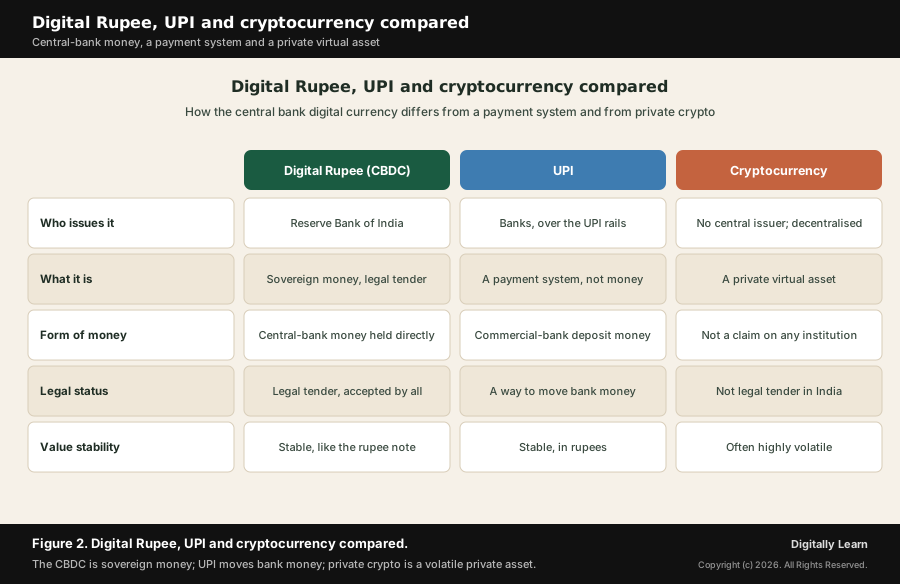
A common confusion is between the Digital Rupee and UPI, since both let a person pay from a phone. The difference is fundamental. UPI is a payment system: when money moves over UPI, what moves is a commercial-bank deposit, an instruction that debits one bank account and credits another, with the banks settling between themselves afterwards.
The e-Rupee is not a payment system but a form of money in its own right. When a person pays in e-Rupee, they hand over central-bank money directly, and the payment settles then and there without a later interbank step or any need for collateral to guard against settlement risk. In short, UPI moves bank money along the rails, while the Digital Rupee is the money itself, held by the public and settled with finality.
How the e-Rupee differs from private cryptocurrency
The Digital Rupee is just as sharply distinct from private cryptocurrency such as Bitcoin. A cryptocurrency is a private virtual asset created on a decentralised network, with no central issuer and no sovereign backing. Its price is set purely by the market, which is why private crypto is often highly volatile and is not legal tender in India.
The e-Rupee is the opposite on every count. It is issued by the Reserve Bank of India, is sovereign and centrally controlled, is legal tender, and is as stable as the rupee note because it simply is the rupee in digital form. So while both are digital, a CBDC is state money designed for stability and trust, whereas a private cryptocurrency is a decentralised, unbacked and fluctuating asset. The figure below sets the three side by side.
Why Private Cryptocurrency Unsettled the World and Pushed Central Banks Toward CBDCs
To understand why the RBI built the e-Rupee, it helps to see what private cryptocurrency did to the wider world. From Bitcoin onward, a cryptocurrency let people move value across borders, person to person, without banks or any central authority. That openness drew a wave of speculative investment and, with it, sharp price volatility: boom-and-bust cycles in which fortunes were made and lost in short spans.
For global society, this was a genuinely new way to invest and to transfer money, but one whose swings made it an unstable store of value rather than dependable money. It widened access to digital finance, yet it also moved a large pool of household savings into an asset with no sovereign backing and no guarantee of value.
Those same features carried real costs. Because crypto transfers are pseudonymous and hard to police, the technology has been used in illicit finance, money laundering and ransomware payments. The energy-hungry mining behind proof-of-work networks also raised serious environmental concern about its carbon footprint.
As the market grew, the International Monetary Fund warned that an unbacked, volatile asset class posed risks to financial stability, since a sharp fall could spill into the wider economy. Governments worldwide responded by moving to regulate or restrict private crypto, and many central banks began exploring sovereign digital money of their own, the rationale that led directly to central bank digital currencies.
- Speculation and volatility: A borderless, decentralised asset drew heavy investment but swung through sharp boom-and-bust cycles, an unstable store of value.
- Illicit use: Pseudonymous transfers eased money laundering, ransomware and other illicit finance that authorities struggle to trace.
- Energy footprint: Proof-of-work mining is energy-intensive, raising environmental concern in many jurisdictions.
- Financial-stability risk: The IMF flagged an unbacked, volatile asset class as a threat to wider financial stability, prompting global regulation and the move to CBDCs.
India felt the same forces. Retail investor interest in cryptocurrencies grew quickly here, set against the Reserve Bank of India's repeated caution that private virtual currencies pose risks to financial stability, to investor protection and to the conduct of monetary policy. The position on legal status is firm: a private cryptocurrency is not legal tender in India, so no one is bound to accept it.
The State chose to tax the activity rather than ban it outright. In the Union Budget 2022-23, per the Press Information Bureau, income from the transfer of any virtual digital asset became taxable at a flat 30 per cent, with no deduction except the cost of acquisition and no set-off of losses, and a 1 per cent tax deducted at source on payments above a threshold so that transactions can be traced.
The deeper response, though, was constructive. Rather than leave the field to private tokens, the RBI built a sovereign, stable, regulated public alternative: the Digital Rupee, the very CBDC this article explains. So India's answer to cryptocurrency has two halves, a cautious tax-and-warn stance on private crypto and the positive creation of its own central bank digital currency.
Token-based and account-based, direct and indirect
Two further distinctions help in the exam. A CBDC can be token-based or account-based. The retail e-Rupee is token-based, like cash: whoever holds the token can spend it, and the token itself carries the value. The wholesale e-Rupee works in an account-based way, where ownership is recorded against an institution's account, which suits large, identified financial players.
A CBDC can also be issued directly, with the central bank giving currency straight to the public, or indirectly through a two-tier model. India has chosen the indirect, two-tier route, distributing the e-Rupee through banks. This keeps the existing banking system intact and lets banks manage customer relationships, while the RBI focuses on issuing and backing the currency.
Benefits and Challenges of the Digital Rupee: Rationale and Debates
Why the RBI is building a CBDC
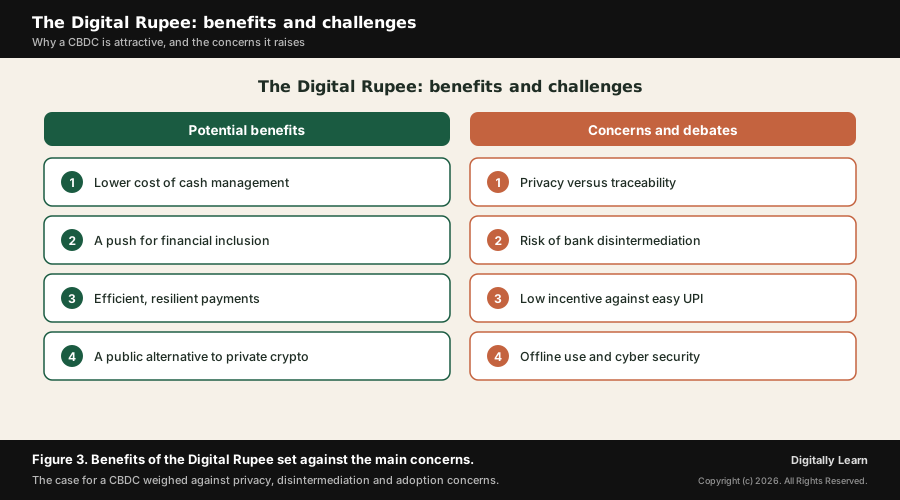
The case for the Digital Rupee rests on several benefits. The most immediate is a lower cost of cash: printing, transporting, storing and securing physical currency is expensive, and a digital rupee can reduce that burden over time. Closely linked is the promise of financial inclusion, since a simple, risk-free public digital currency can reach people who are outside the formal banking system.
A CBDC can also make the payment system more efficient and resilient by adding a public option alongside private platforms, and it opens the door to programmability, where money can be set to be spent only for a defined purpose, useful for targeted subsidies and benefit transfers. In the wholesale track, settling in central-bank money makes large transactions faster and safer.
Two wider gains are often cited. A sovereign digital currency offers a public alternative to private crypto, keeping the anchor of the monetary system in State money. And a well-designed CBDC could eventually make cross-border payments cheaper and faster, an aim of several international CBDC experiments. The figure below pairs these benefits with the main concerns.
The concerns and debates around a CBDC
A balanced view must weigh the concerns, the more so because UPSC questions reward this balance. The most debated is privacy. Physical cash is anonymous, but a digital currency can in principle be traced, which raises fears of surveillance; the design challenge is to protect privacy while still meeting the rules against money laundering, and offline use only sharpens that tension.
A second concern is bank disintermediation. If people moved large sums out of bank deposits into the e-Rupee, banks could lose the deposits they lend against, weakening credit. The cash-like design, with no interest and no large rewards for holding the e-Rupee, is partly meant to limit this risk.
A third concern is adoption. With UPI already fast, free and familiar, ordinary users have little obvious reason to switch to the e-Rupee, so take-up has been modest. Alongside these sit questions of cyber security and reliable offline functionality. None of these is fatal, but each must be solved before a pilot can become a national currency, which is exactly what the careful, staged rollout is testing.
The Digital Rupee in Context: Global CBDCs, the Digital Economy and Cross-Border Payments
How India's CBDC sits beside global practice and the wider economy
Contemporary linkages place the Digital Rupee within a worldwide wave of central-bank experiments. Bodies such as the International Monetary Fund track scores of CBDC projects around the world, and the same rationale recurs everywhere: financial inclusion, more efficient payments, programmability and a public answer to private digital money.
The e-Rupee belongs, too, to the larger story of India's digital economy. The country already runs one of the world's busiest digital-payment systems through UPI and a vast direct-benefit-transfer machinery, and the Digital Rupee is being tested as a new layer on top, for instance through CBDC-based pilots that route food-subsidy benefits to beneficiaries under the public distribution system.
The Digital Rupee was first announced in the Union Budget 2022-23, to be issued by the RBI, signalling that the State sees sovereign digital currency as part of the country's financial future. It connects to live debates on the regulation of private cryptocurrencies, on data privacy, and on how far money should become programmable.
- Global CBDCs: Many central banks are piloting their own digital currencies, with the IMF and others tracking the rationale and the design choices.
- Cross-border payments: International CBDC experiments aim to make cross-border transfers cheaper and faster than today’s correspondent-banking chains.
- Private cryptocurrency: The CBDC is read partly as a sovereign, stable counterpart to volatile private crypto and stablecoins.
- Programmable money: The ability to restrict spending to a defined purpose links the e-Rupee to targeted subsidies and benefit transfers.
Finally, the e-Rupee sits within India's evolving monetary architecture, alongside cash, bank deposits and UPI. It does not replace any of them; it adds a sovereign digital option whose place in the system the RBI is still defining through its pilots.
UPSC Relevance and Exam Focus
Where this fits in the UPSC-CSE syllabus
This topic maps most directly to General Studies Paper III: the Indian economy, banking, and the mobilisation of resources, with money, monetary policy and the financial system at its core. It also reaches into the science-and-technology and digital-economy parts of the syllabus, since a CBDC is a fintech innovation, and into questions on financial inclusion and digital payments.
For Prelims, hold the high-yield facts: the Digital Rupee, or e-Rupee, is the RBI's CBDC; the wholesale pilot began in November 2022 and the retail pilot in December 2022; the e-Rupee is legal tender and a direct liability of the central bank; the retail version is a token distributed through banks in a two-tier model; and it earns no interest.
For Mains, the recurring framing is to explain what a CBDC is and to weigh its benefits against its risks, the cost and inclusion gains set against privacy, bank-disintermediation and adoption concerns. A strong answer also contrasts the sovereign Digital Rupee with private cryptocurrency, treating the CBDC as the State's stable, regulated alternative.
Recurring linked concepts an aspirant should keep in working memory:
- Central Bank Digital Currency (CBDC): Sovereign currency in digital form, a direct liability of the central bank and legal tender.
- Legal tender and central-bank money: Money that must be accepted to settle debts, and that is a claim on the central bank rather than a commercial bank.
- Two-tier (indirect) issuance: A model in which the central bank creates the CBDC and banks distribute it to the public.
- Cryptocurrency: A decentralised private virtual asset, not legal tender and typically volatile, against which the CBDC is contrasted.
A common Prelims trap is to equate the Digital Rupee with UPI or with cryptocurrency. The e-Rupee is sovereign central-bank money and legal tender; UPI is only a payment system moving bank deposits, and a cryptocurrency is a private, decentralised, non-sovereign asset.
A common Mains trap is to praise the CBDC without testing it. Its exam value lies in a balanced judgment: the genuine gains in cost, inclusion and a public payment option, set honestly against the concerns over privacy, the disintermediation of banks and weak adoption next to an already convenient UPI.
Previous Year UPSC-CSE Questions By the end you will be able to draft model answers for the following UPSC questions. Each question carries a collapsible framework showing how to approach it in the exam.
- UPSC Mains 2021 GS-IWhat is Cryptocurrency? How does it affect global society? Has it been affecting Indian society also?
How to structure the answer in the exam
Body (sub-themes to develop):
- What it is: a decentralised, privately created virtual asset recorded on a distributed network, with no central issuer, not legal tender, and with a price set by the market, hence volatile.
- Effect on global society: it has spread new ways to invest and transfer value across borders, but its volatility, use in illicit transfers and energy use have drawn regulatory concern worldwide.
- Effect on Indian society: growing retail interest set against regulatory caution; private crypto is not legal tender in India, and concerns include investor protection, financial stability and misuse.
- The sovereign response: central banks, including the RBI, have built central bank digital currencies such as the Digital Rupee as a stable, regulated, legal-tender alternative to private crypto.
- Balance: the CBDC keeps the anchor of money sovereign and offers cost, inclusion and payment-efficiency gains, while privacy, disintermediation and adoption concerns must still be managed.
Sources and Further Reading
- Reserve Bank of India: Digital Rupee (e-Rupee) FAQs
- Press Information Bureau: Digital Rupee (Concept and pilots)
- Press Information Bureau: CBDc (e-Rupee-R) is a digital token that represents legal tender
- Press Information Bureau: Introduction of Central Bank Digital Currency 'Digital Rupee' announced
- Department of Economic Affairs: Investment and Digital Economy Division
- International Monetary Fund: Central Bank Digital Currency Virtual Handbook
- World Bank: Central bank digital currencies and fast payment systems
- Wikipedia: Digital rupee
- Wikipedia: Central bank digital currency
Editorial Disclaimer
This briefing is for UPSC preparation. Verify the figures and pilot details against the official RBI and PIB sources before relying on them, as the pilot adoption numbers change over time.


