


Overview
Project Cheetah is India's programme to bring the cheetah back to the wild, decades after the animal was declared extinct in the country in 1952. Launched at Kuno National Park in Madhya Pradesh on 17 September 2022, it is the world's first inter-continental translocation of a large carnivore. Eight cheetahs were flown in from Namibia in September 2022 and twelve more from South Africa in February 2023. The mission is led by the National Tiger Conservation Authority under the Ministry of Environment, Forest and Climate Change, with the Madhya Pradesh Forest Department and the Wildlife Institute of India. By December 2025 Kuno supported about thirty cheetahs, with cubs born on Indian soil.
India Reintroduces the Cheetah at Kuno National Park
Project Cheetah and the translocation from Africa
India has brought back an animal it had lost for seventy years. Through Project Cheetah, the world's fastest land animal has been reintroduced to the wild at Kuno National Park in Madhya Pradesh, decades after the cheetah was declared extinct in the country in 1952.
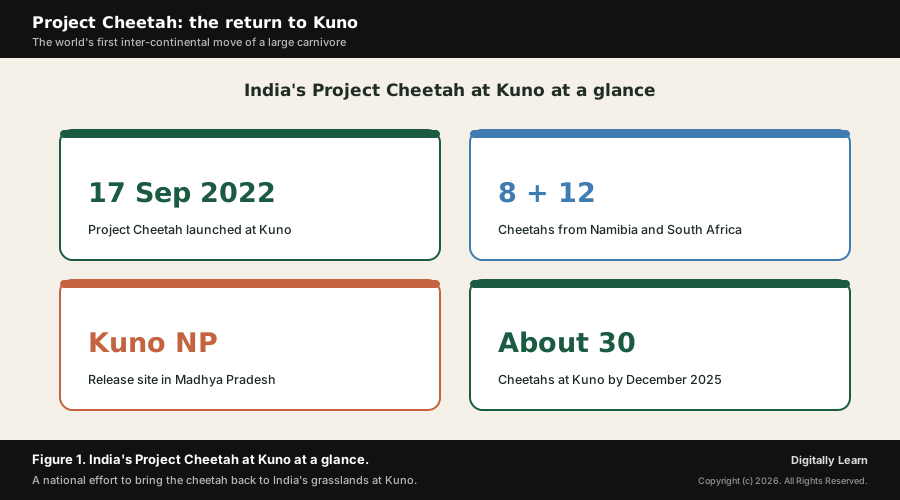
The project was launched on 17 September 2022, when eight cheetahs flown in from Namibia were released into a fenced enclosure at Kuno. It is described by the wildlife authorities as the world's first inter-continental translocation of a large carnivore, the first time such an animal has been moved between continents to re-establish a population.
A second batch followed. In February 2023 twelve more cheetahs were translocated from South Africa to Kuno, taking the founding group towards the planned size. The effort is led by the National Tiger Conservation Authority under the Ministry of Environment, Forest and Climate Change, working with the Madhya Pradesh Forest Department and the Wildlife Institute of India. The figure below sets out the project at a glance.
Why Project Cheetah Is in the News: Cubs and a Growing Population
Indian-born cubs and the population by December 2025
Why it matters now is that the reintroduced cheetahs have begun to breed in India. Cubs have been born on Indian soil at Kuno, the first cheetahs in the wild in the country since the species was lost, which is the clearest sign that the animals are settling into their new home.
By December 2025 Kuno supported about thirty cheetahs, a mix of the original founder animals brought from Africa and a larger number born in India. That a population is now growing on its own, rather than depending only on fresh arrivals, is the milestone that keeps the project in the news. The exact count changes as cubs are born and as some animals are lost, so it is read as an approximate figure for that date.
Understanding the Significance of Project Cheetah
A lost species restored and a flagship for grasslands
What is the significance of Project Cheetah lies first in what it restores. The cheetah was the only large mammal that independent India is known to have lost to extinction, so bringing it back repairs a gap in the country's fauna and tests whether a missing large carnivore can be re-established at all.
The deeper purpose is ecological. Conservationists use the cheetah as a charismatic flagship and umbrella species to draw attention and resources to India's open grasslands, savanna and scrub. These open ecosystems have long been undervalued against forests, yet they shelter their own threatened wildlife and provide services such as grazing, water and carbon storage, so protecting the cheetah's habitat protects much else with it.
Background and Rationale: From the 1952 Extinction to the African Cheetah
How India lost the cheetah and turned to Africa
India once had its own cheetahs, the Asiatic cheetah, which ranged across the dry open country of the subcontinent. Hunting, the loss of prey and the destruction of grassland habitat drove the animal to vanish, and by 1952 the cheetah was formally declared extinct in India, the last few having been recorded around the late 1940s.
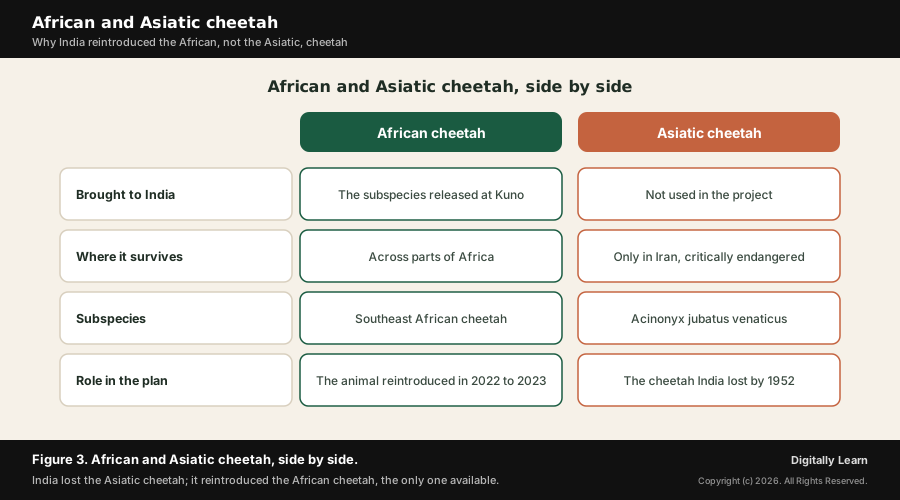
The Asiatic cheetah, a distinct subspecies known as Acinonyx jubatus venaticus, survives today only in Iran, where it is critically endangered with very few individuals left. Because so few remain, Iran could not spare animals for India, so the only practical way to bring the cheetah back was to use the African cheetah instead. The figure below compares the two.
| Aspect | Asiatic cheetah | African cheetah |
|---|---|---|
| Where it survives | Only in Iran, critically endangered | Across parts of Africa, including Namibia and South Africa |
| Link to India | The cheetah India lost by 1952 | The subspecies reintroduced at Kuno from 2022 |
| Conservation status | Critically endangered, very few left | Vulnerable on the IUCN Red List |
Reading the rows together explains the choice: with the Asiatic cheetah too rare to move, India reintroduced the closely related African cheetah, the only cheetah it could realistically obtain to fill the empty ecological role. The figure below contrasts the two.
The Supreme Court, the action plan and the grassland case
The path to reintroduction ran through the courts. An earlier plan was held up, and it was only in January 2020 that the Supreme Court permitted the introduction of African cheetahs to a carefully chosen site on a trial basis, clearing the legal way for the project to proceed.
Kuno itself had a history. The park had been prepared years earlier as a possible second home for the Asiatic lion from Gir, with villages resettled to make room, which left it with the space and prey base that suited the cheetah. The scientific case rests on a published action plan that frames the cheetah as a tool to restore India's open natural ecosystems, the grasslands and scrub that conservation has too often overlooked.
How a Cheetah Translocation Works: Protocol, Bomas and Monitoring
Site selection, soft release and the prey base
Moving a large carnivore between continents follows a careful protocol. Experts first survey and rank candidate sites, and Kuno was chosen for its suitable habitat and an adequate prey base of deer and antelope, the food a cheetah needs to survive and hunt on its own.
The cheetahs are not simply set loose. They go through a soft release: each animal first spends time in a fenced quarantine enclosure, then in a larger holding camp, before being released into the wider park. This staged approach lets the cheetah recover from the journey, adjust to local conditions and learn to hunt the local prey, raising the chance that it will settle.
The whole effort is built on the international IUCN guidelines on reintroductions and conservation translocations, the recognised scientific framework for moving animals back into the wild, supported by veterinary care, disease screening and quarantine.
Quarantine bomas and radio-collar monitoring
The fenced enclosures used at Kuno are called bomas, a term from African wildlife management for a secured compound. Here each newly arrived cheetah is held and watched, kept free of disease and allowed to acclimatise before it moves to the open park, which is the heart of the soft-release method.
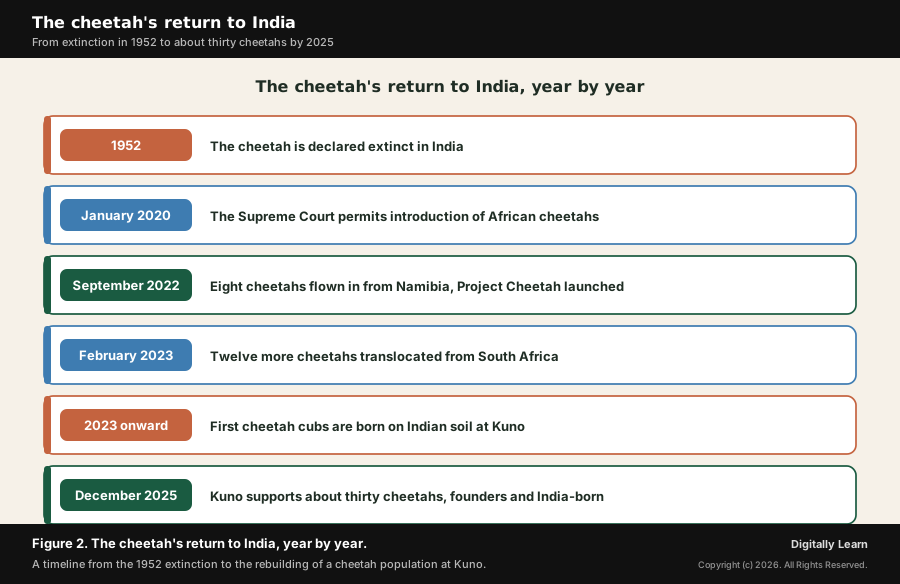
Once in the wild, every cheetah wears a radio collar, so that field teams can track its movements day and night, check on its health and step in quickly if an animal is injured, falls sick or strays into trouble. This close monitoring is what allows a reintroduction to be managed as carefully as it must be in the early, fragile years. The timeline below traces the project's main steps.
Outcomes and Challenges: Births, Losses and Carrying Capacity
What has gone right and what remains hard
The project has recorded real successes. Cheetahs have bred and cubs have been born and raised in India, the population at Kuno has grown to about thirty, and the founder animals have shown they can hunt and survive in Indian conditions, all encouraging signs for a first attempt of this kind.
There have also been losses. Some of the translocated adults and some cubs have died, from causes such as natural illness, the stress of the move, the demands of the Indian climate and the ordinary risks of the wild. Deaths in the early years of a reintroduction are expected, and each is studied so the protocol can be improved, but they are a reminder that the outcome is not yet assured.
- (a) Carrying capacity. Kuno can hold only so many cheetahs, so a single park cannot support a large, self-sustaining population on its own.
- (b) A second site. Gandhi Sagar Wildlife Sanctuary is being prepared as the next home, so the cheetahs are spread across more than one protected area.
- (c) Genetic diversity. A healthy population needs enough unrelated animals, which may require further translocations from Africa over time.
- (d) Coexistence. As cheetahs range more widely, managing their contact with people, livestock and other predators becomes an ongoing task.
Read together, these challenges show why the project is planned as a long, staged effort across several sites rather than a single release, aiming over many years for a self-sustaining population of cheetahs in India.
Project Cheetah in Context: Conservation Law, Grasslands and the Global Effort
Where the project sits in India's conservation framework
Contemporary linkages tie Project Cheetah to the wider story of wildlife conservation in India. It is run by the National Tiger Conservation Authority, the same statutory body that runs Project Tiger, which shows how India's flagship-species programmes, for the tiger, the lion, the elephant and now the cheetah, anchor its conservation effort.
The project also rests on India's conservation laws and institutions. Kuno is a protected area, the cheetah a protected species, and the reintroduction is governed by the country's wildlife-protection framework and overseen by the courts, a reminder that species recovery in India is built on a foundation of law and regulation as much as field science.
It speaks, too, to a long-overlooked priority: India's grasslands and open ecosystems. By making the cheetah the public face of these landscapes, the project tries to win them the attention and funding that have long flowed mainly to forests and tigers, even though grasslands shelter species such as the great Indian bustard, the wolf and the blackbuck.
Finally, Project Cheetah connects to the global practice of reintroducing lost species, from large carnivores returned to their old ranges abroad to the international guidelines that shape every such effort. Its progress is watched well beyond India as a test of whether a top predator can be carried across continents and made at home again.
How India's Biodiversity Varies and the Law That Protects It
Project Cheetah sits inside a much larger picture: how India's biodiversity varies across the country, and the law that conserves it. India is one of the world's seventeen megadiverse countries, and its wildlife changes sharply from one part of the subcontinent to another, which is exactly why a single cheetah landscape can be neglected while the country as a whole is rich in species.
The standard way to read this variation is the Wildlife Institute of India's classification of the country into ten biogeographic zones, each with its own characteristic flora and fauna. They run from the Trans-Himalaya and the Himalaya, through the Indian Desert, the Semi-Arid zone, the Western Ghats, the Deccan Peninsula and the Gangetic Plain, to North-East India, the Coasts and the Islands.
On top of this zoning, India holds four of the world's biodiversity hotspots, the Himalaya, the Western Ghats, the Indo-Burma region and the Nicobar Islands within Sundaland. These hotspots concentrate large numbers of species found nowhere else, which is why the loss of any one habitat type carries a heavy cost for the country's wildlife as a whole.
- Forests and the Western Ghats: Tropical evergreen and moist forests, richest in the Western Ghats and the North-East, hold a large share of India’s endemic plants, amphibians and birds.
- The Himalaya and Trans-Himalaya: Alpine meadows, temperate forests and cold high-altitude deserts support specialised mountain wildlife such as the snow leopard and unique alpine flora.
- Deserts, grasslands and scrub: The Thar Desert and the open grasslands, savanna and scrub of the Deccan, the cheetah’s natural home, are biodiversity-rich yet long undervalued against forests.
- Coasts, wetlands and islands: Mangroves, coral reefs, lagoons and the Andaman and Nicobar Islands carry distinct marine and island species found nowhere else in the country.
This is the variation that frames the cheetah's case. The animal belongs to the open grassland, savanna and scrub, a kind of biodiversity quite distinct from the forest wildlife that has drawn most of India's conservation attention. Treating these open ecosystems as wasteland has left their species, from the great Indian bustard to the wolf and the blackbuck, poorly protected, which is the gap Project Cheetah is meant to close by making them visible.
To conserve this varied wildlife, India relies on a framework of law. The central statute for biological resources is the Biological Diversity Act, 2002, which was enacted to conserve biological diversity, to promote the sustainable use of its components, and to ensure the fair and equitable sharing of the benefits that arise from the use of biological resources and the traditional knowledge linked to them.
The Act works through a three-tier institutional structure. The National Biodiversity Authority, a statutory body at Chennai, sits at the national level; State Biodiversity Boards operate in the states; and Biodiversity Management Committees function at the level of local bodies, carrying conservation down to the village and municipality. The Authority also regulates access by foreigners and foreign entities to India's biological resources and the knowledge associated with them, so that the country's genetic wealth is used on fair terms.
Alongside it stands the older Wildlife (Protection) Act, 1972, which provides for the protection of wild animals, birds and plants and underpins the network of national parks and sanctuaries. It is this framework of protected areas that gives Kuno National Park its legal standing and that supports the statutory bodies, the National Tiger Conservation Authority among them, which run India's species-recovery programmes.
Read together, the two laws show how India conserves its flora and fauna. They work by regulating the use of biological resources, by building institutions from the national to the local level, and by securing the habitats in which species such as the cheetah can be re-established. Project Cheetah is one outcome of that legal and institutional effort applied to a single, long-neglected kind of biodiversity.
UPSC Relevance and Exam Focus
Where this fits in the UPSC-CSE syllabus
This topic maps to General Studies Paper III: conservation, environment and biodiversity, with links to the protection of species, the role of protected areas, and India's conservation laws and institutions.
For Prelims, hold the high-yield facts: Project Cheetah at Kuno National Park, run by the National Tiger Conservation Authority; the 1952 extinction; the Asiatic cheetah surviving only in Iran while the African cheetah was reintroduced; and the cheetah's status as Vulnerable on the IUCN Red List and on CITES Appendix I.
For Mains, the recurring framing is how India conserves its biodiversity through species recovery, protected areas and law, and how grasslands and open ecosystems can be valued alongside forests. Project Cheetah is a ready example of in-situ conservation and of using a flagship species to protect a wider habitat.
Recurring linked concepts an aspirant should keep in working memory:
- In-situ conservation: Protecting species within their natural habitat, as through national parks and sanctuaries, the approach Project Cheetah follows.
- Flagship and umbrella species: A well-known species used to rally support and, by protecting its habitat, to shelter many others.
- Biological Diversity Act, 2002: India’s law for conserving biological diversity and the sustainable use of its components.
- IUCN Red List and CITES: The global lists that classify a species’ extinction risk and regulate its international trade.
A common Prelims trap is to assume the cheetahs brought to Kuno are the Asiatic cheetah. They are the African cheetah, since the Asiatic subspecies survives only in Iran and is too few to move.
A common Mains trap is to judge Project Cheetah only by the number of animals alive. Its deeper exam value is as a case of in-situ conservation, grassland restoration and the use of a flagship species, set against the law and institutions that govern wildlife in India.
Previous Year UPSC-CSE Questions By the end you will be able to draft model answers for the following UPSC questions. Each question carries a collapsible framework showing how to approach it in the exam.
- UPSC Mains 2018 GS-IIIHow does biodiversity vary in India? How is the Biological Diversity Act, 2002 helpful in conservation of flora and fauna?
How to structure the answer in the exam
Body (sub-themes to develop):
- India's biodiversity varies across biogeographic zones, from Himalayan and Western Ghats forests to the deserts, the grasslands and scrub, and the coasts and wetlands, each with distinct species.
- Grasslands and open ecosystems are biodiversity-rich yet undervalued, which is why a flagship effort such as Project Cheetah is used to draw attention and resources to them.
- The Biological Diversity Act, 2002 conserves flora and fauna by regulating access to biological resources, providing for benefit sharing, and creating the National Biodiversity Authority and State and local biodiversity bodies.
- In-situ conservation through national parks, sanctuaries and species programmes, such as Project Cheetah at Kuno run by the NTCA, protects species within their habitats.
- International instruments such as the IUCN Red List and CITES complement domestic law by classifying extinction risk and regulating trade in species such as the cheetah.
Sources and Further Reading
- National Tiger Conservation Authority: Project Cheetah, Kuno National Park
- Press Information Bureau: Commemorating one year of Project Cheetah in India
- Wildlife Institute of India: Action Plan for Introduction of Cheetah in India
- IUCN Red List: Acinonyx jubatus (Cheetah)
- CITES: Cheetahs
- Wikipedia: Cheetah reintroduction in India
- Wikipedia: Asiatic cheetah
- Wikipedia: Kuno National Park
- Wikipedia: Biodiversity of India
- Wikipedia: Biogeographic classification of India
- Wikipedia: Biological Diversity Act, 2002
- Wikipedia: Wildlife Protection Act, 1972
Editorial Disclaimer
This briefing is for UPSC preparation. Verify the figures and details against the official NTCA, PIB and Wildlife Institute of India sources before relying on them.


