


Overview
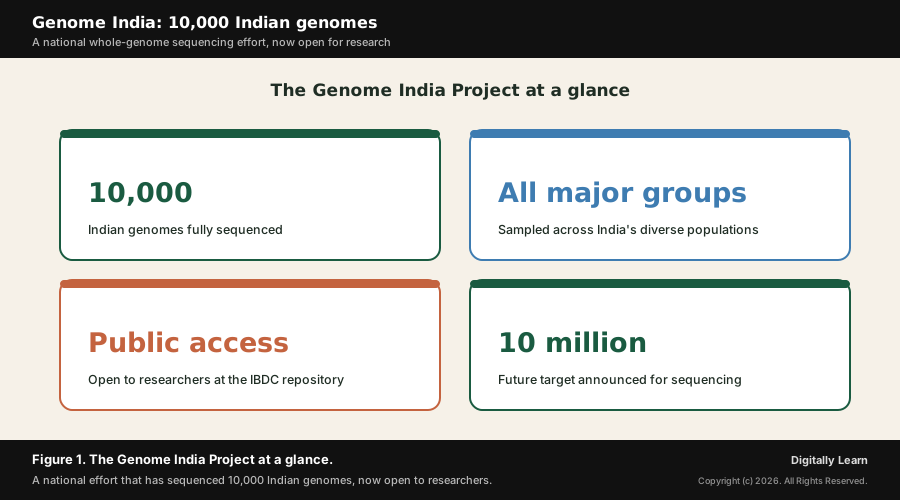
The Genome India Project, known as GenomeIndia and funded by the Department of Biotechnology, has completed the whole-genome sequencing of more than 10,000 individuals drawn from all major population groups across the country. The full dataset is now open for public research access at the Indian Biological Data Centre, India's national repository for life-science data. The aim is to build a reference catalogue of the genetic variation found in Indians, so that future medicine, disease prediction and diagnostics can be tuned to the country's own population rather than to data drawn mostly from other parts of the world.
India Completes Whole-Genome Sequencing of 10,000 Indians
Ten thousand Indian genomes, now open for research
India has completed one of the largest genetic studies of its own people. The Genome India Project, funded by the Department of Biotechnology and known as GenomeIndia, has finished the whole-genome sequencing of more than 10,000 individuals drawn from all major population groups across the country.
The full set of 10,000 genomes has now been made available for public research access at the Indian Biological Data Centre, the national repository for life-science data. Any approved researcher in India or abroad can now study this catalogue of Indian genetic variation, which is why the completion has drawn wide attention.
The project set out to read the entire genetic code, the full genome, of each volunteer, rather than only a few marker positions. Reading the whole genome captures far more of the variation that makes one person's biology differ from another's. The figure below sets out the project at a glance.
Why Genome India Is in the News: From Sequencing to Open Data
The dataset moves from collection to public use
Why it matters now is that the project has crossed from quiet data collection into open scientific use. The blood samples were gathered and stored in a biobank, the sequencing was completed, and the resulting genomes have been archived and released through the Indian Biological Data Centre for the wider research community.
Alongside the data, the government has signalled the next stage. A future target of sequencing as many as ten million genomes has been announced, a scale that would move the effort from a research catalogue towards a tool that could touch routine healthcare. The release of the first 10,000 genomes is the milestone that makes that larger ambition concrete.
Understanding the Significance of Genome India for the Country
A genetic baseline tuned to Indian populations
What is the significance of the Genome India Project lies in giving the country its own reference picture of how Indians differ from one another in their genes. Until now, most of the world's genomic data has come from populations of European descent, so risk scores, drug-response predictions and diagnostic tests built on that data fit Indians poorly. A home-grown reference catalogue begins to correct that imbalance.
The significance is also practical. With a large, diverse Indian dataset, doctors and researchers can start to identify the genetic variants that drive disease in Indian families, predict who is at risk and design treatment and screening that work for Indian patients. This is the foundation on which precision medicine in India will be built, and it strengthens the country's wider biotechnology capability.
How Genome India Works: Sequencing, the Consortium and Open Data
Whole-genome sequencing and a catalogue of variation
The project rests on whole-genome sequencing, the reading of almost the entire three-billion-letter DNA code of a person. Unlike a simple genetic test that checks a handful of positions, whole-genome sequencing records the full sequence, so it can reveal both common differences and rare variants that a narrow test would miss. Comparing many people's sequences then shows which spellings of the code are common, which are rare, and which are linked to disease.
From thousands of such sequences, the project builds a catalogue of genetic variation, in effect a record of how Indians vary at each position in the genome. This catalogue is the real product: it lets later studies ask whether a particular variant is common or rare in Indians, and whether it travels with a given disease. The table below contrasts a narrow genetic test with whole-genome sequencing.
| Feature | A narrow genetic test | Whole-genome sequencing |
|---|---|---|
| What is read | A few chosen marker positions | Almost the entire three-billion-letter genome |
| Variants found | Only the ones already looked for | Common and rare variants across the whole genome |
| Best use | Checking a single known condition | Building a population-wide reference catalogue |
Read together, the two columns show why the project chose to read the whole genome: only the fuller method captures the rare and population-specific variation that a reference catalogue for India needs to record.
The national consortium that built the dataset
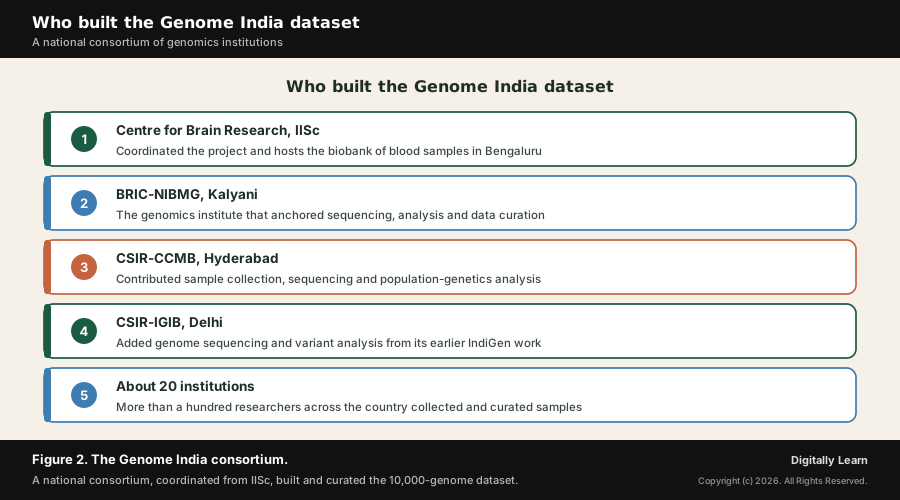
Genome India was not the work of a single laboratory. It was coordinated by the Centre for Brain Research at the Indian Institute of Science in Bengaluru, which also hosts the biobank where the blood samples are stored. The genomics work was anchored by the National Institute of Biomedical Genomics at Kalyani, which led much of the sequencing, analysis and curation of the data.
Two long-standing genomics laboratories of the Council of Scientific and Industrial Research joined in: the Centre for Cellular and Molecular Biology in Hyderabad and the Institute of Genomics and Integrative Biology in Delhi. In all, more than a hundred researchers across about twenty institutions contributed the sample collection, sequencing, analysis and curation. The figure below names the main partners.
The Indian Biological Data Centre and governed access
The finished genomes are archived at the Indian Biological Data Centre, the country's first national repository for life-science data, set up at the National Capital Region Biotech cluster around the Regional Centre for Biotechnology at Faridabad. The centre stores the data and serves them to approved researchers through a managed portal.
Access is governed, not a free download. Because genomic data are deeply personal, researchers apply for access under defined consent and privacy rules, and the volunteers who gave samples did so under informed consent. This balance, opening the data for science while protecting the people behind it, is central to how the project is run.
Why India Needs Its Own Genome Data: Diversity, Endogamy and Founder Effects
Indians are under-represented in global genomic data
India holds a sixth of humanity and an extraordinary depth of genetic diversity, yet Indians make up only a tiny share of the world's published genomic data, which is drawn mostly from populations of European descent. A genetic risk score or a diagnostic test calibrated on that data can mislead when applied to an Indian patient, because the underlying variants and their frequencies differ.
Closing this gap is the first reason India needs its own data. A reference catalogue built from Indian genomes lets clinicians read a patient's variants against the right population baseline, so that prediction, screening and treatment rest on data that actually represent the people being treated. The figure below sets out what such data make possible.
Endogamy and founder effects shape disease in India
India's social structure also makes its genetics distinctive. Long practice of marriage within communities, known as endogamy, means many groups have stayed genetically separate for generations. Within such a group, a harmful variant carried by a small number of early ancestors can become unusually common, a pattern geneticists call a founder effect.
As a result, India carries a heavy burden of inherited and rare diseases that cluster within particular communities, from certain blood disorders to specific metabolic conditions. A reference catalogue that records which variants are common in which communities is exactly what is needed to identify these conditions, counsel families and design screening, in a way that data from other populations simply cannot do.
What Genome India Enables: Precision Medicine, Drug Response and Diagnostics
Four areas the data are built to serve
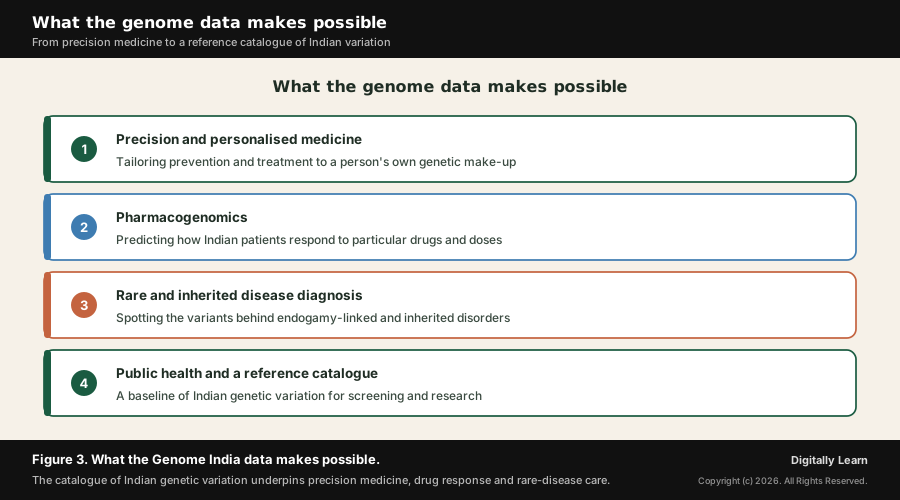
The catalogue of Indian variation is designed to be put to work, not merely studied. Its applications reach across prevention, treatment and diagnosis, each tuned to Indian populations rather than borrowed from abroad, so the data read the health of the country as a connected whole.
- (a) Precision and personalised medicine. Tailoring prevention and treatment to a person’s own genetic make-up, so care fits the individual rather than an average patient.
- (b) Pharmacogenomics. Predicting how Indian patients respond to particular drugs and doses, which can avoid harmful reactions and wasted treatment.
- (c) Rare and inherited disease diagnosis. Identifying the variants behind endogamy-linked and inherited disorders, to speed diagnosis and guide family counselling.
- (d) Public health and a reference catalogue. Providing a population baseline for screening programmes, disease-risk research and the design of tests calibrated for Indians.
Read together, these uses make Genome India a working tool for healthcare and research, not only a scientific archive, reaching from prevention to diagnosis. The figure below names the four areas.
How these capabilities reach Indian patients
For patients the promise is concrete. With a reliable Indian baseline, a clinician can read whether a worrying variant is common and harmless in that community or genuinely linked to disease, which sharpens both diagnosis and reassurance. For couples in communities with a known inherited condition, carrier screening built on Indian data can guide informed choices.
In treatment, knowing how Indian patients metabolise a drug helps set the right medicine and dose, reducing the trial and error that pharmacogenomics is meant to remove. Over time, as the dataset grows towards the announced target of ten million genomes, these uses can move from research hospitals into wider public health, from newborn screening to risk prediction for common diseases. The figure below sets out what the data make possible.
Genome India in Context: IndiGen, Global Projects and Data Ethics
Earlier programmes, global comparisons and the ethics of genomic data
Contemporary linkages tie Genome India to several wider stories. At home it builds on an earlier effort, the IndiGen programme of the Council of Scientific and Industrial Research, which sequenced about a thousand Indian genomes from 2019 and showed both the value and the feasibility of an Indian genomic resource. Genome India scales that idea by an order of magnitude and places the data in a national repository.
Abroad, the project sits in a line of national and international genome programmes. The Human Genome Project, declared complete in 2003, first read a single reference human genome. Britain's 100,000 Genomes Project, finished in 2018, linked sequencing to the health service for rare disease and cancer. Large biobanks and population projects elsewhere have shown how genomic data can drive both research and care; Genome India is India's entry into that company, built around its own population.
The effort also connects to the policy push to make biotechnology a driver of the economy and of public health, in which genomics, data infrastructure and a skilled research base reinforce one another. A national data repository that can hold and serve genomic data at scale is part of that wider build-out of scientific capability.
Finally, Genome India raises questions of data privacy and ethics that run through all genomic work: informed consent, the security of deeply personal data, fair benefit-sharing with the communities that gave samples, and guarding against any misuse of genetic information. How the country manages these questions will shape public trust in the project as it grows.
UPSC Relevance and Exam Focus
Where this fits in the UPSC-CSE syllabus
This topic maps to General Studies Paper III: science and technology, developments in biotechnology and their applications, and issues relating to intellectual property and ethics, with links to health, social justice and the use of technology for development.
For Prelims, hold the high-yield facts: Genome India is a Department of Biotechnology project that has sequenced 10,000 Indian genomes from all major population groups, the data are open at the Indian Biological Data Centre, it was coordinated from the Centre for Brain Research at the Indian Institute of Science, and a target of ten million genomes has been announced. Keep the terms whole-genome sequencing, endogamy, founder effect and pharmacogenomics distinct and clear.
For Mains, the recurring framing is how achievements in applied biotechnology translate into benefits for ordinary people, including poorer and under-served communities. Genome India is a ready example: a catalogue of Indian variation that can bring rare-disease diagnosis, carrier screening and better-targeted treatment to communities that global data have long overlooked.
Recurring linked concepts an aspirant should keep in working memory:
- Whole-genome sequencing (WGS): Reading almost the entire DNA code of a person, rather than a few marker positions, to capture common and rare variation.
- Precision medicine: Tailoring prevention and treatment to a person’s own genetic make-up instead of treating an average patient.
- Pharmacogenomics: Using genetic data to predict how a patient will respond to particular drugs and doses.
- Endogamy and founder effect: Marriage within a community over generations, which can make a few ancestral variants, including harmful ones, unusually common in that group.
A common Prelims trap is to confuse the 10,000 human Indian genomes of this project with a separate milestone of 10,000 sequenced genomes of the tuberculosis bacterium. The two are unrelated: Genome India sequences people, the other effort sequences a pathogen for disease control.
A common Mains trap is to praise the science without naming its limits. A strong answer also weighs the questions of data privacy, consent and ethics, the risk of widening inequality if benefits reach only well-resourced hospitals, and the long road from a research catalogue to care that reaches every community.
Previous Year UPSC-CSE Questions By the end you will be able to draft model answers for the following UPSC questions. Each question carries a collapsible framework showing how to approach it in the exam.
- UPSC Mains 2021 GS-IIIWhat are the research and developmental achievements in applied biotechnology? How will these achievements help to uplift the poorer sections of the society?
How to structure the answer in the exam
Body (sub-themes to develop):
- Genomics achievements: Genome India has sequenced 10,000 Indian genomes and built a reference catalogue of Indian genetic variation, enabling precision medicine and pharmacogenomics tuned to Indian populations.
- Health for the under-served: a home-grown catalogue allows rare-disease diagnosis, carrier screening and better-targeted treatment for endogamous and tribal communities under-represented in global data, directly aiding poorer sections.
- Agriculture and food: applied biotechnology delivers improved, stress-tolerant crop varieties and better diagnostics that raise farm incomes and food security for small and marginal farmers.
- Affordable diagnostics and vaccines: indigenous biotechnology lowers the cost of tests, vaccines and biopharmaceuticals, widening access for low-income households.
- Enabling architecture: a national data repository, a skilled research base and a supportive policy framework let these achievements scale and reach the wider population.
Sources and Further Reading
- DBT: Completion of Sequencing of 10,000 Genomes from the Indian Population
- DBT: Genome India Project makes genomic data of 10,000 Indians available for public access
- PIB: India Takes a Giant Leap in Genomics (Indian Genomic Data Set and IBDC portals)
- PIB: PM's remarks at the GenomeIndia data dedication
- IBDC: Indian Biological Data Centre
- Regional Centre for Biotechnology (host of the IBDC at Faridabad)
- CSIR-IGIB: IndiGenomes resource (the earlier IndiGen programme)
- Wikipedia: Human Genome Project
- Wikipedia: 100,000 Genomes Project
Editorial Disclaimer
This briefing is for UPSC preparation. Verify the figures and project details against the official Department of Biotechnology and PIB sources before relying on them.


