


Overview
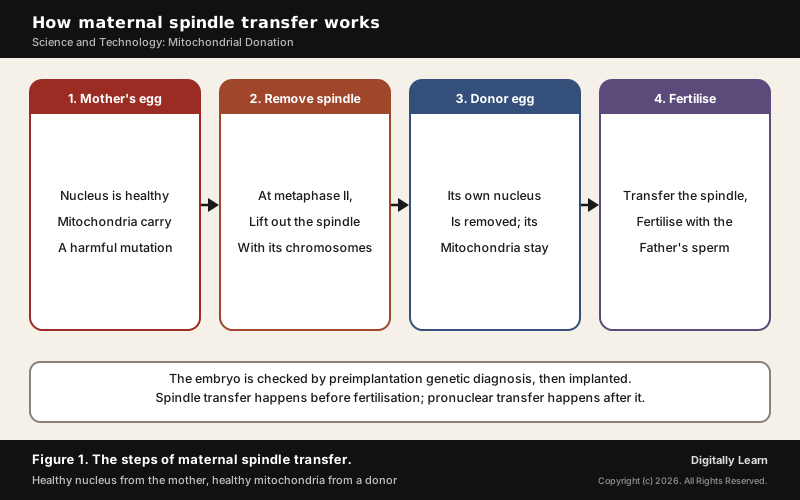
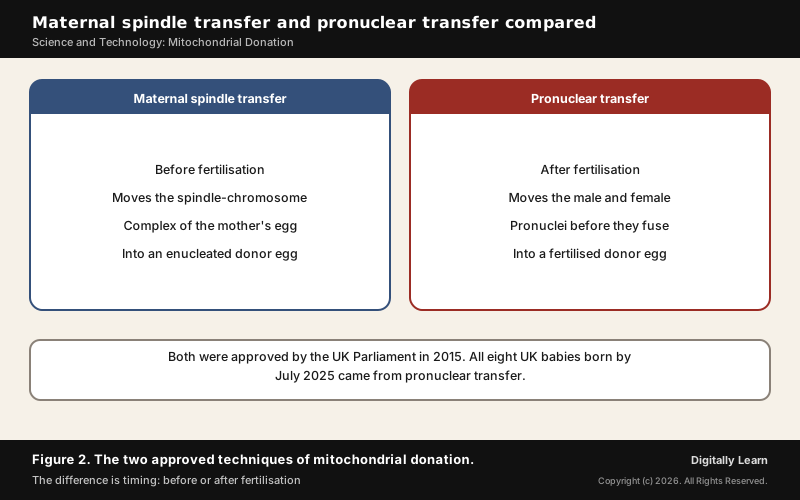
Mitochondrial replacement therapy (MRT), or mitochondrial donation, is a form of in vitro fertilisation that stops a mother from passing mitochondrial disease to her child. In maternal spindle transfer, the chromosomes of the mother's egg are moved into a donor egg that has healthy mitochondria, before fertilisation. The child gets nuclear DNA from both parents and mitochondrial DNA from the donor, hence the popular name three-parent baby.
Mitochondria, Mitochondrial DNA and Mitochondrial Disease
Mitochondria and Mitochondrial DNA: Why Only the Mother's Count
These organelles are the sites of aerobic respiration: they produce cellular energy as ATP, which is why they are called the power houses of the cell. Each is a double-membrane structure whose inner membrane folds into cristae. Unusually, the matrix holds its own single circular DNA molecule, some RNA, 70S ribosomes and the components needed to make proteins, and mitochondria divide by fission.
- Size of the genome: Human mitochondrial DNA (mtDNA) has 16,569 base pairs and 37 genes: 13 for proteins, 22 for transfer RNAs and 2 for ribosomal RNAs.
- Maternal inheritance: An egg contains on average 200,000 mtDNA molecules, while a healthy human sperm carries about 5.
- Paternal copies removed: Sperm mitochondria are marked with ubiquitin so that they are destroyed inside the embryo.
Mitochondrial Diseases: Causes, Examples and Inheritance
Mutations in mitochondrial DNA are found in about 0.5 per cent of people, but disease is much rarer, around one in 5,000, because each cell holds many mitochondria and only some carry the mutation. Copies accumulate random mutations as mitochondria multiply, a state called heteroplasmy, and disease appears only when the share of affected mitochondria crosses a level known as threshold expression.
- Leigh syndrome: Subacute necrotising encephalomyelopathy; the 2016 spindle-transfer baby was born to a mother with it.
- Leber’s hereditary optic neuropathy: Progressive loss of central vision from degeneration of the optic nerves and retina.
- MERRF: Myoclonic epilepsy with ragged red fibres, for which the UK’s regulator authorised MRT for two women in 2017.
Women at risk of passing on mitochondrial disease had three choices: an egg from another woman, adoption or remaining childless. Where it is legal, MRT is a fourth option that lets them have a child genetically their own. Births to women at risk of passing on such disease are estimated at about 150 a year in the United Kingdom and 800 in the United States.
Mitochondrial Replacement Therapy Techniques
How Maternal Spindle Transfer Works: Step by Step
Ordinary in vitro fertilisation (IVF) fertilises an egg with sperm outside the body and transfers the embryo into the uterus; it is popularly known as the test tube baby programme. MRT adds a second egg, from a healthy donor, and moves the mother's nuclear material into it. In maternal spindle transfer this happens before fertilisation:
- An egg (oocyte) is taken from the mother, whose nucleus is healthy but whose mitochondria carry a harmful mutation.
- When the egg is at the metaphase II stage of division, the spindle-chromosome complex is removed; a little cytoplasm, and so some mitochondria, comes with it.
- The complex is inserted into a donor egg whose own nucleus has already been removed.
- The reconstructed egg is fertilised with the father’s sperm and allowed to form a blastocyst.
- The embryo is checked by preimplantation genetic diagnosis for mitochondrial mutations, then implanted in the mother’s uterus.
Maternal Spindle Transfer vs Pronuclear Transfer, Polar Body and Cytoplasmic Transfer
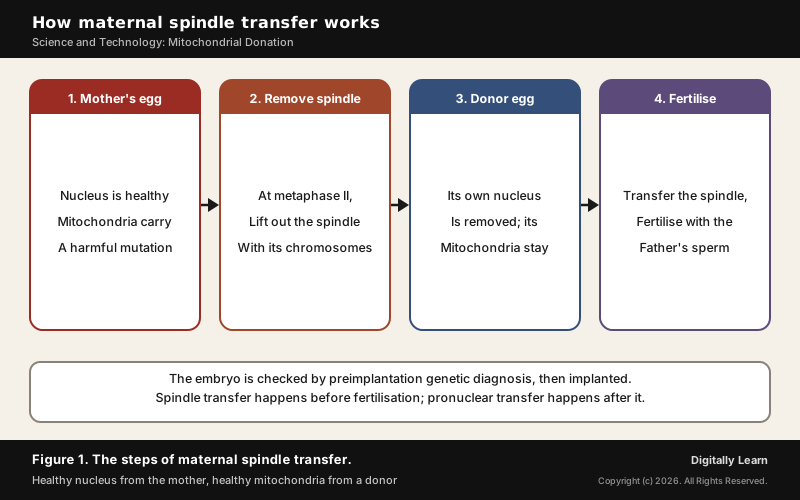
As of 2016 there were three MRT techniques in use: maternal spindle transfer, pronuclear transfer and polar body transfer. In pronuclear transfer both the mother's egg and the donor egg are first fertilised with the father's sperm; the male and female pronuclei are then removed from the mother's fertilised egg before they fuse and placed into the donor's fertilised egg, whose own pronuclei have been removed.
| Technique | When | Status |
|---|---|---|
| Maternal spindle transfer | Before fertilisation: moves the mother's spindle-chromosome complex | Approved in the UK in 2015 |
| Pronuclear transfer | After fertilisation: moves the two pronuclei before they fuse | Approved in the UK in 2015; used for the UK births |
| Polar body transfer | Either: uses a polar body, which has very few mitochondria | First published in 2014; not yet consistently replicated |
| Cytoplasmic transfer | Before fertilisation: injects donor cytoplasm into the mother's egg | About 30 babies; halted by the US FDA |
The Three-Parent Baby: What the Child Inherits
A child born through MRT carries nuclear DNA from its mother and father and mitochondrial DNA from the donor. The donor's contribution is small: the 37 genes of the mitochondrial genome, 13 of them for proteins.
- Carry-over: Some maternal mitochondria travel with the spindle; with the techniques used in the UK they were estimated at about 2 per cent or less of the egg’s mitochondria, a level the regulator considered safe.
- Reversion risk: In a Greek study of spindle transfer for infertility, the mother’s mitochondria in one child had expanded to 50 per cent by birth; researchers noted MRT might not always prevent disease if that happened.
- Mito-nuclear mismatch: Nuclear genes make some proteins used by mitochondria, so a donor’s mitochondria might in theory interact badly with the parents’ nuclear DNA; no evidence of this had been found as of 2016.
History, Results and Regulation of Mitochondrial Replacement Therapy
From the 2016 Spindle Transfer Birth to the UK Mitochondrial Donation Trial
In 2016 a team of scientists from Mexico and New York led by John Zhang used spindle transfer to help a Jordanian woman with Leigh disease give birth to a baby boy; she had suffered four miscarriages and lost two children to the disease. In August 2017 the US FDA warned that the technique should not be marketed in the United States.
- United Kingdom: Newcastle University was licensed in 2005 to develop pronuclear transfer; regulations making mitochondrial donation legal came into force on 29 October 2015, and the first clinical licence went to the Newcastle Fertility Centre in March 2017.
- UK results: In July 2025, 22 patients had taken part in the UK trial and eight babies, including one set of identical twins, had been born using pronuclear transfer, with little or no sign of mitochondrial disease.
- Ukraine and Greece: Clinics used MRT to treat infertility rather than to prevent disease; in Greece, six babies were born in a spindle-transfer pilot study and were reported healthy at four years old.
- Australia: Maeve’s Law, passed in 2022, legalised mitochondrial donation under a special licence.
Regulation of Mitochondrial Replacement Therapy: The World and India
The United Kingdom became the first country to legalise the procedure, and its Human Fertilisation and Embryology Authority licenses and regulates clinics. Elsewhere the law is mixed:
- United States: As of 2016 there was no regulation of mitochondrial donation, and Congress barred the FDA from evaluating applications that involve implanting modified embryos.
- China: Guidelines issued by its health ministry in 2003 essentially prohibit MRT.
- Mexico: Allows mitochondrial donation under certain conditions for unresolved infertility, though some states prohibit it.
- India: A 2018 review listed India among twelve countries where MRT was insufficiently regulated.
India's main law for fertility treatment is the Assisted Reproductive Technology (Regulation) Act, 2021 (No. 42 of 2021), which received the President's assent on 18 December 2021. It provides for a National Board, State Boards and a National Registry to regulate and supervise ART clinics and banks, prevent misuse and ensure safe and ethical practice. Before it, clinics followed national guidelines of the Indian Council of Medical Research issued in 2005.
- Who may use ART: Services are offered to a woman above 21 and below 50 years, and to a man above 21 and below 55 years.
- Genetic testing: Pre-implantation genetic testing may be used only to screen embryos for known, pre-existing, heritable or genetic diseases.
- No sex selection: Clinics may not offer a child of a pre-determined sex, in line with the Pre-conception and Pre-natal Diagnostic Techniques Act, 1994.
- The Board: The National Board is the National Assisted Reproductive Technology and Surrogacy Board set up under the Surrogacy (Regulation) Act, 2021.
Benefits, Risks and Ethics of Mitochondrial Replacement
Benefits and Risks of Mitochondrial Replacement Therapy
The benefit is clear: a woman who carries a mitochondrial disease can have a child that is genetically hers without passing the disease on. Mitochondrial transfer also has a second use outside reproduction: autologous mitochondria, taken from a patient's own healthy tissue, have been supplied to damaged tissue to restore its function. In 2018 researchers reported using this to restore heart tissue in cardiac-compromised newborns, whose damaged heart cells absorbed the healthy mitochondria. The risks of reproductive MRT come from the procedure itself:
- IVF risks: MRT involves preimplantation screening, preimplantation genetic diagnosis and IVF, and carries all their risks.
- Handling damage: Removing and inserting nuclear material physically disrupts two eggs and may cause forms of damage not well understood.
- Timing: Because MRT acts at precise moments of egg development, eggs may mature or be fertilised abnormally.
- Epigenetic change: The procedure or mito-nuclear interactions might modify DNA; as of 2016 this appeared minimal and was being monitored in children born through it.
- Limited evidence: There have been few studies of MRT in large animal models.
Ethical Debate: Germline Modification and Designer Babies
Mitochondrial donation modifies the germline: the change passes to later generations. Human germline engineering, which alters the genes of the germ cells that mature into eggs and sperm, is prohibited by law in more than 70 countries. MRT does not edit genes, but because it changes what a child inherits, it sits inside the same debate.
- Embryos and donors: Creating embryos for research is controversial, and egg donors are induced by financial compensation.
- Identity: Ethicists ask whether children may be affected emotionally on learning they differ from children conceived by two parents.
- Playing God: Opponents argue scientists are playing God and that children with three genetic parents may suffer psychological and physical harm.
- A middle path: A 2016 US National Academies report found clinical research ethically permissible under conditions, and recommended at first using the technique only for male embryos, to ensure that DNA with potential mitochondrial disease would not be passed on, since males do not pass on their mitochondria.
Previous Year UPSC-CSE Questions
Previous Year UPSC-CSE Questions By the end you will be able to draft model answers for the following UPSC questions. Each question carries a collapsible framework showing how to approach it in the exam.
- UPSC Prelims 2021 Prelims-GSIn the context of hereditary diseases, consider the following statements:
- Passing on mitochondrial diseases from parent to child can be prevented by mitochondrial replacement therapy either before or after in vitro fertilization of egg.
- A child inherits mitochondrial diseases entirely from mother and not from father.
Which of the statements given above is/are correct?
How to approach this Prelims question
Approach: Check the timing of the techniques and the pattern of inheritance.
Trap to watch: Both statements are true: MRT works before or after fertilisation, and mitochondria are inherited only from the mother.
Key facts to recall:
- (a) 1 only: wrong. Statement 2 is also correct: mitochondria come from the mother alone.
- (b) 2 only: wrong. Statement 1 is also correct: spindle transfer works before fertilisation and pronuclear transfer after it.
- (c) Both 1 and 2: right. MRT can be done before or after in vitro fertilisation, and the egg carries about 200,000 copies of mitochondrial DNA against about five in the sperm.
- (d) Neither 1 nor 2: wrong. Both statements are correct.
Answer signal: Both statements are correct, so the answer is option (c).
Sources and Further Reading
- NCERT: Biology (Class XI), Chapter 8, Cell: The Unit of Life (mitochondria)
- NCERT: Biology (Class XII), Chapter 4, Reproductive Health (assisted reproductive technologies)
- PIB: Winter Session, 2021 of Parliament (Assisted Reproductive Technology (Regulation) Bill, 2021)
- PIB: IVF Clinics (Lok Sabha reply on ICMR guidelines for ART clinics)
- ICMR: The Assisted Reproductive Technology (Regulation) Act, 2021 (text of the Act)
- WHO: Human genome editing
- Wikipedia: Mitochondrial replacement therapy
- Wikipedia: Mitochondrial DNA
- Wikipedia: Mitochondrial disease
- Wikipedia: Human germline engineering
- UPSC: Previous year question papers
Editorial Disclaimer
This article explains mitochondrial replacement therapy from the NCERT biology textbooks, official releases and the other sources listed below. It is educational content, not medical advice.


