


Overview
India is building its capability in quantum technology through the National Quantum Mission, a mission run under the Department of Science and Technology that was approved in 2023 with an outlay of about Rs 6,003 crore over eight years. It works through four thematic hubs covering quantum computing, quantum communication, quantum sensing and metrology, and quantum materials and devices, and it aims to build quantum computers and to develop secure quantum communication over long distances.
India Pushes Ahead on Quantum Technology
A national mission, an outlay and four hubs
India is steadily building its place in quantum technology, the field that uses the strange rules of the very small to compute, communicate and sense in new ways. The effort is led by the National Quantum Mission, run under the Department of Science and Technology.
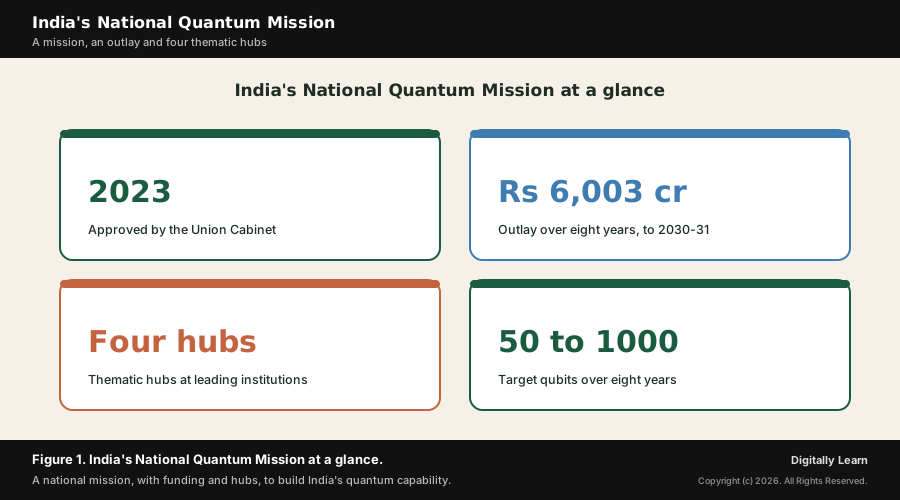
The mission was approved in 2023 with an outlay of about Rs 6,003 crore spread over eight years, to 2030-31. It is organised into four thematic hubs, each hosted at leading institutions, that divide the work between computing, communication, sensing and materials.
The aim is ambitious. Over the eight years the mission seeks to build quantum computers with between fifty and a thousand qubits, to develop secure communication over long distances, and to make the sensors, clocks and materials that quantum technology needs. The figure below sets out the mission at a glance.
Why Quantum Technology Matters
A strategic and economic frontier
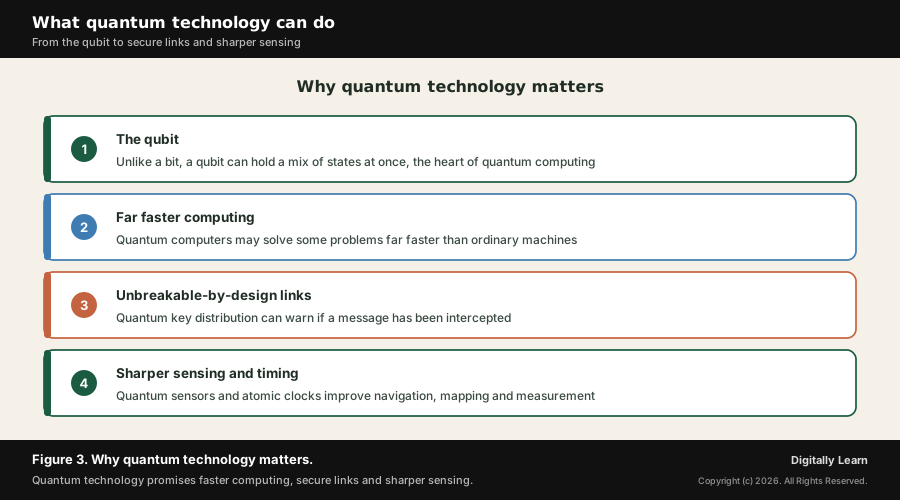
Why it matters is that quantum technology is among the most powerful of the emerging fields, with the potential to transform computing, security and measurement. A quantum computer could one day solve problems that defeat even the fastest ordinary machines.
The same physics threatens today's encryption, because a powerful quantum computer could break the codes that protect banking, defence and government data. A country that leads in quantum gains both an economic and a security edge, which is why the mission is treated as strategic.
What a Home-Grown Quantum Mission Signifies
From dependence to self-reliance
What is the significance of the mission lies in building this capability within India rather than buying it from abroad. Quantum hardware and know-how are closely guarded by the few countries that lead the field, so a national effort is the surest route to self-reliance.
By funding hubs at Indian institutions and drawing in industry and start-ups, the mission aims to grow a domestic quantum ecosystem, of skilled people, laboratories and companies, so that the gains in security and industry stay with the country. The challenge is to turn research into working technology at scale.
The National Quantum Mission and Its Four Hubs
The mission at a glance
The table sets out the key features of the mission and what each one means. Together they show a structured national effort, from the funding to the targets and the bodies that carry the work.
| Feature | Detail |
|---|---|
| The mission | The National Quantum Mission, approved in 2023 |
| Nodal department | The Department of Science and Technology |
| Outlay | About Rs 6,003 crore over eight years, to 2030-31 |
| Structure | Four thematic hubs at leading institutions |
| Computing target | Quantum computers of 50 to 1000 qubits over eight years |
| Communication target | Secure quantum communication, including satellite-based links, over long distances |
Read together, the rows show a mission that pairs a clear structure with concrete targets, the mark of a serious national technology programme.
Computing, Communication, Sensing and Materials
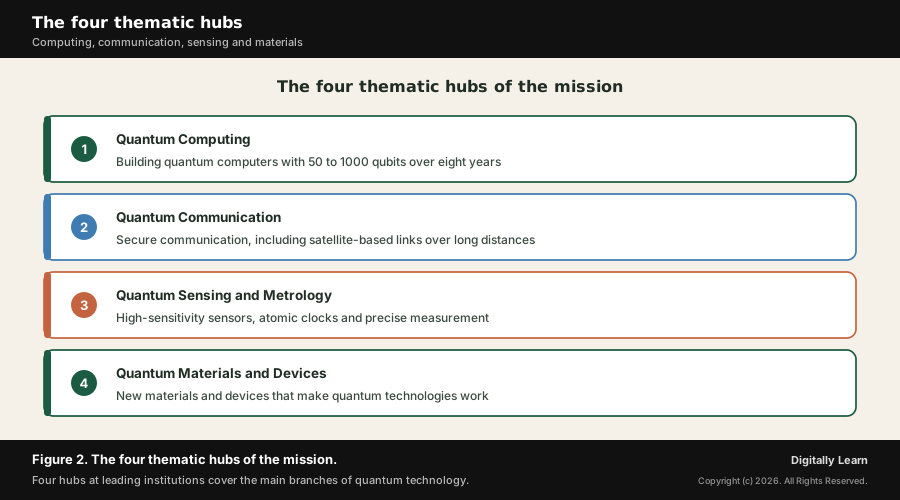
The mission divides its work among four thematic hubs. One works on quantum computing, building the machines and the qubits; a second on quantum communication, including the secure, satellite-based links that quantum physics makes possible.
A third hub works on quantum sensing and metrology, the science of measuring with extreme precision, which yields better atomic clocks, magnetometers and navigation; the fourth works on the quantum materials and devices that all the others depend on. The figure below names the four. Each hub is hosted at leading institutions such as the Indian Institute of Science and the Indian Institutes of Technology.
What to Watch in India's Quantum Effort
Three things to track from here
The mission points to three developments worth following, since a technology programme is judged by what it builds, not what it promises.
- (a) The qubit count. Whether the hubs build quantum computers that climb steadily towards the 50-to-1000 qubit target.
- (b) Secure communication. Whether quantum key distribution and satellite-based quantum links move from trials to real use.
- (c) The ecosystem. Whether skilled people, start-ups and industry grow around the hubs so the capability endures.
The real test is whether the mission turns laboratory science into technology that India can use and build on, in security, in industry and in research.
Quantum Technology and the Wider Picture
From the qubit to a global race
Contemporary linkages tie the mission to a wider global race in quantum technology. A handful of countries, among them the United States and China, have launched large national programmes, and India's mission places it in that small group.
At the heart of the field is the qubit, the quantum version of the ordinary computer bit. Where a bit is either zero or one, a qubit can hold a mix of both at once, a property called superposition, and qubits can be linked through entanglement, which together give quantum computers their power.
One of the most discussed uses is quantum key distribution, a way to share secret keys whose security rests on the laws of physics, so that any attempt to intercept the message is revealed. It connects to the wider concern of securing communication against future quantum computers, the field of post-quantum cryptography.
The mission also links to India's broader push for self-reliance in critical and emerging technologies, alongside its efforts in semiconductors, supercomputing and artificial intelligence, each a pillar of a modern, secure economy.
UPSC Relevance and Exam Focus
Where this fits in the UPSC-CSE syllabus
This topic maps to General Studies Paper III: science and technology, and developments in emerging technologies, with links to internal and external security and to the indigenisation of technology.
For Prelims, hold the high-yield facts: the National Quantum Mission and its nodal Department of Science and Technology, its four thematic hubs, the meaning of a qubit, and quantum key distribution.
For Mains, the recurring framing is how emerging technologies such as quantum computing affect security and the economy, and how India can build self-reliance in them.
Recurring linked concepts an aspirant should keep in working memory:
- Qubit: the basic unit of quantum information, able to hold a mix of states (superposition).
- Entanglement: a quantum link between particles that underlies quantum computing and communication.
- Quantum key distribution: sharing secret keys with security guaranteed by the laws of physics.
- Department of Science and Technology: the nodal department for the National Quantum Mission.
A common Prelims trap is to confuse the qubit with an ordinary bit; the qubit's power is that it can be in a mix of states at once, not just zero or one.
A common Mains trap is to treat quantum only as faster computing. It is equally about secure communication and the threat a quantum computer poses to today's encryption.
Previous Year UPSC-CSE Questions By the end you will be able to draft model answers for the following UPSC questions. Each question carries a collapsible framework showing how to approach it in the exam.
- UPSC Prelims 2022 GS-IWhich one of the following is the context in which the term "qubit" is mentioned?
How to approach this Prelims question
Approach: Recall that the qubit, or quantum bit, is the basic unit of information in quantum computing.
Trap to watch: The distractors (cloud services, visible-light and wireless communication) are unrelated; the qubit belongs to quantum computing.
Key facts to recall:
- A qubit is the quantum analogue of a classical bit.
- It can hold a mix of states (superposition), unlike a bit.
- It is the basic unit used in quantum computing.
Answer signal: The term qubit is used in the context of Quantum Computing.
Sources and Further Reading
Editorial Disclaimer
This briefing is for UPSC preparation. Verify the provisions and figures against the official Press Information Bureau and Department of Science and Technology sources before relying on them.


