


Overview
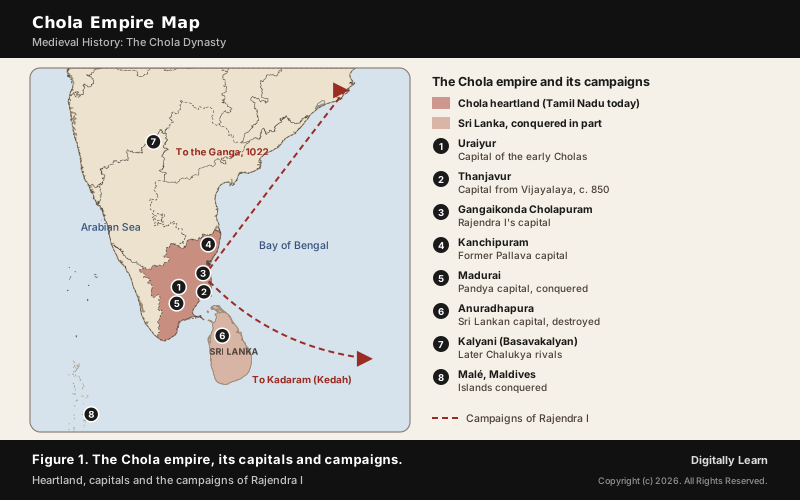
The Chola dynasty was a Tamil dynasty from the Kaveri valley that built the largest empire of medieval south India. The imperial line was founded by Vijayalaya, who captured Thanjavur in the middle of the ninth century; Rajaraja I and Rajendra I carried Chola power to Sri Lanka, the Maldives, the Ganga and South-East Asia. The Cholas ruled through a powerful king, a hierarchy of provinces and districts, and village assemblies, and built the great temples of Thanjavur and Gangaikonda Cholapuram.
Origins of the Cholas: From the Sangam Age to Vijayalaya
Early Cholas: Ashokan Edicts, Sangam Literature and Uraiyur
The Cholas were one of the three crowned kings of the Tamil country, with the Cheras and the Pandyas, and their heartland was the fertile valley of the Kaveri. The earliest datable references to them come from inscriptions of the third century BCE, in the reign of the Mauryan emperor Ashoka.
- Ashoka’s neighbours: The Ashokan edicts name the Cholas among the Mauryan empire’s southern neighbours, not subject to Ashoka but on friendly terms.
- Sangam kings: Karikala and Kocengannan are the best-known Chola kings of Sangam literature.
- Foreign notices: The Periplus of the Erythraean Sea and the geographer Ptolemy mention the Chola country, its towns, ports and commerce.
- Early capitals: Uraiyur (now part of Tiruchirappalli) was the oldest capital, and Kaveripattinam (Puhar) also served as one.
- Eclipse: After the Kalabhra invasion and the rise of the Pallavas, the Cholas survived for about three centuries as minor chiefs.
Chola Dynasty Founder: Vijayalaya and the Capture of Thanjavur
The founder of the Chola empire was Vijayalaya, at first a feudatory of the Pallavas. A minor chiefly family, the Muttaraiyar, held the Kaveri delta under the Pallava kings of Kanchipuram; Vijayalaya, of the ancient Chola family of Uraiyur, captured the delta from them in the middle of the ninth century. He built the town of Thanjavur and a temple for the goddess Nishumbhasudini there.
- Growth: His successors conquered the Pandya and Pallava territories to the south and north.
- Setback: The Rashtrakuta king Krishna III defeated Parantaka I in 949 and annexed the northern part of the Chola empire.
- Recovery: The Cholas recovered quickly after Krishna III’s death in 965 and the fall of the Rashtrakutas.
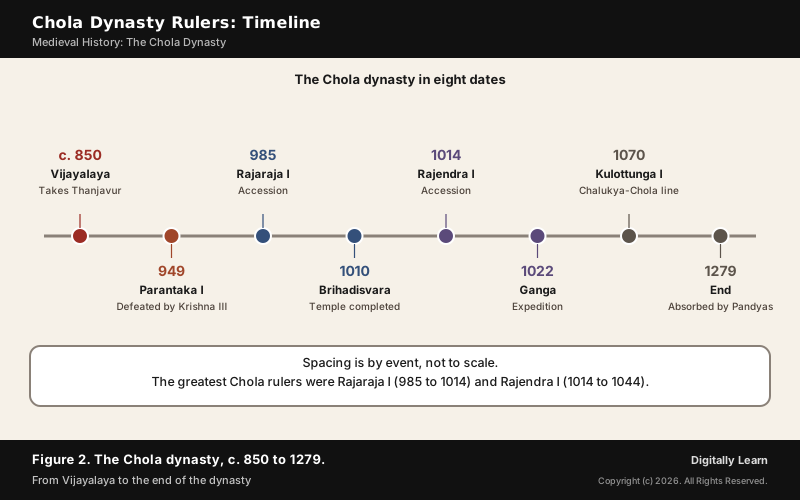
The Chola dynasty time period, for the imperial line, runs from about 850 to the thirteenth century. The dynasty stayed stable until 1215, and was absorbed by the Pandyan empire, ceasing to exist by 1279.
Chola Dynasty Rulers: Rajaraja I, Rajendra I and the Later Cholas
Rajaraja I (985 to 1014): Conquests and Reorganisation
The greatest Chola rulers were Rajaraja I (985 to 1014) and his son Rajendra I (1014 to 1044). Rajaraja had been appointed heir apparent in his father's lifetime and had long experience of administration and war before he took the throne.
- Navy and the west coast: He destroyed the Chera navy and attacked Quilon (Kollam).
- The Pandyas: He conquered Madurai and captured the Pandyan king.
- Sri Lanka: He invaded Sri Lanka and annexed its northern part to his empire.
- The Maldives: One of his naval exploits was the conquest of the Maldive Islands.
- Trade motive: These moves were partly meant to bring trade with South-East Asia under Chola control.
Rajaraja also reorganised the empire. He began a land survey and assessment in 1000 that regrouped the Tamil country into units called valanadus, and he built the Brihadisvara temple at Thanjavur, completed in 1010.
Rajendra I (1014 to 1044): The Ganga Expedition and Srivijaya
His son, Rajendra I, carried his father's policy further. He completed the conquest of Sri Lanka and extended Chola rule over the Pandya and Chera lands. In 1018 his forces took the Maldives and the Lakshadweep islands.
- To the Ganga: A Chola army marched across Kalinga to Bengal, crossed the Ganga and defeated local kings; the expedition ended in 1022.
- New title and capital: Rajendra took the title Gangaikondachola and built Gangaikonda Cholapuram, the capital of the Cholas for about 250 years.
- Srivijaya: A naval expedition against the Srivijaya empire, which controlled the sea route to China, took Kadaram (Kedah) and places in the Malay peninsula and Sumatra.
- A Chola lake: For a time the Chola navy was the strongest in the region, and the Bay of Bengal became a Chola lake.
- Embassies to China: Chola embassies reached China in 1016 and 1033.
India still marks his reign. In July 2025 the Ministry of Culture held the Aadi Thiruvathirai festival at Gangaikonda Cholapuram, commemorating 1,000 years of Rajendra I's maritime expedition to South-East Asia and of the start of the temple there.
Later Cholas and the Decline of the Chola Empire
The later Cholas fought constantly with the later Chalukyas of Kalyani over Vengi, the Tungabhadra doab and the Ganga country of north-west Karnataka. Neither side won decisively, and the struggle exhausted both empires.
- Harsh wars: Chola armies sacked Chalukyan cities, including Kalyani, and destroyed Anuradhapura, the old capital of Sri Lanka.
- Chalukya-Chola line: In 1070 Kulottunga I took the Chola throne, beginning the later Chola or Chalukya-Chola period.
- Trade with China: A Chola embassy of 70 merchants reached China in 1077.
- After conquest: Once they had conquered a country, the Cholas tried to set up a sound system of administration there, encouraging local self-government in the villages.
- Decline: The empire declined in the early thirteenth century, and its place was taken by the Pandyas and the Hoysalas.
| Ruler | Reign | Main achievement |
|---|---|---|
| Vijayalaya | c. 850 | Captured Thanjavur; founded the imperial line |
| Parantaka I | Defeated 949 | Lost the north to Krishna III |
| Rajaraja I | 985 to 1014 | Northern Sri Lanka, Maldives; Brihadisvara temple |
| Rajendra I | 1014 to 1044 | Ganga expedition; Srivijaya campaign; new capital |
| Kulottunga I | From 1070 | Began the Chalukya-Chola line |
Chola Empire: Capitals, Extent, Map and Symbol
Chola Dynasty Capitals and the Extent of the Chola Empire
The Chola capitals moved as the empire grew. The early Cholas ruled from Uraiyur and Puhar; Vijayalaya made Thanjavur the main city, and Rajendra I established Gangaikonda Cholapuram after his Ganga campaign. Kanchipuram and Madurai served as regional capitals where courts were sometimes held.
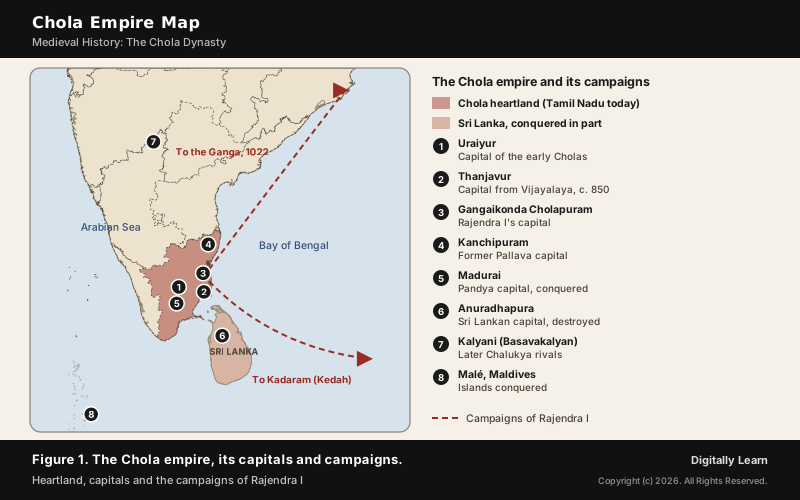
- Extent: Between 980 and about 1150 the empire covered the whole peninsula from sea to sea, bounded in the north by the Tungabhadra and the Vengi frontier.
- Unification: The Cholas unified peninsular India south of the Tungabhadra and held it as one state for three centuries.
- Why a new capital: Rajendra I founded Gangaikonda Cholapuram to commemorate his victory over the Pala dynasty, for administrative and strategic reasons; today it is a small village remembered by its temple.
- Chola dynasty symbol: The tiger emblem; before Rajaraja’s reign, Chola coins carried the tiger, with the fish and bow of the Pandyas and Cheras.
Chola Administration: King, Officials and Divisions
The Chola King and the Central Government
The king was the most important person in Chola administration, and all authority rested in his hands. Chola monarchs took titles such as Chakravartigal (emperor) and Tribhuvana-Chakravartin (emperor of the three worlds). From Rajaraja's time the crown prince took part in administration, and princes were made regional governors.
- Orders: The king issued oral commands, which an official called the Tirumandira Olai Nayagam recorded on palm leaf; many were inscribed on temple walls.
- Officials: A hierarchy of officials with titles such as Marayan and Adigarigal served at the crown’s pleasure, with Perundanam and Sirutanam marking seniority.
- Pay: Officials were generally paid with assignments of revenue-bearing land.
- Tours and audits: Kings toured to keep in touch with administration, and officials’ work was audited; officials who delayed recording a grant under Uttama Chola were punished.
Sources differ on the ministers. One account says the king had a council of ministers to advise him; another finds no definite evidence of such a council, only the names of individual ministers in inscriptions. Both agree that a powerful bureaucracy carried out the king's orders.
Chola Administrative Divisions, Army and Revenue
The empire was divided into mandalams or provinces, each divided into valanadus and nadus. At the empire's height there were eight or nine provinces, including Sri Lanka.
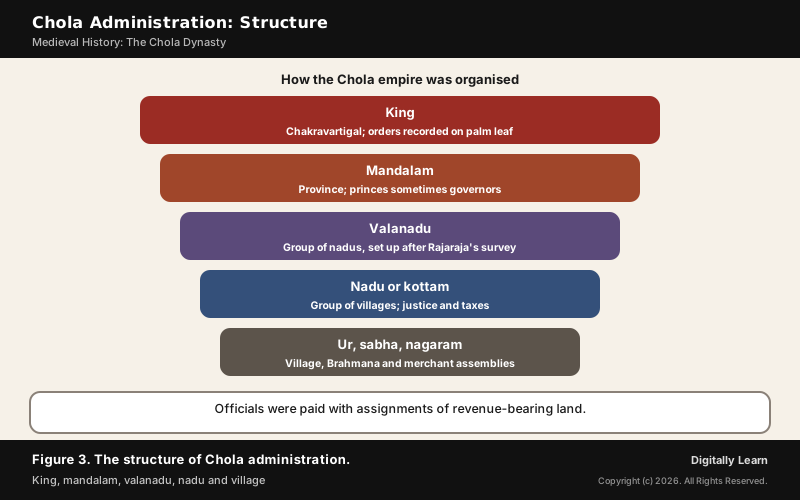
- Villages and nadu: Villages (ur) grouped into a nadu, and the village council and the nadu collected taxes and dispensed justice.
- Army: Elephants, cavalry and infantry, called the three limbs of the army, and a strong navy that for a time dominated the Bay of Bengal.
- Revenue: Some Chola rulers surveyed land to fix the government’s share; they also took tolls on trade and taxes on professions. Kulottunga I made an extensive resurvey around 1089.
- Roads and irrigation: They built royal roads for trade and troops, and tanks and channels from the Kaveri for irrigation.
Chola Achievements in Art and Architecture
Great Living Chola Temples and Chola Bronzes
Temple architecture in the south reached its climax under the Cholas, in the style called Dravida. Storeys rose above the sanctum to form the vimana; a pillared hall, the mandap, stood in front; and high walls pierced by gateways called gopurams enclosed the courtyard.
- Brihadisvara, Thanjavur: Begun by Rajaraja I around 1003 to 1004 and consecrated around 1009 to 1010; its vimana rises 59.82 metres.
- Gangaikonda Cholapuram: Rajendra I’s temple, second in scale only to Thanjavur, with a main tower 55 metres tall.
- World Heritage: With the Airavatesvara temple at Darasuram, these form the UNESCO site of the Great Living Chola Temples, still used for worship.
- Bronzes: Chola bronze images, including the dancing Shiva (Nataraja), are considered among the finest in the world.
Temples were more than places of worship. Endowed with land, they became the nuclei of settlements and centres of craft production, and the hub of the economic, social and cultural life of the region. Some grew so rich that they lent money and took part in business, and spent on wells, tanks and irrigation channels that expanded farming.
Literature flourished too. The age of Kamban, in the late eleventh and early twelfth centuries, is regarded as a golden age of Tamil literature, and his Ramayana is a classic; Kamban is believed to have lived at a Chola court.
Previous Year UPSC-CSE Questions
Previous Year UPSC-CSE Questions By the end you will be able to draft model answers for the following UPSC questions. Each question carries a collapsible framework showing how to approach it in the exam.
- UPSC Mains 2024 GS-I“Though the great Cholas are no more yet their name is still remembered with great pride because of their highest achievements in the domain of art and architecture.” Comment.
How to structure the answer in the exam
Introduction: Temple architecture in the south reached its climax under the Cholas, in the Dravida style.
Body (sub-themes to develop):
- Dravida style: vimana, mandap, gopuram and walled courtyards.
- Brihadisvara at Thanjavur (vimana 59.82 m), Gangaikonda Cholapuram, Darasuram: UNESCO Great Living Chola Temples.
- Chola bronzes, including Nataraja, among the finest in the world.
- Temples as landholders and centres of craft, economy and culture.
Conclusion: Conclude that the living temples keep the Chola name alive, as shown by the 2025 commemoration at Gangaikonda Cholapuram.
- UPSC Prelims 2001 Prelims-GSWhich one of the Chola kings conquered Ceylon?
How to approach this Prelims question
Approach: Recall which ruler first annexed part of Sri Lanka.
Trap to watch: Rajendra I completed the conquest, but Rajaraja I conquered Ceylon first.
Key facts to recall:
- Rajaraja I annexed northern Sri Lanka
Answer signal: Rajaraja I: option (b).
- UPSC Prelims 2003 Prelims-GSConsider the following statements:
- The Cholas defeated Pandya and Chera rulers and established their domination over peninsular India in early medieval times.
- The Cholas sent an expedition against the Sailendra empire of South-East Asia and conquered some of the areas. Which of these statements is/are correct?
How to approach this Prelims question
Approach: Check each statement against the Chola conquests.
Trap to watch: The Sailendra rulers of Srivijaya had earlier been friendly with the Cholas, but Rajendra I still attacked.
Key facts to recall:
- Pandya and Chera lands conquered
- Kadaram and places in Malaya and Sumatra taken
Answer signal: Both 1 and 2: option (c).
Sources and Further Reading
- NCERT: Our Pasts II (Class VII), New Kings and Kingdoms
- UNESCO World Heritage Centre: Great Living Chola Temples
- PIB: Celebrating the legacy of Rajendra Chola I, Aadi Thiruvathirai Festival (2025)
- Tamil Nadu Tourism (Government of Tamil Nadu): Gangaikonda Cholapuram
- Wikipedia: Chola dynasty
- Wikipedia: Chola Empire
- Wikipedia: Chola government
- Wikipedia: Vijayalaya Chola
- Wikipedia: Rajaraja I
- Wikipedia: Rajendra I
- Wikipedia: Gangaikonda Cholapuram
- UPSC: Previous year question papers
Editorial Disclaimer
This article explains the Chola dynasty and its central administration for UPSC preparation. Dates, figures and attributions reflect the cited sources.