


Overview
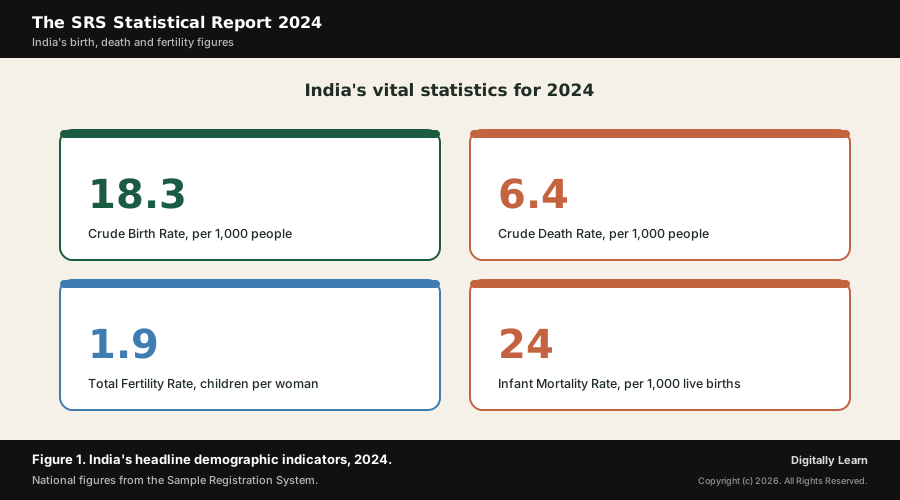
The Sample Registration System Statistical Report 2024, released by the Office of the Registrar General of India, is the country's main source of annual figures on births, deaths and fertility. For the year 2024 it puts India's crude birth rate at 18.3 per 1,000 people, the crude death rate at 6.4, the infant mortality rate at 24 per 1,000 live births, and the total fertility rate at 1.9 children per woman. A fertility rate of 1.9 is below the replacement level of about 2.1, the point at which a population renews itself, marking a turning point in India's demographic story.
India Releases the SRS Statistical Report 2024
India's vital statistics for the year 2024
The Office of the Registrar General of India has released the Sample Registration System Statistical Report for 2024, the official record of the country's births, deaths and fertility. It is the single most-watched source of these demographic figures, used by every ministry that plans for the future.
For 2024, the report puts India's crude birth rate at 18.3 per 1,000 people and the crude death rate at 6.4. The infant mortality rate has fallen to 24 per 1,000 live births, down from 30 in 2019, a steady improvement in the survival of newborns.
The headline figure is the total fertility rate, the average number of children a woman is expected to have. At 1.9, it sits below the replacement level of about 2.1, meaning that, on average, each generation is no longer quite replacing itself.
Why India's Vital Statistics Matter
A nation reading its own births and deaths
Why it matters is that birth and death rates are the raw material of nearly every long-term plan a country makes. How many schools, hospitals, homes and jobs India will need decades from now depends on how many children are born today and how long people live.
A falling birth rate and a falling infant mortality rate are signs of progress in health, education and the status of women. But a fertility rate below replacement also carries a warning: the supply of young workers will eventually shrink, and the share of older people will rise.
The Significance of the 2024 Demographic Figures
A country growing more slowly and beginning to age
What is the significance of this fertility figure lies in what it foretells. A total fertility rate of 1.9 does not mean the population is falling now; India will keep growing for some years because of its young age structure. It means the momentum of growth is slowing and will one day stop.
The report also shows that nearly two-thirds of Indians, 66.4 percent, are of working age, between 15 and 59, while only 9.7 percent are aged 60 and above. This wide base of working-age people is the much-discussed demographic dividend, but it is a window that will not stay open forever.
The Four Core Indicators and Their 2024 Values
India's fertility and mortality indicators at a glance
The table sets out the main national figures from the report and what each one means. Read together, they describe a country where both births and deaths are becoming less frequent relative to the size of the population.
| Indicator | India, 2024 | What it means |
|---|---|---|
| Crude Birth Rate | 18.3 per 1,000 | Live births in a year per 1,000 people |
| Crude Death Rate | 6.4 per 1,000 | Deaths in a year per 1,000 people |
| Total Fertility Rate | 1.9 | Children per woman, below replacement (about 2.1) |
| Infant Mortality Rate | 24 per 1,000 | Infant deaths under one year per 1,000 live births |
| Under-five Mortality Rate | 28 per 1,000 | Deaths before age five per 1,000 live births |
| Sex Ratio at Birth | 918 (2022-24) | Girls born per 1,000 boys |
The spread across States is wide. Bihar has the highest fertility rate at 2.9, while Delhi has the lowest at 1.2; sixteen States and Union Territories now have fertility below the replacement level.
Birth Rate, Death Rate, Fertility and Mortality Defined
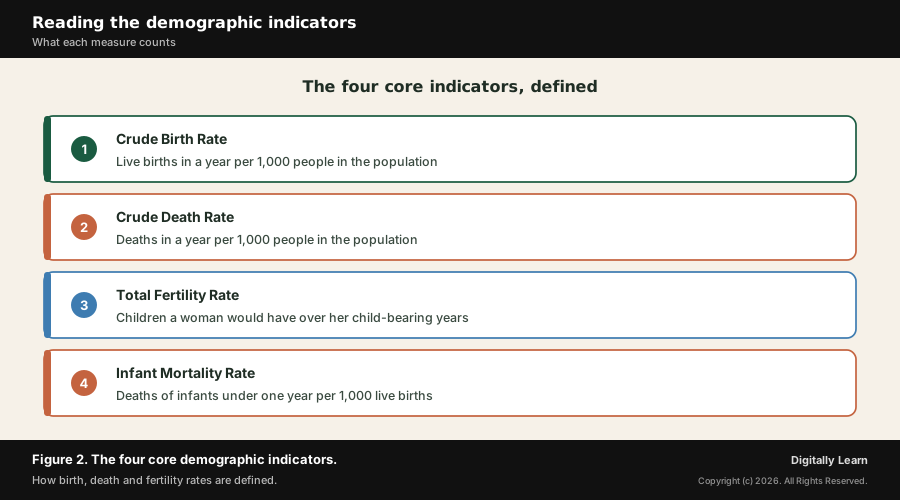
The crude birth rate is the number of live births in a year for every 1,000 people, and the crude death rate is the number of deaths in a year for every 1,000 people. Both are simple, widely used measures of how fast a population is being added to or reduced.
The total fertility rate is the average number of children a woman would have over her child-bearing years at current rates. The infant mortality rate counts the deaths of infants under one year of age for every 1,000 live births, a sensitive gauge of a country's health system.
Demographic Shifts to Track from Here
Three trends that will shape India's population
The 2024 figures point to three shifts that will define India's demography in the coming decades, since the path of a population is set by today's births and deaths.
- (a) Below-replacement fertility. Whether the total fertility rate keeps falling, as it has in richer States, and how soon the national population stops growing.
- (b) An ageing society. Whether India prepares, through pensions and health care, for a rising share of people aged sixty and above.
- (c) The dividend window. Whether the large working-age population is given the education, skills and jobs to turn numbers into national prosperity.
The real test is whether India can grow prosperous and build its institutions while its working-age share is still large, before the population ages and the demographic dividend begins to close.
Demographic Dividend, Ageing and Population Policy
How the SRS connects to India's population debates
Contemporary linkages tie these figures to some of India's largest debates. The demographic dividend, the economic boost a country can get when its working-age population is large relative to dependants, rests directly on the age structure the SRS measures.
The numbers also feed the debate over an ageing society and the future of pensions and elder care, and the discussion of replacement-level fertility that shapes how India thinks about population, family size and the long-delayed delimitation of parliamentary seats by population.
They connect, too, to the wider goals of human development: a falling infant mortality rate reflects better maternal and child health, while the gap between States shows how much still depends on education, income and the status of women.
For policy, the lesson is that India's population challenge is no longer mainly about growing too fast. It is about using a one-time demographic advantage wisely, and preparing early for the ageing that below-replacement fertility makes certain.
UPSC Relevance and Exam Focus
Where this fits in the UPSC-CSE syllabus
This topic maps to General Studies Paper I: population and associated issues, and to Paper II through health and social-sector policy, making it one of the most reliably examined areas of Indian society.
For Prelims, hold the precise definitions and figures: the total fertility rate as children per woman, the replacement level of about 2.1, the infant mortality rate as deaths under one year per 1,000 live births, and that the Registrar General of India conducts the Sample Registration System.
For Mains, two framings recur: whether India is heading towards a low-fertility future, the idea behind the 2024 question on a demographic winter, and how the country can realise its demographic dividend through education, skills and jobs.
Recurring linked concepts an aspirant should keep in working memory:
- Replacement-level fertility: a total fertility rate of about 2.1, at which a population renews itself.
- Demographic dividend: the growth potential of a large working-age population.
- Demographic transition: the shift from high birth and death rates to low ones as a country develops.
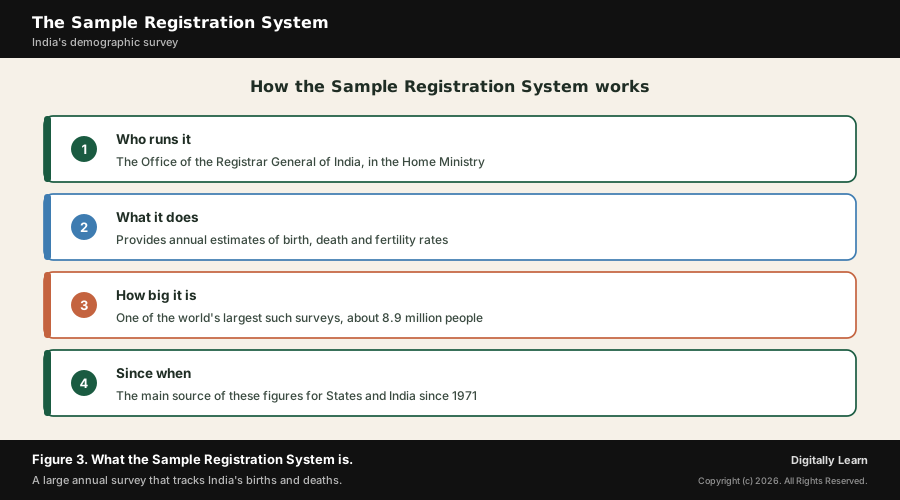
- Sample Registration System: the large annual survey by the Registrar General that yields these rates.
A common Prelims trap is to confuse the infant mortality rate, which uses a denominator of 1,000 live births and counts deaths within the first year, with deaths within a month or per 100 births.
A common Mains trap is to treat a large population as purely a burden. The demographic dividend means a young population can be an asset, if it is educated, healthy and employed.
Previous Year UPSC-CSE Questions By the end you will be able to draft model answers for the following UPSC questions. Each question carries a collapsible framework showing how to approach it in the exam.
- UPSC Mains 2024 GS-IWhat is the concept of a 'demographic Winter'? Is the world moving towards such a situation? Elaborate.
How to structure the answer in the exam
Introduction: Define a demographic winter as a prolonged period of below-replacement fertility and population ageing.
Body (sub-themes to develop):
- Concept: fertility persistently below the replacement level of about 2.1, leading to an ageing and shrinking population.
- Global picture: many developed and middle-income countries already have low fertility; India's total fertility rate has now fallen to 1.9.
- Drivers: rising incomes, education, urbanisation, later marriage and the higher status of women.
- Consequences: a smaller workforce, a rising old-age dependency and pressure on pensions and health care.
Conclusion: Conclude that parts of the world, and increasingly India, are edging towards below-replacement fertility, making early preparation for ageing essential.
- UPSC Prelims 2024 GS-IThe total fertility rate in an economy is defined as :
How to approach this Prelims question
Approach: Recall the precise definition of the total fertility rate.
Trap to watch: Do not confuse it with the crude birth rate (births per 1,000 people) or the natural growth rate (birth rate minus death rate).
Key facts to recall:
- The total fertility rate is the average number of live births a woman would have by the end of her child-bearing age.
- The replacement level is a total fertility rate of about 2.1.
Answer signal: The average number of live births a woman would have by the end of her child-bearing age.
- UPSC Prelims 2009 GS-IConsider the following statements :
- Infant mortality rate takes into account the death of infants within a month after birth.
- Infant mortality rate is the number of infant deaths in a particular year, per 100 live births during that year.
Which of the above statements is/are correct ?
How to approach this Prelims question
Approach: Test each statement against the precise definition of the infant mortality rate.
Trap to watch: The infant mortality rate covers the first year of life, not the first month, and uses a denominator of 1,000 live births, not 100.
Key facts to recall:
- The infant mortality rate counts deaths of infants under one year of age.
- It is expressed per 1,000 live births in the year.
Answer signal: Both statements are wrong, so the answer is Neither 1 nor 2.
Sources and Further Reading
- Office of the Registrar General of India: Sample Registration System Statistical Report 2024
- Office of the Registrar General of India: SRS Statistical Reports catalogue
- Office of the Registrar General of India: Vital Statistics Division
- Press Information Bureau: steady downward trend in maternal and child mortality
- Ministry of Health and Family Welfare: maternal and child health indicators
Editorial Disclaimer
This briefing is for UPSC preparation. Verify the latest figures against the official Sample Registration System report of the Registrar General of India before relying on them.


