


Overview
The High-Level Committee on Demographic Change is an expert panel set up by the Government of India through the Ministry of Home Affairs in May 2026. Chaired by retired judge Justice Prakash Prabhakar Navlekar, it has been tasked with the scientific study of the nature, causes and consequences of demographic change across the country. It must recommend policy, administrative and legal measures to address them. The committee is part of the Demography Mission, and it is expected to submit its report within one year.
Why the demographic-change committee is in focus
A new expert panel on demographic change
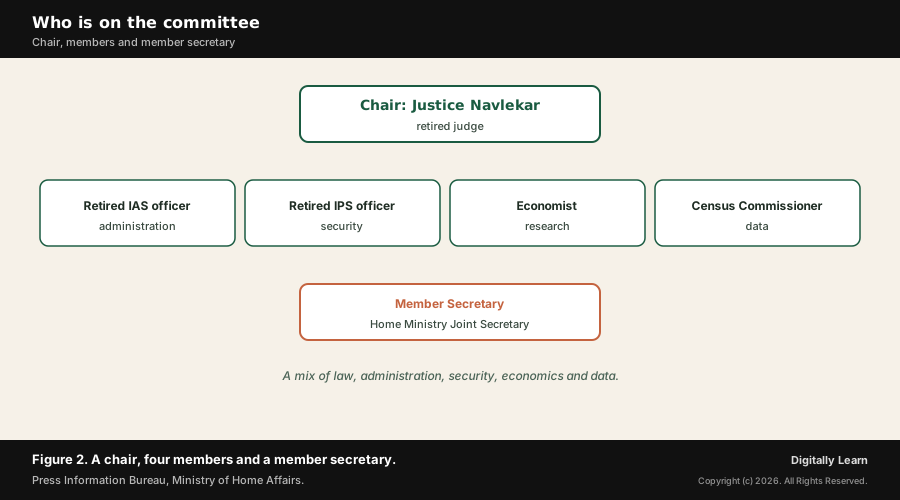
The Government of India, through the Ministry of Home Affairs, constituted a High-Level Committee on Demographic Change in May 2026. It is chaired by retired judge Justice Prakash Prabhakar Navlekar.
A high-level committee is an expert body the government sets up to study a complex issue in depth and to recommend measures. This one is tasked with examining demographic change across the country.
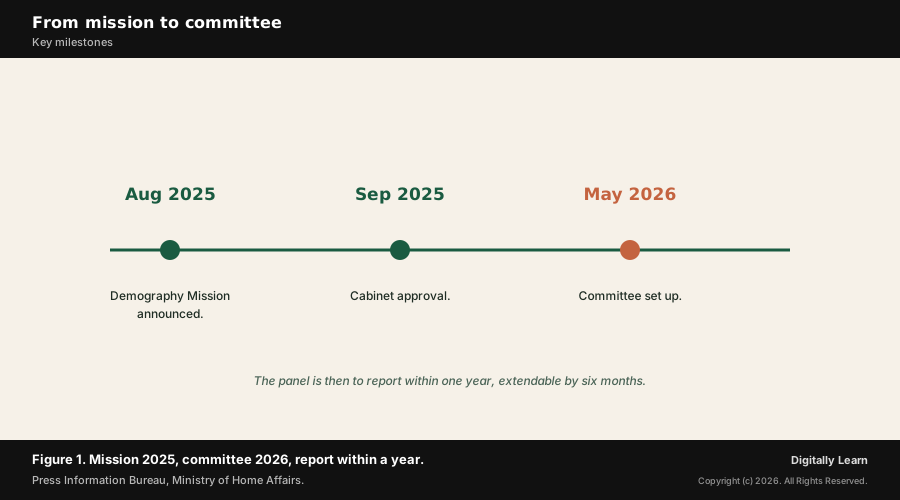
The committee flows from the Demography Mission, announced by the Prime Minister on 15 August 2025 and approved by the Union Cabinet on 11 September 2025. The panel gives the mission its expert, investigative arm.
The key features of the committee are:
- Chair: retired judge Justice Prakash Prabhakar Navlekar.
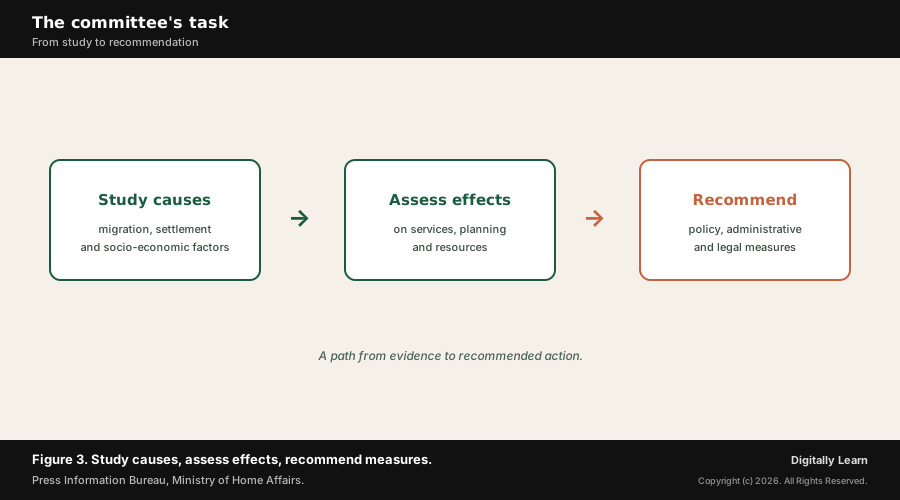
- Mandate: study the nature, causes and consequences of demographic change.
- Output: recommend policy, administrative and legal measures.
- Timeline: report within one year, extendable by up to six months.
Why the committee matters
Demography shapes policy and planning
Demographic change shapes the demand for jobs, housing, schools and health care. A clear, evidence-based picture of how the population is changing helps the state plan services and target resources.
The committee gives the issue an institutional home. Rather than ad hoc debate, it offers a structured, expert study, with the authority to seek records and data from ministries, states and other public bodies.
It also matters because the panel reports to a fixed timeline. A report within a year, extendable by six months, is meant to turn study into concrete policy, legal and administrative recommendations.
What the committee signifies
Evidence, breadth of mandate, and policy intent
Three threads carry the weight: a turn to evidence, the breadth of the mandate, and a clear intent to translate findings into policy.
First, the turn to evidence. The panel is asked for a scientific study of demographic change, drawing on official data, so that policy rests on analysis rather than assertion.
Second, the breadth of mandate. It will examine the causes of demographic change, including illegal immigration, cross-border movement, settlement patterns and socio-economic factors, across regions.
Third, the policy intent. The committee must not only describe change but also recommend policy, administrative and legal measures, which signals that action is expected to follow.
Distinguishing features of the committee
The committee at a glance
The table sets out the key facts, so the composition and mandate of the panel are visible at a glance.
| Feature | Detail |
|---|---|
| Set up by | Government of India, Ministry of Home Affairs |
| Chair | Justice Prakash Prabhakar Navlekar (retired) |
| Parent initiative | Demography Mission (announced 2025) |
| Core task | Study causes and consequences of demographic change |
| Reporting time | One year, extendable by six months |
Three features that define the committee
Three elements set this committee apart from a routine review:
- (i) A mixed panel. It brings together a retired judge, senior former officials, an economist and the Census Commissioner.
- (ii) Power to gather data. It can seek records and information from ministries, states and other public bodies.
- (iii) A fixed deadline. It must report within a year, keeping the study time-bound and action-oriented.
Observable outcomes
Three trackable outcomes
The committee translates into three developments to watch over the coming year.
- (a) Data gathering. The panel will collect records and evidence from ministries, states and public bodies.
- (b) A report with recommendations. Within a year, it is to submit findings and proposed measures.
- (c) Possible policy follow-up. Its legal and administrative proposals may shape later government action.
A committee studies and recommends; it does not legislate. Whether its proposals are accepted and acted on is a separate, later test of its impact.
Demography, the census and India's planning
The census, the demographic dividend and policy
The committee's work depends on the census, India's primary count of the population, which provides the baseline data for any study of demographic change.
It connects to the idea of the demographic dividend, the growth opportunity from a large working-age population, which depends on understanding how the age structure is shifting.
It also links to wider planning, since population trends shape decisions on jobs, housing, education, health and the sharing of resources between regions.
UPSC relevance and exam focus
Where this fits in the UPSC-CSE syllabus
This topic maps to General Studies Paper I: population and associated issues, and to General Studies Paper II: governance and the appointment of bodies, with links to internal security in Paper III.
For Prelims, hold the high-yield facts: the committee is set up by the Ministry of Home Affairs, chaired by Justice Navlekar, and is part of the Demography Mission.
For Mains, two framings recur: the drivers and effects of demographic change, and the role of expert committees in shaping policy.
Recurring linked concepts an aspirant should keep in working memory:
- Census: India’s official population count and data base.
- Demographic dividend: growth potential from a large working-age population.
- Demography Mission: the broader initiative behind the committee.
- Internal migration: movement of people within and across borders.
The committee was set up by the Ministry of Home Affairs, not by the Election Commission or the statistics ministry. Mixing up the parent ministry is an easy error.
Do not treat demographic change as a single cause. The committee itself lists several drivers, so a balanced answer weighs many factors together.
Previous Year UPSC-CSE Questions By the end you will be able to draft model answers for the following UPSC questions. Each question carries a collapsible framework showing how to approach it in the exam.
- UPSC Mains 2014 GS-IIIHow does illegal transborder migration pose a threat to India’s security? Discuss the strategies to curb this, bringing out the factors which give impetus to such migration.
How to structure the answer in the exam
Introduction: Open with illegal cross-border migration as a security and demographic concern.
Body (sub-themes to develop):
- Security effects: pressure on resources, identity and border management.
- Drivers: porous borders, economic pull and weak documentation.
- Strategies: border fencing, surveillance and verification.
- The role of data and registers in tracking movement.
- The committee's mandate to study causes and recommend measures.
Conclusion: Conclude that a mix of border management, evidence and humane policy is needed.
- UPSC Prelims 2011India is regarded as a country with “Demographic Dividend”. This is due to
How to approach this Prelims question
Approach: Recall what gives a country a demographic dividend.
Trap to watch: The dividend comes from the working-age group of 15 to 64 years, not from a high total population or a young or old age group alone.
Key facts to recall:
- The demographic dividend is the growth potential from a large working-age population.
- The working-age band is taken as 15 to 64 years.
- It must be realised through jobs, skills and health.
Answer signal: The working-age share drives the dividend. Correct answer: its high population in the age group of 15-64 years.
Sources and Further Reading
- Press Information Bureau: The Government of India constitutes the High-Level Committee on Demographic Change
- Ministry of Home Affairs, Government of India
- Office of the Registrar General and Census Commissioner, India
- Press Information Bureau: Rising population growth and demographic changes
- Wikipedia: Demographics of India
- United Nations: Sustainable Development Goal 10
Editorial Disclaimer
This article is compiled from the reference materials listed in the Sources section. It is an explainer for UPSC preparation and is not a substitute for primary documents (NCERTs, GoI ministry releases, IMD bulletins, RBI / CEA / MoEFCC publications, and Standing-Committee reports).


