


Overview
In June 2026, the Agricultural and Processed Food Products Export Development Authority, known as APEDA, facilitated India's first sea shipment of value-added, ready-to-cook millet functional foods, sent from Karnataka to New Zealand. Millets, branded in India as Shree Anna, are nutritious, climate-hardy grains. The shipment of processed millet products, rather than raw grain, marks a step in India's push for higher-value agricultural exports and better incomes for the farmers who grow these grains.
APEDA Ships India's First Sea Consignment of Millet Foods
Value-added millet foods head abroad by sea
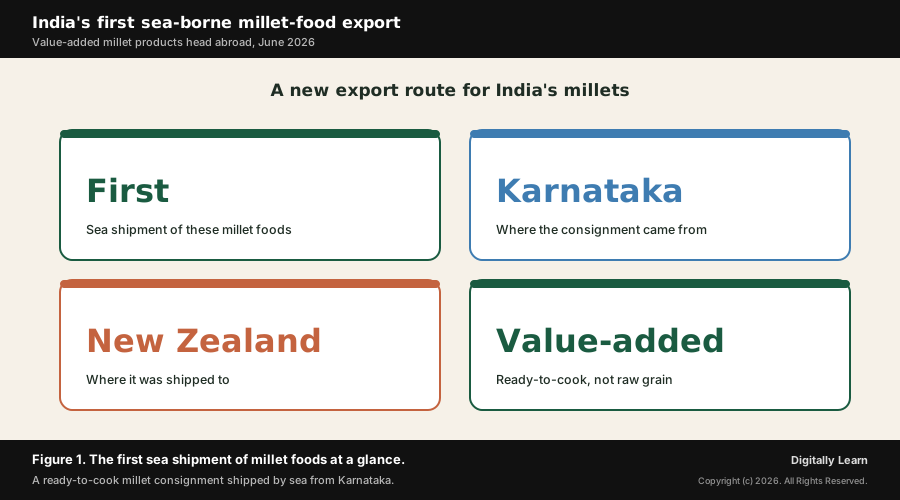
In June 2026, India sent its first sea shipment of value-added, ready-to-cook millet functional foods, from Karnataka to New Zealand. The export was facilitated by APEDA, the government body that promotes farm and processed-food exports.
The consignment was a small but symbolic one of processed millet products, shipped by a Bengaluru-based firm. What made it notable was that it carried value-added foods, ready to cook, rather than raw grain sold in bulk.
Shipping by sea, rather than by air, also matters for trade in foods. Sea freight is far cheaper for bulk goods, so a successful sea consignment suggests millet products can be exported at a scale and price that work in foreign markets.
Why Value-Added Millet Exports Matter
Earning more from processed grain
Why it matters is that exporting processed foods earns far more than selling raw grain. Turning millets into ready-to-cook products adds value within India, keeping more of the final price, and the jobs, at home.
It also taps a rising global appetite for healthy, gluten-free foods. As demand for nutritious grains grows abroad, millet exports can open a new market for India's traditional crops and lift the incomes of the farmers who grow them.
What the First Sea Shipment Signifies
From raw grain to processed foods
What is the significance of this shipment lies less in its size than in the shift it shows. India has long exported farm goods as raw commodities; moving up to processed, branded foods is the harder and more rewarding step.
A first sea consignment proves that Indian millet products can meet the standards and the costs of an overseas market. If it is followed by larger orders, it points to a route by which India turns a traditional grain into a modern export.
Millets, Their Value and India's Export Body
The first sea shipment of millet foods at a glance
The table sets out the key facts of the shipment and what each one means. Together they show a value-added farm export, facilitated by a government body, opening a new market.
| Feature | Detail |
|---|---|
| What | India's first sea shipment of value-added, ready-to-cook millet functional foods |
| Facilitated by | APEDA, the agricultural and processed-food export body |
| From and to | From Karnataka to New Zealand |
| Quantity | About one tonne of value-added millet products |
| Exporter | A Bengaluru-based firm |
| When | June 2026 |
Read together, the rows show the model India is chasing: processed foods made from a home-grown grain, sold into a willing foreign market.
Millets as Nutri-Cereals and India's Export Authority
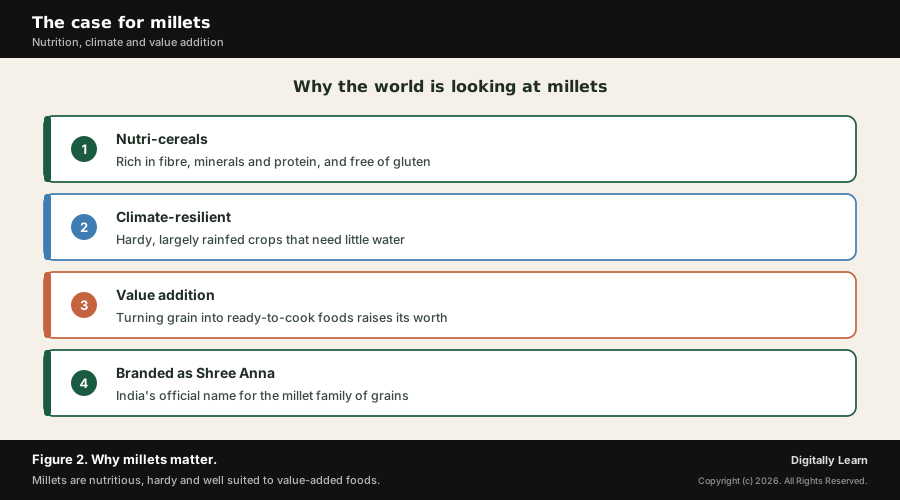
Millets are a group of small-grained cereals, including sorghum, pearl millet and finger millet, known in India as jowar, bajra and ragi. They are rich in fibre, minerals and protein, are gluten-free, and are branded by the government as Shree Anna.
The export was facilitated by APEDA, the Agricultural and Processed Food Products Export Development Authority, a body under the commerce ministry that promotes the export of farm and processed-food products and helps exporters meet foreign standards.
What to Watch in India's Millet Exports
Three things to track from here
The shipment points to three developments worth following, since a first consignment is a test of a market rather than proof of a settled trade.
- (a) Repeat orders. Whether the first shipment is followed by larger and regular orders from abroad.
- (b) Farmer gains. Whether rising exports actually lift the incomes of millet-growing farmers.
- (c) The product range. Whether more processed millet foods, meeting foreign standards, reach new markets.
The real test is whether such shipments grow into a steady trade that rewards farmers and builds a lasting market for India's millet products.
India's Millet Mission and Agricultural Exports
Shree Anna, the Year of Millets and value addition
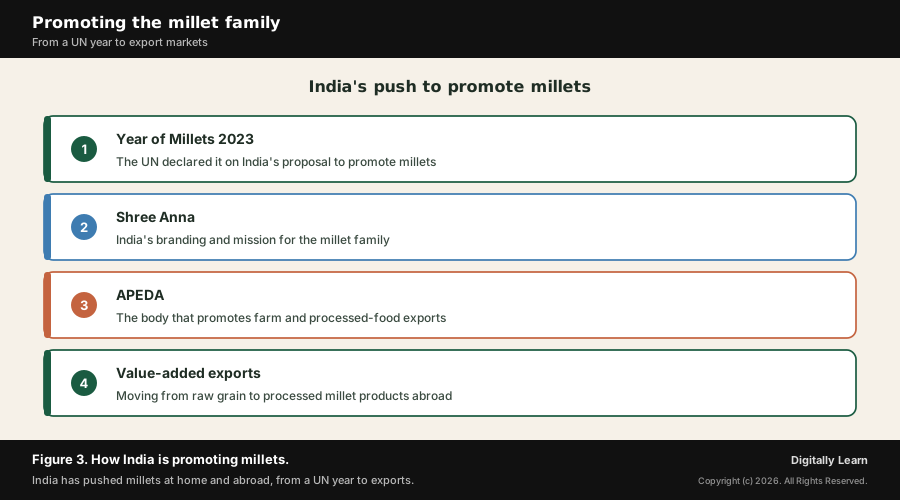
Contemporary linkages tie this shipment to India's wider millet mission. The government has branded millets as Shree Anna and pushed their cultivation and consumption as nutritious, climate-resilient grains suited to a warming world.
India also led the call for an International Year of Millets, which the United Nations declared for 2023 on India's proposal, raising the profile of these grains around the world. That campaign helped build the foreign demand this shipment now serves.
The export fits India's broader goal of moving farm trade up the value chain. Rather than shipping raw grain, the aim is to export processed, branded products that earn more, a shift that bodies like APEDA are meant to support.
These efforts connect food, climate and incomes. Millets need less water than rice or wheat, suit dry and rain-fed regions, and offer small farmers a hardy crop with a growing market at home and abroad.
UPSC Relevance and Exam Focus
Where this fits in the UPSC-CSE syllabus
This topic maps to General Studies Paper III: agriculture, food processing and the economy, with links to nutrition, climate-resilient farming and farmer incomes.
For Prelims, hold the high-yield facts: millets as nutri-cereals branded Shree Anna, the role of APEDA, the International Year of Millets, and the nature of millets as hardy, largely rain-fed crops.
For Mains, two framings recur: the role of millets in health and nutritional security, and how value addition and exports can raise farmers' incomes.
Recurring linked concepts an aspirant should keep in working memory:
- Millets (Shree Anna): nutritious, climate-hardy small-grained cereals such as jowar, bajra and ragi.
- APEDA: the body that promotes India’s farm and processed-food exports.
- Value addition: processing raw grain into higher-value products.
- International Year of Millets: the United Nations year, declared for 2023 on India’s proposal.
A common Prelims trap is to treat millets as low-value coarse grains; they are nutrient-rich nutri-cereals now promoted as Shree Anna.
A common Mains trap is to focus on production alone. Raising farmers' incomes depends on value addition, processing and access to markets, not just growing more grain.
Previous Year UPSC-CSE Questions By the end you will be able to draft model answers for the following UPSC questions. Each question carries a collapsible framework showing how to approach it in the exam.
- UPSC Mains 2024 GS-IIIExplain the role of millets for ensuring health and nutritional security in India.
How to structure the answer in the exam
Introduction: Open with millets as nutritious, climate-hardy grains branded Shree Anna.
Body (sub-themes to develop):
- Nutrition: high fibre, minerals, protein and gluten-free.
- Health: helpful against lifestyle diseases such as diabetes.
- Security: hardy rain-fed crops that diversify diets and reduce risk.
- Promotion: Shree Anna, the International Year of Millets and value addition.
Conclusion: Conclude that promoting millets strengthens both nutritional security and the resilience of farming.
- UPSC Prelims 2016 GS-IWith reference to ‘Initiative for Nutritional Security through Intensive Millets Promotion’, which of the following statements is/are correct?
- This initiative aims to demonstrate the improved production and post-harvest technologies, and to demonstrate value addition techniques, in an integrated manner, with cluster approach.
- Poor, small, marginal and tribal farmers have larger stake in this scheme.
- An important objective of the scheme is to encourage farmers of commercial crops to shift to millet cultivation by offering them free kits of critical inputs of nutrients and microirrigation equipment.
Select the correct answer using the code given below.
How to approach this Prelims question
Approach: Test each statement about the millet-promotion scheme.
Trap to watch: Statement 3 overstates the scheme; it does not offer free input kits to shift commercial-crop farmers to millets.
Key facts to recall:
- The scheme promotes production, post-harvest technology and value addition with a cluster approach, and favours small, marginal and tribal farmers, so statements 1 and 2 are correct.
- It does not give free input kits to switch commercial-crop farmers, so statement 3 is wrong.
Answer signal: Reject statement 3 and the answer is 1 and 2 only.
- UPSC Prelims 2012 GS-IConsider the following crops of India, and identify which are predominantly rainfed:
- Groundnut
- Sesamum
- Pearl millet
Which of the above is/are predominantly rainfed crop/crops?
How to approach this Prelims question
Approach: Check which of the listed crops are predominantly rain-fed.
Trap to watch: All three, including pearl millet, are predominantly rain-fed in India.
Key facts to recall:
- Groundnut, sesamum and pearl millet are all predominantly rain-fed crops.
- Pearl millet (bajra) is a hardy crop of dry, rain-fed regions.
Answer signal: All three are rain-fed, so the answer is 1, 2 and 3.
Sources and Further Reading
- Press Information Bureau: APEDA Facilitates First-Ever Sea Shipment of Botanical-Infused Millet Functional Foods from Karnataka to New Zealand
- APEDA: Millet Portal and value-added products
- APEDA: About the Authority
- Press Information Bureau: APEDA entrusted to promote Indian millets in the international market
Editorial Disclaimer
This briefing is for UPSC preparation. Verify the export details against the official government and APEDA sources before relying on them.


