


Overview
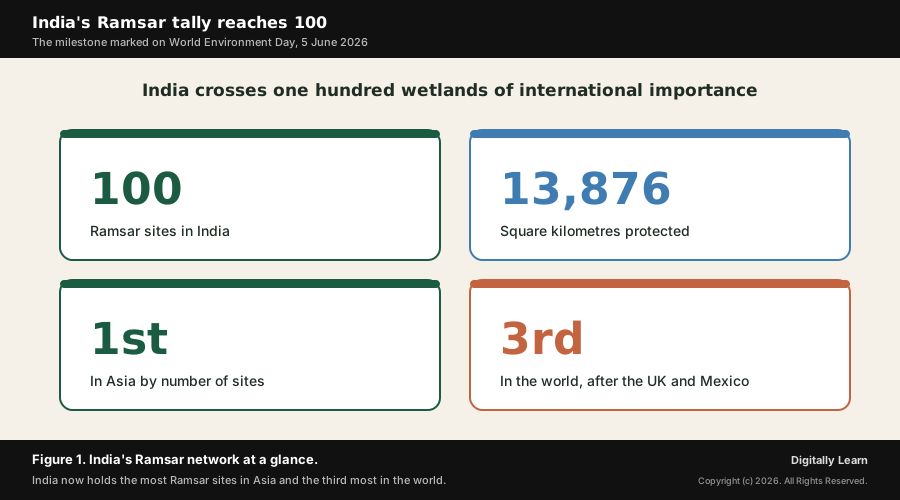
The Jai Prakash Narayan Bird Sanctuary, a wetland in Ballia district of Uttar Pradesh popularly known as Surha Tal, has been recognised as India's 100th Ramsar site, a wetland of international importance under the global Ramsar Convention. The milestone was marked on World Environment Day, 5 June 2026. With one hundred listed wetlands, India now has the most Ramsar sites in Asia and the third most in the world.
India's 100th Ramsar Site and the Milestone It Marks
A bird sanctuary in Uttar Pradesh joins the global list
On World Environment Day, 5 June 2026, the Jai Prakash Narayan Bird Sanctuary in Ballia district of Uttar Pradesh was recognised as India's 100th Ramsar site. The wetland, an oxbow lake of the Ganga system, is widely known by its local name, Surha Tal.
A Ramsar site is a wetland judged to be of international importance and placed on a list maintained under the Ramsar Convention. The sanctuary draws large numbers of migratory and resident water birds, which is the kind of value the Convention is designed to protect.
With this listing India reaches one hundred Ramsar sites, the most of any country in Asia and the third most in the world, after the United Kingdom and Mexico. It is also the thirteenth Ramsar site in Uttar Pradesh.
Why Wetlands and Their Protection Matter
The kidneys of the landscape
Why it matters is that wetlands do quiet but vital work. They recharge groundwater, hold back floodwater, trap pollutants and store carbon, which is why they are often called the kidneys of the landscape.
They are also among the most threatened ecosystems, lost to drainage, building and pollution faster than forests. A growing list of protected wetlands is therefore a measure of how seriously a country takes its water and biodiversity security.
What the Hundredth Listing Signifies
From a single lake to a national commitment
What is the significance of this milestone lies less in the single lake than in the trend it completes. India listed its first Ramsar sites, Chilika Lake in Odisha and Keoladeo National Park in Rajasthan, in the early 1980s, and the number has climbed sharply in recent years.
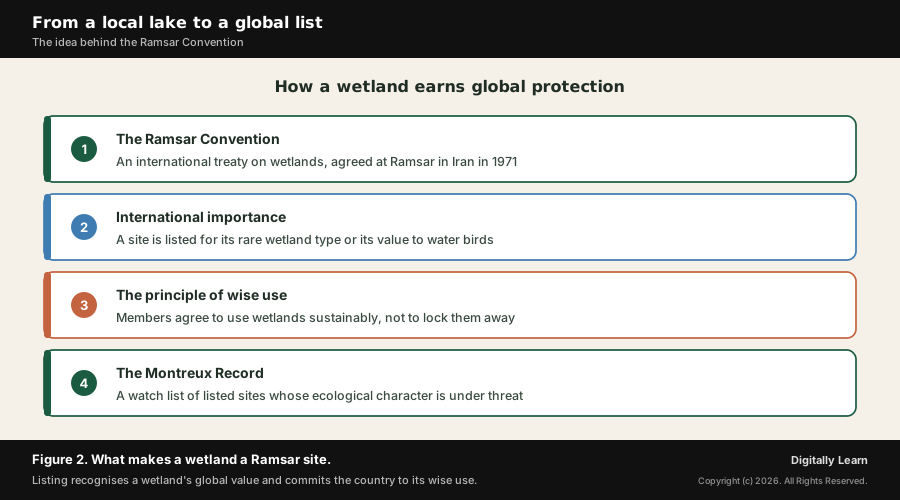
Each listing places a wetland under international watch and commits the country to its wise use, the Convention's core idea that wetlands should be used sustainably rather than drained or fenced off. Reaching one hundred sites signals a wider shift from treating wetlands as wasteland to valuing them as natural infrastructure.
The Ramsar Framework and the New Site in Detail
The 100th Ramsar site at a glance
The table sets out the key facts of the new listing and what each one means. Together they show a bird-rich wetland in the Gangetic plains being recognised for its value beyond India's borders.
| Feature | Detail |
|---|---|
| Site | The Jai Prakash Narayan Bird Sanctuary, popularly called Surha Tal |
| Location | Ballia district, Uttar Pradesh, in the Gangetic plains |
| Recognition | India's 100th Ramsar site, a wetland of international importance |
| Marked on | World Environment Day, 5 June 2026 |
| State tally | The thirteenth Ramsar site in Uttar Pradesh |
| Ecological value | A habitat for many migratory and resident water birds |
Read together, the rows place a familiar Gangetic oxbow lake on a global list. The recognition rests on the wetland's birds and its place in the river system, not on its size, and it carries a standing duty to manage the site with care.
What a Ramsar site is and how it is judged
The Ramsar Convention on Wetlands is an international treaty agreed at the town of Ramsar in Iran in 1971. It asks member countries to list their most valuable wetlands and to manage all their wetlands sustainably.
A wetland qualifies as a Ramsar site if it represents a rare wetland type or supports significant numbers of water birds or other species. Listed sites whose ecological character is under threat can be placed on the Montreux Record, a watch list; India's two such sites are Keoladeo in Rajasthan and Loktak in Manipur.
What to Watch in India's Wetland Story
Three things to track from here
The hundredth listing points to three developments worth following, since recognition is the start of conservation rather than its end.
- (a) Quality, not just count. Whether listed wetlands are genuinely protected from drainage, encroachment and pollution, not only added to a list.
- (b) The threatened sites. Whether Keoladeo and Loktak, on the Montreux Record, recover enough to leave the watch list.
- (c) Livelihoods and conservation. Whether schemes such as Amrit Dharohar link wetland protection to local incomes so that communities gain from conservation.
The real test is whether one hundred listings translate into healthier wetlands on the ground, rather than paper recognition for sites that keep degrading.
How India Governs Its Wetlands
From a global treaty to a village scheme
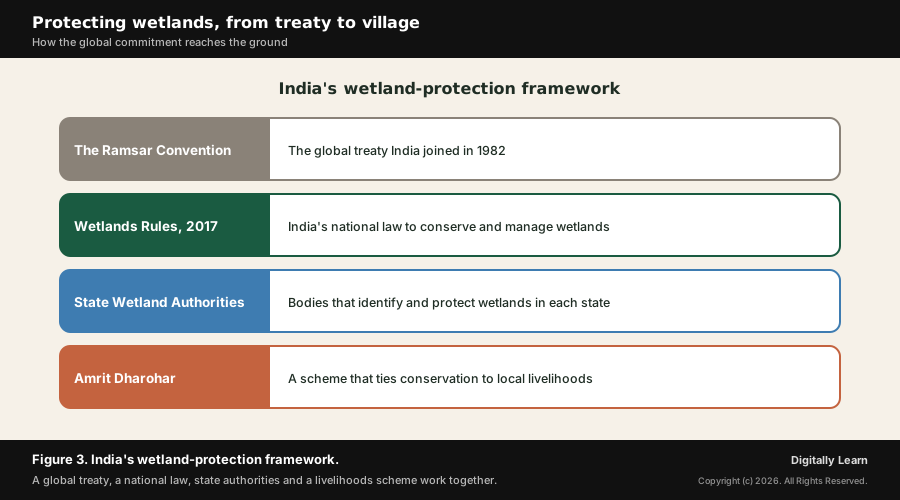
Contemporary linkages tie this milestone to India's wider wetland governance, which runs from an international treaty down to local management. India joined the Ramsar Convention in 1982 and has steadily expanded both its listings and its domestic rules.
At home, the Wetlands (Conservation and Management) Rules, 2017 are the main legal tool. They bar harmful activities, require states to set up Wetland Authorities, and protect not only the water body but its surrounding catchment.
Newer schemes try to make conservation pay for the people nearby. Amrit Dharohar, launched by the environment ministry in 2023, promotes the conservation values of Ramsar sites alongside nature tourism and alternative livelihoods, so that wetlands support local incomes rather than competing with them.
These efforts connect wetlands to the wider goals of climate resilience and biodiversity, since healthy wetlands store carbon, buffer floods and droughts, and shelter the species that international targets aim to protect.
UPSC Relevance and Exam Focus
Where this fits in the UPSC-CSE syllabus
This topic maps to General Studies Paper III: conservation, environmental pollution and degradation, and to the biodiversity and environment portion of the Prelims syllabus.
For Prelims, hold the high-yield facts: the Ramsar Convention of 1971 and India's 1982 membership, the meaning of wise use and the Montreux Record, India's first sites at Chilika and Keoladeo, and the new total of one hundred sites.
For Mains, two framings recur: the meaning of wetlands and the wise-use concept with Indian examples, and an assessment of India's wetland conservation programme and its Ramsar sites.
Recurring linked concepts an aspirant should keep in working memory:
- Ramsar Convention: a 1971 treaty on wetlands of international importance, joined by India in 1982.
- Wise use: the Convention’s principle of sustainable use of wetlands.
- Montreux Record: a watch list of threatened Ramsar sites; India’s are Keoladeo and Loktak.
- Wetlands Rules, 2017: India’s law to conserve and manage wetlands and their catchments.
A common Prelims trap confuses the Ramsar Convention with the World Heritage system; Ramsar is specific to wetlands, while World Heritage sites are cultural or natural sites under a separate treaty.
A common Mains trap is to treat a rising count of sites as conservation in itself. The harder question is whether listed wetlands are actually protected and used wisely on the ground.
Previous Year UPSC-CSE Questions By the end you will be able to draft model answers for the following UPSC questions. Each question carries a collapsible framework showing how to approach it in the exam.
- UPSC Mains 2023 GS-IIIComment on the National Wetland Conservation Programme initiated by the Government of India and name a few India's wetlands of international importance included in Ramsar sites.
How to structure the answer in the exam
Introduction: Open with the value of wetlands and India's commitment under the Ramsar Convention.
Body (sub-themes to develop):
- The conservation effort: the Wetlands (Conservation and Management) Rules 2017 and State Wetland Authorities.
- Ramsar sites of international importance: Chilika, Keoladeo, Loktak, Sundarbans and the new Surha Tal site.
- Supportive schemes: Amrit Dharohar linking conservation to livelihoods.
- The gaps: encroachment, pollution and weak enforcement on the ground.
Conclusion: Conclude that India's growing Ramsar list must be matched by genuine protection and wise use.
- UPSC Mains 2018 GS-IIIWhat is wetland? Explain the Ramsar concept of 'wise use' in the context of wetland conservation. Cite two examples of Ramsar sites from India.
How to structure the answer in the exam
Introduction: Open by defining a wetland as land saturated with water that supports distinct ecosystems.
Body (sub-themes to develop):
- Definition: areas of marsh, water or peatland, natural or artificial.
- Wise use: sustainable use that maintains the wetland's ecological character.
- Indian examples: Chilika Lake in Odisha and Keoladeo National Park in Rajasthan.
- Why it matters: water security, biodiversity and flood control.
Conclusion: Conclude that wise use balances human needs with the wetland's survival.
- UPSC Prelims 2019 GS-IConsider the following statements:
- Under Ramsar Convention, it is mandatory on the part of the Government of India to protect and conserve all the wetlands in the territory of India.
- The Wetlands (Conservation and Management) Rules, 2010 were framed by the Government of India based on the recommendations of Ramsar Convention.
- The Wetlands (Conservation and Management) Rules, 2010 also encompass the drainage area or catchment regions of the wetlands as determined by the authority.
Which of the statements given above is/are correct?
How to approach this Prelims question
Approach: Test each statement against what the Convention actually binds India to do and what the Wetlands Rules cover.
Trap to watch: Statement 1 overstates the Convention: it does not make protecting every wetland in India mandatory.
Key facts to recall:
- The Ramsar Convention rests on the principle of wise use, not blanket mandatory protection.
- India's Wetlands Rules flow from the Convention and cover the catchment, so statements 2 and 3 are correct.
Answer signal: Reject statement 1 and the answer narrows to 2 and 3 only.
- UPSC Prelims 2014 GS-IIf a wetland of international importance is brought under the 'Montreux Record', what does it imply?
How to approach this Prelims question
Approach: Recall what the Montreux Record is: a watch list within the Ramsar system.
Trap to watch: Do not confuse the Montreux Record with the World Heritage list or with a buffer-zone rule.
Key facts to recall:
- The Montreux Record flags listed wetlands whose ecological character has changed, is changing or may change due to human interference.
- India's two sites on the Record are Keoladeo and Loktak.
Answer signal: The phrase 'changes in ecological character' points to the first option.
Sources and Further Reading
- Press Information Bureau: PM lauds designation of Jai Prakash Narayan Bird Sanctuary as India's 100th Ramsar site
- Ramsar Convention on Wetlands: official website
- Ministry of Environment, Forest and Climate Change: Wetlands Division
- List of Ramsar Sites in India (overview of total sites and area)
- Press Information Bureau: Amrit Dharohar Capacity Building Scheme for Ramsar sites
Editorial Disclaimer
This briefing is for UPSC preparation. Verify the latest Ramsar site figures against the official government and Ramsar Convention sources before relying on them.

