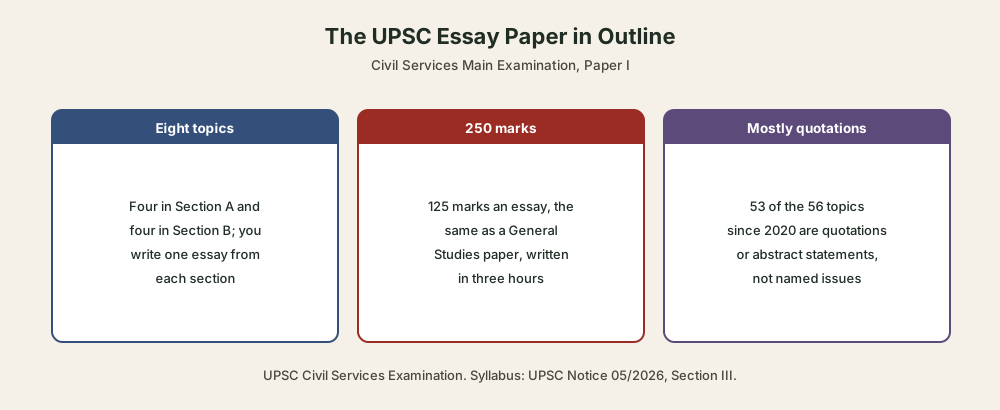
The UPSC essay paper is Paper I of the Main Examination, worth 250 marks: eight topics in two sections, one essay of about 1,000 to 1,200 words from each, in three hours. This guide covers the official syllabus, the 2025 and 2026 topics, how to write the essay step by step, how to prepare, and the two qualifying language papers.
Essay Paper Pattern in UPSC Mains: Topics, Marks and Word Limit
Eight Topics, Two Essays and 250 Marks in Three Hours
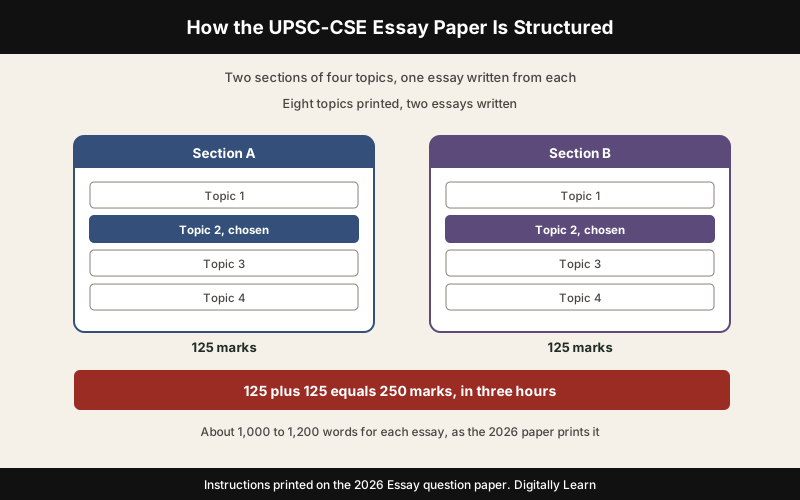
The UPSC essay paper is Paper I of the Civil Services Main Examination, and its pattern is simple. It prints eight topics in two sections of four, and you write one essay from Section A and one from Section B. Each essay carries 125 marks, so the paper is worth 250 marks, and like every Mains paper it lasts three hours.
The 2026 question paper asked for about 1,000 to 1,200 words for each essay. Three hours for two essays leaves about ninety minutes for each, and that ninety minutes has to cover choosing the topic, planning and writing.
Why the Essay Paper Matters for Your Final Rank
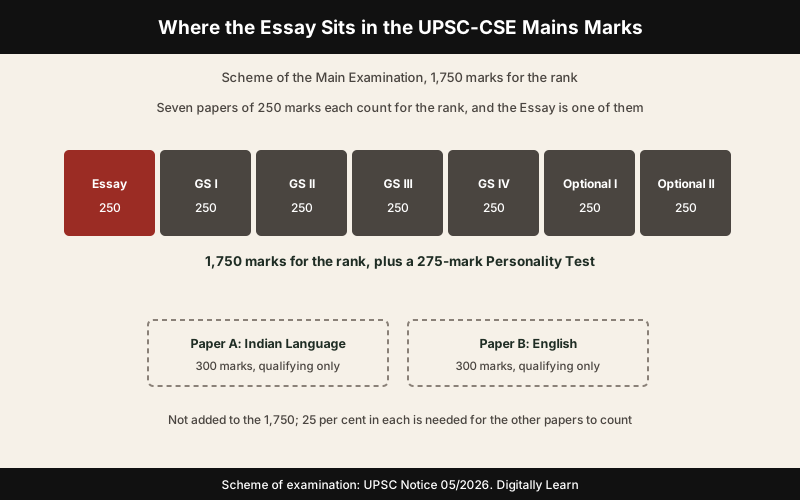
The Essay carries the same 250 marks as each General Studies paper and each Optional paper. Seven such papers make up the 1,750 marks of the written Mains, so the Essay alone is 14.3 per cent of them; the 275-mark Personality Test then takes the total to 2,025.
The Essay also counts in a tie. When two candidates have the same final marks, the notice ranks higher the one with more marks in the compulsory papers, the Essay and the four General Studies papers, together with the Personality Test.
UPSC Essay Syllabus: What the Commission Asks For
The Official UPSC Essay Syllabus in Full
The whole UPSC essay syllabus is four sentences in Examination Notice 05/2026, Section III. It names no topics or themes. Three of the four sentences are about how to write, which tells you the paper tests composition, not recall.
Read each instruction as a marking criterion, since the notice gives no other published rubric for this paper:
- Keep closely to the subject: An essay that drifts from the topic loses on the first thing the notice asks for.
- Arrange ideas in orderly fashion: Structure is named separately from content, so a clear plan earns credit of its own.
- Write concisely: Padding does not help; the word limit is a ceiling, not a target.
- Effective and exact expression: Credit is given for the writing itself, for precise words and clear sentences.
UPSC Essay Paper 2026 and 2025: The Latest Topics
Topics in the UPSC Essay Paper 2026 and 2025
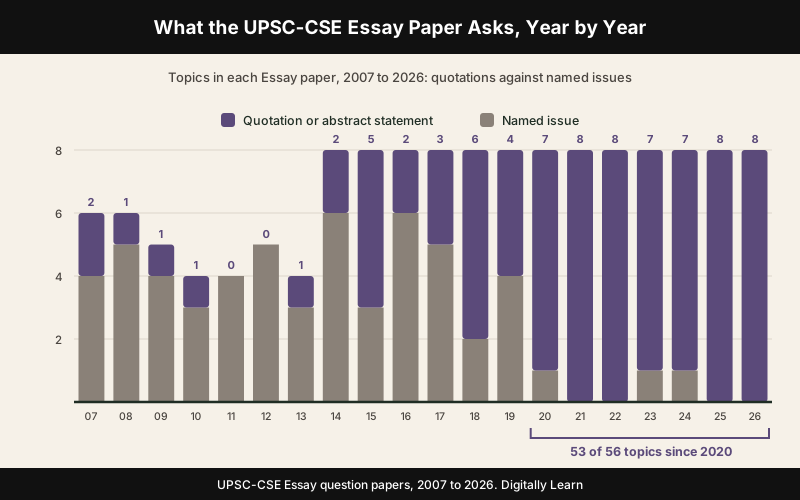
The two latest papers show what you will face. Every one of their sixteen topics is a quotation, proverb or abstract statement; none names a policy or an institution. The 2026 paper is listed first.
The UPSC Essay paper of 2026 set these eight topics, four in each section:
- Q1 (Section A): Oxymorons reflect the ironies of life.
- Q2 (Section A): A grateful mind is very beautiful.
- Q3 (Section A): A thorn is a changed bud.
- Q4 (Section A): When two elephants fight, it is the grass that gets trampled.
- Q5 (Section B): Nature is the symbol of the spirit.
- Q6 (Section B): A well-educated mind will always have more questions than answers.
- Q7 (Section B): Shelving hard decisions is the least ethical course.
- Q8 (Section B): A good leader is one who follows the followers.
The UPSC Essay paper of 2025 set these eight topics, four in each section:
- Q1 (Section A): Truth knows no color.
- Q2 (Section A): The supreme art of war is to subdue the enemy without fighting.
- Q3 (Section A): Thought finds a world and creates one also.
- Q4 (Section A): Best lessons are learnt through bitter experiences.
- Q5 (Section B): Muddy water is best cleared by leaving it alone.
- Q6 (Section B): The years teach much which the days never know.
- Q7 (Section B): It is best to see life as a journey, not as a destination.
- Q8 (Section B): Contentment is natural wealth; luxury is artificial poverty.
All 138 topics from 2007 to 2026, grouped by year and theme, are on the UPSC essay topics of previous years page.
How the Essay Paper Has Changed Since 2007
The paper took its present form of eight topics and two essays in 2014; before that it printed four to six topics and asked for one essay. The kind of topic has changed too. Up to 2015, 13 of 50 topics were quotations or abstract statements. Since 2020 it is 53 of 56. Topics that name an issue, such as food security or foreign investment in retail (both set in 2012), were common in the early papers; since 2020 only three have appeared.
How to Write an Essay in the UPSC Exam
Choosing Your Two Topics in the First Ten Minutes
Choosing can eat into your time: eight topics invite comparison, and comparison invites delay. Aim to settle both choices within about ten minutes, so that each essay keeps close to its ninety minutes.
- Test each topic for examples: Pick the topic for which three good examples come to mind at once.
- Check you can take a position: Prefer a topic you can agree with, qualify or dispute, over one you can only describe.
- Avoid the impressive-sounding trap: A plainer topic written well scores better than a grand one written thinly.
Decoding a Quotation Topic and Taking a Position
A quotation-style topic gives you a claim and nothing else, so the first job is to decode it. Restate the line as a plain question, define its key words in your own terms, and then decide what you think. The essay needs a clear position that runs from the first paragraph to the last.
- Literal reading: What does the sentence say on its face?
- Deeper claim: What general idea about people, society or life does it assert?
- Your position: Do you agree, agree with limits, or disagree, and why?
- Where it fails: In which cases does the claim not hold? This becomes your counter-view.
Structuring a UPSC Essay: Introduction, Body and Conclusion
An essay of about a thousand words needs a shape the examiner can follow. Build it in six steps, the first two on the rough page and the last four in the answer booklet.
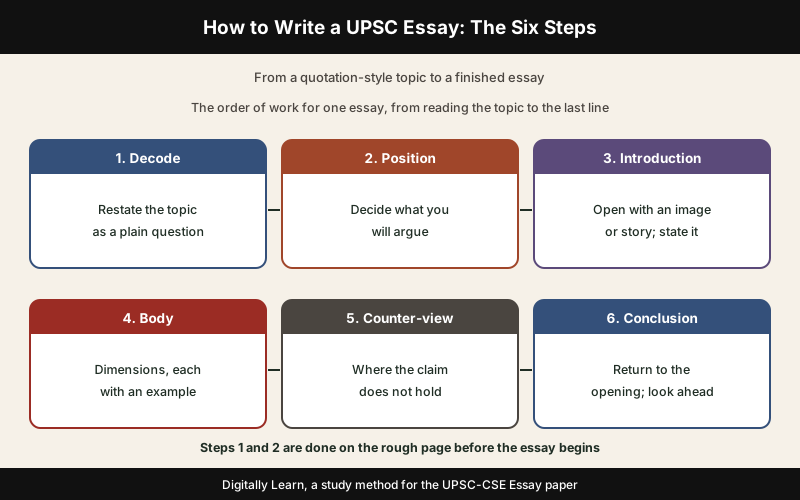
- Introduction: Open with a short story, an image or a question, and end the paragraph by stating your position.
- Body by dimensions: Take the idea through several dimensions, such as the individual, society, the economy, governance, science and the environment, one paragraph or two for each.
- One example per paragraph: Support each dimension with a concrete example from history, current affairs, science or everyday life.
- Counter-view: Give the strongest case against your position and answer it; this shows balance rather than weakness.
- Conclusion: Return to the opening image, restate the position in a new light, and end on a forward-looking line.
Link each paragraph to the next with a sentence that shows why the argument moves on. The notice's demand for ideas in orderly fashion is met by these links as much as by the headings in your plan.
Worked Example: Planning an Essay on a 2026 Topic
Take a topic from the 2026 paper: "A thorn is a changed bud". The plan below shows the six steps applied to it. It is a plan to show the method, not a model essay, and your own reading of the line may differ.
- Decode: A thorn grows where a bud might have grown. The line suggests that what hurts or protects us often begins as something with other promise. Plain question: can hardship be a changed form of possibility, and what follows if we see it that way?
- Position: Largely yes, with a limit: seeing a thorn as a changed bud helps us understand difficulty, but it must not become an excuse to accept avoidable suffering.
- Introduction: Open with an image of a rose stem, then state the position.
- Body dimensions: The individual (a setback that builds resilience); society (resistance that turns into reform); nature (defences that protect life); governance (rules that begin as protection and harden into obstacles).
- Counter-view: Some thorns are only thorns; romanticising hardship can hide injustice that should be removed, not admired.
- Conclusion: Return to the rose: the gardener prunes some thorns and leaves others, and wisdom lies in knowing which is which.
Many of these mistakes come from writing the essay like a General Studies answer. Those answers reward compression, while the Essay rewards development: a line of argument that holds together over several pages. The GS Paper 4 guide covers the ethics paper, whose themes overlap with many essay topics.
How to Prepare for the UPSC Essay Paper
Building an Example Bank and Practising to Time
Since a quotation topic supplies no material, your examples have to exist before the exam. The useful stock is wide and shallow: a handful of episodes from history, a few from science and technology, a few from governance and society, and a few from outside the syllabus, each known well enough to be told in four sentences.
- History: Episodes from modern Indian history and world history that show change, courage or failure.
- Governance: Institutions and reforms from polity and governance that show how rules work in practice.
- Science and technology: Discoveries and their effects on society.
- Society and daily life: Stories of individuals and communities that make an abstract idea concrete.
The Study Library is organised by subject, which suits this: an example is easier to find under the topic it belongs to than under an abstract theme it might one day illustrate. Keep a notebook of examples by theme as you read.
The only practice that tests both limits at once is writing a full essay by hand, to about 1,000 to 1,200 words, inside ninety minutes. An outline tests neither. Start with one essay a week and move to two essays in a single three-hour sitting, one from each section, as the exam requires.
- Use real topics: Practise on the 2020 to 2026 papers, which match the current mix.
- Review your own essay: Check it against the four instructions of the syllabus: on subject, orderly, concise and exact.
- Rewrite one paragraph: Improve the weakest paragraph of each essay, since revision teaches more than a new essay does.
The Qualifying Language Papers in UPSC Mains
Paper A and Paper B: What They Test and Why They Matter
Alongside the seven merit papers, Mains has two qualifying papers of 300 marks each: Paper A in an Indian language from the Eighth Schedule, and Paper B in English. They are of matriculation or equivalent standard and are qualifying only, so their marks are not counted for ranking.
- Both papers: Comprehension of given passages, precis writing, usage and vocabulary, and short essays.
- Indian language paper only: Translation from English into the language and back.
- Exemption: Paper A is not compulsory for candidates from Arunachal Pradesh, Manipur, Meghalaya, Mizoram, Nagaland and Sikkim, and for some candidates with hearing impairment who meet the notice's conditions.
They still decide whether the rest of your Mains counts. All papers are evaluated together, but your Essay, General Studies and Optional papers are taken into account only if you score at least 25 per cent in the Indian language paper and 25 per cent in English. A few timed practice papers, with attention to precis, reduce that risk.
Common Questions About the UPSC Essay Paper
How many essays do you write in UPSC Mains?
Two. The paper prints eight topics in two sections of four, and you write one essay from each section, of about 1,000 to 1,200 words each, in three hours.
How many marks is the UPSC essay paper?
250 marks, 125 for each essay. That is the same as each General Studies paper and each Optional paper, and 14.3 per cent of the 1,750 marks of the written Mains.
How do I write an essay in the UPSC exam?
Decode the topic into a plain question, decide your position, open with an image or story, build the body through several dimensions with one example each, answer the strongest counter-view, and conclude by returning to your opening.
Can I write the UPSC essay in Hindi?
Yes. The notice lets candidates answer every paper except the two qualifying language papers in English or in any one language of the Eighth Schedule, which includes Hindi.
Is there a syllabus for the UPSC essay paper?
Only four sentences in the notice. They ask you to keep closely to the subject, arrange ideas in orderly fashion and write concisely, and they say credit is given for effective and exact expression. No topics or themes are listed.
Official Sources
- Union Public Service Commission: Examination Notice No. 05/2026-CSE, Civil Services Examination 2026
- Union Public Service Commission: Civil Services (Main) Examination 2026, Essay question paper
- Union Public Service Commission: Civil Services (Main) Examination 2025, Essay question paper
- Union Public Service Commission: previous years' question papers
- Union Public Service Commission: Civil Services Examination 2025, minimum qualifying marks
- Union Public Service Commission: online registration and application portal
- Department of Personnel and Training: Gazette notifications (the Civil Services Examination Rules are notified here each year)
- Gazette of India: the Civil Services Examination Rules, which set the scheme of the examination, are notified here each year
- National Council of Educational Research and Training: school textbooks, the matriculation standard of the two qualifying language papers
- Wikipedia: Civil Services Examination
Editorial Disclaimer
The syllabus and the scheme on this page are taken from the Commission's current examination notice, and the topics from its question papers. The six-step writing method and the worked plan are Digitally Learn's own teaching and are not published by the Commission. The notice in the Gazette of India is the final authority.