


Overview
Left Wing Extremism (LWE), also called Naxalism or Maoism, is an armed insurgency waged by the Communist Party of India (Maoist) and allied groups in parts of central and eastern India, the belt known as the Red Corridor. Its declared aim is to overthrow the Indian State through a protracted armed struggle, which the Government has long treated as the gravest internal-security threat of its kind. The movement traces its name to the 1967 Naxalbari uprising, a peasant revolt in West Bengal. Over the last decade it has declined sharply: the number of affected districts and the toll of violence have both fallen, though the figures vary across official releases and the movement still affects pockets of the country. The Government has set a target to make India free of Left Wing Extremism by 31 March 2026.
What Left Wing Extremism Is: Naxalism, the Red Corridor and the Threat
Naxalism, the Maoist insurgency and the Red Corridor
Left Wing Extremism, commonly called Naxalism or Maoism, is an armed insurgency that seeks to overthrow the Indian State through a protracted people's war and install a revolutionary order. It is waged chiefly by the banned Communist Party of India (Maoist), formed in 2004, and by allied groups. The movement draws its ideology from Maoist thought and its method from armed rural struggle, which is why the State has long regarded it as the gravest internal-security threat of its kind.
The insurgency takes its name from Naxalbari, a village in West Bengal where a peasant uprising broke out in 1967 over land and the rights of cultivators. From that revolt a stream of armed factions emerged, drawing on the grievances of landless and tribal communities. Over the decades the centre of the movement shifted from Bengal to the forested, mineral-rich districts of central and eastern India.
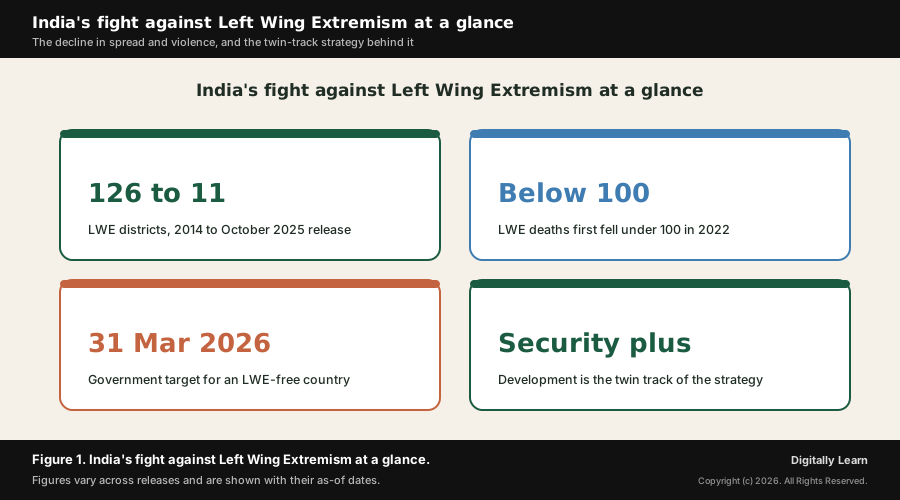
The belt where the Maoists have been most active is known as the Red Corridor, a stretch of districts across states such as Chhattisgarh, Jharkhand, Odisha, Bihar, Maharashtra, Telangana and Andhra Pradesh. The corridor is marked by dense forest, difficult terrain and weak connectivity and large tribal populations, the very conditions in which an armed underground could take hold. The figure below sets out the broad picture before the detail.
Why LWE Is in the News: A Steep Decline and the 2026 Target
A downward trend and a stated goal of an LWE-free India
Why it matters now is that Left Wing Extremism, after decades as a serious security challenge, is in a marked decline. Official releases from the Ministry of Home Affairs and the Press Information Bureau report that both the geographic spread of the insurgency and the level of violence have fallen sharply over the last decade, even as the movement continues to affect a shrinking set of districts.
The decline has been framed around an explicit goal. The Government has set a target to make the country free of Left Wing Extremism by 31 March 2026, and successive reviews track progress against it. This is a stated target rather than an accomplished fact, and the official figures themselves vary from one release to the next, so the picture is one of strong momentum rather than a closed chapter.
The topic is therefore prominent for two reasons. First, the security gains are real and measurable, and they are presented as evidence that the long-running strategy is working. Second, the approaching deadline keeps attention on whether the residual pockets of the insurgency, and the underlying grievances that fed it, can be addressed in a way that makes the gains durable.
Understanding the Significance of LWE and Its Decline for India
Internal security, the State's writ and the human dimension
What is the significance of Left Wing Extremism lies first in what it challenges. An armed movement that seeks to overthrow the State directly contests the State's monopoly on the legitimate use of force and its writ over its own territory. Its decline therefore matters as a restoration of that writ across districts where, for years, the administration could not function freely.
Its second significance is that LWE is, at root, a problem of development and governance as much as of security. The insurgency took hold in regions of deep poverty, displacement and tribal land alienation, which is why the official response has always paired force with development. The episode is thus a live case study in the security-development nexus, the idea that lasting security follows from credible development and justice, not from force alone.
Its third significance is the human dimension. The conflict has cost the lives of security personnel, civilians and cadres, and has weighed heavily on the tribal communities caught between the insurgents and the State. A fair reading values the security gains while keeping in view the rights, rehabilitation and dignity of the people in the affected districts.
The Decline in Numbers: Districts, Violence and Casualties by Date
The shrinking geography of the Red Corridor
The clearest measure of the decline is the shrinking geography of the insurgency, though the exact counts must be read with their dates, because different official releases report different figures as the situation changes. The headline comparison is that the number of LWE-affected districts has fallen from about 126 districts, across ten states, in the 2013-14 period.
From that base the count has come down in stages across successive releases: to about ninety districts by April 2018, about seventy by July 2021, and about thirty-eight by April 2024, the last figure spread across nine rather than ten states. More recent releases report a further fall, to about eighteen districts by April 2025 and about eleven by an October 2025 release. These are point-in-time figures, not a single fixed current number.
The category of the most affected districts has narrowed even faster. From roughly thirty-five to thirty-six such districts in 2014, official releases report the number cut to a single-digit figure, with a 2025 release putting the most affected districts at six. The pattern across every release is the same, a steady contraction of the corridor, even though the precise count depends on the date and the category being measured.
| As-of release | LWE-affected districts |
|---|---|
| 2013 to 2014 | About 126, across 10 states |
| April 2018 | About 90 |
| July 2021 | About 70 |
| April 2024 | About 38, across 9 states |
| April 2025 | About 18 |
| October 2025 | About 11 |
Read down the column, the trend is unmistakable: a corridor that once spanned more than a hundred districts has contracted sharply. The honest way to state it is as a range across dates, not as one pinned number, because each release captures a different moment in a still-changing situation.
Annual deaths below 100 and the drop from the 2010 peak
The second measure is the fall in violence and casualties, again read against official comparisons rather than a single year. The toll peaked around 2010, when the resultant deaths of security forces and civilians together reached an all-time high of about 1,005 in a single year, and the insurgency was reported from a far wider set of police-station areas than today.
From that peak the numbers have fallen steeply. For the first time in roughly three decades, annual LWE-related deaths fell below one hundred, to about ninety-eight, in 2022, and stood at about 138 in 2023, on the Ministry of Home Affairs figures. Comparing the decade to 2014 with the decade after, official releases report that LWE violent incidents fell by around 73 per cent and the resultant deaths by around 86 per cent against the 2010 high.
Two cautions belong with these numbers. First, they are approximate and release-dependent: casualty totals are revised and reported differently across PIB and MHA statements, so they are best read as a direction of travel. Second, a fall in violence is not the same as elimination; the residual incidents are concentrated in a few districts of the corridor, which is why the strategy continues rather than stops, and the figures are attributed to the MHA and PIB comparison.
The Government's Strategy: National Policy 2015, SAMADHAN and Development
The National Policy and Action Plan of 2015
The framework for the response is the National Policy and Action Plan approved in 2015. Its central idea is that Left Wing Extremism cannot be addressed by force alone, so it sets out a multi-pronged strategy that combines security measures with development interventions and with ensuring the rights and entitlements of local communities. This security-plus-development design is the spine of everything that follows.
The policy is delivered through two organising principles that the Government uses to describe its method. The first is a whole-of-government approach to development, in which the many ministries that build roads, lay telecom lines, open banks and run welfare schemes act in a coordinated way. The second is a whole-of-agency approach to security, in which the central and state police forces, central armed police, intelligence agencies and the state administration operate as one.
Because public order and police are State subjects under the Constitution, the actual operations are run by the states, while the Union Ministry of Home Affairs coordinates, funds and supports them. This Centre-state division shapes the whole response: the Centre sets the policy and provides money, forces and equipment, and the states carry out the operations and the development on the ground. The figure that follows breaks down the operational doctrine at the heart of the security effort.
The SAMADHAN operational doctrine
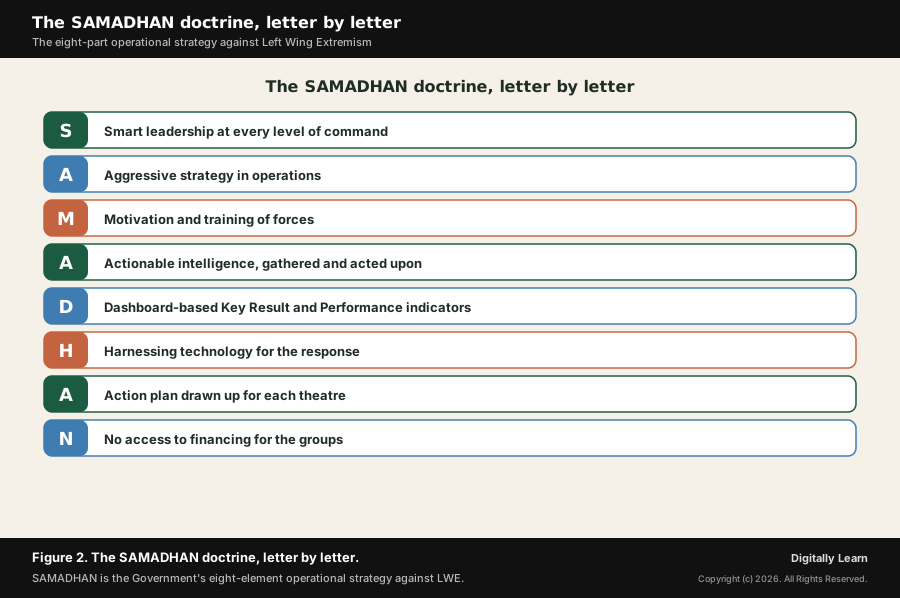
At the operational level the security effort is captured by the doctrine known as SAMADHAN, an acronym whose eight letters each name an element of the strategy. The word itself means resolution, and it is used to bundle the operational lessons of years of counter-insurgency into a single, memorable formula that commanders and ministries can act on.
Spelt out, the eight elements are: S for smart leadership, A for aggressive strategy, M for motivation and training, A for actionable intelligence, D for dashboard-based Key Result Areas and Key Performance Indicators, H for harnessing technology, A for action plan for each theatre, and N for no access to financing. Together they span command, operations, intelligence, measurement, technology, planning and the choking of the insurgency's funds.
The doctrine is notable for what it adds to plain force. The emphasis on actionable intelligence, on technology and on cutting off financing reflects a shift from large sweeps to targeted, information-led operations, while the dashboard of result areas brings measurement and accountability to a long campaign. The figure below sets out the doctrine letter by letter.
Development measures in the affected districts
Running alongside the security effort is a substantial development push, on the logic that the State's absence created the space the insurgency filled. The most visible strand is road connectivity: under dedicated schemes such as the Road Requirement Plan and the Road Connectivity Project for LWE-affected areas, thousands of kilometres of road have been sanctioned and built to open up districts that were long cut off.
A second strand is communications and financial inclusion. Mobile towers have been planned and commissioned in large numbers to bring telecom and 4G coverage to remote villages, and the banking network has been widened through new bank branches, ATMs, banking correspondents and post offices, so that welfare payments and credit can actually reach people. Connectivity and banking together pull the affected areas into the mainstream economy.
A third strand works through focused programmes and funding. The Aspirational Districts Programme covers many LWE-affected districts and drives improvements in health, education, agriculture and basic services, while Special Central Assistance fills critical gaps in public infrastructure in the most affected districts. The Centre also reimburses states for Security Related Expenditure, covering the costs of operations, the upkeep of forces and the rehabilitation of surrendered cadres.
- Road connectivity: Road Requirement Plan and the Road Connectivity Project open up districts long cut off by terrain and conflict.
- Telecom and 4G expansion: Mobile towers and 4G projects bring communications to remote and aspirational-district villages.
- Financial inclusion: New bank branches, ATMs, banking correspondents and post offices deepen banking in the affected districts.
- Aspirational Districts Programme: Focused improvement in health, education, agriculture and services in many LWE districts.
- Special Central Assistance: Funds fill critical gaps in public infrastructure in the most affected districts.
- Security Related Expenditure: The Centre reimburses states for operations, force upkeep and the rehabilitation of surrendered cadres.
Taken together, the twin track of security and development is the defining feature of the Indian response. The contention is that security operations win the space, and development, rights and rehabilitation are what hold it, so that a district cleared of armed cadres does not slip back into the conditions that bred the insurgency.
Root Causes and the Development Debate: Tribal Rights, FRA and PESA
Why the insurgency took root
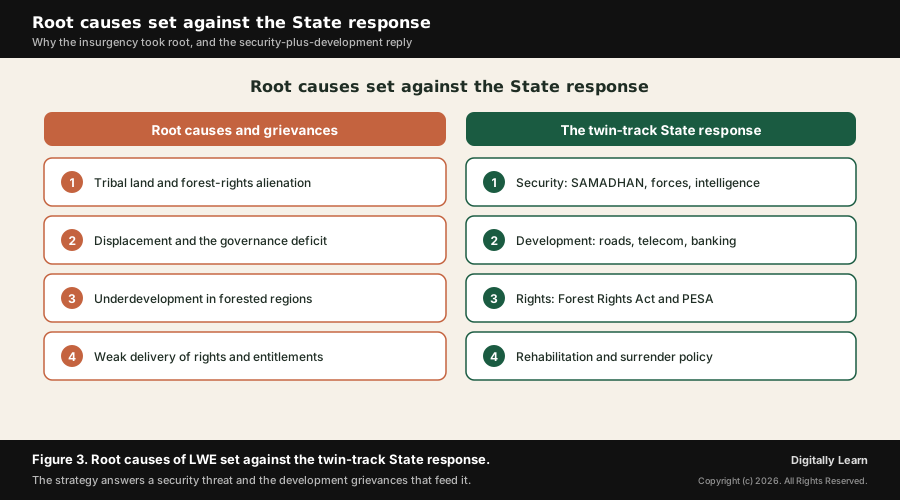
A balanced reading must look past the security ledger to the root causes that gave the insurgency its hold, since UPSC questions reward this depth. The Maoist belt overlaps closely with India's forested, mineral-rich and largely tribal districts, and the grievances there are old: the alienation of tribal land, the loss of access to forests on which livelihoods depend, and displacement caused by mining, dams and industry without adequate resettlement.
On top of land lies a governance deficit. For decades these districts saw weak delivery of basic services, thin administration, poor roads and a remote State, conditions in which an armed group offering rough order and a grievance narrative could win a foothold. The insurgency, on this reading, fed less on ideology among ordinary people than on the everyday experience of neglect, injustice and a State that was felt as distant or predatory.
This is why the official framing itself describes Naxalism as a social, economic and developmental issue that manifests as a violent security threat. Treating it only as a law-and-order problem risks addressing the symptom while leaving the cause, which is the reasoning behind the development and rights strands of the strategy rather than a purely military one.
Forest Rights Act, PESA and the rehabilitation track
Central to addressing those causes is the rights dimension. The Forest Rights Act, 2006 recognises the individual and community rights of forest-dwelling and tribal people over the land and forest resources they have traditionally used, and its honest implementation is widely seen as a way to address the land grievance at the heart of the insurgency. Where the Act is delivered well, it can restore to tribal communities a stake the insurgency had claimed to defend.
Alongside it sits PESA, the Provisions of the Panchayats (Extension to Scheduled Areas) Act, 1996, which extends self-government to Scheduled Areas and gives gram sabhas a say over local resources, land acquisition and development in tribal regions. PESA is meant to make governance in these areas participatory rather than imposed, narrowing the gap between the State and the community that the insurgency exploited. The figure below pairs the grievances with the State's reply.
The third element is rehabilitation and surrender. States run surrender-and-rehabilitation policies that offer cadres who lay down arms a path back into society, with financial help, skill training and reintegration. This track matters for balance: a strategy that only kills or captures, without a credible door back to ordinary life, leaves no incentive to leave the movement, and it sits uneasily with the rights of those who are, in part, victims of the conditions that produced the insurgency.
The development-versus-security debate and the rights concerns
The fair assessment requires holding two truths together. The security gains are genuine: the corridor has contracted, violence has fallen, and the writ of the State has returned to districts that were effectively beyond it. To deny this would be to ignore the evidence of the official figures, read with their dates and caveats.
Yet the gains raise their own concerns, which a complete answer must record. Critics caution against reading the decline as a purely military victory, and against an approach that is heavy on force and light on justice. There are worries about the human-rights costs of operations in tribal areas, about civilians caught in between, and about whether the Forest Rights Act and PESA are implemented in spirit or only on paper.
The durable question, and the one an exam answer should reach, is whether the gains can be held. That depends less on further operations than on whether development reaches the cleared districts, whether tribal rights are honoured, and whether surrendered cadres and ordinary residents see a credible stake in the mainstream. On this view the decline of Left Wing Extremism is a real achievement whose permanence will be decided by governance and justice, not by force alone.
LWE in Context: Internal-Security Architecture and the Security-Development Nexus
How LWE links to India's wider internal-security framework
Contemporary linkages place Left Wing Extremism within India's broader internal-security architecture. The response runs through the Union Ministry of Home Affairs, which has a dedicated division for LWE, and relies on central armed police forces such as the CRPF working alongside state police, with intelligence coordinated across agencies. Because police and public order are State subjects, the model is one of Centre-state coordination rather than central command.
The topic also connects to the wider family of internal-security challenges the State manages, from insurgency in the North-East to terrorism in Jammu and Kashmir. Each has its own causes, but they share the underlying themes of grievance, governance and the State's reach, and the contrast in approaches across them is itself an exam-relevant comparison.
Most of all, LWE is the textbook illustration of the security-development nexus. It shows, in one case, how underdevelopment and exclusion can curdle into violence, and how security and development must advance together for a gain to last. That link runs through tribal welfare, forest and land rights, mineral-belt governance and the constitutional framework for Scheduled Areas.
- Internal-security architecture: The MHA LWE Division, central armed police forces and state police working under Centre-state coordination.
- Tribal rights and Scheduled Areas: The Forest Rights Act, PESA and the Fifth Schedule, which frame governance in the affected belt.
- Security-development nexus: The principle that lasting security follows from development, rights and justice, not force alone.
- Mineral-belt governance: Mining, displacement and resettlement in the resource-rich districts where the insurgency took root.
It sits, finally, within the constitutional design for tribal areas. The Fifth Schedule governs the administration of Scheduled Areas, and the under-implementation of its safeguards has itself been linked to the spread of the insurgency, which ties the security question back to questions of governance and federalism.
UPSC Relevance and Exam Focus
This topic maps directly to General Studies Paper III: internal security, the development-extremism linkage and the role of security forces. It also reaches into General Studies Paper II and Paper I, where tribal rights, the Fifth Schedule, PESA and the governance of Scheduled Areas sit, and into the society syllabus on tribal communities.
For Prelims, hold the high-yield facts: LWE is also called Naxalism or Maoism; it is waged by the Communist Party of India (Maoist) in the Red Corridor; it traces to the 1967 Naxalbari uprising in West Bengal; the strategy rests on the National Policy and Action Plan of 2015 and the SAMADHAN doctrine; and police and public order are State subjects coordinated by the MHA. Treat the figures as dated trends, not fixed numbers.
For Mains, the recurring framing is to explain the Government's approach to countering LWE and to weigh the security gains against the development and rights dimension. A strong answer treats Naxalism as a social, economic and developmental issue manifesting as a security threat, and argues that lasting gains depend on the security-development nexus, not on force alone.
Recurring linked concepts an aspirant should keep in working memory:
- Red Corridor and CPI (Maoist): The geography of the insurgency and the banned outfit that wages it, with roots in the 1967 Naxalbari uprising.
- National Policy and Action Plan, 2015: The security-plus-development framework that organises the State’s response.
- SAMADHAN doctrine: The eight-element operational strategy, from smart leadership to no access to financing.
- Forest Rights Act and PESA: The rights laws meant to address the tribal land and self-governance grievances behind the insurgency.
A common Prelims trap is to treat any single district or casualty figure as the fixed, current number; the right approach is to read each figure with its release date and as part of a downward trend. Another is to confuse the CPI (Maoist) with the parliamentary communist parties, which contest elections and are entirely distinct from the banned armed outfit.
A common Mains trap is one-sided triumphalism, celebrating the security decline without the development and rights dimension. The exam value lies in a balanced judgment: the genuine and measurable gains, set honestly against the unfinished tasks of tribal rights, rehabilitation and the durable development that alone can make the gains permanent.
Previous Year UPSC-CSE Questions By the end you will be able to draft model answers for the following UPSC questions. Each question carries a collapsible framework showing how to approach it in the exam.
- UPSC Mains 2018 GS-IIIExplain the Government of India's approach to counter Left Wing Extremism, which is in a downward trend but still affects parts of the country.
How to structure the answer in the exam
Body (sub-themes to develop):
- The downward trend: LWE-affected districts have fallen from about 126 in 2013-14 to a far smaller number across later releases (about 38 in April 2024, 18 in April 2025, 11 in October 2025), and resultant deaths fell below 100 for the first time in decades in 2022; figures are read with their dates.
- The policy framework: the National Policy and Action Plan of 2015 sets a security-plus-development strategy, delivered through a whole-of-government approach to development and a whole-of-agency approach to security, with the Centre coordinating and funding while states, for whom police and public order are State subjects, run operations.
- The security doctrine: the SAMADHAN strategy, smart leadership, aggressive strategy, motivation and training, actionable intelligence, dashboard-based result areas, harnessing technology, action plan for each theatre and no access to financing, shifting to intelligence-led, technology-enabled operations and choking the insurgency's funds.
- The development track: road connectivity, telecom and 4G expansion, financial inclusion through banks and post offices, the Aspirational Districts Programme, Special Central Assistance and Security Related Expenditure, on the logic that the State's absence created the space the insurgency filled.
- Rights and rehabilitation, and holding the gains: the Forest Rights Act and PESA to address tribal land and self-governance grievances, and surrender-and-rehabilitation policies, with the lasting answer resting on the security-development nexus rather than force alone.
Sources and Further Reading
- Ministry of Home Affairs: Left Wing Extremism Division
- Press Information Bureau: India's Decisive Battle Against Left Wing Extremism (Naxalmukt Bharat Abhiyan)
- Press Information Bureau: From Red Corridor to Naxal-Free Bharat, A Decade of Decisive Gains (2014-2025)
- Press Information Bureau: Union Government's Comprehensive Strategy against Naxalism
- Press Information Bureau: Development of LWE Affected Areas
- Press Information Bureau: Incidents of Violence Related to LWE
- NITI Aayog: Aspirational Districts Programme (covers 35 LWE-affected districts)
- Ministry of Tribal Affairs: The Forest Rights Act (FRA), 2006
- Ministry of Tribal Affairs: Development Challenges in Extremist Affected Areas
- National Portal of India: Scheduled Tribes and tribal development
- Wikipedia: Naxalite-Maoist insurgency
- Wikipedia: Naxalbari uprising
- Wikipedia: Red corridor
Editorial Disclaimer
This briefing is for UPSC preparation. The district and casualty figures vary across official releases and are shown with their as-of dates; verify them and the provisions against the official MHA and PIB sources before relying on them.
