


Overview

The Palaeolithic Age (also spelt Paleolithic), or Old Stone Age, is the earliest and longest period of the human past in India, from about two million years ago to about 12,000 years ago. Its people were hunter-gatherers who made tools of stone, and it is divided into the Lower, Middle and Upper Palaeolithic by the tools they made: hand axes and choppers, then flakes, then blades.
Old Stone Age: What Is Stone Age and the Prehistoric Period in India
What Is Palaeolithic Age? Meaning of the Old Stone Age
The prehistoric period is the time before writing. There were no books or written documents, so everything known about it comes from the things people made and left behind. Of these, stone tools have lasted best, and the three ages of the Stone Age are named after them.
The names come from Greek: palaeo means old, meso middle and neo new, and lithos means stone. The Mesolithic follows from about 12,000 to 10,000 years ago and the Neolithic from about 10,000 years ago. The ages are broad stages of technology rather than sharp breaks, and older kinds of tools went on being used after new ones appeared.
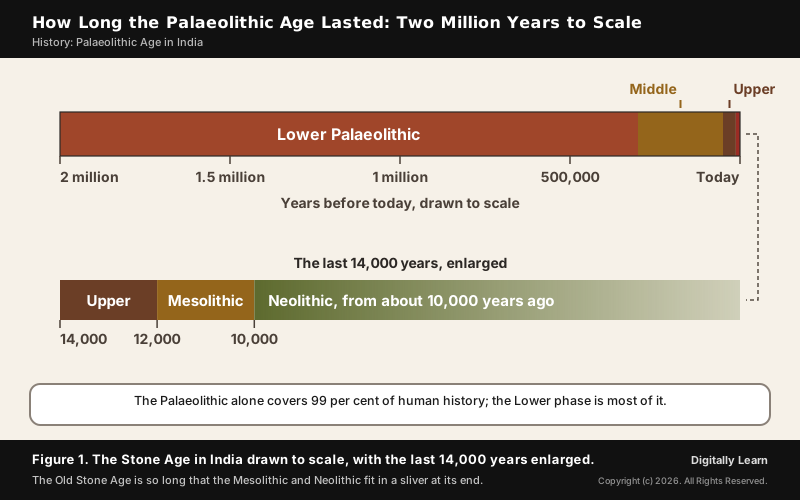
Drawn to scale, the difference in length is striking. The Palaeolithic covers 99 per cent of human history, and its Lower phase alone fills most of that span; the Mesolithic and the Neolithic together are a thin sliver at its end.
Palaeolithic Age Time Period in India and the Pleistocene
In India the Palaeolithic stretches from about two million years ago to about 12,000 years ago. It is divided into the Lower, Middle and Upper Palaeolithic by the kinds of tools people made. The span of each phase is broad and varies from region to region.
| Phase | Time span | Tools |
|---|---|---|
| Lower Palaeolithic | Until about 300,000 years ago | Hand axes, cleavers, choppers |
| Middle Palaeolithic | About 300,000 to 50,000 years ago | Flakes from prepared cores |
| Upper Palaeolithic | About 50,000 to 12,000 years ago | Blades, burins |
The Old Stone Age falls within a geological epoch called the Pleistocene, which ran from about 2.58 million years ago to 11,700 years ago and was a time of repeated cold glacial spells. The Palaeolithic is usually taken to end with the end of the ice age, when the earth's climate became warmer; that change came about 12,000 years ago and marks the start of the Mesolithic.
How Historians Study the Prehistoric Past: Tools and Sites
People of the Old Stone Age made tools of stone, wood and bone, but only the stone tools have survived well, so they are the main evidence. Archaeologists study them at sites, the places where the remains of things people made and used are found: on the surface, buried under the earth or even under water.
- Habitation sites: Places where people lived, such as caves and rock shelters, which gave protection from rain, heat and wind.
- Factory sites: Places where good stone was found and tools were made, recognised by blocks of stone, discarded tools and chips of waste stone.
- Habitation-cum-factory sites: Places where people both made tools and lived for long spells.
Dating such old material needs special methods. At Attirampakkam near Chennai, tools were dated by cosmic ray exposure dating, the first use of the method at an Indian site, and by luminescence dating; at the Siwalik site of Masol, the fossil layer was dated by palaeomagnetism. Such dates keep changing the picture: the oldest Acheulian tools of India are now known to be as old as those of Africa and Central Asia.
Phases of the Palaeolithic Age: Lower, Middle and Upper Palaeolithic
Lower Palaeolithic Age: Hand Axes, Cleavers and Choppers
The earliest and longest phase made its tools in two traditions. The Acheulian made bifacial hand axes and cleavers, worked on both faces, while the Soanian, named after the Soan river, a tributary of the Indus, made choppers and other tools on quartzite pebbles.
- Attirampakkam, Tamil Nadu: Acheulian hand axes and cleavers about 1.5 million years old, among the oldest known anywhere.
- Isampur, Karnataka: A quarry about 1.27 million years old, one of about 200 Acheulian sites in the Hunsgi and Baichbal valleys, where over 15,000 artefacts show every step of tool-making from limestone slabs.
- Didwana, Rajasthan: Hand axes dated to the Middle Pleistocene, about 400,000 years ago.
Who made these tools is not known from fossils. The makers of Acheulian tools elsewhere were early humans such as Homo erectus, so their presence in India is inferred from the tools. Acheulian sites spread from the Kortallayar valley in Tamil Nadu and Chirki-Nevasa in Maharashtra to Didwana and the Bhimbetka hills.
Some traces are older than the Acheulian. Cut-marked bones at Masol in the Siwaliks are about 2.6 million years old, and tools at Riwat and in the Pabbi Hills of Pakistan belong to a technology separate from both the Acheulian and the Soanian; these north-western sites are described with the other sites below.
Middle Palaeolithic: Flake Tools and the Levallois Technique
In the middle phase the emphasis shifted from large bifaces to tools made on flakes, which needed more planning. Toolmakers shaped a core first, so that the form of the flake struck from it was decided in advance; this prepared-core method, more elaborate than the Acheulian, is called the Levallois technique.
- Attirampakkam: Over 7,000 artefacts show Levallois technology dated to about 385,000 years, among the earliest outside Africa; whether early modern humans or an older species made them is unresolved.
- Jwalapuram, Andhra Pradesh: Tools lie both below and above the ash of the Toba super-eruption of about 74,000 years ago; people survived that event in the region.
- Narmada valley: India’s oldest human fossil, a skull cap found near Hathnora in 1982 by Arun Sonakia of the Geological Survey of India.
The Narmada Human, as that fossil is called, is still debated. It was first classed as Homo erectus narmadensis; later studies have placed it closer to archaic Homo sapiens, and its age is put anywhere between about 50,000 and 160,000 years. Collarbones from the same valley point to a second, short and stocky population that lived beside a larger-bodied one between about 250,000 and 70,000 years ago.
Upper Palaeolithic: Blades, Burins and Modern Humans
The last phase of the Old Stone Age is the age of modern humans, Homo sapiens, who reached the subcontinent between 75,000 and 50,000 years ago on the evidence of mitochondrial DNA. Tools were now made on long, thin blades, and the burin, a stone tool with a chisel-like edge, was used to work bone, antler and hides.
- Early microliths: Tiny tools at Mahadebbera and Kana in West Bengal date from 42,000 to 25,000 years ago; that is earlier than was once thought.
- Belan valley, Uttar Pradesh: Radiocarbon dates of 18,000 to 17,000 years.
- Patne, Maharashtra: Large quantities of ostrich egg shells, some engraved with designs, and beads made from them; ostriches then lived in India.
- Hunsgi, Karnataka: A late Old Stone Age site with long blades of reddish-brown chert.
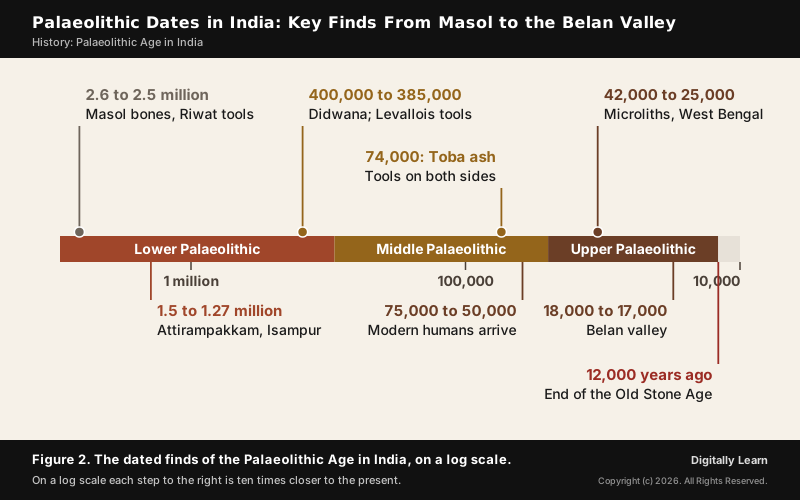
Placed on one scale, these dates show how slowly the tools changed. The hand axes of Attirampakkam and Isampur came more than a million years before the planned flakes of the middle phase, and the blades and microliths of the last phase crowd into the final 50,000 years before the Old Stone Age ended about 12,000 years ago.
Palaeolithic Age Tools: How Old Stone Age Tools Were Made and Used
Palaeolithic Age Tools: Techniques of Making Stone Tools
Palaeolithic age tools changed slowly over almost two million years. The trend ran from large, heavy tools shaped on both faces to smaller, thinner and more specialised flakes and blades, and good stone mattered so much that people looked for places where it was easily available. Two ways of shaping stone were in use.
- Stone on stone: The pebble to be shaped, called the core, was held in one hand and struck with a hammer stone held in the other, knocking off flakes until the shape was right.
- Pressure flaking: The core was placed on a firm surface, and the hammer stone struck a piece of bone or stone placed on the core, removing flakes that could be shaped into tools.
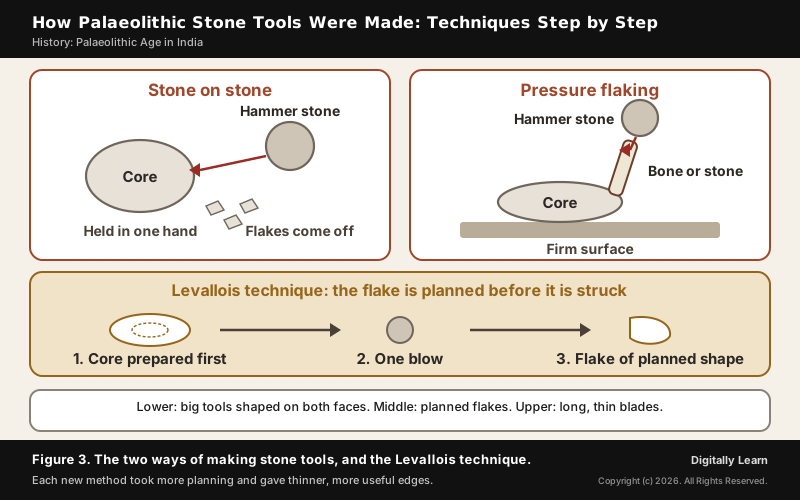
The Levallois technique added planning to these methods. Instead of trimming a pebble until a tool emerged, the toolmaker first prepared the core and then struck off one flake whose shape had been decided in advance, which gave a thin, sharp tool with less waste of good stone.
Raw Materials and Uses of Old Stone Age Tools
The stone chosen depended on what each region offered. Quartzite was worked at Attirampakkam and in the Siwaliks, the local limestone at Hunsgi and Isampur, and finer stones such as chert and jasper were used for the blades and small tools of the later phases.
| Material | Where used | Tools |
|---|---|---|
| Quartzite | Attirampakkam, Siwaliks | Hand axes, choppers |
| Limestone | Hunsgi, Isampur | Bifaces, cleavers |
| Chert, jasper | Upper Palaeolithic sites | Blades, small tools |
The uses of these tools can be read from their shapes. Some cut meat and bone, scraped bark from trees and hides of animals, or chopped fruit and roots; some were fixed to handles of bone or wood to make spears and arrows for hunting. Others chopped wood for fuel, huts and more tools, dug up edible roots or stitched clothes made of animal skin.
Palaeolithic Sites in India
Palaeolithic Sites in South India: Attirampakkam, Hunsgi and Kurnool
South India holds some of the oldest and best-studied sites. Attirampakkam, a village near the Kortallayar river about 60 kilometres from Chennai, has a record of tool-making that runs from the early Acheulian to the Middle Palaeolithic. Robert Bruce Foote of the Geological Survey found the first tools there in 1863, and with Pallavaram near Chennai it became the type site of the Madrasian culture, the name once used for the Acheulian of the region.
- Hunsgi, Karnataka: A number of early Palaeolithic sites; the large ones, with tools for all sorts of work, were habitation-cum-factory sites and some smaller ones only places where tools were made; several lay close to springs, and most tools were of local limestone.
- Kurnool caves, Andhra Pradesh: Traces of ash show that people knew the use of fire, which could give light, cook meat and scare away animals.
- Jwalapuram, Andhra Pradesh: Tools sealed above and below the ash of Toba, a volcano in Sumatra; the ash layer has become a marker for dating Indian prehistory.

Palaeolithic Sites in Central India: Bhimbetka and the Narmada Valley
Central India's hills were a natural home for Stone Age people. Bhimbetka, in the Raisen district of Madhya Pradesh about 45 kilometres from Bhopal, lies in the foothills of the Vindhyas; some of its shelters were lived in more than 100,000 years ago. It shows human life from Acheulian times onwards. Its name is read as Bhima's resting place, after the Pandava of the Mahabharata.
- Discovery and status: The archaeologist V. S. Wakankar discovered the complex in 1957, and the Rock Shelters of Bhimbetka became a UNESCO World Heritage Site in 2003, as a tradition continuing from the Palaeolithic to the medieval period.
- Size: Seven hills and over 750 rock shelters spread over about 10 kilometres.
- Cupules: Small cup-like hollows at the end of its Auditorium rock shelter, dated to nearly 100,000 years.
- Adamgarh hills, Narmadapuram: Rock shelters with Lower Palaeolithic and Mesolithic tools.
Natural caves and rock shelters are common in the Vindhyas and the Deccan plateau, and many lie close to the Narmada valley, where the Narmada Human was found. People chose them because they gave shelter from rain, heat and wind and lay near water and good stone, which is why prehistoric sites cluster along rivers and hills.
Palaeolithic Sites in North-West India: Soan Valley, Siwaliks and Didwana
The Siwalik foothills hold the oldest traces of early humans in South Asia. The Soanian tools are found along the Siwaliks in present-day India, Nepal and Pakistan, and include choppers, discoids, scrapers, cores and flakes, mostly made on quartzite pebbles and cobbles.
- Masol: North of Chandigarh, fossil bones in a layer dated by palaeomagnetism to 2.6 million years carry cut marks that researchers have read as the work of early humans using quartzite edges.
- Riwat and the Pabbi Hills, Pakistan: Tools at Riwat on the Pothohar plateau are dated to about 2.5 million years, and simple tools from the Pabbi Hills to 2.2 to 0.9 million years.
- Didwana, Rajasthan: Hand axes whose shapes and sizes trace the Acheulian from its early to its very late stage.
The Soanian is hard to date because its tools are mostly found on the surface, not in datable layers. One view places it in the Middle Pleistocene and credits it to Homo erectus; another treats it as much later, the work of people derived from the Harappan civilisation. Its tools are often found near those of the Acheulian in the same sub-Himalayan zone.
Life in the Palaeolithic Age: Hunter-Gatherers, Art and Climate
Why Palaeolithic Hunter-Gatherers Moved From Place to Place
Palaeolithic people did not stay in one place for long. Hunting animals that are faster and stronger than humans needed alertness and skill, and gathering needed knowledge of which plants were edible and when fruits ripened. In a tropical land with an immense variety of plants, gathering was an extremely important source of food.
- Food ran out: Staying long in one place would use up the plants and animals nearby.
- Animals moved: Deer and wild cattle moved in search of grass and leaves, and their hunters followed.
- Seasons changed: Different plants bear fruit in different seasons.
- Seasonal water: Many rivers and lakes are seasonal, so people moved in the dry months.
Who did which work is not known. Men and women may have done many tasks together, or some tasks may have been done only by women and others only by men, and practice may have differed from region to region. People also travelled to meet friends and relatives, always on foot.
Palaeolithic Art: Engraved Shells, Cupules and the First Paintings
Art appears late in the Old Stone Age. The earliest paintings in India are reported from Upper Palaeolithic times, and at Bhimbetka the oldest group shows huge bison, elephants, tigers, rhinos and boars drawn as linear figures in green and dark red, with stick-like human figures; the green paintings are of dancers and the red ones of hunters.
- Engraved ostrich shells: At Patne in Maharashtra, designs were engraved on pieces of ostrich egg shell, and beads were made from them.
- Cupules: The cup-like hollows of Bhimbetka’s Auditorium rock shelter, nearly 100,000 years old.
- First discovery: Rock paintings were first found in India in 1867-68 by the archaeologist Archibold Carlleyle, twelve years before the discovery of the Altamira cave in Spain.
The same age saw cave painting elsewhere. In France, paintings made between 20,000 and 10,000 years ago show wild horses, bison, reindeer and bear in colours made from minerals such as ochre or iron ore, and charcoal, perhaps for rituals before a hunt. The fuller story of Indian rock painting belongs to the next age and is told in the Mesolithic Age in India.
End of the Palaeolithic Age: A Warmer Climate 12,000 Years Ago
The Palaeolithic Age ended with a change in the world's climate. Around 12,000 years ago conditions became relatively warm, and in many areas grasslands spread; deer, antelope, goat, sheep and cattle, animals that live on grass, increased in number.
- Hunters who followed these herds learned their food habits and breeding seasons, which may have led them to think of herding and rearing the animals themselves.
- Fishing became important.
- Wheat, barley and rice grew wild in different parts of the subcontinent, and people who collected the grain learned where it grew and when it ripened, which may have led them to grow plants on their own.
These changes open the next age, traced in the Mesolithic Age in India. Farming, pottery and villages follow in the Neolithic Age in India, and the first cities in the Indus Valley Civilisation.
Palaeolithic Age Characteristics and How It Differs From Later Ages
- Way of life: Hunting, fishing and gathering, with no farming and no herding.
- Stone tools: Used with tools of wood and bone, changing from hand axes to flakes and then to blades.
- Shelter: Caves, rock shelters and open camps near water and good stone, with frequent moves.
- Fire: Its use is shown by traces of ash in the Kurnool caves.
- Rock art and engraving: Cupules, engraved ostrich shell and, at the end, the first paintings.
- Climate: The cold and changing Pleistocene, ending in the warmer conditions of 12,000 years ago.
| Feature | Palaeolithic | Mesolithic | Neolithic |
|---|---|---|---|
| Time | 2 million to 12,000 years ago | 12,000 to 10,000 years ago | From about 10,000 years ago |
| Tools | Hand axes, flakes, blades | Microliths | Polished stone tools |
| Food | Hunting, gathering | Hunting, fishing, gathering | Farming and herding |
| Settlement | Caves, rock shelters, camps | Camps, some longer stays | Villages with houses |
Previous Year UPSC-CSE Questions
Previous Year UPSC-CSE Questions By the end you will be able to draft model answers for the following UPSC questions. Each question carries a collapsible framework showing how to approach it in the exam.
- UPSC Mains 2023 GS-IExplain the role of geographical factors towards the development of Ancient India.
Answer outline: how to structure the answer
What the question asks, the main arguments, relevant examples and the direction of the conclusion. This is not a full model answer.
Introduction: Introduce geography as the setting that decided where the earliest Indians lived and how they got their food.
Body (sub-themes to develop):
- Stone and water: Palaeolithic sites near rivers, springs and good stone, such as Attirampakkam on the Kortallayar and Hunsgi with its springs and limestone.
- Relief: rock shelters of the Vindhyas and the Deccan, Bhimbetka above all, gave shelter from rain, heat and wind.
- Climate: the warmer conditions of about 12,000 years ago spread grasslands and wild grains, leading towards herding and farming.
- Later stages: fertile river valleys for farming villages and cities; mountains and seas as barriers and routes.
Conclusion: Conclude that geography set the stage for each step, while people's choices shaped the outcome.
Sources
- NCERT: Our Pasts I (Class VI), On the Trail of the Earliest People
- NCERT: An Introduction to Indian Art, Part I (Class XI), Prehistoric Rock Paintings
- PIB: Bhimbetka Rock Shelters in Madhya Pradesh declared World Heritage (4 July 2003)
- PIB: India, World Heritage Properties (list)
- Ministry of Culture: Rock Shelters of Bhimbetka
- IGNCA (Ministry of Culture): The Art on Rocks
- Wikipedia: South Asian Stone Age
- Wikipedia: Paleolithic
- Wikipedia: Lower Paleolithic
- Wikipedia: Middle Paleolithic
- Wikipedia: Upper Paleolithic
- Wikipedia: Acheulean
- Wikipedia: Soanian
- Wikipedia: Madrasian culture
- Wikipedia: Attirampakkam
- Wikipedia: Hunsgi
- Wikipedia: Bhimbetka rock shelters
- Wikipedia: Narmada Human
- Wikipedia: Jwalapuram
- Wikipedia: Didwana
- Wikipedia: Adamgarh Hills
- Wikipedia: Hand axe
- Wikipedia: Hunter-gatherer
- UPSC: Civil Services Examination question papers
Editorial Disclaimer
This article draws on the NCERT textbooks and the other sources listed on this page. Dates for prehistoric sites are revised as new methods are applied.