


Overview
The White Revolution in India is the transformation of its dairy sector from a milk-short trade run by private contractors into a network of cooperatives owned by the farmers who produce the milk. It began in 1946 with the Kaira milk producers' union at Anand, the body that later created the Amul brand. Verghese Kurien (also written Varghese Kurien) built that union into a modern dairy and in 1965 became the first chairman of the National Dairy Development Board (NDDB), which spread the model across India through Operation Flood from 1970. India became the world's largest milk producer in 1998 and produced about 248 million tonnes of milk in 2024‑25.
Indian Dairy Before 1946: Household Milk and the Polson Monopoly
Milk Supply in Colonial India and the Kaira Milkshed
Until independence, dairy production and trade in India lay almost entirely in the household sector, and most milk was produced for home consumption. Modern milk processing and marketing technologies were introduced in India in the 1920s, and the first dairy animal census was taken in 1919. A report of 1937 put milk intake at about 200 grams a day per person, including all dairy products, the lowest among the large dairy countries. Isolated attempts to form milk producers' cooperatives were made in the 1930s and 1940s, but they succeeded only after independence.
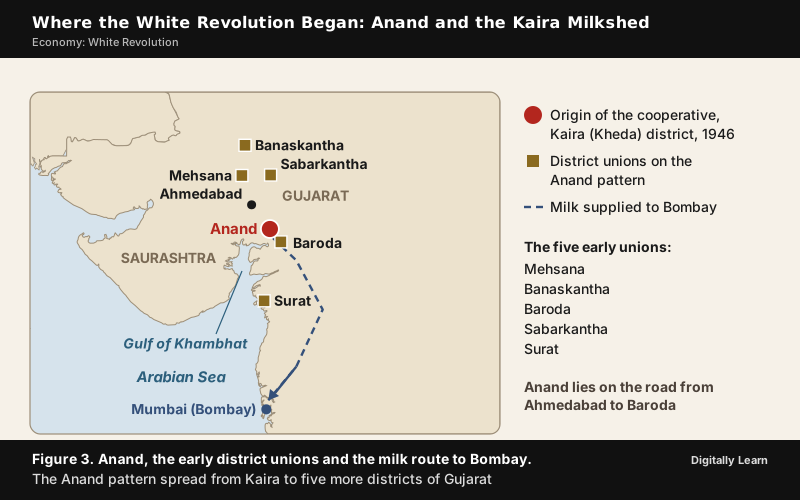
Kaira district, also called Kheda, lay in Bombay Province and supplied milk to the city of Bombay (now Mumbai). Its farmers did not sell to the city themselves. Polson, a private dairy firm, held a near-monopoly on milk collection from Kaira and on its supply to Bombay, and three conditions kept the producers weak:
- Prices set by the buyer: Traders and agents fixed milk prices arbitrarily on Polson's behalf.
- Small, perishable supply: Most producers were marginal farmers who could deliver at most one or two litres a day, and milk spoils fast in hot weather, so it had to be sold at once.
- No other buyer: The producers had no outlet for their milk except Polson's agents and had to accept the price offered.
The producers felt cheated by the milk traders.
The national picture was no better after independence. India faced a milk shortage and depended on imports in the 1950s and 1960s, when imports of dairy commodities made up 50 to 60 per cent of the dairy industry's total requirement. Milk production grew at a compound annual rate of 1.64 per cent in the first decade after independence and only 1.15 per cent in the 1960s, even though India had the world's largest cattle population. Foreign exchange was spent on dairy imports from Europe and New Zealand to fill the gap.
History of Amul: The Kaira Cooperative of 1946
Sardar Patel, Morarji Desai and the Kaira Milk Strike
The farmers of Kaira, led by Tribhuvandas Kishibhai Patel, took their complaint to Sardar Vallabhbhai Patel, who came from the same district. He advised them to form a cooperative of their own, so that they could supply milk directly to the Bombay Milk Scheme instead of selling through Polson. Sardar Patel sent Morarji Desai to organise the farmers.
At a meeting in Chaklasi the farmers formed the cooperative and resolved to stop supplying milk to Polson. With the help of a milk strike, they pressed the Bombay government to buy milk from their union. The Kaira District Co-operative Milk Producers' Union Limited was registered on 14 December 1946.
The union was organised from the bottom up. Milk collection was decentralised, with a cooperative society in each village, because the members were small producers bringing a litre or two each. Membership was open to any farmer, whatever the member's religion, caste, gender or political affiliation.
Tribhuvandas Patel and the Early Kaira Union
Tribhuvandas Kishibhai Patel (1903‑1994), a lawyer and Gandhian freedom fighter from Anand, became the first chairman of the union in January 1947 and was re-elected to the post for over 25 years. He walked from village to village to persuade farmers to form milk societies, and he is regarded as the father of the cooperative movement in India.
The union started with two village cooperative societies, each with fewer than 100 members, supplying 250 litres of milk a day. By June 1948 it was pasteurising milk for the Bombay Milk Scheme, and by 1952 its daily procurement had reached 20,000 litres.
When Tribhuvandas Patel retired from the chairmanship in the early 1970s, the members of the village cooperatives presented him with a purse of ₹6 lakh, each member giving ₹1. He used it to start the Tribhuvandas Foundation, which works on the health of women and children in Kheda district.
| Year | Event |
|---|---|
| 1946 | Kaira District Co-operative Milk Producers' Union registered (14 December) |
| 1947 | Tribhuvandas Patel elected first chairman (January) |
| 1948 | Pasteurising of milk for the Bombay Milk Scheme begun (June) |
| 1949 | Verghese Kurien posted to the government's experimental creamery at Anand (13 May) |
| 1955 | Spray dryer for buffalo milk installed; brand name Amul adopted |
| 1960 | Factory for cheese and baby food from buffalo milk added |
| 1964 | Lal Bahadur Shastri's visit to Anand (31 October); cattle feed factory commissioned |
| 1965 | National Dairy Development Board founded at Anand |
| 1970 | Operation Flood launched (13 January) |
| Early 1970s | Gujarat Co-operative Milk Marketing Federation set up; Amul brand transferred to it |
Verghese Kurien and H. M. Dalaya at Anand
Verghese Kurien's Arrival at Anand in 1949
Verghese Kurien was born on 26 November 1921 in Calicut, now Kozhikode in Kerala, and died on 9 September 2012. He graduated in physics from Loyola College, took a degree in mechanical engineering from the College of Engineering, Guindy, and went to Michigan State University in the United States on a government scholarship meant for dairy engineering.
On 13 May 1949 he left for Anand, where the Government of India had posted him to its creamery for five years in return for his scholarship. He spent his evenings helping Tribhuvandas Patel repair the union's dairy equipment, and when he wanted to leave his government post, Patel persuaded him to stay. Kurien was the union's chief executive from 1950 to 1973, and he was an employee of the Kaira milk producers, not of the government. NCERT's Class VI textbook names Kurien with Tribhuvandas Patel as the leaders under whom the union was set up in 1946, although Kurien reached Anand only in 1949, three years after the union was registered.
Kurien held that if every section of the village gained from the cooperative, economic self-interest would bring its members together across caste and class. Professional managers ran the business, but they answered to leaders elected by the producers. He is known as the "Father of the White Revolution", and National Milk Day is observed on 26 November, his birth anniversary.
Buffalo Milk Powder: Dalaya's Spray-Drying Breakthrough of 1955
Harichand Megha Dalaya (1921‑2004), who had studied dairy technology at Michigan State University, came to Anand at Kurien's request and stayed until he retired. He solved a problem that held back the union's growth.
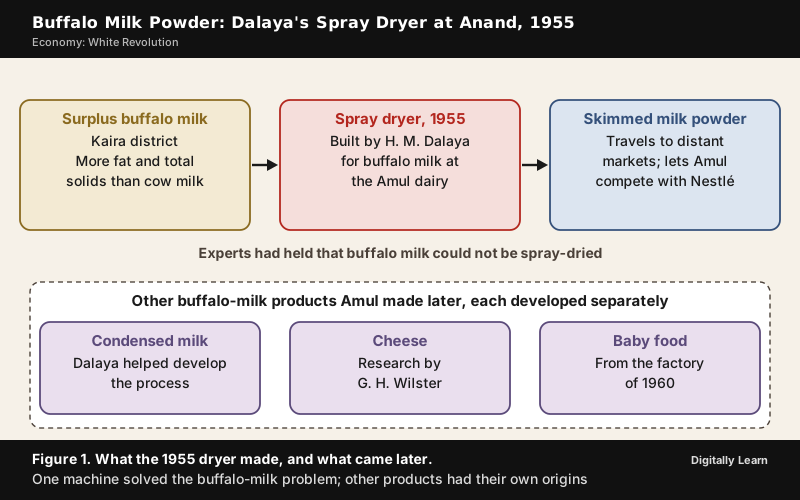
Buffalo milk was abundant in Kaira district, and across India buffalo milk was plentiful while cow milk was in short supply. To expand, the union had to turn that surplus into powder, which could travel long distances. Only cow milk was then spray-dried into powder, and dairy experts held that buffalo milk could not be spray-dried because of its high fat content. Dalaya developed a process that did it. In 1955 the world's first spray dryer for buffalo milk was installed at the Amul dairy, and the same year the union set up a factory for milk powder and butter, partly so that the larger yields of milk in winter would not go unsold.
Skimmed milk powder made from buffalo milk allowed Amul to compete with cow-milk suppliers such as Nestlé. Amul also made other products from buffalo milk, each developed separately, and several of them replaced imports:
- Condensed milk: Dalaya also helped develop an indigenous process for making condensed milk from buffalo milk. After Nestlé refused Kurien's request in 1956 to make condensed milk in India from local buffalo milk, Amul raised its own output, and the Government of India banned the import of condensed milk two years later.
- Butter: Commerce Minister T. T. Krishnamachari cut butter imports in steps as Amul delivered matching increases in its own butter production.
- Cheese and baby food: Research by G. H. Wilster led to cheese from buffalo milk, and a factory added in 1960 was the first in the world to make cheese and baby food from buffalo milk on a large commercial scale.
The union chose the brand name Amul, from Anand Milk Union Limited, for its products in 1955, and the brand came to compete with Glaxo across India.
Buffalo milk still matters. Nearly half of the milk produced in India comes from water buffaloes, and buffalo milk carries more fat, protein and total solids than cow milk, which suits it to products such as cheese.
Anand Pattern: Three-Tier Cooperative Model of the Kaira Union
Village Society, District Union and State Federation
The Anand pattern is the integrated cooperative structure, first built at Anand, that procures, processes and markets milk through institutions the producers own and control. It has three tiers: The members own the village society, the societies own the district union and the unions own the State federation.
- Village dairy cooperative society: Milk producers form it by buying a share and agreeing to sell milk only to the society, which collects milk every day, tests each member's milk and pays for it by its quality.
- District milk producers' union: The village societies own it; it buys all their milk, processes and markets it, and supplies feed, veterinary care and artificial insemination.
- State federation: The district unions of a State form it to market the milk and milk products of all member unions.
The rules of the Kaira cooperative gave the producer the final say. A member paid an entrance fee of ₹1 and bought at least one share of ₹10, and each member had one vote, however many shares the member held. The managing committee of a village society was elected by secret ballot. At the district union, six of the 12 directors were elected from among the chairmen of the village societies, and the board appointed the managing director, who hired the professional staff.
| Feature | Contractor chain before 1946 | Kaira cooperative after 1946 |
|---|---|---|
| Buyer of the milk | Traders and agents working for Polson | The farmers' own village society |
| Price | Fixed arbitrarily by traders and agents | Paid on the quality of each member's milk |
| Owner of processing | Polson, a private firm | The district union, owned by the village societies |
| Supply to Bombay | Polson, which collected nearly all of Kaira's milk | The union, supplying the Bombay Milk Scheme directly |

Benefits of the Kaira Cooperative for Small and Landless Producers
The cooperative mattered most to the poorest households of the district. The producer who queued at the village collection centre each day usually owned one or two buffaloes, not a large herd, and by one estimate a third of the milk producers were landless. Membership required only that a person be a genuine milk producer who supplied the society regularly, so a household without land could join on the same terms as a landowner.
- Daily payment: Members sold milk at the collection centre day after day and collected payment for the previous sale, so even a family with one or two animals had a regular income.
- A large share of rural income: By one estimate, nearly 48 per cent of the income of rural households in Kaira district came from dairying.
- Services a single farmer could not afford: The union ran artificial insemination through the village societies, a mobile veterinary service, cattle insurance and fodder seed supply, and from 1964 it made balanced cattle feed.
- Women at the centre: Women generally looked after the animals, so the union made a special effort to educate them.
- Village facilities: Part of the profit went into common facilities such as wells, roads and schools.
Spread of the Anand Pattern in Gujarat and the Founding of GCMMF
The success of Tribhuvandas Patel, Kurien and Dalaya soon spread to neighbouring districts. Within a short span, five more district unions were set up on the same lines in Mehsana, Banaskantha, Baroda, Sabarkantha and Surat. To combine their strength, enlarge the market, save on advertising and avoid competing against each other, the unions set up the Gujarat Co-operative Milk Marketing Federation (GCMMF) in the early 1970s as their apex marketing body, and the Kaira Union transferred the Amul brand to it.
GCMMF owns the Amul brand today. Amul's network has 36 lakh farmer members, 18,000 village societies and 18 district unions, collects nearly 3 crore litres of milk a day, and recorded a turnover of over ₹90,000 crore in 2024‑25.
National Dairy Development Board: Lal Bahadur Shastri and the 1965 Founding
Lal Bahadur Shastri's Anand Visit of October 1964
Lal Bahadur Shastri visited Anand in October 1964 to inaugurate the union's cattle feed factory, and on 31 October he spoke with the farmers about their cooperative. The same year he wrote to the Chief Ministers of all States about a large programme to set up cooperative dairies on the Anand pattern, and on his return to Delhi he set in motion an organisation to repeat the Kaira cooperative in other parts of India.
The National Dairy Development Board was created in 1965 at his initiative, with Verghese Kurien as its first chairman. Three choices shaped it:
- Location: At Kurien's insistence NDDB was placed at Anand, not in New Delhi.
- Form: It was set up as a society, with a structure suited to its objectives rather than that of a government department.
- Leadership: Kurien served as honorary chairman and kept drawing his salary as an employee of the Kaira milk producers.
The Board organised farmers into village milk societies and drew heavily on the Kaira Union for staff and expertise. Parliament declared NDDB an Institution of National Importance by an Act of 1987, and it now works under the Ministry of Fisheries, Animal Husbandry and Dairying. Kurien led it until he retired in 1998, when Amrita Patel, who had joined Amul in 1965 and trained under him, succeeded him; she headed NDDB until 2014.
NDDB and the Launch of Operation Flood in 1970
NDDB carried the Kaira model to the whole country through Operation Flood, launched on 13 January 1970. In its first phase the programme linked 18 of India's best milksheds with consumers in Delhi, Mumbai, Kolkata and Chennai, and by 1998 it had helped India overtake the United States as the world's largest milk producer. The programme was built on institutions first developed at Anand, namely the village society, the district union, the professional manager answerable to farmers, and the buffalo-milk technology that let Indian cooperatives make products that had been imported.
White Revolution Among India's Agricultural Revolutions After Independence
Green Revolution and White Revolution Compared
India's agricultural growth after independence is often described as a set of revolutions, each known by a colour: The Green Revolution in foodgrains, the Yellow Revolution in oilseeds, the White Revolution in milk, the Blue Revolution in fish and the Golden Revolution in fruits and vegetables. The Green Revolution and the White Revolution (Operation Flood) were among the strategies the Government of India used in the 1960s and 1970s to improve Indian agriculture, and they are the two most often compared.
| Feature | Green Revolution | White Revolution |
|---|---|---|
| Produce | Foodgrains, especially wheat | Milk |
| Start | 1960s; first introduced in Punjab in 1966‑67 | Kaira Union in 1946; national programme from 1970 |
| Main method | High-yielding varieties of seed, fertilisers and irrigation | Farmer-owned cooperatives, professional management and new dairy technology |
| Early regions | Punjab, Haryana and western Uttar Pradesh | Gujarat, then milksheds linked to Delhi, Mumbai, Kolkata and Chennai |
| Leading figure | M. S. Swaminathan | Verghese Kurien |
| Leading institution | Indian Agricultural Research Institute and the Indian Council of Agricultural Research (ICAR) | National Dairy Development Board |
| Main gain | Greater self-sufficiency in wheat and rice | World's largest milk producer from 1998 |
Under both strategies, development remained concentrated in a few selected areas.
White Revolution, Poverty Alleviation and Food Security
The White Revolution reduced rural poverty by turning household dairying into a regular cash income for millions of small producers. Dairying directly employs more than 8 crore farmers and contributes around 5 per cent to the national economy. Across India, women form around 70 per cent of the dairy workforce and about 35 per cent of the members of dairy cooperatives; among Amul's producers, more than 65 per cent are women.
Four measures show what the White Revolution did for food security:
- Production: Milk production rose about 12 times between 1951 and 2021, mainly because of Operation Flood, and reached about 248 million tonnes in 2024‑25, up from 146.31 million tonnes in 2014‑15.
- World position: India is the world's largest milk producer, with nearly 25 per cent of global output.
- Per capita availability: Milk available per person reached 485 grams a day in 2024‑25.
- Self-reliance: A country that depended on imports in the 1950s and 1960s is now largely self-sufficient in milk, and its dairy imports are negligible.
Milk supplies high-quality animal protein along with calcium, magnesium and potassium in easily absorbed forms, which is why its wider availability counts as a gain in nutrition and not only in output.

Legacy of the Kaira Cooperative: Ministry of Cooperation and Tribhuvan Sahkari University
Cooperative Institutions Built on the Anand Experience
The Kaira experiment left institutions beyond dairying. In 1979 Kurien set up the Institute of Rural Management Anand (IRMA) to train managers for the milk cooperatives, with the Amul complex and the Kaira Union as its live laboratory. The same year he applied the cooperative model to edible oils through the Oilseeds Growers' Cooperative Project, known as Operation Golden Flow. Other States now have milk cooperatives of their own, selling under brands such as Nandini in Karnataka, Aavin in Tamil Nadu, Sudha in Bihar and Verka in Punjab.
At the national level, the Union Government created a separate Ministry of Cooperation, announced on 6 July 2021, with the vision "Sahkar se Samriddhi" (prosperity through cooperation). Before it, cooperatives were handled by the Ministry of Agriculture. The ministry gives cooperatives their own administrative, legal and policy framework.
Previous Year UPSC‑CSE Questions
Each Prelims question is explained option by option, and each Mains question comes with an answer outline.
- UPSC Prelims 2006Match List‑I with List‑II and select the correct answer using the code given below the lists:List I (Person)
- A. Chanda Kochhar
- B. Amrita Patel
- C. Indra Nooyi
- D. Piyush Pandey
List II (Organization / Area of work)
- 1. Advertising
- 2. Banking
- 3. Dairy Development
- 4. Pepsi Co.
A B C D
How to approach this Prelims question
Approach: Fix the one pair the dairy story settles, then use it to strike out options before matching the rest. Amrita Patel headed the National Dairy Development Board from 1998 to 2014, so B matches 3 (Dairy Development), and only options (b) and (c) give B‑3. Chanda Kochhar built her career at ICICI Bank, so A matches 2 (Banking), which rules out (b), where A is 4. Indra Nooyi was PepsiCo's chief financial officer and became its chief executive in 2006, so C matches 4 (Pepsi Co.). Piyush Pandey spent four decades at the advertising agency Ogilvy, so D matches 1 (Advertising). The matching is A‑2, B‑3, C‑4, D‑1, which is option (c).
Trap to watch: Option (a) keeps A‑2 and C‑4 right but swaps Amrita Patel with Piyush Pandey, so a candidate who knows only the business names can fall for it, while the dairy pair alone rules it out.
Why each option is right or wrong:
- (a) 2 1 4 3: Wrong. It places Amrita Patel in advertising, but she headed the National Dairy Development Board, so B is 3, not 1.
- (b) 4 3 2 1: Wrong. Its B‑3 and D‑1 are right, but Chanda Kochhar was a banker at ICICI Bank and Indra Nooyi led PepsiCo, so A is 2 and C is 4.
- (c) 2 3 4 1: Correct. Chanda Kochhar matches banking, Amrita Patel dairy development, Indra Nooyi PepsiCo and Piyush Pandey advertising.
- (d) 4 1 2 3: Wrong. Every pair is mismatched; Amrita Patel, for example, belongs with dairy development, not advertising.
Answer: (c) 2 3 4 1. Amrita Patel, Kurien's successor, headed the National Dairy Development Board, and that pair together with Chanda Kochhar's career in banking leaves only option (c).
- UPSC Mains 2017 GS‑IIIExplain various types of revolutions, took place in Agriculture after independence in India. How these revolutions have helped in poverty alleviation and food security in India?
Answer outline
The outline sets out what the question asks, the main arguments, relevant examples and the direction of the conclusion; it is not a full model answer.
Introduction: After independence, India raised the output of foodgrains, oilseeds, milk, fish and fruits and vegetables through drives known as the Green, Yellow, White, Blue and Golden Revolutions.
Body (sub-themes to develop):
- Green Revolution: From the late 1960s, high-yielding varieties of seed with fertilisers and irrigation, first in Punjab, Haryana and western Uttar Pradesh, improved India's self-sufficiency in wheat and rice.
- White Revolution: The Kaira cooperative of 1946, NDDB from 1965 and Operation Flood from 1970 made India the largest milk producer by 1998; output reached about 248 million tonnes in 2024‑25.
- Other revolutions: The Yellow Revolution raised oilseeds, the Blue Revolution fish and the Golden Revolution fruits and vegetables.
- Poverty alleviation: Dairy cooperatives paid regular income to small, marginal and landless producers; in Kaira, by one estimate, nearly 48 per cent of rural household income came from dairying, and dairying now directly employs more than 8 crore farmers.
- Food security: Higher wheat and rice output improved self-sufficiency, India became largely self-sufficient in milk with negligible dairy imports, and milk availability reached 485 grams per person a day in 2024‑25.
- Limits: Under both the Green and the White Revolution, development stayed concentrated in a few selected areas.
Conclusion: The revolutions turned a food-short country into a large producer of grain and milk, and the White Revolution showed that gains reach the poor most surely when producers own the institutions that buy and sell their produce.
Sources
- NCERT: Indian Economic Development (Class XI), Chapter 5, Rural Development
- NCERT: Contemporary India II (Class X), Chapter 4, Agriculture
- NCERT: Exploring Society: India and Beyond (Class VI), Chapter 14, Economic Activities Around Us
- PIB: National Milk Day, Backgrounder of the Ministry of Fisheries, Animal Husbandry and Dairying (26 November 2021)
- PIB: National Milk Day, Honouring the White Revolution (25 November 2025)
- PIB: India's Dairy Sector, Anchoring Nutrition and Income Security (September 2025)
- PIB: The New Era of Indian Agriculture and Allied Sectors (12 August 2026)
- NDDB: Genesis
- NDDB: The Anand Pattern
- NDDB: Operation Flood
- Ministry of Cooperation: "Tribhuvan" Sahkari University, Brief Note
- Ministry of Cooperation: "Tribhuvan" Sahkari University, About the University
- Akashvani News: Parliament passes Tribhuvan Sahkari University Bill, 2025 (1 April 2025)
- Wikipedia: Amul
- Wikipedia: Verghese Kurien
- Wikipedia: Tribhuvandas Kishibhai Patel
- Wikipedia: Harichand Megha Dalaya
- Wikipedia: National Dairy Development Board
- Wikipedia: White Revolution (India)
- Wikipedia: Dairy in India
- Wikipedia: Water buffalo
- Wikipedia: Green Revolution in India
- Wikipedia: Ministry of Co-operation
- Wikipedia: Tribhuvan Sahkari University
- Wikipedia: Amrita Patel
- Wikipedia: Chanda Kochhar
- Wikipedia: Indra Nooyi
- Wikipedia: Piyush Pandey
- UPSC: Previous year question papers
Editorial Disclaimer
This article draws on the current NCERT textbooks, official releases and the other sources listed in the Sources section.
See more of our UPSC articles in Google Search
Add to Preferred Sources