


Overview
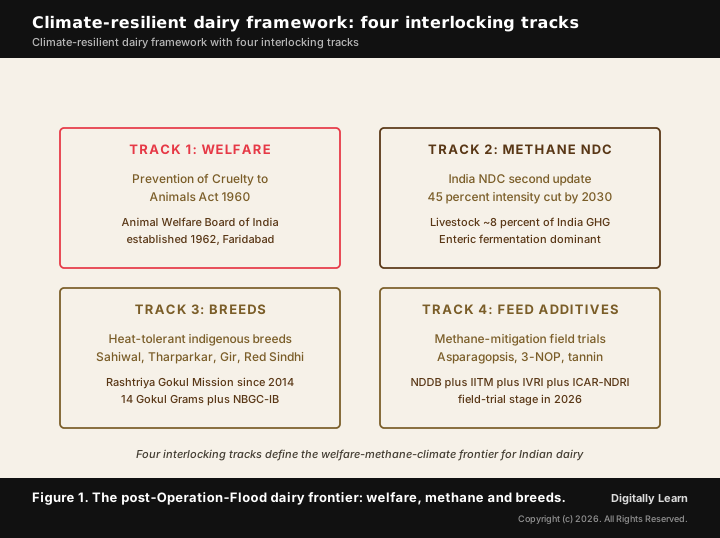
White Revolution Part 4 covers the animal welfare, livestock-methane mitigation, and climate-resilient dairy strategy questions that the post-Operation-Flood and National Dairy Plan programmes left to the next decade. The entry traces the regulatory framework under the Prevention of Cruelty to Animals Act 1960, India's Nationally Determined Contribution commitment to a 45 percent emissions-intensity reduction by 2030, the indigenous-breed productivity strategy under the Rashtriya Gokul Mission, and the contested implementation of methane-mitigation feed additives and perennial-fodder security at field scale.
White Revolution Part 4: animal welfare, methane mitigation, and climate-resilient dairy in 2026
Why it matters: India is the world's largest milk producer and also the world's largest concentration of dairy cattle and buffaloes. That scale makes the livestock-methane footprint a binding constraint on India's climate commitments, and the welfare-and-emissions trade-off is the central design problem of the next policy decade. UPSC Mains GS-III rewards candidates who connect the welfare statute (Prevention of Cruelty to Animals Act 1960), the methane-emissions pathway under India's Nationally Determined Contribution, and the breed-feed-fodder strategy as one integrated climate-resilience question rather than three separate ones.
What is the animal-welfare-and-methane policy framework: PCA Act 1960, Animal Welfare Board of India, and the cattle-transport-and-slaughter regulatory architecture
Prevention of Cruelty to Animals Act 1960: statutory anchor for animal welfare across livestock, research, and entertainment
What is the significance of the Prevention of Cruelty to Animals Act 1960? The Act is the foundational statutory anchor for animal welfare in India, predating every other contemporary welfare law and shaping the institutional architecture across livestock, research, transport, and entertainment. The Act criminalises specific cruel practices, empowers the central government to make rules on transport and slaughter, and constitutes the Animal Welfare Board of India as its primary advisory body.
Animal Welfare Board of India: statutory body, Faridabad headquarters, and advisory plus guideline-issuing functions
The Animal Welfare Board of India was established in 1962 under Section 4 of the Prevention of Cruelty to Animals Act 1960, making it the oldest statutory animal-welfare body in any independent country at the time of its constitution. The Board is headquartered in Ballabhgarh in Faridabad district of Haryana, having moved from Chennai in early 2018, and currently functions under the Ministry of Fisheries, Animal Husbandry and Dairying (Department of Animal Husbandry and Dairying).
Cattle Transport and Slaughter Rules and the Contemporary Animal-Welfare Regulatory Debate
Cattle transport, slaughter-house design, and dairy-welfare specifics are regulated through subordinate rules under the PCA Act 1960. The Transport of Animals Rules 1978 set minimum standards for vehicle dimensions, feed and water arrangements, and journey-duration limits, with separate provisions for rail, road, sea, and air transport of cattle and buffaloes.
Where India's livestock-methane footprint sits: the Indian Nationally Determined Contribution, enteric fermentation, and the agriculture share of total emissions
Livestock as roughly 7 to 8 percent of India's CO2-equivalent emissions and the largest single agricultural source
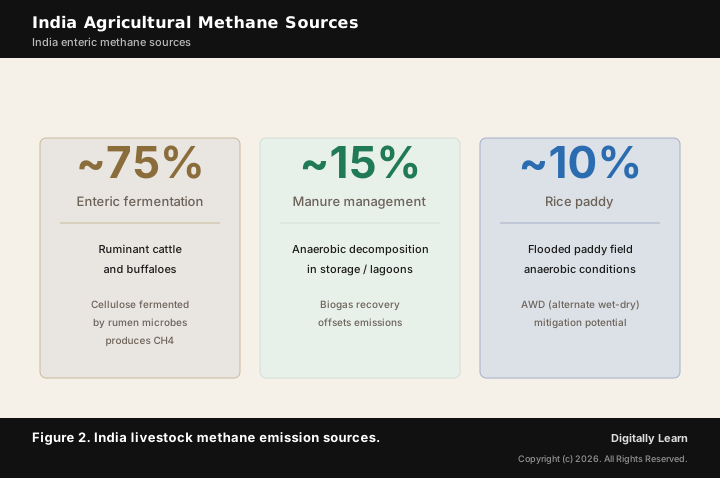
Livestock contributes roughly 7 to 8 percent of India's economy-wide greenhouse-gas emissions on a CO2-equivalent basis, and close to half of India's national methane, on the inventory drawn from India's communications to the UN Framework Convention on Climate Change. This makes enteric fermentation the largest single source of agricultural emissions in India and the dominant pathway through which dairy and draught cattle interact with India's climate commitments.
India's NDC commitment to 45 percent emissions-intensity reduction by 2030 and livestock methane within the agricultural pathway
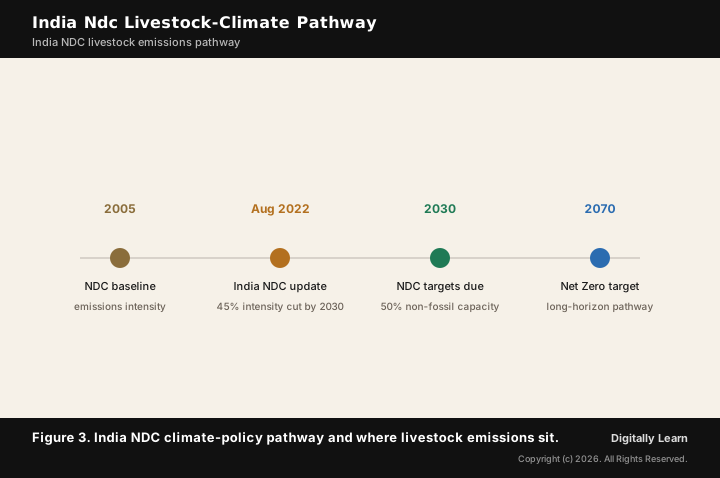
India's Nationally Determined Contribution under the Paris Agreement was first submitted in 2015 and updated in August 2022. The second update, approved by the Union Cabinet on 3 August 2022, commits India to reducing the emissions intensity of GDP by 45 percent by 2030 against 2005 levels (raised from the original 33-35 percent target), and to achieving 50 percent cumulative electric-power installed capacity from non-fossil-fuel-based energy resources by 2030.
Enteric fermentation mechanism: methanogenic archaea in the rumen and the biological roots of cattle-buffalo methane output
Enteric fermentation is the biological process by which cattle, buffaloes, sheep, and goats digest cellulose-rich plant material through microbial fermentation in the rumen. The methanogenic archaea (Methanobrevibacter, Methanosphaera, Methanomicrobium species) that inhabit the rumen produce methane as a byproduct of hydrogen metabolism during the breakdown of carbohydrates. The methane is released through eructation (belching), not flatulence, correcting the popular misunderstanding that the methane comes from the rear end of cattle.
Distinguishing features of climate-resilient dairy strategy: heat-tolerant breeds, methane-mitigation feed additives, and perennial-fodder security
(i) Heat-tolerant indigenous breeds: Sahiwal, Tharparkar, Gir, and Red Sindhi versus exotic Holstein-Friesian and Jersey
India's principal indigenous dairy breeds (Sahiwal, Tharparkar, Gir, Red Sindhi, Rathi, Kankrej) evolved under tropical and arid conditions and carry physiological adaptations to high ambient temperatures, lower water-intake requirements, and tick-borne disease resistance. These breeds typically yield 1,500 to 3,000 litres per lactation under smallholder management, against the 5,500 to 7,500 litres of exotic Holstein-Friesian and Jersey under intensive feeding.
| Attribute | Indigenous breeds (Sahiwal, Tharparkar, Gir, Red Sindhi) | Exotic breeds (Holstein-Friesian, Jersey) |
|---|---|---|
| Milk yield per lactation | 1,500 to 3,000 litres | 5,500 to 7,500 litres |
| Heat tolerance | High; adapted to tropical and arid climates | Low; productivity falls sharply under heat stress |
| Water and feed demand | Lower intake; suits smallholder management | Higher intake; needs intensive feeding |
| Disease resistance | Strong tick-borne disease resistance | Weaker; higher veterinary dependence |
| Methane intensity profile | Lower per animal, higher per litre at low yield | Higher per animal, lower per litre at high yield |
(ii) Methane-mitigation feed additives: seaweed-based, tannin-based, and 3-NOP options under NDDB and IITM trial programmes
Three classes of feed additive have moved from laboratory to field-trial stage in 2026. Each targets the methanogenic archaea in the rumen through a different mechanism, and each carries different feasibility constraints for smallholder dairying in India.
(iii) Perennial fodder cultivation and silage promotion under NDP-II: feed quality as the productivity and methane lever
(iii) Perennial fodder cultivation and silage promotion. Indian dairy carries a structural green-fodder deficit of approximately 11 percent and a dry-fodder deficit of approximately 23 percent against requirement, per the IGFRI Vision-2050 fodder-balance assessment. The deficit forces smallholders to rely on crop residues (rice straw, wheat straw, sugarcane bagasse) that are low-nutrition and high-methane per unit of feed.
Observable outcomes of the climate-resilient dairy policy push: regulatory compliance, breed-deployment progress, and contested implementation
(a) Welfare regulatory record: AWBI guideline compliance, judicial intervention, and the cattle-transport-and-slaughter contestation
The AWBI guideline framework has operated for over six decades, but compliance varies sharply across states and sectors. Cattle and buffalo transport compliance under the 1978 Rules remains weak because road-transport enforcement is decentralised to state police and animal-husbandry departments. Slaughter-house compliance under FSSAI's 2017 regulations is stronger in registered abattoirs but weak in unregistered ones, which account for the majority of cattle and buffalo slaughter outside the registered-export pipeline.
(b) Indigenous-breed deployment status: Rashtriya Gokul Mission progress, Gokul Grams, and the genomic-selection accelerator
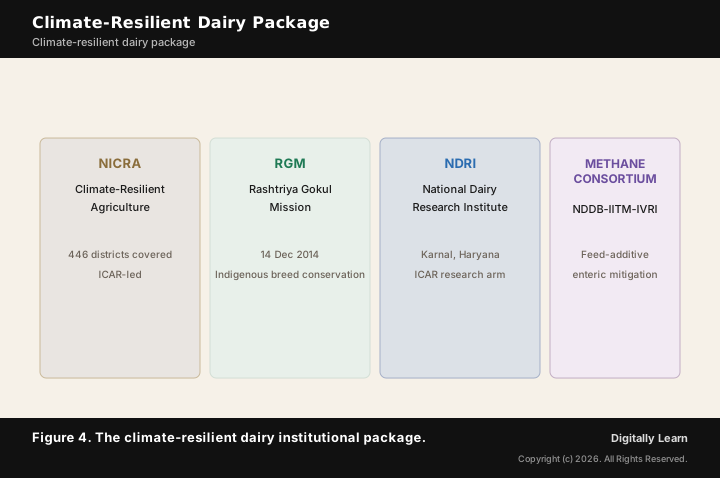
Rashtriya Gokul Mission since 2014 funds genetic-improvement infrastructure across the seven principal indigenous breeds. The Mission operates 14 Gokul Grams as integrated indigenous-cattle development centres, the National Bovine Genomic Centre for Indigenous Breeds (NBGC-IB) for genomic-selection research, and the e-Pashu Haat online platform for breeding-animal trade. The Mission was restructured in 2021 with an allocation of Rs 2,400 crore for the 2021-22 to 2025-26 period.
(c) Methane-mitigation field-trial status: where each additive class stands in 2026 under NDDB-IITM-IIVR research consortia
Three additive classes remain in field-trial stage in 2026, with no single additive approved for nationwide commercial use. The trial consortium includes NDDB, IITM Pune, ICAR-NDRI Karnal, Indian Veterinary Research Institute (IVRI) Izatnagar, and ICAR-Indian Grassland and Fodder Research Institute (IGFRI) Jhansi.
(d) Fodder system status: perennial-fodder coverage, silage adoption, and the green-fodder deficit India still carries
India's structural fodder deficit persists despite the perennial-fodder push. The green-fodder deficit stands at approximately 11 percent of requirement, the dry-fodder deficit at approximately 23 percent, and the concentrate deficit at approximately 28 percent against ICAR-IGFRI norms. The deficit pattern forces continued reliance on crop residues with poor methane-intensity profile.
The policy frontier ahead: NDC second update, Mission Mausam livestock module, and the dairy-climate alignment debate
India's NDC second update (2022 Cabinet approval) and the 45 percent emissions-intensity reduction commitment by 2030
India's NDC second update, approved by the Union Cabinet on 3 August 2022 and communicated to the UNFCCC, commits India to reducing the emissions intensity of GDP by 45 percent by 2030 against 2005 levels. The agricultural pathway within this commitment relies on productivity gains (output rises faster than emissions) rather than absolute emissions caps. Livestock methane occupies the largest share of agricultural emissions and therefore the largest mitigation lever within the sector.
Mission Mausam livestock module (announced 2024) and heat-wave forecasting for dairy cattle
Mission Mausam, announced by the Ministry of Earth Sciences in 2024, includes a dedicated livestock module for heat-wave forecasting that targets cattle-mortality prevention. The module integrates IMD heat-wave warnings with state animal-husbandry departments to issue cattle-protection advisories during severe heat events. Pilot implementation began in selected states during the 2024 summer.
NDP-II climate-adaptation track: fodder security, ration balancing, and methane-mitigation field trials
The National Dairy Plan Phase II climate-adaptation track operationalises four interventions at the village-cooperative level: fodder seed multiplication for perennial varieties, silage demonstration units, ration balancing for methane-intensity reduction, and breed-improvement extension through MAITRI village-level paravets. The combined intervention pattern aims for 15 to 25 percent yield gain and 7 to 12 percent methane reduction per litre of milk on participating farms.
Five policy choices for climate-resilient dairy 2026 to 2035: productivity vs welfare, intensification vs methane, exotic vs indigenous, central vs state, mandate vs incentive
The climate-resilient dairy strategy faces five policy choices for the 2026 to 2035 decade. Each choice has welfare, equity, and emissions dimensions, and the choices interact rather than decompose cleanly.
- Productivity versus welfare: High-yield exotic-breed intensification raises milk output but increases heat-stress risk and reliance on confined-housing models that complicate welfare compliance.
- Intensification versus methane: Feed-quality upgrades reduce methane per litre but raise absolute productivity, leaving the total-emissions trajectory dependent on demand growth.
- Exotic versus indigenous: Indigenous breeds offer climate resilience and lower methane intensity per animal but lower absolute output; the cross-breed strategy attempts to bridge but underperforms both extremes.
- Central versus state: Cattle-welfare and slaughter regulation sits at the constitutional intersection of central PCA Act 1960 authority, state agriculture-list authority, and Directive Principles (Article 48), making uniform implementation difficult.
- Mandate versus incentive: Methane-mitigation feed additives and breed improvement can be pushed through subsidy and extension or through regulatory mandate; the choice between persuasion and compulsion remains unresolved for smallholder dairying.
Previous Year UPSC-CSE Questions
Previous Year UPSC-CSE Questions By the end you will be able to draft model answers for the following UPSC questions. Each question carries a collapsible framework showing how to approach it in the exam.
- UPSC Prelims 2009 General StudiesWhere is the headquarters of Animal Welfare Board of India located ?
How to approach this Prelims question
Approach: Direct fact-recall question; the answer reflects the position when the paper was set. In 2009, AWBI was headquartered in Chennai, which is option (b). The Board moved to Ballabhgarh in Haryana only in early 2018, so a current candidate must remember both the historical and the present location.
Trap to watch: Contemporary recall points to Ballabhgarh because AWBI moved there in 2018, but Ballabhgarh is not even among the 2009 options. For this paper the answer is option (b) Chennai. UPSC questions are dated; the answer must match the position when the paper was set.
Key facts to recall:
- AWBI established: 1962 under Section 4 of the Prevention of Cruelty to Animals Act 1960.
- Headquarters 1962 to 2018: Chennai, which is the 2009 paper answer.
- Headquarters early 2018 onward: Ballabhgarh in Haryana.
Answer signal: Option (b) Chennai, the position before the 2018 move.
- UPSC Prelims 2019 General StudiesConsider the following statements:
- Agricultural soils release nitrogen oxides into environment.
- Cattle release ammonia into environment.
- Poultry industry releases reactive nitrogen compounds into environment.
Which of the statements given above is/are correct?
How to approach this Prelims question
Approach: Verify each statement independently. All three are correct, making the answer (d) 1, 2 and 3. The trap is doubting cattle ammonia because the more familiar association is methane; this is precisely the layered atmospheric-chemistry distinction the question tests.
Trap to watch: Confusing cattle ammonia (NH3) release (correct, from urea hydrolysis) with cattle methane (CH4) release (also correct but not asked here, from enteric fermentation). Both are real but chemically distinct emissions.
Key facts to recall:
- Cattle ammonia (NH3): from urea hydrolysis in urine and manure.
- Cattle methane (CH4): from enteric fermentation in the rumen by methanogenic archaea.
- Agricultural N2O: from nitrification-denitrification of synthetic fertiliser.
Answer signal: All three true; answer is (d) 1, 2 and 3.
- UPSC Prelims 2016 General StudiesThe term 'Intended Nationally Determined Contributions' is sometimes seen in the news in the context of
How to approach this Prelims question
Approach: Identify the international framework the term belongs to. INDC = Intended NDC = Paris Agreement climate-mitigation pledges.
Trap to watch: All four options sound plausible because they reference international frameworks. Lock onto the 'climate change' framing as the unique signal.
Key facts to recall:
- INDC: Intended Nationally Determined Contributions, pre-Paris.
- NDC: Nationally Determined Contributions, post-Paris (December 2015).
- India NDC first: communicated October 2015 with 33 to 35 percent emissions-intensity reduction target by 2030.
Answer signal: (b) plan of action outlined by the countries of the world to combat climate change.
Sources and references: PCA Act 1960, Animal Welfare Board of India, FAO Livestock Climate, IPCC AR6, MoEFCC, DAHD, IITM, IPCC
- NCERT Class 12 India: People and Economy, Chapter 5 – Land Resources and Agriculture
- Animal Welfare Board of India: official portal
- Ministry of Fisheries, Animal Husbandry and Dairying (Department of Animal Husbandry and Dairying): Animal Welfare Division
- Prevention of Cruelty to Animals Act 1960: India Code
- Department of Animal Husbandry and Dairying: Rashtriya Gokul Mission
- India NDC second update: UNFCCC submission August 2022
- India Third National Communication to UNFCCC: agricultural emissions inventory
- IPCC AR6 Working Group I: Chapter 7 climate forcing
- FAO: Tackling Climate Change through Livestock report 2013
- Mission Mausam: Ministry of Earth Sciences announcement 2024
- Indian Institute of Tropical Meteorology (IITM Pune): methane-mitigation research
- Indian Veterinary Research Institute (IVRI) Izatnagar: tannin feed-additive trials
- ICAR-Indian Grassland and Fodder Research Institute (IGFRI) Jhansi: fodder balance Vision 2050
- Wikipedia: Animal Welfare Board of India
- Wikipedia: Rashtriya Gokul Mission
- Wikipedia: Nationally Determined Contribution
Disclaimer and editorial notes
This article is prepared for UPSC – CSE preparation by Digitally Learn's editorial team. Statutes, scheme details, and emission figures are cross-verified against NCERT, government portals, and authoritative climate sources. Please write to us if you spot any error so we can correct it.