


Overview
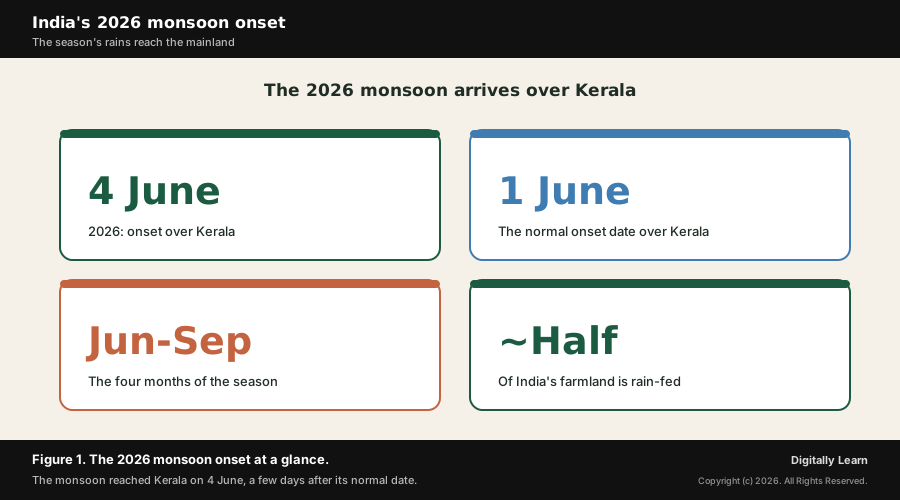
The southwest monsoon, the system of rain-bearing winds that brings most of India's yearly rainfall, set in over Kerala on 4 June 2026, a few days after its normal onset date of 1 June. The onset over Kerala marks the start of the four-month rainy season, from June to September, that the India Meteorological Department tracks as it advances across the country. The monsoon is central to India's farming, water supply and rural economy.
The Southwest Monsoon Sets In Over Kerala
The season's rains reach the mainland
On 4 June 2026, the India Meteorological Department announced that the southwest monsoon had set in over Kerala. This was a few days later than the normal onset date of 1 June, the benchmark the weather office uses for the mainland.
The onset over Kerala is the first major milestone of the rainy season. From there the monsoon usually advances north and west over the following weeks, normally covering the whole country by mid-July before withdrawing from September.
A few days' delay in onset does not by itself decide the season. What matters more is how the rains spread and how much falls over the June to September months, which is why a single onset date is read as a start signal rather than a verdict on the year.
Why the Monsoon Matters So Much
The lifeline of Indian agriculture
Why it matters is that the monsoon delivers the great bulk of India's yearly rainfall in just four months. About half of the country's farmland is rain-fed, with no irrigation, so it depends directly on these rains.
The timing and strength of the monsoon therefore shape harvests, food prices and the incomes of millions of farmers. It also refills reservoirs and groundwater that supply drinking water, industry and hydropower through the rest of the year.
What the Onset Signifies for the Season
A start signal, not the whole story
What is the significance of the onset lies in what it begins rather than what it settles. The arrival over Kerala starts the clock on the season, but the outcome for farmers depends on the spread and total of the rain in the weeks that follow.
This is why the weather office tracks not just the onset but the advance, any breaks in the rain, and the seasonal total. A timely onset followed by long dry spells can still hurt crops, while a slightly late onset followed by steady rain can yield a good season.
How the Southwest Monsoon Works
The 2026 monsoon onset at a glance
The table sets out the key facts of the onset and what each one means. Together they show the start of the season that drives much of India's agricultural year.
| Feature | Detail |
|---|---|
| Onset over Kerala | 4 June 2026 |
| Normal onset date | 1 June, the benchmark for the mainland |
| Season | June to September, the four southwest-monsoon months |
| Tracked by | The India Meteorological Department |
| Dependence | About half of India's farmland is rain-fed |
| Two branches | An Arabian Sea branch and a Bay of Bengal branch |
Read together, the rows show a seasonal system whose timing is watched closely because so much of the country's farming and water supply rides on it.
The Mechanism: A Seasonal Reversal of Winds
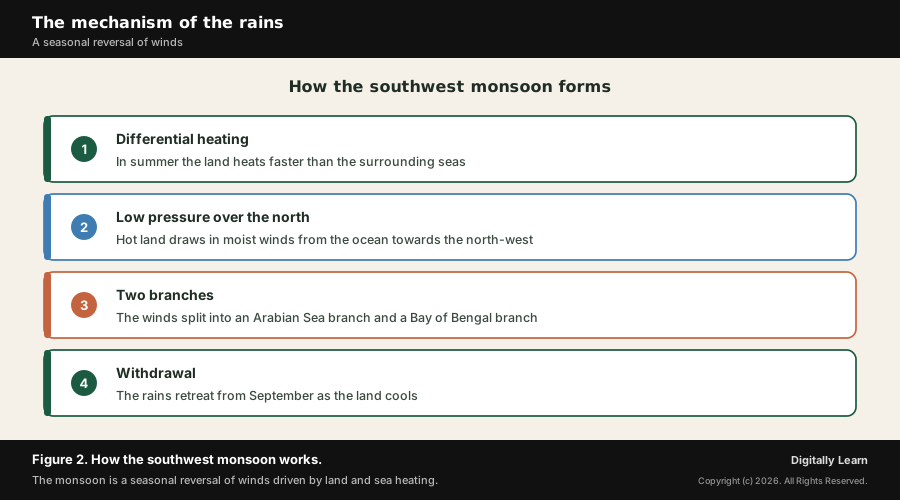
The southwest monsoon is a seasonal reversal of winds. In summer the land heats faster than the surrounding seas, creating a zone of low pressure over north-western India that draws in moist winds from the ocean.
These winds split into two branches, one from the Arabian Sea and one from the Bay of Bengal, which together carry rain across the country. As the land cools from September, the winds reverse and the monsoon withdraws, giving way to the retreating monsoon.
What to Watch in the 2026 Monsoon
Three things to track from here
The onset points to three things worth following, since the season's worth is decided over months, not on its first day.
- (a) The advance. Whether the monsoon spreads across the country on time and without long breaks.
- (b) The total rainfall. Whether the season delivers enough rain, and how evenly it is spread across regions.
- (c) The ocean signals. Whether El Nino, La Nina or the Indian Ocean Dipole strengthen or weaken the rains.
The real test is whether the rains reach the rain-fed farming regions in time and in quantity, not merely whether the onset was on its usual date.
The Ocean Drivers of the Indian Monsoon
El Nino, La Nina and the Indian Ocean Dipole
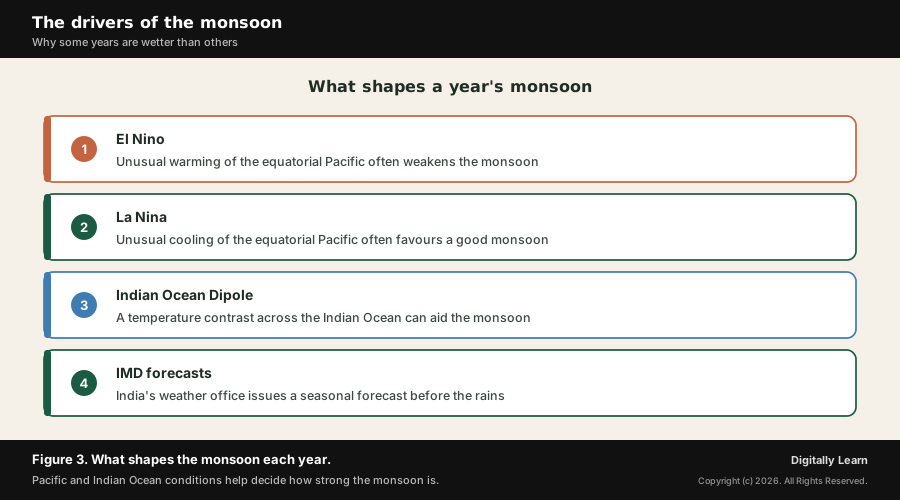
Contemporary linkages tie India's monsoon to conditions in distant oceans. The most watched is the El Nino-Southern Oscillation in the Pacific, a swing between warm and cool phases of the equatorial Pacific Ocean.
An El Nino, the warm phase, often weakens the Indian monsoon and is linked to drought years, while a La Nina, the cool phase, tends to favour a good monsoon. These are tendencies, not certainties, so each year is watched closely.
Closer to home, the Indian Ocean Dipole measures the temperature contrast between the western and eastern parts of the Indian Ocean. A positive phase can strengthen the monsoon and can soften the drying effect of an El Nino in some years.
Because these signals shift from year to year, the India Meteorological Department issues a seasonal forecast before the rains and updates it as the season unfolds, helping governments and farmers plan for the months ahead.
UPSC Relevance and Exam Focus
Where this fits in the UPSC-CSE syllabus
This topic maps to General Studies Paper I: geography, including the monsoon and climate of India, with links to agriculture and disaster management in General Studies Paper III.
For Prelims, hold the high-yield facts: the monsoon as a seasonal reversal of winds, the normal onset date over Kerala, the two branches, and the meaning of El Nino, La Nina and the Indian Ocean Dipole.
For Mains, two framings recur: the characteristics of the monsoon climate that supports so large a population, and how ocean signals and a changing landscape affect the monsoon.
Recurring linked concepts an aspirant should keep in working memory:
- Southwest monsoon: the June to September rains caused by a seasonal reversal of winds.
- El Nino and La Nina: warm and cool phases of the equatorial Pacific that affect the monsoon.
- Indian Ocean Dipole: a temperature contrast across the Indian Ocean that influences the monsoon.
- Long Range Forecast: the seasonal monsoon forecast issued by the India Meteorological Department.
A common Prelims trap is to define the Indian Ocean Dipole using the Pacific Ocean; it is a contrast within the Indian Ocean, between its western and eastern parts.
A common Mains trap is to judge the season by the onset date alone. The total and spread of rain over the four months matter far more than whether the onset was early or late.
Previous Year UPSC-CSE Questions By the end you will be able to draft model answers for the following UPSC questions. Each question carries a collapsible framework showing how to approach it in the exam.
- UPSC Mains 2017 GS-IWhat characteristics can be assigned to a monsoon climate that succeeds in feeding more than 50 percent of the world population residing in Monsoon Asia?
How to structure the answer in the exam
Introduction: Open with the monsoon as the climate that defines Monsoon Asia.
Body (sub-themes to develop):
- Seasonal reversal of winds and a concentrated wet season.
- Heavy, reliable summer rain suited to rice and other crops.
- Warm temperatures and a long growing season.
- Risks: variability, floods and droughts that the same climate brings.
Conclusion: Conclude that the monsoon's reliable summer rain underpins the farming that feeds Monsoon Asia.
- UPSC Prelims 2017 GS-IWith reference to 'Indian Ocean Dipole (IOD)', sometimes mentioned in the news while forecasting Indian monsoon, which of the following statements is/are correct?
- IOD phenomenon is characterised by a difference in sea surface temperature between tropical Western Indian Ocean and tropical Eastern Pacific Ocean.
- An IOD phenomenon can influence an El Nino's impact on the monsoon.
Select the correct answer using the code given below:
How to approach this Prelims question
Approach: Check the definition of the IOD and its relation to El Nino.
Trap to watch: Statement 1 is wrong because the IOD is a contrast within the Indian Ocean, not between the Indian Ocean and the Eastern Pacific.
Key facts to recall:
- The IOD is a contrast between the western and eastern tropical Indian Ocean.
- A positive IOD can influence and soften an El Nino's impact on the monsoon, so statement 2 is correct.
Answer signal: Reject statement 1 and the answer is 2 only.
- UPSC Prelims 2011 GS-ILa Nina is suspected to have caused recent floods in Australia. How is La Nina different from El Nino?
- La Nina is characterised by unusually cold ocean temperature in equatorial Indian Ocean whereas El Nino is characterised by unusually warm ocean temperature in the equatorial Pacific Ocean.
- El Nino has adverse effect on south-west monsoon of India, but La Nina has no effect on monsoon climate.
Which of the statements given above is/are correct?
How to approach this Prelims question
Approach: Test each statement against what El Nino and La Nina actually are.
Trap to watch: Statement 1 wrongly places La Nina in the Indian Ocean; both are Pacific phenomena. Statement 2 wrongly says La Nina has no effect; it tends to favour the monsoon.
Key facts to recall:
- Both El Nino and La Nina are phases of the equatorial Pacific, not the Indian Ocean.
- La Nina generally favours a good Indian monsoon, so it does affect the monsoon.
Answer signal: Both statements are wrong, so the answer is Neither 1 nor 2.
Sources and Further Reading
Editorial Disclaimer
This briefing is for UPSC preparation. Verify the latest monsoon dates and forecasts against the official India Meteorological Department sources before relying on them.


