

Overview
Air masses are large bodies of air with little horizontal variation in temperature and moisture, which take their character from the ocean or plain over which they form, their source region. Where two different air masses meet, the boundary zone is a front; the formation of a front is frontogenesis and its weakening is frontolysis.
Air Masses: Definition, Characteristics and Source Regions
What Is an Air Mass? Air Masses Definition and Characteristics
When air stays over a uniform area, a vast ocean or a wide plain, for long enough, it takes on the temperature and humidity of that surface. The result is an air mass: a large body of air with little horizontal variation in temperature and moisture, covering many hundreds or thousands of square miles.
- Source region: The uniform surface over which an air mass forms is its source region, and air masses are classified by it.
- Time matters: The longer an air mass stays over its source region, the more it takes on the properties of the surface below.
- Movement: Air masses usually move with the flow of the upper air; as the jet stream changes strength and position, it changes their motion and strength.
- Density: Cold air masses are denser than warm ones, which is why cold air undercuts warm air where the two meet.
Source Regions of Air Masses: Five Kinds of Surface
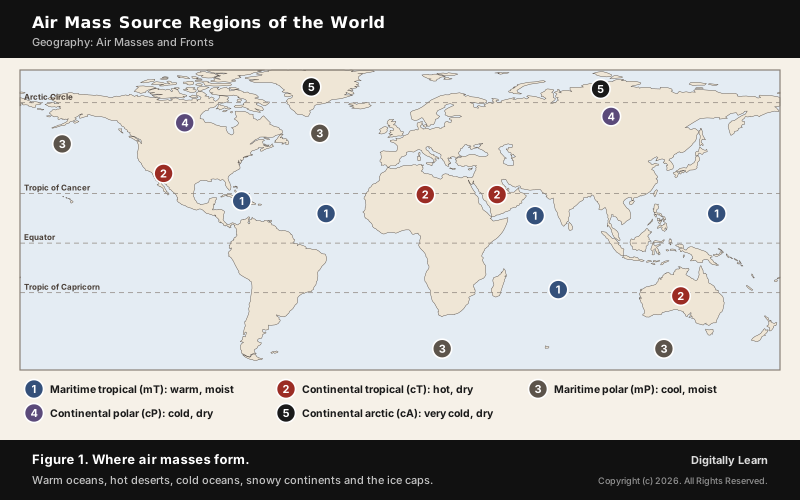
Air masses form only where the surface is uniform over a large area. There are five major source regions, and each gives a type of air mass its name.
- Warm tropical and subtropical oceans: Maritime tropical (mT) air.
- Subtropical hot deserts: Continental tropical (cT) air; the Sahara is the major source, with the Arabian Peninsula, central Australia and the deserts of the south-western United States.
- Cold high-latitude oceans: Maritime polar (mP) air.
- Cold, snow-covered continents in high latitudes: Continental polar (cP) air, as over interior Canada.
- Permanently ice-covered Arctic and Antarctica: Continental arctic (cA) air; air over northern Siberia in winter can also be cA.
The source decides both halves of the name: tropical air masses are warm and polar air masses are cold, while continental ones are dry and maritime ones moist.
Types of Air Masses: Classification, Modification and Air Masses over India
Air Masses Classification: Types, Bergeron Letters and Modification
The Bergeron classification is the most widely used way of naming air masses. It joins a letter for moisture to a letter for the latitude of the source region.
- First letter, moisture: The letter c marks continental air, which is dry, and m marks maritime air, which is moist.
- Second letter, source: T for tropical, P for polar, A for arctic or antarctic, and in some schemes M for monsoon, E for equatorial and S for superior air.
- Third letter, stability: The letter k means the air mass is colder than the ground below it, and w that it is warmer.
| Air mass | Character |
|---|---|
| Maritime tropical (mT) | Warm and moist; sometimes called trade air masses |
| Continental tropical (cT) | Extremely hot and dry |
| Maritime polar (mP) | Cold but moist |
| Continental polar (cP) | Cold and very dry, not as cold as arctic air |
| Continental arctic (cA) | Very cold and dry, formed over ice and snow |
An air mass does not keep its character for ever. Once it leaves its source region, the vegetation and water below can quickly modify it.
- Over the sea: In winter, very cold and dry arctic air moving out over a warmer ocean picks up warmth and moisture and becomes maritime polar air, still fairly cold but moist.
- Over land: The same polar air moving south over land warms up but stays very dry, as continental polar air.
- Stability changes: Polar air over the sea loses its stability as it gains moisture over warmer water.
- Notation: Meteorologists write the change as a transformation, for example cA-mPk for arctic air turning into cold maritime polar air.
Air Masses over India: Dry Winter Air, Local Storms and Western Disturbances
Air masses help explain India's seasons. In winter a high-pressure centre north of the Himalayas sends surface winds towards India that arrive as a dry continental air mass; over north-western India they meet the trade winds, in a contact zone that sometimes shifts as far east as the middle Ganga valley.
- Pre-monsoon storms: In the hot season a sudden contact between dry and moist air masses gives local storms of great intensity, with violent winds, torrential rain and even hail.
- Western disturbances: Extra-tropical storms from the Mediterranean region, driven by the westerlies, bring sudden winter rain to north-western India; four to five form in an average winter.
- Their weight: About 30 per cent of the annual precipitation of Jammu and Kashmir, Ladakh, Himachal Pradesh and Uttarakhand falls in winter, mostly from western disturbances, and it is vital for the rabi crop.
- After they pass: Cold waves and cold days follow their passage, and they bring dense fog to the Indo-Gangetic plains.
Air masses drive India's winter, summer and monsoon seasons, and the winter rain of north-west India comes with western disturbances.
Fronts in Geography: Where Air Masses Meet
What Are Fronts in Weather? Definition and Features
When two different air masses meet, the boundary zone between them is called a front. It is a zone of transition between air masses of different density, and so usually of different temperature; a moving front is named after the advancing air mass, so a cold front is one where colder air is advancing.
- Where they occur: Fronts occur in the middle latitudes and have a steep gradient of temperature and pressure.
- What they bring: Abrupt changes in temperature; they make the air rise, forming clouds and precipitation.
- A sure sign: Some fronts bring no rain and little cloud, but there is always a shift in the wind.
- Dry line: A narrow zone across which moisture, rather than temperature, changes sharply.
Types of Fronts: Cold, Warm, Stationary and Occluded
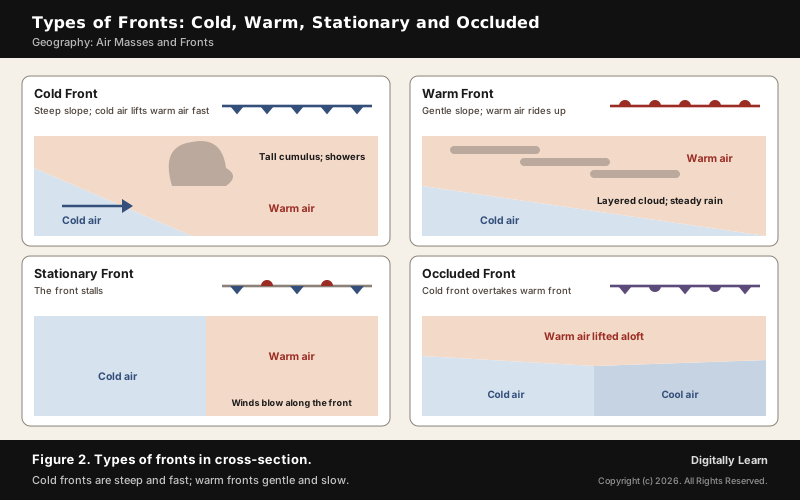
There are four types of fronts. Which one forms depends on which air mass is advancing, and each brings its own kind of weather because cold air is denser than warm air.
| Front | How it forms and moves | Weather it brings |
|---|---|---|
| Cold front | Cold air advances and undercuts warm air on a steep slope; moves faster than a warm front | A narrow band of thunderstorms and showers; temperatures can differ by more than 30 degrees C across it |
| Warm front | Warm air advances and glides up a gentle slope over cold air | Widespread layered cloud, steady rain that increases as it approaches, often fog |
| Stationary front | Neither air mass advances; each moves into the other at under 5 knots | Can stay in one area for hours to days |
| Occluded front | A cold front overtakes a warm front and lifts the warm air off the ground | Forms around mature lows; marks the end of a cyclone |
- Chart symbols: Blue triangles for a cold front, red semicircles for a warm front, alternating blue triangles and red semicircles for a stationary front, and a purple line of both for an occluded front.
- Two occlusions: In a cold occlusion the overtaking air is colder than the air ahead; in a warm occlusion it is warmer and rides over it.
Frontogenesis and Frontolysis: How Fronts Form, Decay and Make Cyclones
Frontogenesis and Frontolysis: How Fronts Form and Decay
A front forms by frontogenesis: the horizontal temperature gradient between two air masses tightens until a sharp boundary appears. It happens as a developing wave in the atmosphere draws cold air from the poles and warm air from the equator together.
- What drives it: Eight mechanisms influence the temperature gradient: horizontal deformation, horizontal shearing, vertical deformation, differential vertical motion, latent heat release, surface friction, turbulence and mixing, and radiation.
- Where it happens: Where air masses converge, fronts form and sharpen; where they diverge, fronts weaken.
- Frontolysis: The weakening or dissipation of a front, as the temperature gradient between the air masses decreases or the wind pattern shifts; on maps it is drawn as a dashed line.
- Shear line: When the density contrast fades, for instance after the air flows over a uniformly warm ocean, a front can degenerate into a mere line separating different wind speeds.
Fronts and Extra-Tropical Cyclones: The Norwegian Cyclone Model
Fronts are the birthplace of the extra-tropical cyclones that bring much of the weather of the middle latitudes, between 30 and 60 degrees. Norwegian meteorologists described their life cycle in the 1910s and 1920s, and it is still known as the Norwegian cyclone model.
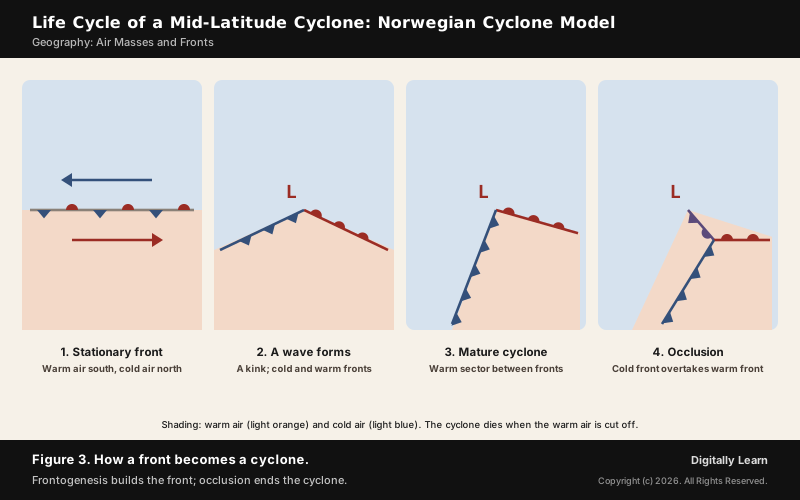
- Stationary front: Along the polar front, warm air lies to the south and cold air to the north.
- A wave forms: When pressure drops along the front, the warm air moves north and the cold air south, setting up an anticlockwise circulation; the front splits into a warm front and a cold front.
- Mature stage: A warm sector lies wedged between the fronts; the warm air glides over the cold air ahead of the warm front, and cumulus clouds build along the cold front.
- Occlusion and death: The faster cold front overtakes the warm front, the warm air is lifted off the ground, and without it the cyclone dissipates.
| Feature | Extra-tropical cyclone | Tropical cyclone |
|---|---|---|
| Fronts | A clear frontal system | No fronts |
| Where it forms | Over land and sea | Only over the seas |
| Area and winds | Larger area; weaker winds | Smaller area; much stronger winds |
| Direction of movement | West to east | East to west |
Fronts are where temperate cyclones form, as the polar front theory explains; tropical cyclones are a different kind of storm.
Air Masses and Climate: Heat, Rain, Seasons and the Jet Stream
Each air mass carries the weather of its source region to distant places, and the fronts between them make much of the weather of the middle latitudes. Their role in climate can be seen at several scales.
- Carriers of heat and moisture: Arctic air turns into moist maritime polar air over the sea, while polar air moving over land stays dry, so the same outbreak brings different weather to different places.
- Rain and storms: Fronts lift air to form cloud and precipitation, and the extra-tropical cyclones that grow on them, with anticyclones, drive the weather over much of the middle latitudes.
- Seasons in India: Dry continental air in winter, storms where dry and moist air meet before the monsoon, and western disturbances that supply north-west India’s winter rain and snow.
- Link to the jet stream: Shifts in the jet stream’s strength and position change how air masses move and how strong they are.
Air masses over India move with the jet streams and pressure belts of each season.
Previous Year UPSC-CSE Questions
Previous Year UPSC-CSE Questions By the end you will be able to draft model answers for the following UPSC questions. Each question carries a collapsible framework showing how to approach it in the exam.
- UPSC Mains 2016 GS-IDiscuss the concept of air mass and explain its role in macro-climatic changes.
Answer outline: how to structure the answer
What the question asks, the main arguments, relevant examples and the direction of the conclusion. This is not a full model answer.
Introduction: Open with the definition: a large body of air with little horizontal variation in temperature and moisture, taking its character from its source region.
Body (sub-themes to develop):
- Five source regions and types: mT, cT, mP, cP, cA; the Bergeron letters.
- Modification as air masses move: arctic air turning maritime polar over the sea.
- Fronts and frontogenesis: rising air, cloud and precipitation in the middle latitudes.
- Extra-tropical cyclones on the polar front drive mid-latitude weather.
- India: dry continental winter air, pre-monsoon storms, western disturbances and cold waves.
Conclusion: Conclude that air masses redistribute heat and moisture and, through their fronts, set the rhythm of seasons and weather far from where they form.
Sources
- NCERT: Fundamentals of Physical Geography (Class XI), Atmospheric Circulation and Weather Systems
- NOAA JetStream: Air Masses
- NOAA JetStream: Norwegian Cyclone Model
- WMO International Cloud Atlas: Glossary
- IMD Srinagar: Western Disturbances and Weather Fronts
- PIB (MoES): Impact of western disturbances on Indian climate, 5 February 2021
- Wikipedia: Air mass
- Wikipedia: Weather front
- Wikipedia: Frontogenesis
- Wikipedia: Frontolysis
- Wikipedia: Cold front
- Wikipedia: Warm front
- Wikipedia: Stationary front
- Wikipedia: Occluded front
- Wikipedia: Extratropical cyclone
- Wikipedia: Western disturbance
- UPSC: Civil Services Examination question papers
Editorial Disclaimer
This article draws on the NCERT geography textbooks, NOAA, the World Meteorological Organization, the India Meteorological Department, the Press Information Bureau and the other sources listed on this page. Source regions on the map are representative, not exact boundaries.


