


Overview
Lifestyle for Environment
Mission LiFE, short for Lifestyle for Environment, is an India-led global mass movement to nudge individuals and communities towards mindful consumption. The Prime Minister proposed it at COP26 in Glasgow on 1 November 2021 and launched it with the UN Secretary-General on 20 October 2022. It lists 75 actions in seven themes, aims at one billion Pro-Planet People, is the first goal of India's updated NDC of 2022 and sits at the centre of its NDC for 2031‑35.
Mission LiFE: Meaning, Full Form and Launch
What Is Mission LiFE: Lifestyle for Environment and Pro-Planet People
Mission LiFE builds on a contrast the Prime Minister drew at COP26: What the world needs is mindful and deliberate utilisation in place of mindless and destructive consumption. The mission asks each person to make that shift in daily life, in how they use energy, water, food, plastic and gadgets, and it calls those who do so Pro-Planet People, or P3.
The idea is that climate change is not only a matter for governments. At the launch the Prime Minister said the mission makes the fight against climate change democratic, in which everyone can contribute within their capacity, and that it makes all of us trustees of the environment, recalling Mahatma Gandhi's idea of trusteeship. The UN Secretary-General added that over-consumption is at the root of the triple planetary emergency of climate change, biodiversity loss and pollution.
- Full form: LiFE stands for Lifestyle for Environment.
- Nature: An India-led global mass movement to nudge individual and community action to protect and preserve the environment.
- Who runs it: NITI Aayog curated and incubated it in its first year; the Ministry of Environment, Forest and Climate Change then took over implementation.
- Footprint argument: The mission document puts the average Indian's carbon footprint at 1.8 tonnes a year against a global average of 4.5 tonnes.
Mission LiFE Launch Date and Its Origin at COP26 Glasgow
The idea came first and the mission a year later. At COP26 in Glasgow on 1 November 2021 the Prime Minister proposed a one-word movement, LIFE, and asked the world to take it forward as a mass movement for an environmentally conscious lifestyle. On World Environment Day, 5 June 2022, India launched the LiFE Global Movement, inviting academics, researchers and start-ups worldwide to suggest how collective action could tackle the environmental crisis.
Mission LiFE was launched on 20 October 2022. The Prime Minister launched it at the Statue of Unity in Ekta Nagar, Kevadia, Gujarat, in the presence of UN Secretary-General Antonio Guterres. The two unveiled the LiFE logo and tagline and released the mission document; heads of 11 nations, representing all regions of the United Nations, sent video messages of support. NITI Aayog and the Environment Ministry organised the launch with the Gujarat government, and the mission was set as a five-year programme.

How Mission LiFE Works: Three Phases, Seven Themes and 75 Actions
Three Phases of Mission LiFE: Change in Demand, Supply and Policy
The mission expects change to spread in three phases, from people to markets to governments. Each phase feeds the next, and all three can run at the same time.
- Change in Demand (Phase I): Individuals across the world are nudged to practise simple, effective environment-friendly actions in daily life.
- Change in Supply (Phase II): Large-scale changes in demand are expected to nudge industries and markets to tailor supply and procurement to the new demand.
- Change in Policy (Phase III): By shifting demand and supply in India and the world, the mission aims to trigger industrial and government policies that support sustainable consumption and production.
In 2022‑23 the mission concentrated on the first phase, change in demand. Its implementation steps were coordinated action by ministries, a baseline survey of every LiFE indicator, key performance indicators and a LiFE dashboard, so that progress could be measured rather than assumed.
Seven Themes of Mission LiFE and the 75 LiFE Actions
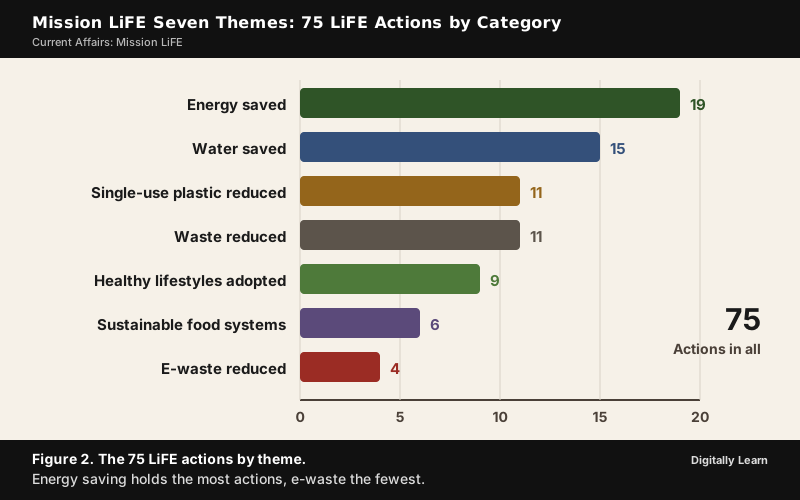
Mission LiFE lists 75 individual actions in seven categories, a number chosen because the mission was launched in the 75th year of India's independence. The actions are meant to be specific and measurable, easy to practise without depending on new supply, and not disruptive to economic activity.
| Theme (category) | Actions | Examples from the list |
|---|---|---|
| Energy saved | 19 | LED bulbs, public transport, AC set at 24 °C, engines off at red lights |
| Water saved | 15 | Millets and less water-intensive crops, rainwater harvesting, fixing leaks |
| Single-use plastic reduced | 11 | Cloth bags, own water bottle, bamboo toothbrushes |
| Sustainable food systems adopted | 6 | Millets in Anganwadi and mid-day meals, home composting |
| Waste reduced (Swachhata actions) | 11 | Segregating dry and wet waste, waste to GOBARDHAN biogas plants |
| Healthy lifestyles adopted | 9 | Natural or organic farming, planting trees, green clubs |
| E‑waste reduced | 4 | Repairing gadgets, e-recycling units, rechargeable cells |
Mission LiFE Targets: One Billion Pro-Planet People and LiFE Villages
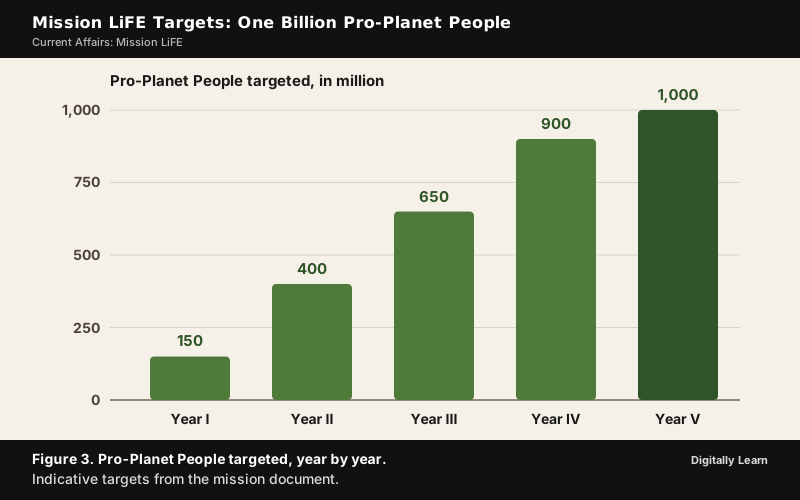
The mission aims to mobilise at least one billion Indians and other global citizens to take individual and collective action for the environment, and to make at least 80 per cent of all villages and urban local bodies in India environment-friendly by 2028. Official texts give the period for the first target as 2022 to 2027 or 2022 to 2028; the target for villages and urban local bodies is set for 2028.
| Indicator | Year I | Year III | Year V (end) |
|---|---|---|---|
| Pro-Planet People | 150 million | 650 million | 1 billion |
| LiFE villages | 77,000 | 3,35,000 | 5,15,000 |
| LiFE urban local bodies | 500 | 2,400 | 3,700 |
| LiFE districts | 115 | 498 | 766 |
The mission document also estimates what a few actions would save if one billion Indians practised them between 2022‑23 and 2027‑28:
- Engines off at signals: Up to 22.5 billion kWh of energy saved.
- Taps turned off: Up to 9 trillion litres of water saved.
- E-recycling: Up to 0.75 million tonnes of e-waste recycled.
Mission LiFE and India's Climate Commitments Under the Paris Agreement
Panchamrit at COP26 and India's Updated NDC of 2022
Under the Paris Agreement each country sets out its climate pledges in a Nationally Determined Contribution (NDC). Before the Agreement, countries set out their intended contributions to combating climate change as Intended Nationally Determined Contributions (INDCs); India submitted its INDC to the UNFCCC on 2 October 2015, and it became its first NDC under the Agreement. Of its eight goals, three had targets to 2030: 40 per cent of electric power installed capacity from non-fossil sources, a 33 to 35 per cent cut in the emissions intensity of GDP from 2005, and an additional carbon sink of 2.5 to 3 billion tonnes of CO₂ equivalent through forest and tree cover.
At COP26 in Glasgow the Prime Minister announced five nectar elements, the Panchamrit:
- Non-fossil energy capacity of 500 GW by 2030.
- Half of energy requirements met from renewable energy by 2030.
- Total projected carbon emissions cut by one billion tonnes till 2030.
- Carbon intensity of the economy cut by 45 per cent by 2030.
- Net zero by 2070.
The Union Cabinet approved the updated NDC on 3 August 2022, and it translates the Panchamrit into enhanced targets. Its first goal is LiFE itself, to propagate a healthy and sustainable way of living based on traditions and values of conservation and moderation, including through a mass movement for LIFE. India is the first country to include LiFE in its NDC.
| Target to 2030 | First NDC (2015) | Updated NDC (2022) |
|---|---|---|
| Emissions intensity of GDP, from 2005 | 33 to 35 per cent cut | 45 per cent cut |
| Non-fossil share of installed power capacity | 40 per cent | About 50 per cent |
| Additional carbon sink, forest and tree cover | 2.5 to 3 billion t CO₂e | Unchanged |
| Lifestyle goal | None | LiFE, a mass movement |
NDC 2031‑35: Mission LiFE at the Centre of India's New Climate Pledge
India has met its earlier targets ahead of time. The 2015 targets on emissions intensity and non-fossil capacity were met 11 and 9 years early, emissions intensity fell 36 per cent between 2005 and 2020, non-fossil capacity reached 52.57 per cent by February 2026, and the forest carbon sink reached 2.29 billion tonnes by 2021.
On 25 March 2026 the Union Cabinet approved India's NDC for 2031 to 2035, aligned with Viksit Bharat 2047 and net zero by 2070:
- Emissions intensity: 47 per cent below 2005 levels by 2035.
- Non-fossil capacity: 60 per cent of installed electric power capacity by 2035.
- Carbon sink: An additional 3.5 to 4.0 billion tonnes of CO₂ equivalent through forest and tree cover by 2035, over the 2005 level.
The new NDC puts LiFE at the centre of India's climate effort, to turn sustainable living into a mass movement, alongside campaigns such as Ek Ped Maa Ke Naam that make tree planting a people's climate action. In shaping it the government considered the first Global Stocktake and the principle of common but differentiated responsibilities and respective capabilities.
Mission LiFE in Practice: Green Credit, Ecomark and Global Resolutions
Green Credit Programme and Ecomark Rules Under Mission LiFE
Two schemes of the Environment Ministry carry LiFE from individual choice to markets, the mission's second phase.
- Green Credit Programme: Notified on 13 October 2023, it is a market-based mechanism that rewards voluntary environmental actions by individuals, communities, industries and companies. The Indian Council of Forestry Research and Education is its administrator, under an inter-ministerial Steering Committee. It began with water conservation and afforestation; a verified activity earns a Green Credit certificate that can be traded.
- Ecomark Rules: Notified on 26 September 2024 in line with LiFE, they replace the Ecomark scheme of 1991. Products that meet set environmental criteria are labelled, so that consumers can choose them and makers are pushed towards cleaner production; the Central Pollution Control Board runs the scheme with the Bureau of Indian Standards.
Mission LiFE Abroad: COP27, G20, UNEA‑6 and Ramsar COP15
India has carried LiFE into international texts, one forum at a time:
- COP27, Sharm el-Sheikh (2022): LiFE was included in the cover decision text of the Sharm el-Sheikh Implementation Plan.
- G20 (2023): The G20 High-Level Principles on Lifestyles for Sustainable Development (LiFE) promote sustainable lifestyles and sustainable consumption and production at every level, from individuals to industry; the G20 parliamentary speakers welcomed them in October 2023.
- UNEA‑6, Nairobi (2024): On 1 March 2024 the UN Environment Assembly adopted India's resolution on promoting sustainable lifestyles, with the support of all participating member States.
- Ramsar COP15, Victoria Falls (2025): On 30 July 2025 the Ramsar Convention adopted India's resolution on promoting sustainable lifestyles for the wise use of wetlands, which builds on the UNEA resolution.
The UNEA resolution asks countries and other stakeholders to create evidence-based enabling conditions, foster public and private collaboration and pursue education at all levels, so that citizens can make informed choices about sustainable lifestyles, the idea of SDG 4.7 on education for sustainable development. Sustainable consumption reached COP30 at Belém in November 2025, where host Brazil placed waste at the heart of the agenda and the conference called on cities to speed up circularity.
Mission LiFE, Circular Economy and Traditional Practices
Circular Economy: Reduce, Reuse and Recycle in Mission LiFE
A circular economy keeps products, materials and equipment in use for longer through reuse, sharing, repair, refurbishment, remanufacturing and recycling, creating a closed loop. That reduces the use of resource inputs and the creation of waste, pollution and carbon emissions.
Mission LiFE rests on the same idea. The Prime Minister described reduce, reuse and recycle as part of the Indian lifestyle for thousands of years, and the mission treats moving from a throwaway culture to a circular economy as imperative, estimating that a circular economy could save around ₹14 lakh crore by 2030. Many of the 75 actions are circular in this sense, such as repairing before discarding, reusing containers and composting food waste.
The idea has deep roots in the economics of sustainable development. The report Our Common Future explained sustainable development as meeting the basic needs of all and extending to all the opportunity to satisfy their aspirations for a better life. The environment can sustain life only while resource extraction stays below the rate of regeneration and the wastes generated stay within its assimilating capacity, and one of Herman Daly's conditions for sustainable development is technological progress that is input efficient, not input consuming.
Traditional Practices Behind LiFE: Stepwells, Kulhads and Moderation
The mission presents itself as a return to Indian habits of conservation and moderation rather than a new sacrifice. Its examples come from everyday India:
- Water harvesting: The stepwells of Gujarat and Rajasthan, the underground tanks (tankaa) of Tamil Nadu, the check dams (johads) of Rajasthan and the Zabo system of Nagaland, which stores water in pond-like structures on terraced hillsides.
- Biodegradable serving: Food served on sal-leaf plates and tea in clay kulhads.
- Daily habits: Architecture that needs less electricity, washing and sun-drying clothes by hand, and a diet that prefers plant-based foods and millets.
The Prime Minister closed the launch with the mantra Prakriti Rakshati Rakshita, those who protect nature are protected by nature. The same principle reaches beyond household habits. Mission LiFE also aims to reduce dependence on extraction through lower demand, resource efficiency, recycling, substitution and circular consumption.
Previous Year UPSC‑CSE Questions
Each Prelims question is explained option by option, and each Mains question comes with an answer outline.
- UPSC Prelims 2025Consider the following statements:
- Statement I: Circular economy reduces the emissions of greenhouse gases.
- Statement II: Circular economy reduces the use of raw materials as inputs.
- Statement III: Circular economy reduces wastage in the production process.
Which one of the following is correct in respect of the above statements?
How to approach this Prelims question
Approach: Check each statement, then whether II and III explain I. A circular economy keeps products and materials in use through reuse, repair and recycling, which reduces the use of resource inputs (Statement II) and the creation of waste (Statement III). Less extraction and less waste mean fewer emissions, so it reduces greenhouse gas emissions (Statement I). Both II and III are true and each explains I.
Trap to watch: Option (b) admits both are true but says only one explains I; both reasons lower emissions.
Why each option is right or wrong:
- (a) Both Statement II and Statement III are correct and both of them explain Statement I: Correct. Fewer raw materials and less waste each lower emissions.
- (b) Both Statement II and Statement III are correct but only one of them explains Statement I: Wrong. Both explain the lower emissions.
- (c) Only one of the Statements II and III is correct and that explains Statement I: Wrong. A circular economy reduces both raw-material inputs and waste.
- (d) Neither Statement II nor Statement III is correct: Wrong. Both statements describe what a circular economy does.
Answer: (a) Both Statement II and Statement III are correct and both of them explain Statement I. Fewer raw materials and less waste each lower emissions, so both statements explain Statement I.
- UPSC Prelims 2016The term 'Intended Nationally Determined Contributions' is sometimes seen in the news in the context of
How to approach this Prelims question
Approach: An Intended Nationally Determined Contribution was each country's intended contribution to combating climate change, submitted to the UNFCCC before the Paris Agreement; India submitted its own on 2 October 2015. Only option (b) describes a plan of action against climate change.
Trap to watch: Option (d) also says plan of action by the countries of the world, but for the SDGs; INDCs are climate pledges.
Why each option is right or wrong:
- (a) pledges made by the European countries to rehabilitate refugees from the war-affected Middle East: Wrong. INDCs were climate pledges made to the UNFCCC.
- (b) plan of action outlined by the countries of the world to combat climate change: Correct. Each country set out its intended contribution to combating climate change.
- (c) capital contributed by the member countries in the establishment of Asian Infrastructure Investment Bank: Wrong. INDCs are submitted to the UNFCCC, not paid into a bank.
- (d) plan of action outlined by the countries of the world regarding Sustainable Development Goals: Wrong. INDCs belong to the climate convention, not the SDG framework.
Answer: (b) plan of action outlined by the countries of the world to combat climate change. INDCs are the national climate pledges each country made to the UNFCCC before the Paris Agreement.
- UPSC Mains 2025 GS‑IIIWrite a review on India's climate commitments under the Paris Agreement (2015) and mention how these have been further strengthened in COP26 (2021). In this direction, how has the first Nationally Determined Contribution intended by India been updated in 2022?
Answer outline
The outline sets out what the question asks, the main arguments, relevant examples and the direction of the conclusion; it is not a full model answer.
Introduction: NDCs are each country's pledges under the Paris Agreement; India submitted its first on 2 October 2015.
Body (sub-themes to develop):
- Paris (2015): 33 to 35 per cent lower emissions intensity of GDP from 2005, 40 per cent non-fossil installed capacity, a 2.5 to 3 billion tonne carbon sink, all by 2030.
- COP26 (2021): The Panchamrit, 500 GW non-fossil capacity, half of energy needs from renewables, one billion tonnes less projected emissions, 45 per cent intensity cut, net zero by 2070; and the LIFE call for mindful consumption.
- Update (2022): Intensity cut raised to 45 per cent, about 50 per cent non-fossil installed capacity, sink unchanged, and LiFE added as the first goal; India the first to put LiFE in an NDC.
- Record and next step: Targets met early, 52.57 per cent non-fossil capacity by February 2026; the NDC for 2031‑35 raises the bar to 47 per cent, 60 per cent and 3.5 to 4.0 billion tonnes.
Conclusion: India has raised its targets step by step while adding a demand-side pillar, LiFE, that no earlier pledge had.
Sources
- PIB: PM's national statement at COP26, Glasgow, 1 November 2021
- PIB: PM launches Mission LiFE at Statue of Unity, 20 October 2022
- PIB (NITI Aayog): PM and UNSG launch Mission LiFE, 20 October 2022
- PIB explainer: Mission LiFE, 9 November 2022
- NITI Aayog: Mission LiFE brochure
- PIB: Cabinet approves India's updated NDC, 3 August 2022
- UNFCCC: India's Updated First Nationally Determined Contribution (August 2022)
- PIB: Cabinet approves India's NDC for 2031‑2035, 25 March 2026
- PIB: Environment Minister at the World Sustainable Development Summit, 22 February 2023
- PIB: Green Credit Programme and Ecomark scheme under LiFE, 13 October 2023
- PIB: Ecomark Rules notified under LiFE, 4 October 2024
- PIB: Resolution on promoting sustainable lifestyles at UNEA‑6, 1 March 2024
- PIB: India's resolution on sustainable lifestyles adopted at Ramsar COP15, 30 July 2025
- PIB: Joint statement of the 9th G20 Parliamentary Speakers' Summit, October 2023
- The Hindu: Urban India, its growing problem of waste (3 January 2026)
- The Hindu: India's updated NDCs (8 April 2026)
- The Hindu: Science must also teach us to say no (19 September 2026)
- Wikipedia: 2021 United Nations Climate Change Conference (COP26)
- Wikipedia: Circular economy
- NCERT: Indian Economic Development (Class XI), Chapter 7, Environment and Sustainable Development
- UPSC: Civil Services Examination question papers
Editorial Disclaimer
This article draws on the Press Information Bureau and the other sources listed under Sources.
See more of our UPSC articles in Google Search
Add to Preferred Sources

