


Overview
Money laundering is the process of concealing the criminal origin of money or property and presenting it as legitimate wealth. Bribes, drug profits, fraud proceeds and smuggling income are hard to spend openly, so offenders pass them through banks, companies, property and foreign accounts until the money appears clean. In India the offence is defined by the Prevention of Money-laundering Act, 2002 (PMLA), enforced by the Enforcement Directorate (ED), and supported by the Financial Intelligence Unit, India (FIU‑IND), which receives reports of suspicious transactions. Laundered money sustains corruption, organised crime and terrorism and weakens the State's control over its own economy.
Money Laundering: Meaning and Threat to Economic Sovereignty
Placement, Layering and Integration
The stages of money laundering describe how dirty money travels from a crime to a respectable asset. Investigators and international bodies divide the process into three steps, though a launderer may skip a step when the money is already inside the banking system.
- Placement: Criminal cash enters the financial system. Large sums are split into small deposits, a method called structuring or smurfing, so that no single deposit crosses a reporting limit; cash may also be mixed into the takings of a cash-heavy business.
- Layering: The money is moved through a chain of transactions to break the trail back to the crime. Transfers between many accounts, shell companies, foreign jurisdictions and false invoices make each step look ordinary while the source fades from view.
- Integration: The money returns to the owner as apparently lawful wealth, such as profit from a company, a loan, an investment from abroad or the sale price of a property.
Indian law does not wait for the last stage. Section 3 of the PMLA makes possessing, concealing or using tainted property an offence on its own.
Effects of Money Laundering on the Economy and Security
Money laundering harms a country in ways that reach beyond the original crime. The Statement of Objects and Reasons of the PMLA gives the reason Parliament acted: "money-laundering poses a serious threat not only to the financial systems of countries, but also to their integrity and sovereignty". A State whose banks, markets and property records can be used to clean criminal money loses part of its control over its own economy, and that loss is what the term economic sovereignty describes.
- Loss of public revenue: Money hidden from the tax system is income on which tax is not paid, so the government has less to spend on welfare and development.
- Distorted markets: Laundered money flows into real estate, gold and luxury goods because these hold large value and are easy to resell, which pushes up prices for honest buyers.
- Fuel for organised crime and terrorism: A crime that cannot be profited from loses its purpose; laundering lets drug networks, smuggling syndicates and corrupt officials enjoy their gains and finance further crime.
- Corruption and weaker institutions: Bribe money that can be cleaned through companies and property makes corruption safer, and bank staff who help open false accounts weaken the integrity of the financial system.
- International standing: A country judged weak against laundering can be placed by the FATF on its list of jurisdictions under increased monitoring, a public warning to banks and investors abroad.
India's own laundering risks arise mainly from crime inside the country, chiefly fraud (including cyber-enabled fraud), corruption and drug trafficking, and the country also faces serious terrorist financing threats.
Methods of Money Laundering
Shell Companies, Hawala and Trade-Based Laundering
Launderers in India rely on a few methods again and again, and each exploits a gap between what the records show and what really happened.
A shell company is a company that exists on paper but carries on little or no real business. Its value to a launderer is secrecy: Money passes through its accounts as apparently ordinary business receipts and payments, while the real owner stays hidden. Trusts and chains of companies registered in tax havens serve the same purpose of disguising the true owners of money.
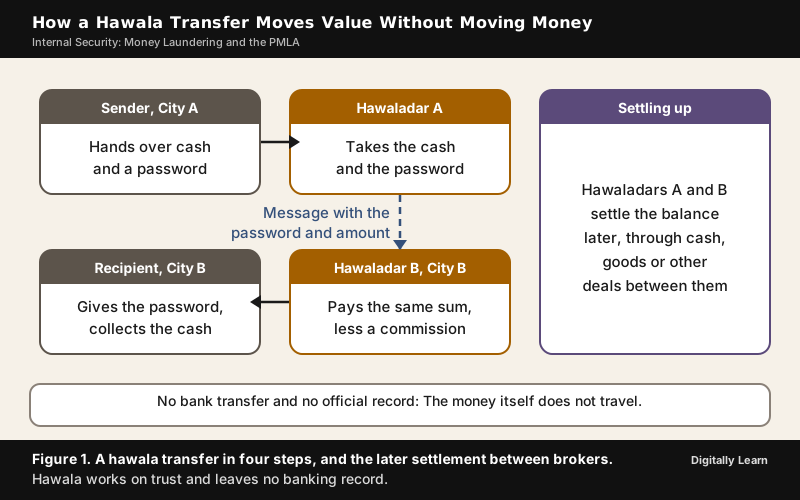
Hawala is an informal system of transferring value through a network of brokers, called hawaladars, without moving money through banks. A customer hands cash to a broker in one city with a password; the broker tells a partner broker in another city, usually abroad, who pays the same sum, less a commission, to the recipient who gives the password. The brokers settle their balances later, in cash, goods or other transactions. Hawala works on trust and leaves no banking record, which is why it suits tax evaders, smugglers and those who fund terrorism. Hawala money has reached public life too: In the hawala case, the Supreme Court directed the Central Bureau of Investigation to investigate politicians and bureaucrats.
Trade-based money laundering hides the movement of money inside ordinary trade. An exporter who over-invoices goods brings extra money into the country disguised as sale proceeds, and an importer who over-invoices sends money out disguised as payment. Under-invoicing works the other way. The Directorate of Revenue Intelligence, which enforces the Customs Act, 1962, counts trade-based money laundering and commercial fraud among the offences it works to prevent.
Real Estate, Bullion and Round-Tripping
Real estate and the trade in valuable goods are high-risk sectors for laundering, because a single purchase can absorb a large sum and the asset can later be sold as an ordinary investment. Gold serves the same purpose: Imported officially or smuggled, it has long carried money held abroad back into India. Diamonds and precious stones sent on false high-value round trips through tax havens move money out and back.
The law brings these businesses under the reporting system of the PMLA. The FATF in 2024 asked India to improve cash restrictions on dealers in precious metals and stones as a priority, given the size of that sector.
Round-tripping is the routing of Indian money abroad and its return as apparently foreign capital. The money leaves through hawala or false invoices, rests in a jurisdiction with low taxes and little disclosure, and comes back as foreign direct investment or portfolio investment, which hides the owner's identity from tax authorities. Large inflows recorded from small economies such as Mauritius have long raised the question whether part of the money is Indian money returning home.
Participatory notes, also called overseas derivative instruments, offer another route: The Indian securities behind them are legally held by foreign institutional investors, while the holder of the note takes the economic benefit without holding the securities in his or her own name. Black money generated by Indians has been reinvested in India this way.
Emerging Technologies and Money Laundering
Crypto Assets, Online Gaming and Mule Accounts
New technology has added fast, borderless routes to the old methods. Crypto assets can be moved across the world in minutes, and privacy coins, mixers that blend many users' coins, and decentralised exchanges that carry out no identity checks all make the owner harder to trace. India responded in 2023 by bringing Virtual Digital Asset Service Providers under the reporting system of the PMLA. FIU‑IND has since issued guidance to these providers, studied which digital assets are commonly misused, and acted against offshore providers that failed to register with it.
On 8 January 2026, FIU‑IND updated its guidelines for crypto exchanges: They must now collect a customer's occupation and income range, a selfie with liveness detection and the location, date, time and IP address of onboarding, and verify the bank account through a small test transaction.
Online money games created another channel. The Promotion and Regulation of Online Gaming Act, 2025, passed by Parliament on 21 August 2025, imposes a complete ban on online money games, bars banks and payment systems from processing transactions linked to them, and sets up a national authority for online gaming. The Government cited addiction, financial losses, fraud, money laundering and the use of some platforms for terror financing as reasons for the ban. Offering or facilitating online money games is punishable with imprisonment of up to three years and a fine of up to ₹1 crore.
A money mule is a person who transfers illegally acquired money, such as the proceeds of theft or fraud, on behalf of others, often through a bank account opened or lent for the purpose. Mule accounts are central to cyber fraud: Victims' money is spread across many such accounts and withdrawn quickly, which turns a fraud into a laundering chain. In one case analysed by FIU‑IND in 2024‑25, several newly opened savings accounts receiving money from a single forest range officer and emptied at once through ATMs led investigators to evidence of corruption and wildlife trafficking, including a suspected tiger skin.
Globalisation and Cross-Border Flows
Globalisation widens the space in which money can hide. Open capital accounts, rising trade, a large diaspora and fast digital payments let legitimate money cross borders easily, and criminal money uses the same roads. A laundering chain can now pass through several countries in a day, while the investigator of each country sees only one link and needs a formal request to obtain records from the next.
- Jurisdictions with weak disclosure: Territories that do not reveal the owners of companies and trusts let a launderer hide behind a foreign company that invests back into India.
- Trade volume: The more goods a country trades, the harder customs authorities find it to check the price on every invoice, which helps trade-based laundering.
- Remittances and digital payments: A large flow of small cross-border payments can hide structured transfers, and informal channels such as hawala run alongside it.
- Different rules in different countries: Money moves towards the country with the weakest checks, so one weak link can undo the efforts of the rest.
India's position makes cross-border cooperation essential. It has the largest diaspora in the world and one of the world's fastest-growing economies, so large sums move in and out every day for lawful reasons. The FATF's evaluation of 2024 found that Indian authorities make good use of financial intelligence and cooperate effectively at home and abroad. The tools of that cooperation are treaties on mutual legal assistance and the exchange of intelligence between financial intelligence units.
Prevention of Money-laundering Act, 2002
Offence, Scheduled Offences and Attachment of Property
The PMLA came into force on 1 July 2005 and has been amended by 11 Acts, the latest being the Jan Vishwas (Amendment of Provisions) Act, 2023. Its long title states its two aims: To prevent money laundering and to provide for confiscation of property derived from, or involved in, money laundering. The Act was passed to meet India's international commitments, including the UN Convention against Illicit Traffic in Narcotic Drugs and Psychotropic Substances of 1988 and the Political Declaration of the UN General Assembly's special session of June 1998, which called on member States to adopt laws against money laundering.
The offence rests on two defined terms. Proceeds of crime means any property derived or obtained, directly or indirectly, as a result of criminal activity relating to a scheduled offence, or its value, including equivalent property in India or abroad when the original is held outside the country. A scheduled offence is a crime listed in the Schedule to the Act, which is divided into three parts.
- Part A: Offences under the Indian Penal Code (such as cheating, extortion, robbery, murder and counterfeiting), the Narcotic Drugs and Psychotropic Substances Act, the Unlawful Activities (Prevention) Act, the Prevention of Corruption Act, the Arms Act, the Wild Life (Protection) Act, the Customs Act, the SEBI Act, the Information Technology Act, the Companies Act and other laws. The Schedule still lists these offences by their Indian Penal Code section numbers, although the Bharatiya Nyaya Sanhita, 2023, replaced the Indian Penal Code on 1 July 2024.
- Part B: False declaration and false documents under Section 132 of the Customs Act, 1962, which counts only when the value involved is ₹1 crore or more.
- Part C: Any Part A offence with cross-border implications, offences against property under Chapter XVII of the Indian Penal Code with such implications, and wilful attempts to evade tax under Section 51 of the Black Money Act, 2015.
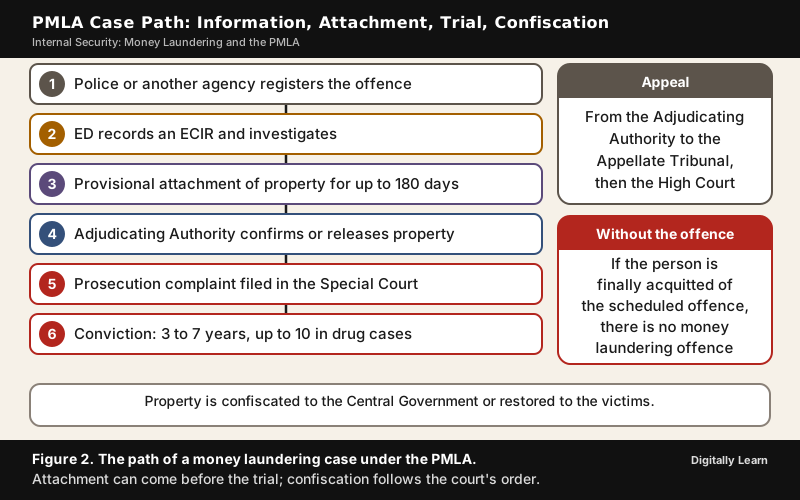
Section 3 defines the offence. A person commits money laundering if he directly or indirectly attempts to indulge in, knowingly assists, is knowingly a party to, or is actually involved in any process or activity connected with the proceeds of crime, including its concealment, possession, acquisition or use, and projecting or claiming it as untainted property. An Explanation added in 2019 states that each of these activities is enough by itself and that the offence continues for as long as a person enjoys the proceeds.
Section 4 prescribes rigorous imprisonment of not less than three years, which may extend to seven years, and a fine; when the proceeds relate to an offence under the Narcotic Drugs and Psychotropic Substances Act, the maximum rises to 10 years.
The ED opens a case by recording an Enforcement Case Information Report (ECIR). The Act also strikes at the property itself: Under Section 5, the Director or an officer not below the rank of Deputy Director who has reason to believe, recorded in writing, that a person holds proceeds of crime likely to be concealed or transferred may provisionally attach the property for up to 180 days. An independent Adjudicating Authority then hears the person under Section 8 and either confirms the attachment or releases the property. A confirmed attachment continues during investigation for up to 365 days, or while the trial is pending, and the property is confiscated to the Central Government after the Special Court's order.
Appeals go to the Appellate Tribunal and then to the High Court, and the offence itself is tried by Special Courts, which are Courts of Session designated by the Central Government in consultation with the Chief Justice of the High Court.
The investigating powers are wide. Section 17 allows search and seizure, and Section 19 allows arrest by an authorised officer who has reason to believe, recorded in writing, that a person is guilty, provided the grounds are told to him and he is produced before a Special Court or Magistrate within 24 hours. Section 50 lets officers summon any person to give evidence or produce records, and such a person is bound to state the truth.
Two provisions weigh heavily on the accused.
- Reverse burden of proof (Section 24): For a person charged with money laundering, the court presumes that the proceeds of crime are involved in money laundering unless the contrary is proved.
- Twin conditions for bail (Section 45): All offences under the Act are cognizable and non-bailable, and bail requires that the Public Prosecutor be heard and, if he opposes it, that the court be satisfied there are reasonable grounds to believe the accused is not guilty and is not likely to offend while on bail. A person under 16, a woman, a sick or infirm person, or one accused of laundering less than ₹1 crore may be released on bail if the Special Court so directs.
Reporting Entities, KYC and FIU‑IND
The PMLA prevents laundering before it happens by placing duties on the businesses through which money passes. A reporting entity is a banking company, financial institution, intermediary, or a person carrying on a designated business or profession, such as a casino, a real estate agent, a dealer in precious metals or stones, or a person who keeps cash and securities for others, as the Central Government notifies.
- Client verification (Section 11A): A reporting entity verifies the identity of its clients and of the beneficial owner, the individual who ultimately owns or controls a client. This is the legal basis of the Know Your Customer (KYC) rules that every bank customer meets.
- Enhanced due diligence (Section 12AA): The Act requires enhanced due diligence before specified transactions, and the record-keeping rules call for extra checks on politically exposed persons, defined as individuals entrusted with prominent public functions by a foreign country, such as heads of State, senior politicians and senior officials.
- Record keeping (Section 12): The Act requires a record of all transactions, kept for five years from the date of the transaction, and records of client identity, kept for five years after the business relationship ends.
- Reporting to FIU‑IND: Prescribed transactions are reported to the Director of FIU‑IND, including cash transaction reports, cross-border wire transfer reports, reports on purchase or sale of immovable property, non-profit organisation transaction reports and suspicious transaction reports.
The Financial Intelligence Unit, India was set up by an office memorandum of 18 November 2004 as the central national agency for receiving, processing, analysing and disseminating information on suspect financial transactions. It is an independent body reporting directly to the Economic Intelligence Council headed by the Finance Minister. Its work is intelligence rather than investigation: It analyses reports, finds patterns and passes intelligence to the ED, tax authorities, police and regulators, and exchanges information with foreign financial intelligence units.
In 2024‑25 reporting entities filed 4,34,668 suspicious transaction reports and 1,73,13,368 cash transaction reports, and FIU‑IND sent 6,908 priority suspicious transaction reports to enforcement agencies. It also imposed penalties of more than ₹30 crore through eight compliance orders against entities that failed in their duties.
Vijay Madanlal Choudhary Judgment 2022
The Vijay Madanlal Choudhary v. Union of India judgment, delivered on 27 July 2022 by a three-judge Bench of Justices A.M. Khanwilkar, Dinesh Maheshwari and C.T. Ravikumar, decided more than 240 petitions challenging the PMLA and its amendments. The Court upheld the main provisions and described the Act as a special law enacted to meet India's international commitments against money laundering.
- Section 3: The word "and" in the section is read as "or", so any one activity is enough; the Court rejected the argument that the offence is complete only when the property is projected or claimed as untainted.
- Dependence on the scheduled offence: The authorities cannot prosecute on the assumption that a scheduled offence was committed; if the person is finally discharged or acquitted of the scheduled offence, or the case is quashed, there can be no offence of money laundering against him.
- Sections 5, 17, 19 and 24: Attachment, search and seizure, arrest and the reverse burden of proof were held valid, with the safeguards built into each.
- Section 45: The twin conditions for bail, struck down in 2017 in Nikesh Tarachand Shah in their earlier form, were held valid after Parliament restored them by the 2018 amendment.
- Section 50: ED officers are not police officers, and statements recorded by them do not attract the protection against self-incrimination in Article 20(3), nor do they violate Article 21.
- ECIR: An ECIR cannot be equated with an FIR, and a copy need not be given to the accused in every case; it is enough that the ED discloses the grounds of arrest at the time of arrest.
- Money Bill question left open: Whether some amendments could be made through a Finance Act was left to a larger Bench.
The judgment is contested: The Supreme Court agreed in August 2022 to hear a petition seeking its review, which is still pending. Critics argue that the reverse burden of proof, the denial of the ECIR and the bail conditions together make the process itself a punishment, and point to the few convictions compared with the number of cases.
In October 2026 a Special Bench of the Court observed that information the ED shares with another agency under Section 66(2) is an intimation, not a mandate, and that the receiving agency decides for itself whether any other law requires a case to be registered.
Enforcement Directorate and Other Institutions
Enforcement Directorate: Powers Under PMLA and FEMA
The Enforcement Directorate is a multi-disciplinary organisation under the Department of Revenue, Ministry of Finance, that investigates money laundering and violations of foreign exchange laws. It began on 1 May 1956 as an Enforcement Unit in the Department of Economic Affairs to handle violations of the Foreign Exchange Regulation Act, 1947, was renamed the Enforcement Directorate in 1957, and moved to the Department of Revenue in 1960. It took charge of enforcing the Foreign Exchange Management Act from 1 June 2000, the PMLA from 1 July 2005 and the Fugitive Economic Offenders Act from 21 April 2018. Its headquarters is in New Delhi, with regional and zonal offices across the country.
- PMLA: The ED investigates to trace the proceeds of crime, provisionally attaches property, prosecutes offenders and seeks confiscation of the property or its restitution to victims.
- Foreign Exchange Management Act, 1999 (FEMA): FEMA is a civil law, so the ED investigates suspected contraventions, adjudicates them and imposes penalties of up to three times the sum involved where it can be quantified; a contravention is not a criminal offence.
- Fugitive Economic Offenders Act, 2018: The ED applies to the Special Court to declare a person a fugitive economic offender and to confiscate his property.
- Foreign Exchange Regulation Act, 1973: The ED still adjudicates show cause notices issued under the repealed Act up to 31 May 2002 and pursues prosecutions already launched.
- COFEPOSA: Under the Conservation of Foreign Exchange and Prevention of Smuggling Activities Act, 1974, the ED sponsors cases of preventive detention for contraventions of FEMA.
The ED's own figures show how its PMLA work has grown. It recorded 1,883 cases (ECIRs) between 1 July 2005 and 31 March 2014, an average of 209 a year, and 5,113 between 2014‑15 and 2023‑24, an average of 511 a year; it recorded 775 in 2024‑25 and 1,080 in 2025‑26. Up to 31 March 2026 the ED had recorded 8,851 cases, filed 3,068 prosecution complaints including supplementary complaints, and secured convictions in 56 cases, in which 124 persons were convicted. Assets under attachment totalled ₹2,36,016.61 crore, of which ₹81,422.63 crore was attached in 2025‑26 alone, and property worth ₹63,142.65 crore had been restored to victims.
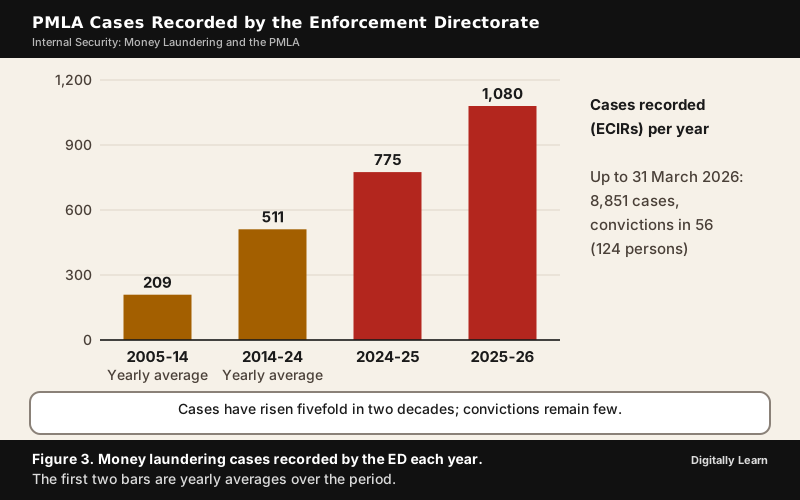
The gap between cases and convictions is the main criticism of the ED's record: Of 8,851 cases recorded in two decades, 56 had ended in conviction by March 2026. Attachments and restitution to victims have risen sharply in recent years, and the FATF in 2024 asked India to address the backlog of money laundering cases still pending in the courts. Critics also argue that the agency's powers are used to intimidate political opponents.
Fugitive Economic Offenders Act 2018 and the Black Money Act 2015
The Fugitive Economic Offenders Act, 2018, deals with economic offenders who escape the reach of Indian courts by staying abroad. A fugitive economic offender is an individual against whom a court in India has issued an arrest warrant for an offence listed in the Schedule to that Act involving ₹100 crore or more, and who has left India to avoid prosecution or refuses to return. On the ED's application, the Special Court may declare the person a fugitive economic offender and order the confiscation of the proceeds of crime and of any other property, including benami property, in India or abroad. Courts may also bar the person, and companies he controls, from bringing or defending civil claims in India.
Up to 2025‑26, proceedings had been started against 54 individuals, 21 had been declared fugitive economic offenders, and property worth ₹2,178.34 crore had been confiscated under the Act.
The Black Money (Undisclosed Foreign Income and Assets) and Imposition of Tax Act, 2015 targets income and assets hidden abroad. It came into force on 1 July 2015 and taxes undisclosed foreign income and assets at 30 per cent of their value, with a penalty equal to three times the tax. A resident who wilfully attempts to evade tax under the Act faces rigorous imprisonment of not less than three years, which may extend to 10 years, and a fine, and that offence is itself a scheduled offence under Part C of the PMLA, which links hidden foreign wealth to the money laundering law.
| Feature | PMLA, 2002 | FEMA, 1999 | Black Money Act, 2015 | Fugitive Economic Offenders Act, 2018 |
|---|---|---|---|---|
| Nature of law | Criminal | Civil | Tax law with criminal offences | Civil confiscation against absconders |
| Main target | Proceeds of scheduled offences | Contraventions of foreign exchange rules | Undisclosed foreign income and assets | Offenders abroad avoiding trial for offences of ₹100 crore or more |
| Enforcing body | Enforcement Directorate | Enforcement Directorate | Income-tax authorities (Assessing Officer) | Enforcement Directorate |
| Main consequence | Imprisonment of 3 to 7 years (up to 10 for drug cases) and confiscation | Penalty up to three times the sum involved | Tax at 30 per cent, penalty of three times the tax, imprisonment of 3 to 10 years for wilful evasion | Declaration as fugitive, confiscation, bar on civil claims |
| In force from | 1 July 2005 | 1 June 2000 | 1 July 2015 | 21 April 2018 |
Other agencies share the work against economic crime, and each sits under a specific ministry.
| Agency | Main work | Ministry |
|---|---|---|
| Enforcement Directorate | Money laundering, foreign exchange violations, fugitive economic offenders | Finance (Department of Revenue) |
| Financial Intelligence Unit, India | Receives and analyses transaction reports and shares financial intelligence | Finance (an independent unit reporting to the Economic Intelligence Council) |
| Central Economic Intelligence Bureau | Gathers economic intelligence and coordinates the agencies fighting economic offences | Finance (Department of Revenue) |
| Directorate of Revenue Intelligence | Enforces the Customs Act, 1962, against smuggling and trade-based laundering | Finance (Department of Revenue, through the Central Board of Indirect Taxes and Customs) |
| Serious Fraud Investigation Office | Investigates complex corporate fraud | Corporate Affairs |
| Central Bureau of Investigation | Investigates corruption and economic and other serious crimes | Personnel, Public Grievances and Pensions (Department of Personnel and Training) |
International Measures Against Money Laundering
FATF Standards, the Egmont Group and UN Conventions
The Financial Action Task Force was set up in 1989 at the summit of the Group of Seven held in Paris to examine money laundering. It sets the global standards for fighting money laundering, terrorist financing and the financing of weapons of mass destruction, now 40 Recommendations, and checks how well each country applies them through peer reviews called mutual evaluations.
India became an observer in 2006 and a full member in 2010, and it also belongs to two FATF-style regional bodies, the Asia/Pacific Group on Money Laundering and the Eurasian Group. India's mutual evaluation, carried out jointly by the FATF, the Asia/Pacific Group and the Eurasian Group, was published on 19 September 2024 and placed India in "regular follow-up", with a report back to the FATF Plenary due in three years. Countries with serious weaknesses are placed on the FATF's public lists of high-risk and monitored jurisdictions, known as the black and grey lists, which warn banks worldwide.
The Egmont Group links financial intelligence units across the world. It is named after the Egmont Palace in Brussels, where such units first met in June 1995, and it provides a secure network, the Egmont Secure Web, for exchanging financial intelligence. FIU‑IND exchanges information through it and has signed memoranda of understanding with many foreign units.
Three United Nations conventions form the treaty base:
- UN Convention against Illicit Traffic in Narcotic Drugs and Psychotropic Substances, 1988: It calls for the prevention of laundering of the proceeds of drug crimes and the confiscation of those proceeds; India is a party.
- UN Convention against Transnational Organized Crime, 2000: Known as the Palermo Convention, it forms, with its protocols, part of the international law on money laundering, human trafficking and arms trafficking; India ratified it on 5 May 2011.
- UN Convention against Corruption, 2003: Adopted on 31 October 2003, it covers corruption in the private sector, including money laundering, and provides legal mechanisms for international asset recovery; India ratified it on 9 May 2011.
Chapter IX of the PMLA gives these commitments legal effect at home. It allows India to agree with other countries on assistance in investigations, to send letters of request for evidence and for the attachment and confiscation of property abroad, and to act on such requests from other countries.
Measures Needed in India
India's legal framework for money laundering is broadly complete; the main gaps lie in how quickly cases end and how evenly the reporting duties are carried out. The FATF's 2024 assessment and the debates around the PMLA point to the following steps.
- Faster trials: More Special Courts, trained prosecutors and time limits would clear the backlog of cases and convert attachments into convictions and confiscation.
- Due process alongside strong powers: Sharing the grounds and material of a case in time, recording interrogations, and using arrest only when needed would answer the criticism of misuse without weakening the law.
- Beneficial ownership and shell companies: Up-to-date registers of the real owners of companies and trusts would close the main hiding place for layered money.
- Non-financial businesses and virtual assets: Supervision of real estate agents, dealers in precious metals and stones and crypto service providers is at an early stage and needs the same depth as the supervision of banks.
- Politically exposed persons at home: The FATF asked India to extend enhanced checks to domestic politically exposed persons, not only foreign ones.
- Cyber fraud and mule accounts: Faster sharing between banks, FIU‑IND and the Indian Cyber Crime Coordination Centre, and freezing of suspected mule accounts, would stop fraud money before it is layered.
- Cooperation abroad: More information-sharing agreements, quicker responses to letters of request and steady work in the FATF would help trace money that leaves India.
Previous Year UPSC‑CSE Questions
Each Prelims question is explained option by option, and each Mains question comes with an answer outline.
- UPSC Prelims 2026With reference to the organisations under the Government of India, consider the following details:
- Organisation: Central Economic Intelligence Bureau (CEIB); Function: To coordinate between various law enforcement agencies; Controlling Union Ministry: Ministry of Home Affairs
- Organisation: Serious Fraud Investigation Office (SFIO); Function: To investigate complex corporate frauds; Controlling Union Ministry: Ministry of Finance
- Organisation: Central Bureau of Investigation (CBI); Function: To preserve values in public life and ensure the health of the national economy; Controlling Union Ministry: Ministry of Personnel, Public Grievances and Pension
In how many of the above rows are the given details correctly matched?
How to approach this Prelims question
Approach: Match each organisation with its controlling ministry as well as its function, since one wrong detail makes the row wrong.
- Row 1: The Central Economic Intelligence Bureau does coordinate the agencies fighting economic offences, but it works under the Department of Revenue, Ministry of Finance, not the Ministry of Home Affairs; wrong.
- Row 2: The Serious Fraud Investigation Office investigates complex corporate fraud, but it works under the Ministry of Corporate Affairs, not the Ministry of Finance; wrong.
- Row 3: The Central Bureau of Investigation, under the Department of Personnel, Ministry of Personnel, Public Grievances and Pensions, describes its role as preserving values in public life and ensuring the health of the national economy; correct.
Only the CBI row is correctly matched.
Trap to watch: Row 2 looks right because fraud sounds like a finance matter, but the SFIO is a statutory body under the Companies Act, 2013, and belongs to the Ministry of Corporate Affairs.
Why each option is right or wrong:
- (a) 1: Correct. Only the CBI row matches both its role and its ministry.
- (b) 2: Wrong. The CEIB is under the Ministry of Finance and the SFIO under the Ministry of Corporate Affairs, so both those rows fail.
- (c) 3: Wrong. Rows 1 and 2 give the wrong ministries.
- (d) None: Wrong. The CBI row is correctly matched.
Answer: (a) 1. Only the CBI row is correct, because the CEIB belongs to the Ministry of Finance and the SFIO to the Ministry of Corporate Affairs.
- UPSC Prelims 2025With reference to the Government of India, consider the following information:Organization | Some of its functions | It works under
- I. Directorate of Enforcement : Enforcement of the Fugitive Economic Offenders Act, 2018 : Internal Security Division-I, Ministry of Home Affairs
- II. Directorate of Revenue Intelligence : Enforces the provisions of the Customs Act, 1962 : Department of Revenue, Ministry of Finance
- III. Directorate General of Systems and Data Management : Carrying out big data analytics to assist tax officers for better policy and nabbing tax evaders : Department of Revenue, Ministry of Finance
In how many of the above rows is the information correctly matched?
How to approach this Prelims question
Approach: Check each row on both its function and its parent body, because a row is correctly matched only if both are right.
- Row I: The ED does enforce the Fugitive Economic Offenders Act, 2018, but it works under the Department of Revenue, Ministry of Finance, not the Ministry of Home Affairs; wrong.
- Row II: The Directorate of Revenue Intelligence enforces the Customs Act, 1962, and works under the Central Board of Indirect Taxes and Customs in the Department of Revenue; correct.
- Row III: The Directorate General of Systems and Data Management of the indirect tax administration looks after computerisation and the collection of revenue data and statistics, not big data analytics for catching tax evaders; wrong.
Only Row II is correctly matched.
Trap to watch: Row I tempts students because the ED really does enforce the Fugitive Economic Offenders Act and its cases often concern security; the error lies in the ministry, because the ED belongs to the Ministry of Finance.
Why each option is right or wrong:
- (a) Only one: Correct. Only Row II, the Directorate of Revenue Intelligence under the Department of Revenue enforcing the Customs Act, is correctly matched.
- (b) Only two: Wrong. Row I fails on the ministry and Row III on the function.
- (c) All the three: Wrong. The ED is not under the Ministry of Home Affairs.
- (d) None: Wrong. Row II is correctly matched.
Answer: (a) Only one. Only the Directorate of Revenue Intelligence row is right, because the ED works under the Ministry of Finance, not the Ministry of Home Affairs.
- UPSC Prelims 2021Which one of the following effects of creation of black money in India has been the main cause of worry to the Government of India?
How to approach this Prelims question
Approach: Identify the effect that strikes the Government directly. Black money is income hidden from tax, so its first and widest effect is that the State does not collect the tax due on it, which limits public spending. The other options are real but narrower consequences of how black money is spent.
Trap to watch: Options (a) and (b) describe effects students read about in news reports on property and gold; the question asks for the Government's main worry, which is the revenue it loses.
Why each option is right or wrong:
- (a) Diversion of resources to the purchase of real estate and investment in luxury housing: Wrong. Property absorbs black money and raises prices, but this is a use of the money, not the Government's main loss.
- (b) Investment in unproductive activities and purchase of precious stones, jewellery, gold, etc: Wrong. Gold and precious stones store black money, but this too is a consequence of spending it.
- (c) Large donations to political parties and growth of regionalism: Wrong. Regionalism is not an economic effect of black money, and donations are only one use of it.
- (d) Loss of revenue to the State Exchequer due to tax evasion: Correct. Black money by definition escapes tax, so the Exchequer loses revenue it needs for welfare and development.
Answer: (d) Loss of revenue to the State Exchequer due to tax evasion. Black money is untaxed income, so its main effect on the Government is lost tax revenue.
- UPSC Prelims 2003Which one of the following statements is correct with reference to FEMA in India?
How to approach this Prelims question
Approach: Check each statement against the dates and nature of FEMA. FEMA came into force on 1 June 2000 and is a civil law under which the ED adjudicates contraventions and imposes penalties. The ED could adjudicate FERA show cause notices issued up to 31 May 2002, which is two years after FEMA began, not one.
Trap to watch: Option (b) looks right because 31 May 2002 is the true cut-off date, but the period it names is wrong; the sunset ran for two years.
Why each option is right or wrong:
- (a) The Foreign Exchange Regulation Act (FERA), was replaced by Foreign Exchange Management Act (FEMA) in the year 2001: Wrong. FEMA came into force on 1 June 2000.
- (b) FERA was given a sunset clause of one year till 31st May 2002 to enable Enforcement Directorate to complete the investigation of pending issues: Wrong. From 1 June 2000 to 31 May 2002 is two years.
- (c) Under FEMA, violation of foreign exchange rules has ceased to be a criminal offence: Correct. FEMA is a civil law; contraventions are settled by adjudication and penalties of up to three times the sum involved.
- (d) As per the new dispensation, Enforcement Directorate can arrest and prosecute the people for the violation of foreign exchange rules: Wrong. Because FEMA is civil, the ED adjudicates and imposes penalties; arrest and prosecution belong to the PMLA.
Answer: (c) Under FEMA, violation of foreign exchange rules has ceased to be a criminal offence. FEMA made foreign exchange violations civil contraventions punished by penalty after adjudication.
- UPSC Prelims 1996Hawala transactions relate to payments
How to approach this Prelims question
Approach: Test each option against what hawala is. Hawala is an informal value transfer system in which brokers pay out money in one place against money received in another, without moving it through banks. The defining feature is the exchange of money across currencies outside official channels, so the option that describes rupees exchanged against foreign currency outside those channels is the answer.
Trap to watch: Option (c) tempts students who link hawala with corruption; hawala is the channel of transfer, not the purpose of the payment.
Why each option is right or wrong:
- (a) received in rupees against overseas currencies and vice versa without going through the official channels: Correct. Hawala brokers pay in one country against money received in another, outside the banking system.
- (b) received for sale/transfer of shares without going through the established stock exchanges: Wrong. Off-market share deals are a securities matter, not a value transfer between countries.
- (c) received as commission for services rendered to overseas investors/buyers/sellers in assisting them to get over the red tape and/or in getting preferential treatment: Wrong. Such a payment is a bribe or a fee, which hawala may carry but which does not define it.
- (d) made to political parties or to individuals for meeting election expenses: Wrong. Hawala money may reach anyone, but payments for elections are not what the term means.
Answer: (a) received in rupees against overseas currencies and vice versa without going through the official channels. Hawala exchanges rupees and foreign currency through brokers outside the official banking channels.
- UPSC Mains 2021 GS‑IIIDiscuss how emerging technologies and globalisation contribute to money laundering. Elaborate measures to tackle the problem of money laundering both at national and international levels.
Answer outline
The outline sets out what the question asks, the main arguments, relevant examples and the direction of the conclusion; it is not a full model answer.
Introduction: Money laundering disguises the criminal origin of money, and new technology and globalisation have made each of its three stages faster and harder to trace.
Body (sub-themes to develop):
- Emerging technologies: Crypto assets, privacy coins, mixers and decentralised exchanges hide owners; online money games and mule accounts move fraud money quickly through many accounts.
- Globalisation: Open capital accounts, large trade volumes, remittances and jurisdictions that hide company owners let one laundering chain cross several countries, as in round-tripping and trade-based laundering.
- National measures: The PMLA with attachment and confiscation, KYC and reporting duties, Virtual Digital Asset Service Providers under the PMLA since 2023, the Online Gaming Act, 2025, and cooperation between FIU‑IND, banks and the Indian Cyber Crime Coordination Centre.
- International measures: FATF's 40 Recommendations and mutual evaluations, Egmont Group exchange between financial intelligence units, the UN conventions against drug trafficking, organised crime and corruption, and PMLA Chapter IX letters of request.
Conclusion: Because technology and open borders let money move faster than investigators, national laws work only when matched by quick international sharing of information.
- UPSC Mains 2013 GS‑IIIMoney laundering poses a serious threat to a country's economic sovereignty. What is its significance for India and what steps are required to be taken to control this menace?
Answer outline
Introduction: Money laundering conceals the criminal origin of money through placement, layering and integration; Parliament enacted the PMLA because laundering threatens the integrity and sovereignty of a country as well as its financial system.
Body (sub-themes to develop):
- Threat to economic sovereignty: Laundered money escapes tax, distorts property and gold prices and lets criminal wealth buy influence in the economy.
- Significance for India: Its main risks come from fraud, including cyber-enabled fraud, corruption and drug trafficking, with serious terrorist financing threats; hawala, round-tripping and trade-based laundering carry money in and out.
- Legal steps taken: The PMLA makes laundering of scheduled-offence proceeds a crime, provides attachment and confiscation, and is backed by FEMA, the Black Money Act, 2015, and the Fugitive Economic Offenders Act, 2018.
- Institutions: The ED investigates and prosecutes; FIU‑IND receives cash and suspicious transaction reports from banks and designated businesses under KYC rules.
- International steps: FATF membership since 2010 and a 2024 rating of regular follow-up, Egmont exchange of intelligence, and the UN conventions of 1988, 2000 and 2003.
- Steps still required: Faster trials and higher convictions, beneficial ownership registers, supervision of real estate, bullion and crypto businesses, coverage of domestic politically exposed persons, and due-process safeguards.
Conclusion: India has a framework that the FATF judged to be achieving good results, and its next task is to turn attachments into convictions while keeping strong powers within fair procedure.
Sources
- NCERT: Indian Constitution at Work (Class XI, revised edition, reprint 2026‑27), Chapter 6, Judiciary
- India Code: The Prevention of Money-laundering Act, 2002 (as on 27 July 2025)
- India Code: The Foreign Exchange Management Act, 1999
- India Code: The Fugitive Economic Offenders Act, 2018
- India Code: The Black Money (Undisclosed Foreign Income and Assets) and Imposition of Tax Act, 2015
- Supreme Court of India: Vijay Madanlal Choudhary and Others v. Union of India and Others, judgment of 27 July 2022
- Directorate of Enforcement: What We Do
- Directorate of Enforcement: History of ED
- Directorate of Enforcement: Financial Action Task Force
- Directorate of Enforcement: Performance Report FY 2025‑26
- FIU‑IND: About FIU‑IND
- FIU‑IND: International cooperation (FATF, Egmont Group, APG, EAG)
- FIU‑IND: Annual Report 2024‑25
- FIU‑IND: PML (Maintenance of Records) Rules, 2005, as amended
- FATF: Anti-money laundering and counter-terrorist financing measures, India, Mutual Evaluation Report, 19 September 2024
- United Nations Treaty Collection: United Nations Convention against Transnational Organized Crime, status
- United Nations Treaty Collection: United Nations Convention against Corruption, status
- Press Information Bureau: Promotion and Regulation of Online Gaming Bill, 2025, explainer of 21 August 2025
- Department of Revenue: Central Board of Indirect Taxes and Customs, directorates and their functions
- Central Bureau of Investigation: Motto, Vision and Mission
- The Hindu: Supreme Court agrees to list plea seeking review of PMLA judgment
- The Hindu: 18 January 2026 issue, What has India's Financial Intelligence Unit mandated for crypto exchanges
- The Hindu: 20 January 2026 issue, opinion article on the Enforcement Directorate's powers
- The Hindu: 22 October 2026 issue, SC stays probe for a week (Section 66(2) of the PMLA)
- The Hindu: 31 October 2026 issue, editorial on digital arrest scams and mule accounts
- Wikipedia: Money laundering
- Wikipedia: Hawala
- Wikipedia: Black money in India
- Wikipedia: Shell corporation
- Wikipedia: Money mule
- Wikipedia: Prevention of Money Laundering Act, 2002
- Wikipedia: Enforcement Directorate
- Wikipedia: Foreign Exchange Management Act, 1999
- Wikipedia: Financial Action Task Force
- Wikipedia: Egmont Group of Financial Intelligence Units
- Wikipedia: Directorate of Revenue Intelligence
- Wikipedia: Central Economic Intelligence Bureau
- Wikipedia: Serious Fraud Investigation Office
- Wikipedia: Central Bureau of Investigation
- Wikipedia: Bharatiya Nyaya Sanhita
- Wikipedia: United Nations Convention Against Illicit Traffic in Narcotic Drugs and Psychotropic Substances
- UPSC: Civil Services Examination question papers
Editorial Disclaimer
Enforcement figures, notified rules and the status of court cases change; where this article and the official text differ, the Act on India Code and the latest notification prevail.
See more of our UPSC articles in Google Search
Add to Preferred Sources

