


Overview
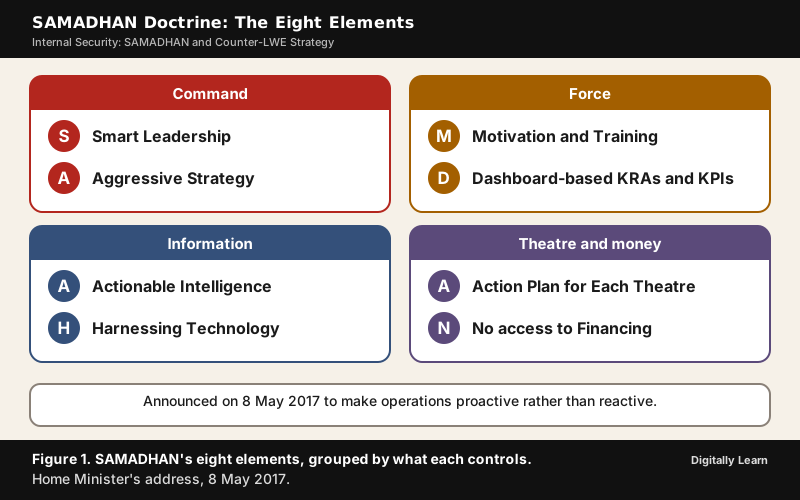
The SAMADHAN doctrine is the strategy for security operations against Left-Wing Extremism (LWE) that the Union Home Minister, Rajnath Singh, announced at a review meeting of the 10 LWE-affected States on 8 May 2017. The name is an acronym of eight elements: Smart Leadership, Aggressive Strategy, Motivation and Training, Actionable Intelligence, Dashboard-based Key Result Areas and Key Performance Indicators, Harnessing Technology, Action Plan for Each Theatre, and No access to Financing. The meeting followed the attack of 24 April 2017 at Burkapal in Sukma district, Chhattisgarh, in which 25 personnel of the Central Reserve Police Force (CRPF) were killed.
Left-Wing Extremism Today: Effects and the 2026 Position
Left-Wing Extremism and Its Effect on Local Communities
Left-Wing Extremism, often called Naxalism, is an armed rebellion inspired by Maoist ideology. It began with the Naxalbari movement of 1967 in West Bengal and spread across the "Red Corridor" of Chhattisgarh, Jharkhand, Odisha, Maharashtra and neighbouring States. The Communist Party of India (Maoist), or CPI (Maoist), formed in 2004, is the main organisation; its methods include armed violence, extortion, destruction of infrastructure and recruitment of children and civilians.
The heaviest losses fall on the people whom the movement claims to represent. By May 2017, LWE violence had taken about 12,000 lives, 2,700 of them security personnel and 9,300 civilians. Most of the civilians killed are tribal people, and extremists also target roads, culverts, railway tracks, telephone towers, hospitals, schools, anganwadis and panchayat buildings. As a result, remote areas remained without roads, electricity and schools, a vicious circle that the National Policy and Action Plan of 2015 set out to break.
LWE-Affected Districts and Violence in 2026
India was declared effectively free from Left-Wing Extremism on 31 March 2026, the date the government had set on 24 August 2024. As of July 2026, no district is categorised as LWE-affected. The number of affected districts fell from 126 in 2014 to 90 in April 2018, 70 in July 2021, 38 in April 2024, eight in December 2025 and zero in March or April 2026. Six of the last eight districts were in Chhattisgarh (Bijapur, Dantewada, Gariaband, Kanker, Narayanpur and Sukma); the other two were West Singhbhum in Jharkhand and Kandhamal in Odisha.
Violence declined at the same time. Incidents fell from 1,936 in 2010 to 870 in 2014 and 33 in 2026 up to 29 July; fatalities fell from 1,005 in 2010 to 310 in 2014 and 11 in 2026 up to the same date. The task has therefore shifted from ending the insurgency to consolidating the gains.
Union and State Roles in Countering Left-Wing Extremism
Union Support to the States: CAPFs, Funding and Coordination
Because police and public order are State subjects under the Seventh Schedule, the Union's role is to supplement the efforts of the States. In May 2017 the Home Minister set out what this meant in practice: 118 battalions of Central Armed Police Forces (CAPFs) deployed in the affected States, 10 Commando Battalions for Resolute Action (CoBRA), and sanction for 56 India Reserve Battalions (IRBs) and 10 Special India Reserve Battalions (SIRBs) to enable the States to raise their own forces.
The Union also funds helicopters and camp infrastructure through the Assistance to Central Agencies for LWE Management scheme, shares intelligence, and supports Counter Insurgency and Anti-Terrorism (CIAT) schools; in 2017, 16 such schools were funded in six States.
The CRPF also drew on local recruits. Its Bastariya Battalion, formed in Chhattisgarh in 2017, recruited 1,143 personnel, including about 400 young people from Bijapur, Sukma and Dantewada, so that local knowledge and language became part of the security grid.
Coordination is the Union's second function. Since 2019, 15 new Joint Task Forces have been created, and the National Investigation Agency (NIA) has a dedicated unit on Naxal financing.
State Police, Special Forces and the Greyhounds Model
The State police carry out operations on the ground. The model that other States studied is the Greyhounds, a special unit of the Andhra Pradesh police raised in early 1989 and later shared with Telangana. The Greyhounds operate in small units of 15 to 30 commandos on combing operations in the forests, and all commandos are under 35 years of age. In 2017 the Home Minister noted that more than 4,000 police personnel a year were being trained by the Army and the Greyhounds.
Other States raised their own elite units, among them the District Reserve Guard (DRG) and other units of the Chhattisgarh police, Jharkhand Jaguar, and State Special Task Forces (STF). Joint training across DRG, STF, CRPF and CoBRA has produced an interoperable force with a clear command structure.
National Policy and Action Plan 2015 on Left-Wing Extremism
Security, Development and Rights of Local Communities
SAMADHAN is one layer of a larger framework. That framework is the National Policy and Action Plan to address LWE, approved in 2015, which combines security measures, development interventions and the protection of the rights and entitlements of local communities.
The Policy combines zero tolerance towards violence with a major push for development, so that the benefits of development reach the poor and the vulnerable. A Media Plan, with Tribal Youth Exchange visits, radio jingles and documentaries, counters Maoist propaganda; ₹52.52 crore had been released under it since 2017‑18 as of April 2025.
Two interpretations of the causes coexist in the policy debate:
- Backwardness: LWE is a vicious circle in which poverty, low literacy, poor health and weak infrastructure are deepened by LWE violence. In 2010 the Home Secretary acknowledged legitimate local grievances over access to forest land and produce and over the distribution of benefits from mining and hydropower projects.
- Ideology: The root cause is Maoist ideology, and the Maoists chose the Red Corridor because the reach of the state was weak in its dense forests, hills and rivers. Home Minister Amit Shah stated this view in March 2026.
The Policy addresses both: Security restores the reach of the state, development closes the gaps, and rights give tribal communities a stake in the established order.
Progress on rights is measured in title deeds. By July 2026, 21,26,268 title deeds had been distributed in the erstwhile LWE-affected areas, of which 20,20,268 were individual and 1,06,000 community titles. The titles are issued under the Forest Rights Act, 2006, which recognises the rights of Scheduled Tribes and other traditional forest dwellers to the forest land they occupy and the forest produce they depend on.
Security Related Expenditure and Special Central Assistance Schemes
Most of the funds flow through sub-schemes of the umbrella scheme for the Modernisation of Police Forces. Before April 2018, 106 districts in 10 States were covered by the Security Related Expenditure (SRE) scheme; as districts were split, their area came to span 126 districts. Of the 106, 35 "Most Affected Districts" (36 after district splits) accounted for 80 to 90 per cent of LWE violence in the country. After a review in April 2018, 90 districts in 11 States were covered and the list of Most Affected Districts was cut from 36 to 30.
By April 2025 fewer than 20 districts remained affected. They were graded in three tiers of six districts each. The Most Affected Districts were the worst hit, the Districts of Concern, where violence was lower, still needed resources beyond the regular Security Related Expenditure support, and the rest were classed as other LWE-affected districts.
| Scheme | Nodal agency | Purpose | Latest figure (date) |
|---|---|---|---|
| Security Related Expenditure (SRE) | Ministry of Home Affairs | Reimburses training, operational needs, ex-gratia, rehabilitation of surrendered cadres, community policing | ₹3,805.04 crore released since 2014‑15 (July 2026) |
| Special Infrastructure Scheme (SIS) | Ministry of Home Affairs | Strengthens State Special Forces, Special Intelligence Branches and district police, and builds fortified police stations | ₹1,761 crore sanctioned (July 2026) |
| Special Central Assistance (SCA), approved 2017 | Ministry of Home Affairs | Fills critical gaps in public infrastructure in the most affected districts; ₹30 crore for Most Affected Districts and ₹10 crore for Districts of Concern (April 2025) | About ₹4,289.20 crore released since 2017 (July 2026) |
| Road Requirement Plan-I (RRP‑I) and Road Connectivity Project for LWE Affected Areas (RCPLWEA) | Ministry of Road Transport and Highways (RRP‑I); Ministry of Rural Development, within the Pradhan Mantri Gram Sadak Yojana (RCPLWEA) | Road connectivity for operations and for development | 15,189 km constructed (July 2026) |
| Assistance to Central Agencies for LWE Management (ACALWEM) | Ministry of Home Affairs | Camp infrastructure and helicopter hire for CAPFs and the Air Force | ₹1,303.68 crore since 2014‑15 (July 2026) |
| Civic Action Programme | Ministry of Home Affairs | Funds CAPFs for medical camps, sports and relief items for local people | ₹221.88 crore since 2014 (July 2026) |
SAMADHAN Doctrine of 2017
Smart Leadership, Aggressive Strategy and the Other Elements
SAMADHAN was designed to end the practice of reacting only after each incident. The Home Minister called on the forces to take a proactive role, and the eight elements set out how.
| Letter | Element | What it requires |
|---|---|---|
| S | Smart Leadership | Vision, mission, passion and self belief; officers who lead from the front; unified command at the strategic, operational and tactical levels |
| A | Aggressive Strategy | Proactive operations in place of purely defensive deployment; State ownership of operations with full CAPF support |
| M | Motivation and Training | Camps with power, water and connectivity; knowledge of local language, dialect and culture; adherence to standard operating procedures |
| A | Actionable Intelligence | Networks with local people; use of surrendered cadres for intelligence; better technical intelligence through mobile connectivity |
| D | Dashboard-based KRAs and KPIs | Key Result Areas and Key Performance Indicators for State police and CAPFs, to judge preparedness and performance |
| H | Harnessing Technology | At least one unmanned aerial vehicle (UAV) or mini UAV with every battalion, pan-tilt-zoom cameras, GPS tracking, thermal imaging, radar, satellite images, trackers in weapons |
| A | Action Plan for Each Theatre | Separate short, medium and long-term plans for each State, in mission mode with fixed goals and deadlines |
| N | No access to Financing | Cutting off the funds of LWE groups, treated as the most basic step |
The question of connectivity shows how the elements are linked. The Home Minister noted that technical intelligence in the Bastar zone was low because only 20 per cent of the area had effective connectivity, and 4 per cent in Sukma district, and called for plans under the Universal Service Obligation Fund. For this reason mobile towers form part of the security strategy and not only of development.
Fortified Police Stations, Forward Bases and Intelligence-Led Operations
Fortified police stations are the physical expression of SAMADHAN. In 2017 the Union made ₹624 crore available to build 400 of them in 10 States. The number of fortified police stations rose from 66 before 2014 to 663 by July 2026. Forward bases followed: 408 new CAPF camps in the seven years to August 2026 and 68 helipads with night-landing facilities, which allow rapid deployment, casualty evacuation and surveillance.
Technology and intelligence drove the operations. The Ministry of Home Affairs used drones, satellite imagery, location tracking, call-log analysis and AI-based data analysis to track movement. A series of named operations in 2022 cleared specific areas: Operation Octopus (Burha Pahad), Operation Double Bull (Gumla, Lohardaga and Latehar districts, which became free of Naxalism), Operation Thunderstorm (Saraikela, West Singhbhum and Khunti), Operation Bhimbarg (Munger) and Operation Chakrabandha (Gaya and Aurangabad).
Development Schemes in LWE-Affected Districts
Road Requirement Plan and Road Connectivity Project for LWE Areas
Roads serve two purposes at once: They allow the security forces to move, and they bring the market, the school and the clinic within reach of the village. Two LWE-specific schemes deliver them. The Road Requirement Plan-I (RRP‑I) is implemented by the Ministry of Road Transport and Highways for Andhra Pradesh, Bihar, Chhattisgarh, Jharkhand, Madhya Pradesh, Maharashtra, Odisha and Uttar Pradesh. The Road Connectivity Project for LWE Affected Areas (RCPLWEA) was launched in 2016 for 44 worst-affected districts and some adjoining districts in nine States, with the twin objectives of facilitating operations against LWE and promoting the socio-economic development of the area.
By August 2017, 4,433 km had been built under RRP‑I, including 1,504 km in the most difficult areas during the preceding three years. Under the two schemes together, 17,589 km were sanctioned, of which 14,618 km were built by April 2025 and 15,189 km by July 2026. The Government has also approved 127.08 km of critical roads and six critical bridges, to be built by the Border Roads Organisation, in the erstwhile LWE-affected area of Chhattisgarh. In the Bastar region alone, more than 3,240 km of roads were built across seven districts in the 12 years to 2026.
Mobile Towers, Eklavya Schools, Banking and Skill Centres
Connectivity and services follow the road. Three telecommunication projects serve the area: The Mobile Connectivity Project (Phases I and II), 4G mobile services in uncovered villages of Aspirational Districts, and Saturation of 4G. Of 10,505 towers planned, 7,768 were commissioned by April 2025; by July 2026, 9,497 towers had been commissioned. In the areas that were most affected, 96 per cent of villages (44,728 of 46,592) had mobile connectivity by August 2026.
Education and skills form the next layer. In the 12 years to 2026, 259 Eklavya Model Residential Schools (EMRS) for Scheduled Tribe children were sanctioned, of which 179 were functional by July 2026, alongside 47 Industrial Training Institutes and 49 Skill Development Centres. For financial inclusion, 1,804 bank branches, 1,321 ATMs and 6,025 post offices were opened between April 2015 and March 2026. In April 2025 the Ministry of Home Affairs was monitoring the Aspirational Districts Programme in 35 LWE-affected districts, and the Dharti Aaba Janjatiya Gram Utkarsh Abhiyan, launched on 2 October 2024, aims at full saturation of amenities in over 15,000 villages of the LWE-affected areas.
Surrender, Rehabilitation and the Push to End LWE by March 2026
Surrender-cum-Rehabilitation Policy and Its Results
The Government of India and the States have surrender-cum-rehabilitation policies, and the Centre reimburses the States under the SRE scheme. The package includes an immediate grant of ₹5 lakh for higher-ranked cadres and ₹2.5 lakh for others, incentives for surrendering weapons and ammunition, and vocational training with a monthly stipend of ₹10,000 for three years. Children of surrendered cadres receive free education up to Class 12, and rehabilitation includes housing under the Pradhan Mantri Awas Yojana.
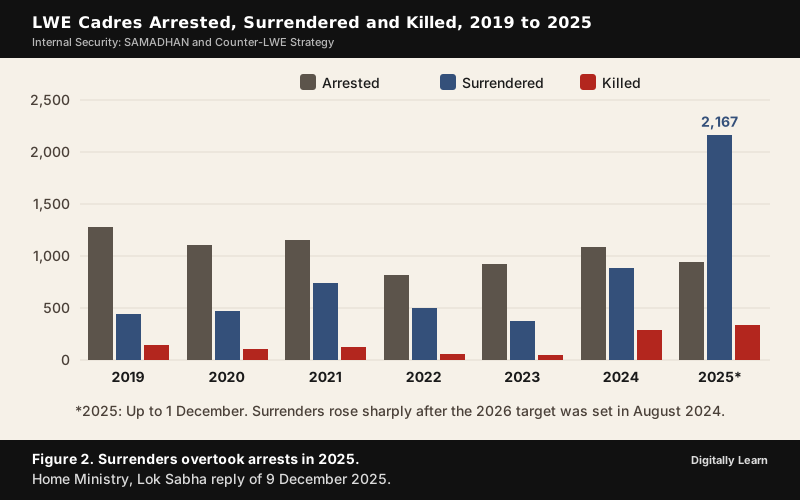
The results are visible in the yearly figures released by the Ministry of Home Affairs. Surrenders were 440 in 2019 and stayed between 376 and 736 until 2023; they rose to 881 in 2024 and 2,167 in 2025 up to 1 December. Arrests stayed between 816 and 1,276 a year. Cadres killed in operations numbered 50 in 2023, 290 in 2024 and 335 in 2025 up to 1 December. Surrenders and operations rose together from 2024, the year in which the deadline was announced, which suggests that rehabilitation worked alongside operations and intelligence.
Operations of 2024 to 2026 and Leadership Losses of the CPI (Maoist)
The Centre announced on 24 August 2024 that Naxalism would be ended by 31 March 2026. The CPI (Maoist) was formed in 2004 by the merger of the People's War Group and the Maoist Communist Centre, and has been banned as a terrorist organisation under the Unlawful Activities (Prevention) Act since 22 June 2009.
In April and May 2025 a 21-day operation in the Karregutta hills on the border of Chhattisgarh and Telangana, named Operation Black Forest, dismantled a Maoist base; more than 30 Maoists were killed. On 21 May 2025 the party's General Secretary, Nambala Keshava Rao, known as Basavaraju, was among those killed in Abujhmad in Chhattisgarh.
The Home Minister told the Lok Sabha on 30 March 2026 that at the beginning of 2024 the party had 21 members in the Central Committee and Politburo. Of these, one had been arrested, seven had surrendered and 12 had been killed, and talks were under way with the one member who was absconding. He added that 706 Maoists were killed in encounters, 2,218 were arrested and a large number surrendered between 2024 and March 2026. The government's position, stated in the same reply, was that dialogue is held only with those who surrender their weapons.
The government's method has three parts: Dialogue, security and coordination. Some Maoist cadres were still active in mid-2026. On 28 and 29 July 2026, 16 active Maoists surrendered in Ranchi and eight in Bijapur, and a Politburo member was arrested near the Dhanbad-Giridih border.
Rights Concerns: Salwa Judum Judgment and Civilian Safety
Security policy must conform to the law. The most frequently cited case is Nandini Sundar v State of Chhattisgarh, decided by the Supreme Court on 5 July 2011 (reported at (2011) 7 SCC 547). Salwa Judum was a state-backed anti-Naxal movement of local tribal youth that began in Chhattisgarh in 2005; many of these young people were appointed Special Police Officers (SPOs). In paragraph 90 of the judgment the Court gave five directions:
- Use of SPOs: Chhattisgarh must cease and desist from using SPOs in any activity aimed at countering Maoist or Naxalite activity.
- Central funding: The Union must stop using its funds to support recruitment of SPOs for counter-insurgency.
- Firearms: Chhattisgarh must make every effort to recall all firearms issued to current and former SPOs.
- Protection of former SPOs: Chhattisgarh must arrange security for those previously employed as SPOs.
- Private groups: Chhattisgarh must take measures to prevent the operation of any group, including Salwa Judum and Koya Commandos, that takes the law into private hands or violates human rights.
In paragraph 95 of the same judgment the Court directed the Central Bureau of Investigation to take over the investigation of violence in March 2011 in Morpalli, Tadmetla and Timmapuram villages of Dantewada. Chhattisgarh then passed the Chhattisgarh Auxiliary Armed Police Force Act, 2011, and the petitioners argued that passing this law was itself contempt of the 2011 judgment. On 15 May 2025 a two-judge bench disposed of the writ petitions and the contempt petition, holding that making a law is not by itself contempt of court and that the Act's validity must be challenged in the manner known to law.
The judgment points counter-insurgency towards regular, trained and accountable forces rather than armed civilians, and towards the protection of civilians, who are the main victims of LWE. Maoists often brand the tribal villagers they kill as "police informers".
Holding Cleared Areas After Left-Wing Extremism
Legacy and Thrust Districts and the Risk of Revival
Once the districts were cleared, the Ministry of Home Affairs created two categories to prevent a relapse. Legacy and Thrust districts are no longer LWE-affected but need security and development support for some time to consolidate the position. In this 2026 classification the name District of Concern took a new meaning. It now denotes a district where violent activity has been fully contained and the Maoist organisation dismantled, but where surveillance continues to prevent any relapse. Under the SRE scheme there were 27 Legacy and Thrust districts in December 2025; in July 2026 there were 37, together with one District of Concern.
The earlier record shows that the risk is real. In 2018 the Ministry noted that some new districts had emerged as the focus of expansion by Left-Wing Extremist groups, and three districts of Kerala were pre-emptively included in the SRE list to counter Maoist efforts at the tri-junction of Kerala, Karnataka and Tamil Nadu. The emerging issues are a possible revival in legacy areas, the opening of new areas, the rehabilitation of surrendered cadres, and the trust deficit between the state and tribal communities.
Governance Tasks That Decide Lasting Peace
The Ministry of Home Affairs has set five tasks for the period after LWE: Saturation of government welfare programmes, strengthening of local self-governance, rehabilitation of surrendered cadres, preservation of tribal identity and culture, and expansion of public services into remote areas. The Ministry is planning jointly with the Ministry of Panchayati Raj, and an independent survey has been conducted in seven formerly LWE-affected districts of Chhattisgarh to assess how far welfare schemes have reached the people.
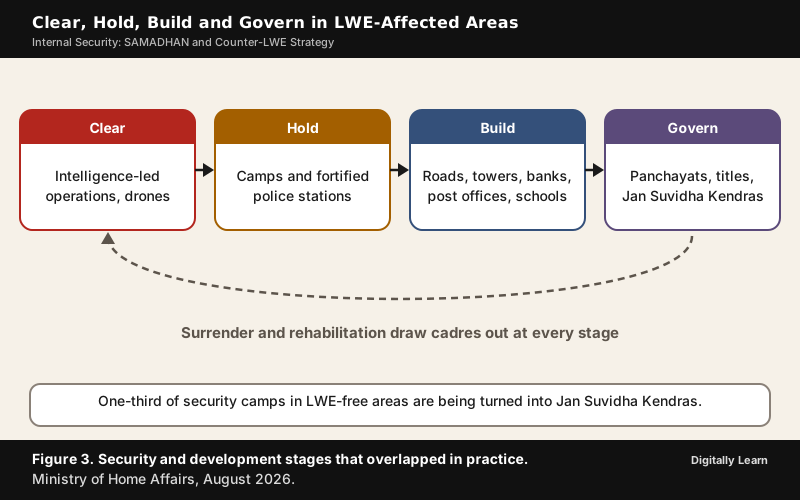
Security infrastructure is being repurposed for governance. One-third of the security camps in LWE-free areas are being converted into Jan Suvidha Kendras that offer livelihood promotion, skill development, access to schemes, digital services and healthcare. The first was the Shaheed Veer Gundadhur Seva Dera Kendra at Netanar, near Jagdalpur, launched in May 2026 as part of a plan to convert about 70 CAPF camps in Bastar into service centres. Cultural events such as Bastar Pandum and the Bastar Olympics aim to bring tribal youth into the mainstream.
The sequence runs clear, hold, build and govern. Operations clear an area, camps and fortified police stations hold it, roads, towers, banks and schools build the presence of the state, and panchayats and service centres govern it. In practice the stages overlapped and reinforced one another.
Previous Year UPSC‑CSE Questions
Each question comes with an answer outline.
- UPSC Mains 2025 GS‑IIIThe Government of India recently stated that Left Wing Extremism (LWE) will be eliminated by 2026. What do you understand by LWE and how are the people affected by it? What measures have been taken by the government to eliminate LWE?
Answer outline
The outline sets out what the question asks, the main arguments, relevant examples and the direction of the conclusion; it is not a full model answer.
Introduction: LWE is an armed rebellion, inspired by Maoist ideology, that began at Naxalbari in 1967; the CPI (Maoist) was formed in 2004.
Body (sub-themes to develop):
- Effects: Civilians, mostly tribals, killed as alleged informers; schools, roads and towers destroyed; development stalled.
- Measures: The 2015 Policy, SAMADHAN, SRE, SIS and SCA, fortified stations and camps, roads, towers, Eklavya schools, the surrender policy and NIA action on funding.
Conclusion: No district was classed as LWE-affected by March-April 2026, with 37 Legacy and Thrust districts still under watch.
- UPSC Mains 2022 GS‑IIINaxalism is a social, economic and developmental issue manifesting as a violent internal security threat. In this context, discuss the emerging issues and suggest a multilayered strategy to tackle the menace of Naxalism.
Answer outline
Introduction: Naxalism draws on social and economic grievances but is fought as an armed threat to the state.
Body (sub-themes to develop):
- Emerging issues: Revival risk in cleared areas, new geographies such as the Kerala, Karnataka and Tamil Nadu tri-junction, rehabilitation of surrendered cadres, the trust deficit, rights concerns after Salwa Judum.
- Layers: Security (SAMADHAN, fortified stations, joint task forces, technology), finance (NIA and ED against funding), development (roads, towers, schools, banks), rights (title deeds, Tribal Youth Exchange) and governance (panchayats, Jan Suvidha Kendras).
Conclusion: A strategy that clears, holds, builds and governs prevents relapse.
- UPSC Mains 2020 GS‑IIIWhat are the determinants of left-wing extremism in Eastern part of India? What strategy should Government of India, civil administration and security forces adopt to counter the threat in the affected areas?
Answer outline
Introduction: LWE took hold in the forested tribal districts of eastern and central India where the reach of the state was weak.
Body (sub-themes to develop):
- Determinants: Backwardness and weak infrastructure; grievances over forest land and produce and over mining and hydropower benefits; difficult terrain; Maoist ideology and funding.
- Government of India: The 2015 Policy, CAPFs, SRE, SIS and SCA funds, the NIA vertical on financing, roads and towers.
- Civil administration: Roads, Eklavya schools, banks and post offices, title deeds, panchayats, Jan Suvidha Kendras.
- Security forces: SAMADHAN, Greyhounds-type local units, intelligence-led operations and technology, accountable forces after the Salwa Judum judgment.
Conclusion: Holding the Legacy and Thrust districts decides whether the gains last.
- UPSC Mains 2018 GS‑IIILeft Wing Extremism (LWE) is showing a downward trend, but still affects many parts of the country. Briefly explain the Government of India's approach to counter the challenges posed by LWE.
Answer outline
Introduction: The National Policy and Action Plan of 2015 combines security measures, development interventions and the rights of local communities.
Body (sub-themes to develop):
- Security: CAPF and India Reserve battalions, fortified police stations, SRE and SIS funding, SAMADHAN with its eight elements.
- Development: RRP and RCPLWEA roads, mobile towers, Eklavya schools and skill centres, SCA for the most affected districts.
- Rights and rehabilitation: Title deeds, the Media Plan and the surrender-cum-rehabilitation package.
Conclusion: Affected districts fell from 126 to zero by March-April 2026.
Sources
- Press Information Bureau: Home Minister gives new doctrine of SAMADHAN for security operations (8 May 2017)
- Press Information Bureau: Home Minister addresses the review meeting of LWE-affected States (8 May 2017)
- Press Information Bureau: Achievements and key initiatives of the Home Ministry in three years (3 June 2017)
- Press Information Bureau: Year End Review 2017, Ministry of Home Affairs (28 December 2017)
- Press Information Bureau: Government's new policy paying dividends in containing LWE (16 April 2018)
- Press Information Bureau: National Policy to Combat Left Wing Extremism (7 February 2024)
- Press Information Bureau: India's Decisive Battle Against Left Wing Extremism (10 April 2025)
- Press Information Bureau: Curbing Naxalism (12 August 2025)
- Press Information Bureau: Scheme related to security infrastructure in LWE affected areas (9 December 2025)
- Press Information Bureau: Home Minister's reply in the Lok Sabha (30 March 2026)
- Press Information Bureau: Status of Naxalism in the Country, Rajya Sabha reply (29 July 2026)
- Press Information Bureau: Naxal-Free India, Integrated Strategies Defeated Left-Wing Extremism (1 August 2026)
- Supreme Court of India: Order of 15 May 2025 in Nandini Sundar v State of Chhattisgarh, quoting paragraphs 90 to 96 of the judgment of 5 July 2011
- Press Information Bureau: Pradhan Mantri Gram Sadak Yojana, Enhancing Rural Connectivity (September 2025)
- NCERT: Class 12 Politics in India since Independence, Chapter 6
- Wikipedia: Salwa Judum
- Wikipedia: Greyhounds (police)
- Wikipedia: Bastariya Battalion
- Wikipedia: Forest Rights Act
- Wikipedia: Naxalite-Maoist insurgency
- Wikipedia: Communist Party of India (Maoist)
- UPSC: Civil Services Examination question papers
Editorial Disclaimer
This article draws on Home Ministry releases, the Supreme Court's orders and Wikipedia. Scheme and district figures are as the dated official releases give them.
See more of our UPSC articles in Google Search
Add to Preferred Sources

