

Overview

The Chalcolithic Age, or Copper Age, is the stage of Indian prehistory in which farming communities used copper alongside stone tools; in India it covers the Ahar-Banas, Kayatha, Malwa and Jorwe cultures of Rajasthan, central India and the Deccan, from about 3000 BCE to about 700 BCE, and it was followed in the south by the megalithic culture of iron-using people.
Chalcolithic Age: The Copper Age in India
Chalcolithic Age Time Period and Meaning of the Copper Age
The word joins two Greek words, khalkos, copper, and lithos, stone, and is pronounced KAL-kuh-LI-thik. Writers began to use it in place of Eneolithic around 1900. The age followed the Neolithic and came before the Bronze Age, and even in it stone tools were still the ones most used.
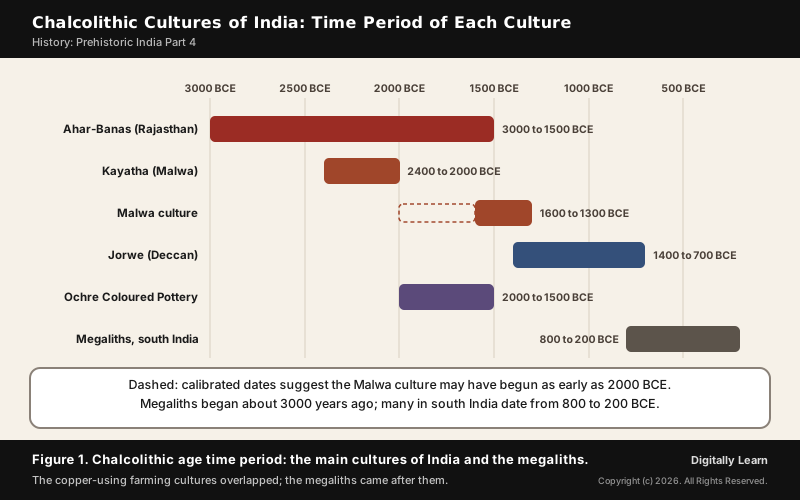
In India the Chalcolithic flourished mainly in four farming communities: Ahar or Banas, Kayatha, Malwa and Jorwe. They shared painted pottery and the use of copper, but each had its own tradition of pottery design, and their dates overlap.
| Culture and region | Time period | Pottery |
|---|---|---|
| Ahar-Banas: south-eastern Rajasthan | About 3000 to 1500 BCE | Black-and-red, white designs |
| Kayatha: Malwa, near Ujjain | About 2400 to 2000 BCE | Painted in brown |
| Malwa: central India, parts of Maharashtra | About 1600 to 1300 BCE | Red or orange, black designs |
| Jorwe: Maharashtra, into Malwa | About 1400 to 700 BCE | Red and orange, black geometric |
Chalcolithic Age Tools, Pottery and Houses
Copper was the new metal, but stone did most of the work. The Ahar-Banas people used the copper ores of the Aravalli range to make axes; at Navdatoli on the Narmada more than 30,000 blades, cores and flakes of chalcedony were found, and each household seems to have made its own tools.
- Metal work: Kayatha had advanced copper metallurgy and a stone blade industry; Daimabad had part of a copper-smelting furnace and a coppersmith’s workshop with a copper razor.
- Pottery: Ahar’s black-and-red ware carried white linear and dotted designs; Malwa ware was red or orange painted in black with geometric, floral, animal and human designs; Jorwe ware was red and orange with black geometric patterns.
- Houses: Malwa people mostly lived in round wattle-and-daub huts, with small round huts for storing grain; Gilund in Rajasthan had mud-brick houses with clay-lined ovens and storage pits.
Houses at Navdatoli had lime on their floors and walls to keep insects out, a fireplace, and a stone slab for grinding grain. In the Jorwe villages most people lived in small single-room houses, while chiefs lived in large houses with several rooms and granaries.
Chalcolithic Culture and Chalcolithic Sites in India
Ahar-Banas Culture: Gilund, the Largest Chalcolithic Site, and Balathal
The Ahar-Banas culture grew on the banks of the Ahar, Banas and Berach rivers in south-eastern Rajasthan, from about 3000 to 1500 BCE. More than 90 of its sites are known; its people grew wheat and barley and made axes from Aravalli copper. Its typical black-and-red ware once gave it the name black and red ware culture.

- Gilund: Locally called Modiya Magari, the bald habitation mound; excavated by B. B. Lal in 1959-60; mud-brick and burnt-brick structures, humped bull figurines, and a cache of more than 100 seal impressions found in 2003 and dated to 2100-1700 BCE.
- Balathal: In Udaipur district; discovered by V. N. Misra in 1962-63 and excavated from 1994 to 2000; a well-fortified settlement with wheat, barley, sheep, goat and cattle, and the earliest evidence of leprosy in the Indian subcontinent.
- Ganeshwar: In Sikar district near the Khetri copper belt, dated to about 2500-2000 BCE; nearly one thousand pieces of copper, arrowheads, spearheads, fish hooks and bangles; it supplied copper objects to Harappa.
Kayatha and Malwa Cultures: Chalcolithic Sites of Central India
Kayatha, in the Ujjain district on the Choti Kali Sindh river, is the type site of the Kayatha culture, discovered by V. S. Wakankar in 1964. It is the earliest known farming settlement in the present-day Malwa region, and its layers run from the Kayatha culture through the Ahar and Malwa cultures to the early historical period.
- Farming: The Malwa people grew wheat, barley, legumes and later rice, and kept cattle, sheep, goats and pigs.
- Settlements: Most had no planning, but some of the largest sites had planned layouts, large houses and public buildings.
- Beliefs: Bull idols, the worship of trees, snakes and goddesses, and altars for fire sacrifices.
- Sites: Kayatha, Nagda, Vidisha, Eran, Mandsaur and Navdatoli, and in Maharashtra Daimabad and Inamgaon.
Navdatoli, across the Narmada from Maheshwar, was excavated by the Deccan College between 1957 and 1959. Its four stages are each marked by their own pottery, and its households made long blades of chalcedony from the river bed. Objects of sea shell at Malwa sites point to trade with the coast of Gujarat, such as Bharuch.
Jorwe Culture and Daimabad: Chalcolithic Culture of the Deccan
The Jorwe culture spread over large parts of Maharashtra and reached north into Malwa. More than 200 settlements are known, from large farming villages to seasonal camps of herders, which points to a chiefdom, a society led by chiefs. Its people traded with Karnataka for gold and ivory, and with Gujarat and the Konkan for fish, conch shell and haematite.
- Daimabad: On the Pravara, a tributary of the Godavari; excavated by the Archaeological Survey of India in 1958-59, 1974-75 and 1975-79; five phases, Savalda, late Harappan, buff-and-cream ware, Malwa and Jorwe.
- Harappan link: Two terracotta button seals and three potsherds with Harappan symbols in the second phase; the Malwa phase has a religious complex with fire altars and a mud platform.
- Bronze hoard: A chariot yoked to two oxen, a buffalo, an elephant and a rhinoceros, found by a farmer in 1974; their date is disputed, since they contain more than 10 per cent arsenic.
- Prakash: At the meeting of the Tapti and the Gomai, excavated by B. K. Thapar in 1955; its first period, about 1700-1300 BCE, is Chalcolithic.
The Jorwe dead were usually buried in urns under house floors or courtyards, with the feet cut off. Most Jorwe sites were abandoned around 1000 BCE, possibly because of famine or drought, and the culture was followed by the Iron Age megalithic culture of the Deccan.
Inamgaon: Life in a Chalcolithic Village of the Deccan
Inamgaon, on the river Ghod, a tributary of the Bhima, was occupied between 3600 and 2700 years ago and is one of the most thoroughly excavated Chalcolithic sites of the Deccan, with Malwa, early Jorwe and late Jorwe phases. Adults were usually buried straight, head to the north, sometimes within the houses, with vessels of food and water.
- Chief’s burial: One man was buried cross-legged in a large four-legged clay jar in the courtyard of a five-roomed house with a granary, one of the largest houses, in the centre of the settlement.
- Crops: Seeds of wheat, barley, rice, pulses, millets, peas and sesame.
- Animals: Cattle, buffalo, goat, sheep, dog, horse, ass and pig, with deer, antelope, hare, birds, crocodile, turtle, crab and fish; many bones carry cut marks from use as food.
- Wild food: Ber, amla, jamun, dates and berries were collected.
Ochre Coloured Pottery, Copper Hoards and Sinauli: Chalcolithic Sites of North India
In the Ganga-Yamuna doab and its west, the Ochre Coloured Pottery culture is generally dated to 2000-1500 BCE, from eastern Punjab to north-eastern Rajasthan and western Uttar Pradesh. Its pottery had a red slip that left an ochre colour on the fingers of the excavators, which gave the culture its name; its villages grew rice, barley and legumes in houses of wattle and daub.
- Copper hoards: Caches of copper objects, mainly in the western Ganga-Yamuna doab, from the first half of the second millennium BCE: flat axes, harpoons, double axes and swords with antenna grips.
- Ores: The copper came from Khetri in Rajasthan, southern Haryana, Singhbhum in the east and Malanjkhand in Madhya Pradesh; the objects are 78 to 99 per cent copper.
- Sinauli, Uttar Pradesh: Excavated by the Archaeological Survey of India in 2005-06 and 2018; more than a hundred burials dated to about 1865-1507 BCE, copper swords and wooden carts with solid wheels.
- Pandu Rajar Dhibi, West Bengal: On the south bank of the Ajay, about 2000-1600 BCE, the Chalcolithic site of the east.
The Sinauli carts were first presented as chariots, but several scholars point out that solid wheels belong to carts. The burials are linked with the Ochre Coloured Pottery and copper hoard cultures, which lived at the same time as the Late Harappan culture.
Features of Chalcolithic Age: Farming, Trade, Beliefs and Decline
- Villages of farmers: Mixed farming and herding in river valleys; most sites were villages, a few large and planned.
- Copper with stone: Copper for axes, rings and arrowheads, but stone blades and microliths still in daily use.
- Painted pottery: Each culture known by its ware, from Ahar’s black-and-red to Jorwe’s black-on-red.
- Trade: Shell from Gujarat, gold and ivory from Karnataka, copper from the Aravalli to Harappa.
- Beliefs: Bull figures, goddesses and fire altars; burials under house floors.
The age ended in the Deccan with decline and abandonment around 1000 BCE, and the megalithic culture and iron followed. The earlier farming villages are the subject of Part 3: the Neolithic Age in India, and the cities these cultures lived beside are traced in the Indus Valley Civilisation.
Megalithic Culture in India
What Is Megalithic Culture? Meaning, Spread and Time Period
The practice of erecting megaliths began about 3000 years ago and spread through the Deccan, south India, the north-east and Kashmir. Megaliths are also reported from the Vindhyas and the north-west, but the heaviest concentrations are in central and peninsular south India, where they emerged from the first millennium BCE, often with a rich range of iron tools and weapons.
Some megaliths stand on the surface, while other megalithic burials lie underground, marked only by a circle of boulders or a single standing stone. Their roots go back to the Neolithic and Chalcolithic, as the urn burials of Inamgaon show, and Burzahom's standing stones followed its Neolithic phase.
Types of Megaliths: Cist, Dolmen, Menhir, Stone Circle and Urn Burial
Megaliths come in many forms. Scholars divide them into sepulchral monuments, which hold the remains of the dead, and non-sepulchral ones, such as large patterned placements of stones over a wide area.
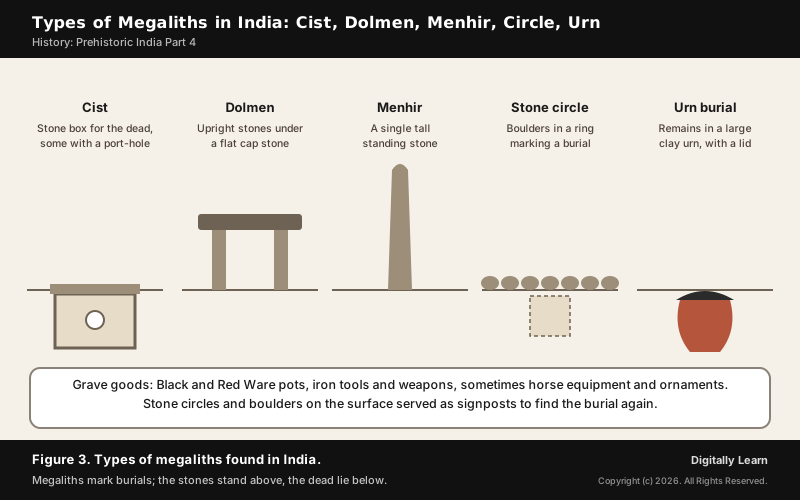
- Cist: A stone box for the dead; some have port-holes used as an entrance, through which those who died later were brought into the same grave.
- Dolmen: Upright stones under a flat cap stone; at Marayoor in Kerala the Iron Age dolmens, called muniyaras, are made of four stones on edge covered by a fifth, the cap stone.
- Menhir: A single tall standing stone, common in Karnataka, Andhra Pradesh and Kerala.
- Stone circle: Boulders in a ring around a burial, as at Mangadu near Kollam.
- Urn burial: The remains placed in a large clay urn, as at Adichanallur and Mangadu.
- Kerala forms: The topikal and the kodaikal are types associated with Kerala.
Megalithic Burials: Iron, Black and Red Ware and Differences in Status
Megalithic burials share common features. The dead were generally buried with distinctive pots called Black and Red Ware, with tools and weapons of iron and sometimes skeletons of horses, horse equipment and ornaments of stone and gold.
- Differences in status: At Brahmagiri one skeleton was buried with 33 gold beads, 2 stone beads, 4 copper bangles and a conch shell, while others had only a few pots.
- Family graves: Some megaliths hold more than one skeleton, perhaps of one family, buried at different times.
- Signposts: Stone circles or boulders on the surface helped people return to the same burial place.
Megalithic Sites in South India: Brahmagiri, Hire Benakal, Maski, Mudumal and Mangadu
- Brahmagiri, Karnataka: Excavated by Mortimer Wheeler in 1947; about 300 tombs in rectangular cists, cist-circles and pit-circles; its iron sickles, spears, swords and arrowheads helped fix the culture sequence of south Indian prehistory.
- Hire Benakal, Karnataka: In Koppal district, protected by the Archaeological Survey of India; almost 1000 megalithic structures, dominated by giant port-holed dolmens, and 11 painted rock shelters.
- Maski, Karnataka: In Raichur district, excavated by Amalananda Ghosh in 1954; iron arrives in its second period with five forms of burial.
- Mudumal, Telangana: Near the Krishna in Narayanapet district; menhirs aligned with sunrise and sunset at the solstices, and a rock with cup marks copying the Great Bear, Ursa Major.
- Adichanallur, Tamil Nadu: In Thoothukudi district; about 169 clay urns with skeletons found in 2005, some with writing in Tamil-Brahmi.
- Mangadu, Kerala: The Madankavu urn-burial site near Kollam; 28 laterite blocks in three circles, twelve large urns, Black and Red Ware, and 30 carnelian beads, 20 of them etched.
Mangadu also shows who built the megaliths. Its iron objects are wedges, knives, sickles and blades, with no war weapons such as spears or tridents, so its builders were mainly farmers; charcoal from one urn gave a date of 900 BCE.
Megalithic Culture and the Iron Age in South India
In India the Iron Age followed the Bronze Age and partly matches the megalithic cultures of south India; iron is one of the marks of the megaliths, especially in Kerala. The more securely dated early Iron Age sites of the south, Hallur in Karnataka and Adichanallur in Tamil Nadu, belong to about 1000 BCE.
- Hallur: The move to the Iron Age took place between 1200 and 1000 BCE.
- Kodumanal, Tamil Nadu: The earliest reliably dated iron furnace in Tamil Nadu, of the 5th century BCE.
- Sivagalai, Tamil Nadu: Claims of iron smelting as early as the mid-4th millennium BCE rest on charcoal dates and are disputed.
Previous Year UPSC-CSE Questions
Previous Year UPSC-CSE Questions By the end you will be able to draft model answers for the following UPSC questions. Each question carries a collapsible framework showing how to approach it in the exam.
- UPSC Mains 2023 GS-IExplain the role of geographical factors towards the development of Ancient India.
How to structure the answer in the exam
Introduction: Introduce geography as the setting that decided where early Indian communities settled and what they could make.
Body (sub-themes to develop):
- Rivers: Banas, Berach, Narmada, Pravara and Ghod valleys hold the Chalcolithic villages.
- Minerals: Aravalli and Khetri copper made Ahar and Ganeshwar metal centres supplying Harappa.
- Soils and stone: black soil at Daimabad, chalcedony at Navdatoli, laterite and granite for south Indian megaliths.
- Climate: drought or famine as a likely cause of the Jorwe abandonment around 1000 BCE.
Conclusion: Conclude that geography set the frame, while trade and technology let communities go beyond it.
- UPSC Prelims 2024 Prelims-GSConsider the following information: Archaeological Site – State – Description
- Chandraketugarh – Odisha – Trading Port town
- Inamgaon – Maharashtra – Chalcolithic site
- Mangadu – Kerala – Megalithic site
- Salihundam – Andhra Pradesh – Rock-cut cave shrines
In which of the above rows is the given information correctly matched?
How to approach this Prelims question
Approach: Check the state and the description in each row separately.
Trap to watch: A correct description can sit with a wrong state, as with Chandraketugarh.
Key facts to recall:
- Inamgaon: Chalcolithic, Maharashtra
- Mangadu: megalithic urn burials, Kerala
- Chandraketugarh: West Bengal
- Salihundam: Buddhist stupas, Andhra Pradesh
Answer signal: Rows 2 and 3 correct: option (b), the official answer.
- UPSC Prelims 2021 Prelims-GSConsider the following pairs: (Historical place) : (Well-known for)
- Burzahom : Rock-cut shrines
- Chandraketugarh : Terracotta art
- Ganeshwar : Copper artefacts
Which of the pairs given above is/are correctly matched?
How to approach this Prelims question
Approach: Check each pair on its own against what the site is best known for.
Trap to watch: Burzahom is a Neolithic site of pit dwellings and menhirs; it has no rock-cut shrines.
Key facts to recall:
- Ganeshwar: copper objects, Khetri copper belt
- Chandraketugarh: terracotta art
- Burzahom: Neolithic pit dwellings
Answer signal: Pairs 2 and 3 correct: option (d), the official answer.
Sources
- NCERT: Our Pasts I (Class VI), What Books and Burials Tell Us
- NCERT: Themes in Indian History I (Class XII), Kings, Farmers and Towns
- Archaeological Survey of India: Excavations, Important, Maharashtra
- Archaeological Survey of India: Excavations, Important, Rajasthan
- Kerala Department of Archaeology: Madankavu urn-burial site, Mangad
- UNESCO World Heritage Centre: Hire Benkal, Megalithic Site (Tentative List)
- UNESCO World Heritage Centre: Mudumal Megalithic Menhirs (Tentative List)
- Wikipedia: Chalcolithic
- Wikipedia: Ahar–Banas culture
- Wikipedia: Gilund
- Wikipedia: Balathal
- Wikipedia: Ganeshwar
- Wikipedia: Kayatha
- Wikipedia: Malwa culture
- Wikipedia: Navdatoli
- Wikipedia: Jorwe culture
- Wikipedia: Daimabad
- Wikipedia: Inamgaon
- Wikipedia: Ochre Coloured Pottery culture
- Wikipedia: Copper Hoard culture
- Wikipedia: Sanauli
- Wikipedia: Megalith
- Wikipedia: Dolmen
- Wikipedia: Brahmagiri archaeological site
- Wikipedia: Hire Benakal
- Wikipedia: Maski
- Wikipedia: Adichanallur
- Wikipedia: Iron Age in India
- Wikipedia: Hallur
- Wikipedia: Chandraketugarh
- Wikipedia: Salihundam
- UPSC: Civil Services Examination question papers
Editorial Disclaimer
This article draws on the NCERT textbooks and the other sources listed on this page. Dates for prehistoric sites are revised as new methods are applied.


