

Overview

The Neolithic Age, or New Stone Age, is the period of Indian prehistory from about 10,000 years ago in which people polished their stone tools, took up farming and herding, made pottery and settled in villages; it began at Mehrgarh in the north-west and reached Kashmir, the south, the Ganga plain and the north-east much later.
Neolithic Age: The New Stone Age in India
Neolithic Age Time Period in India: When Farming Began
The name comes from Greek: neos means new and lithos means stone. The term Neolithic was coined by John Lubbock in 1865, and the feature that marks the age is the polished or ground stone tool, in contrast to the flaked stone tools of the Palaeolithic.
The age did not begin at the same time everywhere in the subcontinent. The earliest farming villages appear in the north-west, and farming reached Kashmir, the south, the Ganga plain and the north-east much later.
- North-west: Mehrgarh, near the Bolan Pass, from about 7000 BCE; settled life in South Asia began here, in Balochistan.
- Kashmir: Burzahom, with phases between 3000 BCE and 1000 BCE.
- South India: From about 3000 BCE, with ash mounds in the Andhra-Karnataka region from 2500 BCE.
- Ganga plain: Clear farming villages after the middle of the third millennium BCE, and mainly after 2000 BCE.
- North-east: Daojali Hading in Assam, dated to about 2,700 years before the present.
Neolithic Revolution: Meaning and the Domestication of Plants and Animals
The Neolithic revolution, also called the First Agricultural Revolution, was the move from hunting and gathering to farming and settled life. People had watched where edible plants grew and how fallen seeds sprouted; they began to protect plants from birds and animals until the seeds ripened, and so became farmers.
Animals were tamed in the same way. The first animal to be tamed was the wild ancestor of the dog; later, people encouraged gentler animals such as sheep, goat, cattle and the pig, which lived in herds and mostly ate grass, to come near their camps, and protected them from wild animals. In this way they became herders.
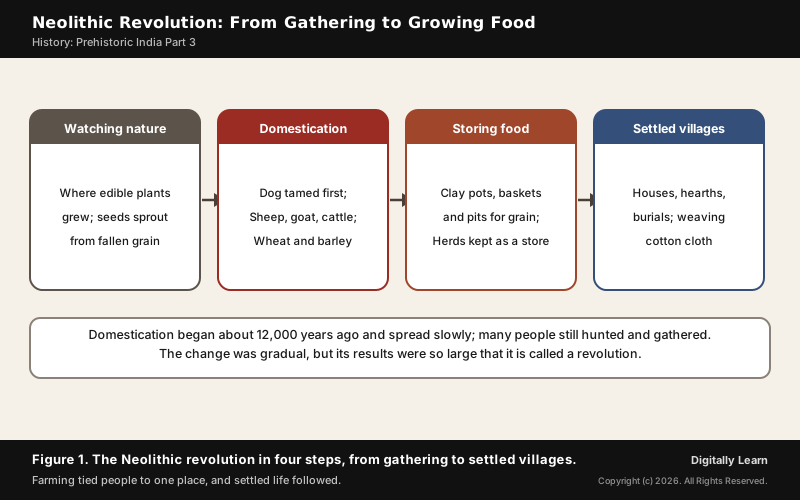
The process in which people grow plants and look after animals is called domestication. People chose plants that resisted disease, gave large grain and had strong stalks, and bred the gentler animals; over time domesticated plants and animals became different from wild ones, and the teeth and horns of wild animals are usually much larger. Domestication began about 12,000 years ago; wheat and barley were among the earliest crops, and sheep and goat among the earliest domesticated animals.
Difference Between Mesolithic and Neolithic Age
The two ages differ most in how people got their food. Mesolithic people were hunters, fishers and gatherers who used microliths and were only beginning to herd; Neolithic people grew crops, kept animals and lived in villages, though older tools and hunting did not disappear. The earlier age is covered in Part 2: the Mesolithic Age in India.
| Feature | Mesolithic | Neolithic |
|---|---|---|
| Time | 12,000 to 10,000 years ago | From about 10,000 years ago |
| Tools | Microliths in handles | Polished stone axes, mortars and pestles |
| Food | Hunting, fishing, gathering | Farming and herding, with some hunting |
| Settlement | Camps, some longer stays | Villages with houses |
| Pottery | At a few late sites | Common, for storing and cooking |
Neolithic Age Tools, Pottery and Houses
Neolithic Age Tools: Polished Stone Axes, Celts, Mortars and Pestles
Many Neolithic tools differ from the earlier Palaeolithic ones, which is why the age has its name. They include tools polished to give a fine cutting edge, and mortars and pestles for grinding grain and other plant produce; mortars and pestles are still used for grinding grain several thousand years later. Tools of the Palaeolithic types went on being made, and some tools were made of bone.
- Celts: Long, thin stone tools like an adze, hoe or axe; at Chirand in Bihar the axes are of quartzite, basalt and granite, and at Brahmagiri in Karnataka of dolerite.
- Grinding tools: Mortars and pestles, found for example at Daojali Hading in Assam, show that people were growing grain and preparing food from it.
- Bone and antler: Burzahom in Kashmir has polished bone tools and tools of antler and horn.
- Later additions: At Burzahom, harvesters, celts, spindle whorls, spear-heads and copper arrowheads appear in the later Neolithic phase.
- Microliths: Still made; Chirand has nine types.
The polished stone axe mattered most. It allowed forest to be cleared on a large scale, and with the adze it shaped wood for houses and other structures, so that new land could be farmed.
Neolithic Age Pottery: Handmade Grey Ware to Cord-Marked Pots
Earthen pots of many kinds have been found at Neolithic sites. They were sometimes decorated and were used for storing things and for cooking food, especially grains like rice, wheat and lentils, which now became an important part of the diet. Grain was also kept in baskets and in pits dug into the ground.
- Burzahom, Kashmir: Handmade thick coarse grey ware, fine grey ware and gritty dull red ware; globular jars and basins, some with mat impressions; burnished grey ware appears later.
- Chirand, Bihar: Mostly handmade; half red ware and half black-and-red ware.
- Sanganakallu, Karnataka: Usually dull brown or black, handmade from coarse clay.
- Daojali Hading, Assam: Cord-marked pottery, rare in the Indian Neolithic, which suggests links with East and South-east Asia.
Neolithic Age Houses: Pit Dwellings, Mud-Brick Rooms and Wattle Huts
Settled life shows in the remains of houses. At Burzahom in Kashmir people built pit-houses, dug into the ground with steps leading into them, which may have given shelter in cold weather; cooking hearths inside and outside the huts suggest that food was cooked indoors or outdoors depending on the weather.
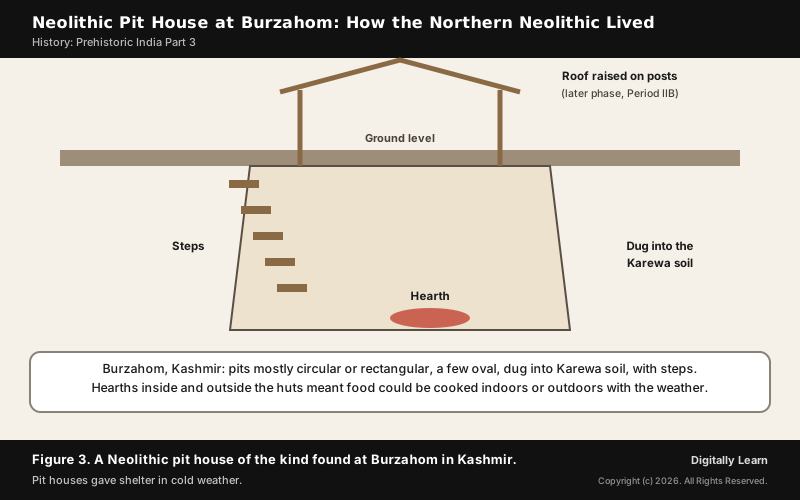
- Burzahom: Dwelling pits mostly circular or rectangular, a few oval, dug into Karewa soil; later the roofs were raised above the ground, and post holes show much use of timber.
- Mehrgarh: Square or rectangular houses of unbaked mud-brick, each with four or more compartments, some perhaps for storage.
- Chirand: Circular wattle-and-daub huts of mud and reeds; the earlier floors lay below ground level and the later ones at ground level.
- Hallur and Sanganakallu, Karnataka: Circular houses with walls of bamboo and mud or clay; at Hallur the walls held up a conical thatched roof.
Neolithic Sites in India
Mehrgarh: Oldest Neolithic Site of the Indian Subcontinent
Mehrgarh lies in a fertile plain near the Bolan Pass, one of the most important routes into Iran. It was probably one of the places where people first learnt to grow barley and wheat and to rear sheep and goats in this area, and it is one of the earliest villages known. The site was discovered in 1974 by a French mission led by Jean-Francois Jarrige and Catherine Jarrige.

- Animal bones: The earliest levels have bones of wild animals such as deer and pig; later levels have more sheep and goat, and still later levels mostly cattle.
- Burials: In one grave the dead person was buried with goats, probably meant as food in the next world.
- Tools: Ground stone axes from Mehrgarh are the earliest from a stratified context in South Asia.
- Teeth: Drilled molars show the oldest known evidence of drilling a living person’s teeth.
Burzahom and Gufkral: Northern Neolithic Sites of Kashmir
Burzahom lies 16 kilometres north-west of Srinagar and is the northernmost excavated Neolithic site of India; its name comes from burz, the Kashmiri word for birch. It was discovered in 1935 by H. De Terra and T. T. Paterson and excavated from 1960 to 1971 under T. N. Khazanchi of the Archaeological Survey of India. Its distinctive culture is called the Northern Neolithic.
- First phase (aceramic): Underground dwelling pits, polished bone and stone tools, and a life of both food gathering and cereal farming.
- Second phase: Handmade pottery; the dog, sheep and goat domesticated; more pits, a sign of a growing population.
- Later Neolithic: Harvesters, spindle whorls and copper arrowheads; beads and pendants that show contact with the regions of Pakistan and the Tibetan Plateau.
- Burials and crops: Dogs and antlered deer buried with humans, some skulls with bored holes; wheat, barley and lentil grown.
- Megalithic phase: Standing stones called menhirs, with the same way of living otherwise.
Gufkral, near Tral in the Pulwama district, is a related site. Its name means cave of the potter: guf means cave and kral means potter. An Archaeological Survey of India team led by A. K. Sharma excavated it in 1981 and found five periods, from the aceramic Neolithic to the Megalithic; wheat and lentil were grown.
Chirand, Koldihwa and Mahagara: Neolithic Sites of the Ganga Plain
Chirand, in the Saran district of Bihar on the northern bank of the Ganga, has a Neolithic layer dated to about 2500 to 1345 BCE. It was excavated by the Bihar State Directorate of Archaeology in 1962-63 and 1970-71, and has yielded wheat, green gram and barley, bones of buffalo and ox, paddy husk impressions on pottery, and terracotta figures of humped bulls, birds and snakes.
- Koldihwa, Uttar Pradesh: In the Belan valley near Devghat, Prayagraj; rice and fragmentary animal bones; excavated from 1972 to 1976.
- Mahagara, Uttar Pradesh: On the opposite bank of the Belan; rice, and cattle hoof marks on a clay surface that suggest a cattle pen.
- Lahuradewa, Uttar Pradesh: In Sant Kabir Nagar district; very early rice grains whose status, cultivated or gathered wild, is still debated.
The early dates once proposed for rice on the Ganga plain are now disputed. Fresh dating of Koldihwa shows clear occupation only from the later Neolithic, after about 1900 BCE, so clear farming villages in the region belong mainly to the period after 2000 BCE, and the early rice at Lahuradewa may have been gathered from the wild.
Neolithic Sites in South India: Sanganakallu, Piklihal, Hallur and Brahmagiri
The Neolithic of South India began around 3000 BCE, and its special feature is the ash mound, created by the ritual burning of wood, dung and animal matter. Its people herded cattle, sheep and goats and grew millets and pulses.
- Sanganakallu, Karnataka: Near Ballari; a factory site with large numbers of pots, stone axes and tools; small millets and pulses, sheep and cattle, and areas for dumping dung.
- Piklihal, Karnataka: In Raichur district, excavated by F. Raymond Allchin in 1952; cattle herders who set up seasonal camps with cowpens made of posts and stakes.
- Hallur, Karnataka: On the Tungabhadra in Haveri district; browntop millet, black gram and horse gram, and some of the earliest crops of African origin in South India, hyacinth bean and pearl millet.
- Paiyampalli, Tamil Nadu: In Tirupattur district, excavated by S. R. Rao in 1964-65 and 1967-68; black gram and millet.
- Brahmagiri, Karnataka: In Chitradurga district, excavated by Mortimer Wheeler in 1947; polished stone axes of dolerite, and infants buried in urns.
- Tekkalakota, Karnataka: In Ballari district; elaborate gold ear ornaments.
Daojali Hading: Neolithic Site of North-East India
Daojali Hading stands on a low hillock in the Dima Hasao district of Assam, in the hills near the Brahmaputra valley and close to routes leading into China and Myanmar. Excavated in 1961-63 by a team led by M. C. Goswami and T. C. Sharma, it is the first stratified Neolithic site found in North-east India.
- Shouldered celts: Typical of the site, found with its other polished stone tools.
- Cord-marked pottery: Rare elsewhere in the Indian Neolithic.
- Grinding tools: Mortars and pestles, a sign that grain was grown and prepared.
- Jadeite and fossil wood: Jadeite, a stone that may have come from China, and tools of fossil wood, ancient wood that has hardened into stone.
The finds point east rather than west. Cord-marked pottery and shouldered celts suggest links with East and South-east Asia, and the site is dated to about 2,700 years before the present, much later than Mehrgarh.
Life in the Neolithic Age
Neolithic Age Agriculture and Domestication of Animals
Scientists identify Neolithic crops from burnt grain and animal bones found at the sites. Different crops grew in different regions: rice needs more water than wheat and barley, and sheep and goat survive more easily than cattle in dry, hilly country. The table shows grain and bones from some of the Neolithic sites.
| Site (state today) | Grain | Animals |
|---|---|---|
| Mehrgarh (Pakistan) | Wheat, barley | Sheep, goat, cattle |
| Burzahom (Kashmir) | Wheat, lentil | Dog, cattle, sheep, goat, buffalo |
| Gufkral (Kashmir) | Wheat, lentil | Not listed |
| Chirand (Bihar) | Wheat, green gram, barley | Buffalo, ox |
| Koldihwa (Uttar Pradesh) | Rice | Animal bones, broken |
| Mahagara (Uttar Pradesh) | Rice | Cattle (hoof marks) |
| Hallur (Karnataka) | Millet | Cattle, sheep, goat, pig |
| Paiyampalli (Tamil Nadu) | Black gram, millet | Cattle, sheep, pig |
Animals were a store of food: they multiplied naturally and, if looked after, gave milk and, when needed, meat. Grain had to be kept both as food and as seed, so people made large clay pots, wove baskets and dug pits. They also began weaving cloth from cotton, which could now be grown.
Neolithic Age Characteristics: Villages, Tribes and Burials
- Tools: Polished stone axes, mortars and pestles, alongside older tools and bone tools.
- Food: Farming and herding, with hunting and gathering in many areas.
- Settlement: Villages with houses, where most people produced food.
- Crafts: Pottery for storing and cooking, and weaving of cotton cloth.
- Burials: Care for the dead, with goats at Mehrgarh, dogs at Burzahom and urns for infants at Brahmagiri.
Archaeology does not show customs directly, so scholars study present-day farmers and herders, many of whom live in tribes. Two or three generations usually live together; women do most of the farm work, men lead large herds to pasture, and land, forests, grasslands and water are shared as the wealth of the whole tribe, with no sharp gap between rich and poor.
In the north-west the farming culture of the Neolithic villages carried on into the Early Harappan stage and the cities of the Indus Valley Civilisation. The stone tools that came before are traced in Part 1: the Palaeolithic Age in India, and the use of copper alongside stone is the subject of Part 4: the Chalcolithic Age in India.
Previous Year UPSC-CSE Questions
Previous Year UPSC-CSE Questions By the end you will be able to draft model answers for the following UPSC questions. Each question carries a collapsible framework showing how to approach it in the exam.
- UPSC Mains 2015 GS-IThe ancient civilization in Indian sub-continent differed from those of Egypt, Mesopotamia and Greece in that its culture and traditions have been preserved without a breakdown to the present day. Comment.
How to structure the answer in the exam
Introduction: Introduce the claim that Indian culture has continued without breakdown, and trace its roots to the Neolithic farming villages.
Body (sub-themes to develop):
- Material continuity: mortars and pestles, pottery for storage and cooking, cotton weaving.
- Food: wheat, barley, rice, millets and pulses first grown at Mehrgarh, Chirand, Koldihwa and Hallur; virtually all food today results from domestication.
- Settlement: Mehrgarh's farming culture carries on into the Early Harappan stage; Burzahom's Megalithic people keep the Neolithic way of living.
- Limits: disputed dates on the Ganga plain; continuity differs from region to region.
Conclusion: Conclude that continuity from the first villages is real and visible, but it is a regional and gradual story rather than a single unbroken line.
- UPSC Prelims 2021 Prelims-GSConsider the following pairs: (Historical place) : (Well-known for)
- Burzahom : Rock-cut shrines
- Chandraketugarh : Terracotta art
- Ganeshwar : Copper artefacts
Which of the pairs given above is/are correctly matched?
How to approach this Prelims question
Approach: Check each pair on its own against what the site is best known for.
Trap to watch: Burzahom is a Neolithic site of pit dwellings and menhirs; it has no rock-cut shrines.
Key facts to recall:
- Burzahom: Neolithic pit dwellings, Kashmir
- Chandraketugarh: terracotta art, West Bengal
- Ganeshwar: copper objects, Khetri copper belt, Rajasthan
Answer signal: Pairs 2 and 3 correct: option (d), the official answer.
Sources
- NCERT: Our Pasts I (Class VI), From Gathering to Growing Food
- Archaeological Survey of India: Excavations at Burzahom (1960-1971)
- UNESCO World Heritage Centre: The Neolithic Settlement of Burzahom (Tentative List)
- PIB: India, properties on the UNESCO Tentative List (2023)
- Wikipedia: Neolithic
- Wikipedia: Neolithic Revolution
- Wikipedia: South Asian Stone Age
- Wikipedia: Mehrgarh
- Wikipedia: Burzahom archaeological site
- Wikipedia: Gufkral
- Wikipedia: Chirand
- Wikipedia: Koldihwa
- Wikipedia: Lahuradewa
- Wikipedia: Sanganakallu
- Wikipedia: Piklihal
- Wikipedia: Hallur
- Wikipedia: Paiyampalli
- Wikipedia: Brahmagiri archaeological site
- Wikipedia: Tekkalakota
- Wikipedia: Daojali Hading
- Wikipedia: Celt (tool)
- Wikipedia: Chandraketugarh
- Wikipedia: Ganeshwar
- UPSC: Civil Services Examination question papers
Editorial Disclaimer
This article draws on the NCERT textbooks and the other sources listed on this page. Dates for prehistoric sites are revised as new methods are applied.


