

Overview

The Mesolithic Age, or Middle Stone Age, is the period of Indian prehistory from about 12,000 to about 10,000 years ago; it lies between the Palaeolithic and the Neolithic. It began with a warmer climate, and its people, still hunters and gatherers, used microliths, tiny stone tools set in handles, and painted the largest body of prehistoric rock art in India.
Mesolithic Age: The Middle Stone Age in India
Mesolithic Age Time Period: 12,000 to 10,000 Years Ago
The name comes from Greek: mesos means middle and lithos means stone, so the Mesolithic Age is the Middle Stone Age. The term was added in 1866 by Hodder Westropp as a stage between the Palaeolithic and the Neolithic, and some scholars prefer the word Epipalaeolithic for the same stage.
The change that opened the age was in the climate. Around 12,000 years ago the world became relatively warm, grasslands spread, and animals that live on grass, deer, antelope, goat, sheep and cattle, increased. Life shifted from group hunting of large animals to a broader way of hunting, fishing and gathering, with smaller tools.
The age had different spans in different regions. In Europe the Mesolithic runs roughly from 15,000 to 5,000 years before the present, and in the Middle East, where it is called the Epipalaeolithic, roughly from 20,000 to 10,000; the Indian dates of 12,000 to 10,000 years ago fall within this global pattern of change after the last glacial period.
Difference Between Palaeolithic and Mesolithic Age
The two ages differ most in tools, food and art. The Palaeolithic was the age of large hand axes, flakes and blades used by hunter-gatherers who moved constantly; the Mesolithic added microliths set in handles, a wider range of food, and the largest body of rock painting. The full story of the earlier age is in Part 1: the Palaeolithic Age in India.
| Feature | Palaeolithic | Mesolithic |
|---|---|---|
| Time | 2 million to 12,000 years ago | 12,000 to 10,000 years ago |
| Tools | Hand axes, flakes, blades | Microliths in handles |
| Food | Hunting large animals, gathering | Hunting, fishing, gathering |
| Art | Few paintings (Bhimbetka Period I) | Most paintings (Period II) |
| Settlement | Constantly on the move | Some longer stays, burials |
Microliths: Mesolithic Age Tools
What Are Microliths? Shapes and Types
Microliths were made by breaking a small blade from a core and trimming it sharply into shape, which left a typical piece of waste called a microburin. Archaeologists sort them into two families: laminar microliths, slightly larger and closer to blades, and geometric microliths shaped as triangles, trapezes or lunates, which are characteristic of the Mesolithic and the Neolithic.
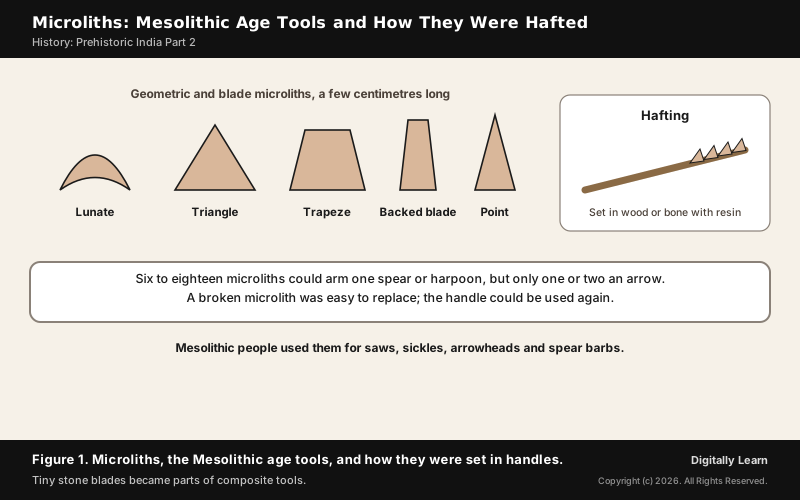
- Earlier forms: Parallel-sided blades, backed blades, points, lunates and scrapers.
- Then triangles: Triangles appear, but trapezes are still absent and there is no pottery.
- Then both: Geometric and non-geometric tools together, with pottery coming into use after the geometric tools.
This sequence comes from the rock shelters of Lekhahia in Mirzapur, where the layers show triangles used before trapezes. Microliths themselves are older than the Mesolithic: in India they appear at Mahadebbera and Kana in West Bengal between 42,000 and 25,000 years ago; that is the Upper Palaeolithic.
Mesolithic Age Tools in Use: Hafting and Composite Tools
A single microlith is too small to use alone. Microliths were stuck onto handles of bone or wood with resin and fibre to make composite tools such as saws and sickles, and to form the points and barbs of spears, harpoons and arrows.
- Many to a weapon: Six to eighteen microliths could arm one spear or harpoon, but only one or two an arrow.
- Easy repair: A dull or broken microlith was easy to replace, while making a new handle took more work.
- Old tools too: Older varieties of tools continued in use alongside the microliths.
The rock paintings show these tools at work. Mesolithic hunters at Bhimbetka are painted hunting in groups with barbed spears, pointed sticks, arrows and bows, and some are shown with traps and snares to catch animals.
Mesolithic Sites in India
Bagor, Tilwara and Langhnaj: Mesolithic Sites of Western India
Western India has some of the best-studied Mesolithic sites. Bagor, on the left bank of the Kothari river in the Bhilwara district of Rajasthan, is the largest Mesolithic site in India and has been excavated horizontally, that is, opened across a wide area. It has three cultural phases.
- Bagor, Rajasthan: Five human skeletons buried in a planned manner, and evidence of fire and of the domestication of animals.
- Tilwara, Rajasthan: A village on the Luni river where evidence of the Mesolithic culture has been excavated.
- Langhnaj, Gujarat: Bones of wild animals, among them rhinoceros, wild boar, chital, nilgai and blackbuck, seven human skeletons and a large number of microliths, from about 10,000 to 8,000 BCE.
The animal bones at Langhnaj show the setting of Mesolithic life: a mix of savannah and forest with wetlands in between, which supported both hunting and gathering. Excavations there ran from 1944 to 1963, by the University of London and the Deccan College, Pune.
Adamgarh, Lekhahia and Chopani Mando: Vindhyas and the Ganga Plain
The Vindhya hills and the Ganga plain form a second cluster. The Adamgarh hills near Narmadapuram in Madhya Pradesh have rock shelters with paintings, and Lower Palaeolithic and Mesolithic tools have been excavated there.

- Lekhahia, Mirzapur: Skeletal remains from a rock shelter, and some finds older than the microliths.
- Chopani Mando, Prayagraj: On the Belan river, excavated by G. R. Sharma in 1967 and 1977; its three phases run from the Palaeolithic through the Mesolithic to the Neolithic.
- Chopani Mando finds: Circular and oval huts with hearths, hand-made cord-impressed pottery, microliths, and remains of rice.
Chopani Mando marks the move from food gathering to food production. The early dates proposed for rice in the Belan valley and the middle Ganga plain are disputed, however: fresh studies of nearby sites such as Koldihwa and Lahuradewa place clear farming much later, so the rice here is best read as a sign of change rather than of full farming.
Mesolithic Rock Paintings in India
Bhimbetka Rock Shelters: Mesolithic Rock Paintings of Central India
The richest rock paintings of India are in the Vindhya ranges of Madhya Pradesh and their extensions into Uttar Pradesh, hills full of Palaeolithic and Mesolithic remains. The largest and most spectacular site is Bhimbetka, forty-five kilometres south of Bhopal, with about 800 rock shelters, 500 of which bear paintings.
- Discovery: Found in 1957-58 by the archaeologist V. S. Wakankar, who spent years surveying the hills.
- Five clusters: Natural rock shelters within massive sandstone outcrops, with paintings that run from the Mesolithic to the historical period.
- World Heritage: Declared a UNESCO World Heritage Site in 2003.
- Living links: The traditions of the twenty-one adivasi villages around the site still resemble those shown in the paintings.
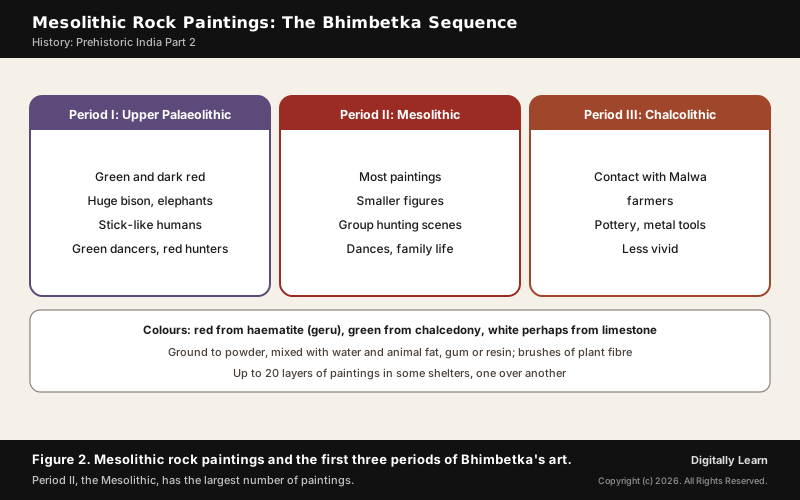
The paintings are grouped into seven periods by style, technique and superimposition. Period I is Upper Palaeolithic, Period III Chalcolithic, and Period II, the Mesolithic, has the largest number: its themes multiply while the figures grow smaller, and hunting scenes predominate. Some scenes are read as a war between three tribes shown by their animal totems, and others show musical instruments, mothers and children, men carrying dead animals, drinking and burials.
Themes, Colours and Style of Mesolithic Rock Paintings
Mesolithic artists loved to paint animals. Elephant, bison, tiger, boar, deer, antelope, leopard, rhinoceros, fish, frog, lizard, squirrel and birds all appear, sometimes chasing men and sometimes hunted by them, painted with fear in some scenes and tenderness in others. A careful study of the animals at Bhimbetka has also found sloth bear, wolf, hyaena, hare, monkeys, turtle and peafowl, with deer and antelope the most numerous, and one domesticated dog.
- People: Humans are drawn in a stylised way, animals naturalistically; women, the young and the old, and children running and playing all appear.
- Daily life: Community dances, gathering fruit or honey, women grinding and preparing food, and scenes that seem to show family life.
- Marks: Hand prints, fist prints and dots made by the fingertips.
- Colours: White, yellow, orange, red ochre, purple, brown, green and black, with white and red the favourites.
The colours were made by grinding rocks and minerals: red from haematite, known as geru, green from chalcedony, white perhaps from limestone. The powder was mixed with water and a sticky substance such as animal fat, gum or resin, and applied with brushes of plant fibre; a reaction with the oxide on the rock surface is believed to have kept the colours intact.
Why Mesolithic People Painted: Meaning of the Rock Art
The purpose of the paintings can only be inferred, but their placing gives clues. Some were painted in the shelters where people lived; others in places that do not seem to have been living spaces at all, which may have had religious importance. Some of the finest are high up, near the ceilings, perhaps so that people could see them from a distance.
- Power over animals: Paintings of hunts and dying animals may have given people a sense of power over the animals they would meet in the open.
- Ritual: Communities today still paint or engrave rocks in rituals at birth, death, coming of age and marriage, and dance masked in hunting rites.
- Record of life: The paintings show early people’s way of life, food habits, daily activities and, above all, how they thought.
The skill is plain to see. The artists kept both proportion and tonal effect in their animals, told stories in dramatic scenes of hunts and dances, and made animals look more youthful and majestic than they perhaps were; the rock paintings are the greatest wealth these people left behind.
Other Rock Art Sites: Lakhudiyar, Pahargarh, Anangpur and Karnataka
Rock paintings have been found in Madhya Pradesh, Uttar Pradesh, Andhra Pradesh, Karnataka, Bihar and the Kumaon hills. The first discovery in India was made in 1867-68 by Archibold Carlleyle, and the first scientific article on Indian rock paintings was published by J. Cockburn in 1883.
- Lakhudiyar, Uttarakhand: Rock shelters on the Suyal river about twenty kilometres from Almora, the name meaning one lakh caves; men, animals and geometric patterns in white, black and red ochre, and hand-linked dancing figures.
- Pahargarh caves, Madhya Pradesh: Near Morena, over 600 paintings in red and white ochre of humans, animals and abstract shapes.
- Anangpur and Mangar Bani, Delhi NCR: Mesolithic sites with cave art and tools.
- Kupgallu, Piklihal and Tekkalkota, Karnataka: Paintings on granite rocks, mostly from the Neolithic and later periods.
At Lakhudiyar the layers show the order of the colours: the earliest paintings are in black, over them come red ochre paintings, and the last group is white. The same superimposition that fills Bhimbetka helps date the art at every site.
Life in the Mesolithic Age: Hunting, Burials and the First Herding
Pottery and Longer Stays in the Late Mesolithic
Towards its end the Mesolithic shows the first signs of settled life. Some sites counted as Mesolithic show the use of pottery and textiles, and the more lasting settlements lay close to lakes, rivers or the sea, which gave a steady supply of food.
- Lekhahia: The layers show pottery coming into use only after geometric microliths.
- Chopani Mando: Circular and oval huts with hearths and hand-made, cord-impressed pottery, alongside microliths of chalcedony.
- Bagor: Three cultural phases at one place, and burials, which suggest people returned to and stayed at the site.
Mesolithic Food, Burials and the Beginnings of Herding
Mesolithic food came from many sources. Hunters followed herds of grazing animals and learned their food habits and breeding seasons, which may have led them to think of herding and rearing animals; fishing became important; and wild wheat, barley and rice were gathered in different parts of the subcontinent.
- Herding: Bagor has evidence of the domestication of animals, the first step towards herding.
- Burials: Five planned burials at Bagor, seven skeletons at Langhnaj and skeletal remains at Lekhahia show care for the dead; Mesolithic burials were simple.
The Mesolithic ends as farming and settled villages take hold, the subject of the Neolithic Age. Where those villages grew into cities is traced in the Indus Valley Civilisation, and the earlier story of stone tools in the Palaeolithic Age in India.
Previous Year UPSC-CSE Questions
Previous Year UPSC-CSE Questions By the end you will be able to draft model answers for the following UPSC questions. Each question carries a collapsible framework showing how to approach it in the exam.
- UPSC Mains 2015 GS-IMesolithic rock cut architecture of India not only reflects the cultural life of the times but also a fine aesthetic sense comparable to modern painting. Critically evaluate this comment.
How to structure the answer in the exam
Introduction: Introduce the Mesolithic rock paintings of central India, above all Bhimbetka's Period II, the largest group of prehistoric art in India.
Body (sub-themes to develop):
- Cultural life: group hunting with barbed spears and bows, traps, dances, honey gathering, family scenes.
- Aesthetic sense: naturalistic animals with proportion and tone, storytelling, many mineral colours.
- Technique: haematite, chalcedony and limestone pigments; brushes of plant fibre; superimposition.
- Limits: natural rock shelters, not cut architecture; stylised humans; uncertain dating of layers.
Conclusion: Conclude that the paintings are a rich record of prehistoric life and skill, even if the comparison with modern painting must be made with care.
Sources
- NCERT: Our Pasts I (Class VI), On the Trail of the Earliest People
- NCERT: An Introduction to Indian Art, Part I (Class XI), Prehistoric Rock Paintings
- PIB: Bhimbetka Rock Shelters in Madhya Pradesh declared World Heritage (4 July 2003)
- PIB: World Heritage Day explainer (Ministry of Culture, 2022)
- Ministry of Culture: Rock Shelters of Bhimbetka
- IGNCA (Ministry of Culture): The Art on Rocks
- Wikipedia: Mesolithic
- Wikipedia: Microlith
- Wikipedia: South Asian Stone Age
- Wikipedia: Bagor, Rajasthan
- Wikipedia: Tilwara
- Wikipedia: Langhnaj
- Wikipedia: Lekhahia
- Wikipedia: Adamgarh Hills
- Wikipedia: Chopani Mando
- Wikipedia: Belan River
- Wikipedia: Bhimbetka rock shelters
- Wikipedia: Pahargarh Caves
- Wikipedia: Rock art
- UPSC: Civil Services Examination question papers
Editorial Disclaimer
This article draws on the NCERT textbooks and the other sources listed on this page. Dates for prehistoric sites are revised as new methods are applied.


