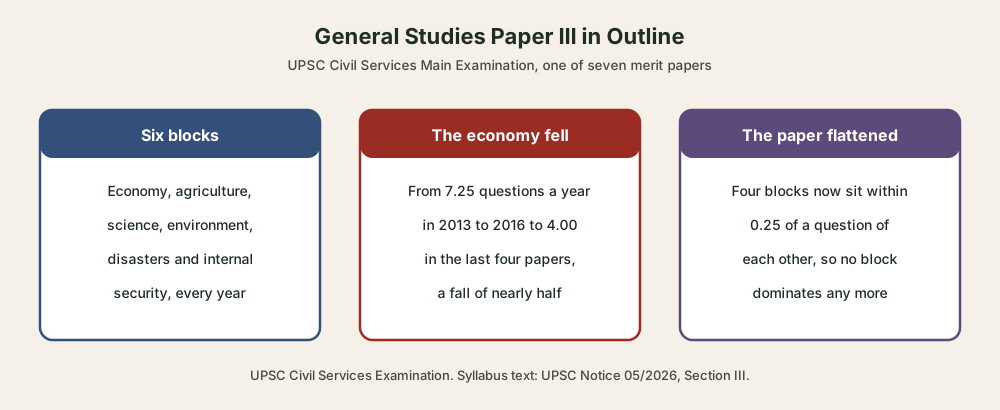
The UPSC Mains GS 3 syllabus covers the economy, agriculture and food, science and technology, environment, disaster management and internal security, set out in twenty clauses. The paper asks twenty compulsory questions for 250 marks in three hours. This guide sets the official syllabus against the subject wise weightage of 244 questions asked between 2013 and 2024, block by block.
What General Studies Paper III Is, and How It Is Marked
Paper IV in the Commission's Numbering
General Studies Paper III, searched for as GS Paper 3 or GS 3, is Paper IV in the Commission's numbering. It is the fourth of the seven papers whose marks count towards the rank, and the third of the four General Studies papers.
The Commission's title for it is General Studies-III: Technology, Economic Development, Bio diversity, Environment, Security and Disaster Management. Six subjects named in one line, which is the widest brief of any paper in the examination.
Where it sits among the nine papers is set out in the exam pattern guide.
Ten Questions at Ten Marks, Ten at Fifteen
The paper asks twenty questions and every one is compulsory. Ten carry 10 marks with a 150-word limit, ten carry 15 marks with a 250-word limit, and the total is 250 marks in three hours.
The marking is identical to Paper I and Paper II, so the timing practice carries across all three. About nine minutes an answer is the arithmetic that matters.
Why Papers Before 2017 Are Not a Like-for-Like Guide
This shape settled in 2017. Before that the marks and word limits moved, and 2013 asked 25 questions rather than twenty.
Older papers stay useful for their content. They are a poor guide to timing, because a candidate rehearsing them is writing to a limit the paper no longer sets.
The Official GS-III Syllabus
The Twenty Clauses, as the Commission Prints Them
The notice sets this paper out in twenty clauses, and they range from government budgeting to cropping patterns to cyber security. They follow in the notice's own words, before any counting is laid over them.
- Indian Economy and issues relating to planning, mobilization, of resources, growth, development and employment.
- Inclusive growth and issues arising from it.
- Government Budgeting.
- Major crops-cropping patterns in various parts of the country, - different types of irrigation and irrigation systems storage, transport and marketing of agricultural produce and issues and related constraints; e-technology in the aid of farmers.
- Issues related to direct and indirect farm subsidies and minimum support prices; Public Distribution System- objectives, functioning, limitations, revamping; issues of buffer stocks and food security; Technology missions; economics of animal-rearing.
- Food processing and related industries in India- scope' and significance, location, upstream and downstream requirements, supply chain management.
- Land reforms in India.
- Effects of liberalization on the economy, changes in industrial policy and their effects on industrial growth.
- Infrastructure: Energy, Ports, Roads, Airports, Railways etc.
- Investment models.
- Science and Technology- developments and their applications and effects in everyday life.
- Achievements of Indians in science & technology; indigenization of technology and developing new technology.
- Awareness in the fields of IT, Space, Computers, robotics, nano-technology, bio-technology and issues relating to intellectual property rights.
- Conservation, environmental pollution and degradation, environmental impact assessment.
- Disaster and disaster management.
- Linkages between development and spread of extremism.
- Role of external state and non-state actors in creating challenges to internal security.
- Challenges to internal security through communication networks, role of media and social networking sites in internal security challenges, basics of cyber security; money-laundering and its prevention.
- Security challenges and their management in border areas - linkages of organized crime with terrorism.
- Various Security forces and agencies and their mandate.
Six Blocks Inside One Paper
The twenty clauses group into six blocks. The economy takes six of them, internal security five, agriculture and food four, science and technology three, and environment and disaster management one each.
This page takes each block against 244 real questions from 2013 to 2024. As in Paper II, a Mains question carries a subject but no finer tag, so the block is as deep as the counting goes.
What the Paper Has Actually Asked
Six Blocks, All Present in All Twelve Years
No block has ever been absent. The largest, the economy, has carried 65 questions and the smallest, disaster management, 17. Disaster management has asked either one or two questions in every single paper, never none and never three.
| Block | Clauses | Questions | A year | 2013 to 2016 | 2021 to 2024 | Shift |
|---|---|---|---|---|---|---|
| Economy | 6 | 65 | 5.42 | 7.25 | 4.00 | -3.25 |
| Internal security | 5 | 48 | 4.00 | 4.50 | 3.75 | -0.75 |
| Agriculture and food | 4 | 47 | 3.92 | 3.50 | 4.00 | +0.50 |
| Science and technology | 3 | 40 | 3.33 | 3.25 | 3.75 | +0.50 |
| Environment | 1 | 27 | 2.25 | 1.50 | 2.75 | +1.25 |
| Disaster management | 1 | 17 | 1.42 | 1.25 | 1.75 | +0.50 |
Read the last two columns together and the paper's real change appears. The economy has fallen by 3.25 questions a year while four other blocks rose, which is the subject of the next two sections.
How This Was Counted, and the Question We Are Missing
Every question in every General Studies Paper III from 2013 to 2024, assigned to one block. Twelve papers should give 25 plus twenty a year, which is 245. Our bank holds 244.
The Paper That Stopped Being About the Economy
From Seven Questions a Year to Four
The economy averaged 7.25 questions a year across 2013 to 2016, nearly double the next largest block. Across 2021 to 2024 it averages 4.00, and the last four papers asked four apiece.
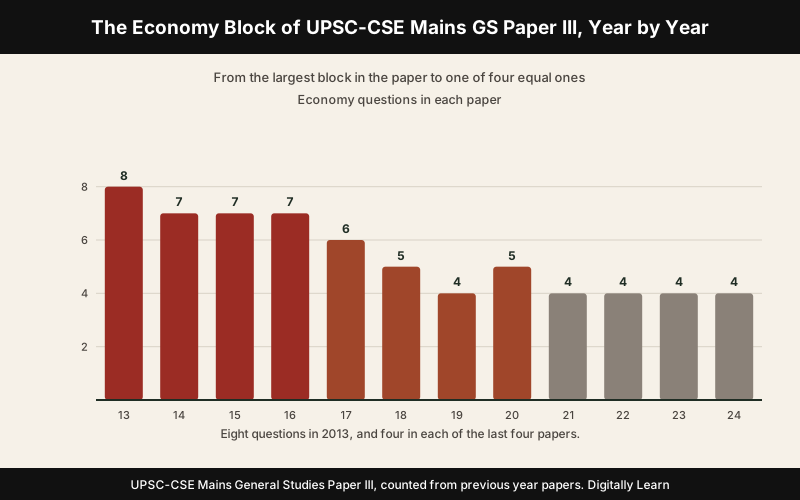
That is a fall of nearly half in twelve years. It is the largest single movement of any block in any of the three Mains General Studies papers, and it has happened quietly enough that most preparation has not caught up with it.
Six Clauses Still, But a Quarter of the Paper
The syllabus has not shrunk. The economy still holds six of the twenty clauses: planning and the mobilisation of resources, inclusive growth, government budgeting, the effects of liberalisation on industrial policy, infrastructure, and investment models.
So this block carries 30 per cent of the printed syllabus and produces 26.6 per cent of the questions. The reading load has stayed where it was while the return on it has fallen.
What an Economy Question Now Looks Like
The early papers asked broad descriptive questions about growth and planning. The recent ones are narrower and more mechanical: what a policy instrument does, why an intervention had the effect it did, what a budgeting choice costs.
Infrastructure and investment models have held up better than the macro clauses, which is where the fall has concentrated.
The practical reading of that is not to abandon the macro material, which still anchors every answer in this block, but to stop treating growth and planning as the centre of the paper. They are now one clause group among six.
The Flattening: Four Blocks Within a Quarter Question
The Spread Has More Than Halved
In 2013 to 2016 the largest block asked 7.25 questions a year and the smallest 1.25, a spread of 6.00. In 2021 to 2024 the range runs from 4.00 to 1.75, a spread of 2.25.
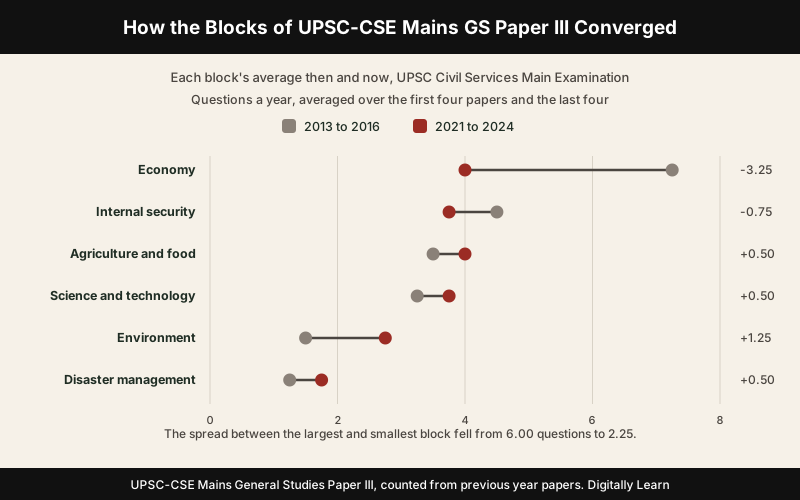
Economy, agriculture, internal security and science now sit within 0.25 of a question of one another. Four blocks of roughly equal size is a different paper from one with a dominant block and a tail.
| Year | Economy | Security | Agriculture | Science | Environment | Disasters | Paper |
|---|---|---|---|---|---|---|---|
| 2013 | 8 | 5 | 4 | 5 | 2 | 1 | 25 |
| 2014 | 7 | 5 | 2 | 3 | 2 | 1 | 20 |
| 2015 | 7 | 4 | 4 | 3 | 1 | 1 | 20 |
| 2016 | 7 | 4 | 4 | 2 | 1 | 2 | 20 |
| 2017 | 6 | 4 | 4 | 3 | 2 | 1 | 20 |
| 2018 | 5 | 4 | 5 | 2 | 3 | 1 | 20 |
| 2019 | 4 | 4 | 4 | 4 | 2 | 2 | 20 |
| 2020 | 5 | 3 | 4 | 3 | 3 | 1 | 19 |
| 2021 | 4 | 4 | 4 | 3 | 3 | 2 | 20 |
| 2022 | 4 | 4 | 4 | 4 | 2 | 2 | 20 |
| 2023 | 4 | 4 | 4 | 3 | 4 | 1 | 20 |
| 2024 | 4 | 3 | 4 | 5 | 2 | 2 | 20 |
The last column is the paper total in our bank, which is why 2013 reads 25 and 2020 reads 19. Follow the economy row across and the fall is visible without any averaging at all.
Why a Flat Paper Is Harder to Prepare
A dominant block is a gift to a candidate with limited time, because it tells them where to concentrate. This paper no longer offers that. Every block now returns about the same per hour invested, so there is no efficient place to specialise.
The practical consequence is that breadth beats depth here more than in any other General Studies paper, and that a weak block costs its full share rather than being absorbed by a strong one.
Agriculture and Food: Four Clauses, Four Questions
Forty-Seven Questions, and Six Papers at Exactly Four
Agriculture has carried 47 questions and has asked exactly four in each of the last six papers. That is the second longest identical run in any General Studies paper, behind international relations in Paper II.
It has also risen slightly, from 3.50 a year to 4.00, which makes it one of the four blocks that now share the paper's centre.
Crops, Irrigation, Subsidies, Food Processing, Land Reform
The four clauses are major crops and cropping patterns with irrigation, storage, transport and marketing; direct and indirect farm subsidies, minimum support prices and the public distribution system; food processing and its supply chains; and land reforms in India.
The subsidy and minimum support price clause has produced the most of the four, because it is the one that renews itself with every procurement season and every policy revision.
Food processing is the clause most often skipped and it carries its own vocabulary: upstream and downstream requirements, supply chain management, and the location factors the notice names. Land reforms is the quietest of the four and the most likely to appear as a historical question rather than a current one.
Internal Security: Five Clauses, Under a Fifth of the Paper
Forty-Eight Questions From Five Clauses
Internal security holds five of the twenty clauses, the second largest count in the paper, and produces 19.7 per cent of the questions. That gap of -5.3 points is the largest in the paper in that direction.
It has also slipped, from 4.50 questions a year to 3.75. It remains a block no candidate can skip, at close to four questions in every paper.
Extremism, External Actors, Cyber, Borders, Agencies
The five clauses are the linkage between development and the spread of extremism; the role of external state and non-state actors; challenges through communication networks, the media and social networking, with the basics of cyber security and money laundering; security challenges in border areas and the link between organised crime and terrorism; and the various security forces and their mandates.
The cyber and communications clause has grown fastest inside the block, which is what a candidate would expect and is worth weighting for.
The clause on security forces and their mandates is the one that rewards precise knowledge: which force, raised under which law, answering to which ministry. It is also the shortest clause in the block and the easiest to prepare fully.
Science and Technology in GS Paper III
Forty Questions From Three Clauses
Science and technology has carried 40 questions, 3.33 a year, and has risen from 3.25 to 3.75. The 2024 paper asked 5, matching its 2013 high.
It is the block most often mistaken for a current-affairs block. The syllabus asks for applications and effects, not for a catalogue of the year's launches and announcements.
Everyday Applications, Indigenisation, IT and Space
The three clauses are developments in science and technology and their applications and effects in everyday life; the achievements of Indians in the field, with the indigenisation of technology and developing new technology; and awareness in information technology, space, computers, robotics, nanotechnology, biotechnology and intellectual property rights.
The third clause names eight fields in one sentence, which makes it the widest single clause in the paper and the one most likely to be under-read.
Intellectual property rights sit at the end of that list and are the part most often missed. They are also the part that connects this block to the economy block, because the questions tend to be about incentives and access rather than about the technology itself.
The Two One-Clause Blocks
Environment: One Clause, an Eighth of the Paper
Environment holds one clause of twenty, 5 per cent of the printed syllabus, and produces 11.1 per cent of the questions. It has risen from 1.50 a year to 2.75, the largest proportional growth in the paper.
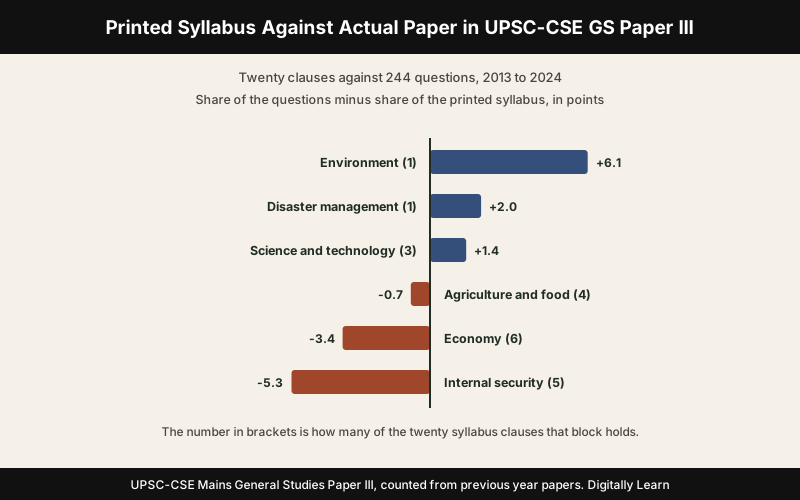
That gap of +6.1 points is the widest in this paper by some distance, with disaster management next at +2.0. The clause is nineteen words long and it carries more than a tenth of a 250-mark paper.
Disaster Management: One or Two Questions, Every Paper
Disaster management is the other one-clause block, and the clause is five words: disaster and disaster management. It has produced 17 questions in twelve years, and has asked either one or two in every paper without exception.
At 1.42 questions a year it is the smallest block in the paper, and at +2.0 points against its clause share it is still asked more than the syllabus suggests.
Its questions divide cleanly into the institutional half, meaning the national framework and the authorities that run it, and the hazard half, meaning what a specific class of disaster does and what reduces its damage. Preparing only the first is the common error.
Why Clause Count Understates Both
A clause is a unit of drafting, not a unit of weight. These two clauses are short because the subjects are easy to name, not because they are small, and a reader who budgets by clause length will under-prepare both.
| Block | Clauses | Clause share | Questions | Question share | Gap |
|---|---|---|---|---|---|
| Environment | 1 of 20 | 5 per cent | 27 of 244 | 11.1 per cent | +6.1 points |
| Disaster management | 1 of 20 | 5 per cent | 17 of 244 | 7.0 per cent | +2.0 points |
| Science and technology | 3 of 20 | 15 per cent | 40 of 244 | 16.4 per cent | +1.4 points |
| Agriculture and food | 4 of 20 | 20 per cent | 47 of 244 | 19.3 per cent | -0.7 points |
| Economy | 6 of 20 | 30 per cent | 65 of 244 | 26.6 per cent | -3.4 points |
| Internal security | 5 of 20 | 25 per cent | 48 of 244 | 19.7 per cent | -5.3 points |
The ranking itself is honest: every block with more clauses than another also has more questions. The narrowest of those margins is internal security over agriculture, 48 questions against 47, which is one question in twelve years and should be read as a tie.
So the clause count is a fair guide to rank and a poor guide to size. It will tell a candidate that the economy outweighs environment, which is true, and it will not tell them that a nineteen-word clause outweighs three clauses on science, which is also true.
How the Questions Are Framed
More Than Half the Questions Carry an Instruction
Discuss appears in 76 of the 244 questions, then explain at 28, examine at 16 and suggest at 16.
| Directive | Questions containing it |
|---|---|
| Discuss | 76 |
| Explain | 28 |
| Examine | 16 |
| Suggest | 16 |
| Critically | 15 |
| Comment | 10 |
| Elaborate | 6 |
| Analyse | 6 |
Counted on the eight words used across this series so the three papers compare on identical terms: Paper I 131 of 254, Paper II 174 of 245, and this paper 136 of 244. Paper II is the outlier, not this one.
Suggest Is the Instruction That Marks This Paper
Suggest appears 16 times here, against 10 in Paper II and 2 in Paper I. It asks for a remedy, and an answer that diagnoses a problem thoroughly without proposing anything has answered half the question.
This is the applied paper of the four. Its questions tend to end with a live problem rather than a settled one, which is why the remedy is so often what is being marked.
What a Word Limit Buys in an Economy Answer
A hundred and fifty words is an introduction, three developed points and a close. An economy or security question usually wants a mechanism, a consequence and a measure, which is exactly three.
Two hundred and fifty words allows the mechanism to be explained rather than asserted. Neither limit allows a survey of everything a candidate knows about the sector.
What This Means for Preparing GS Paper III
Do Not Prepare This as the Economy Paper
This is the single most common misallocation here. The economy was 7.25 questions a year when much of the available preparation material was written, and it is 4.00 now.
- Treat economy, agriculture, internal security and science as four blocks of roughly equal size, because that is what they are.
- Give environment more than its one clause suggests: it produces 11.1 per cent of the questions and is still rising.
- Keep disaster management small but never empty, since it has asked at least one question in every paper.
- Read the science block for applications and effects rather than as a list of the year's announcements.
No Block Is Safe to Skip and None Is Worth Overweighting
The flattening cuts both ways. There is no dominant block to reward concentration, and there is no negligible block to absorb a gap, so the cost of skipping anything is close to its full share.
In practice that means four questions lost for a skipped major block, which on a paper of twenty is a fifth of 250 marks.
Where the Current Affairs Actually Bite
Three of the six blocks renew themselves annually: the economy through the budget and policy cycle, science and technology through applications, and environment through conservation decisions and impact assessment.
Agriculture and internal security move more slowly. That is a useful division, because it tells a candidate which half of this paper needs the year's reading and which half rewards a settled base.
Common Questions About the GS-III Syllabus
How many questions come in UPSC Mains GS Paper 3?
Twenty, all compulsory. Ten carry 10 marks with a 150-word limit and ten carry 15 marks with a 250-word limit, for 250 marks in three hours. That structure has been unchanged since 2017.
What is the subject wise weightage in UPSC Mains GS 3?
Across 244 questions from 2013 to 2024: economy 65, internal security 48, agriculture 47, science and technology 40, environment 27 and disaster management 17. In the last four papers the first four of those sit within a quarter of a question of each other.
Is economy still the biggest part of GS Paper 3?
By the twelve-year total, yes. By recent papers, no: the economy has fallen from 7.25 questions a year to 4.00 and now ties with agriculture rather than leading.
How much environment comes in UPSC Mains GS 3?
About 2.25 questions a year across twelve years, rising to 2.75 in the last four papers, which is more than a tenth of the paper from a single syllabus clause.
How much science and technology is in GS Paper 3?
40 questions in twelve years, 3.33 a year, from three syllabus clauses. The 2024 paper asked 5.
Official Sources
- Union Public Service Commission: Examination Notice No. 05/2026-CSE, Civil Services Examination 2026
- Union Public Service Commission: Civil Services Examination 2025, minimum qualifying marks
- Union Public Service Commission: Programme of Examinations and Recruitment Tests 2027
- Ministry of Statistics and Programme Implementation: national accounts and economic statistics
- Ministry of Agriculture and Farmers Welfare
- Ministry of Environment, Forest and Climate Change
- National Disaster Management Authority: guidelines and plans
- Union Public Service Commission: online registration and application portal
- Wikipedia: Civil Services Examination
Editorial Disclaimer
The syllabus on this page is reproduced from the Commission's current examination notice, with the notice's dashes replaced by commas and colons for readability. Assigning past questions to blocks is our own analysis and is not published by the Commission. The notice in the Gazette of India is the final authority.