


Overview
The statute that replaced MGNREGA on 1 July 2026 and raised the guarantee to 125 days
The Act came into force across rural India on 1 July 2026, repealing the Mahatma Gandhi NREGA. It raises the guarantee from 100 to 125 days per rural household, sets a Rs 300 wage floor, and gives the Gram Sabha the choice of works.
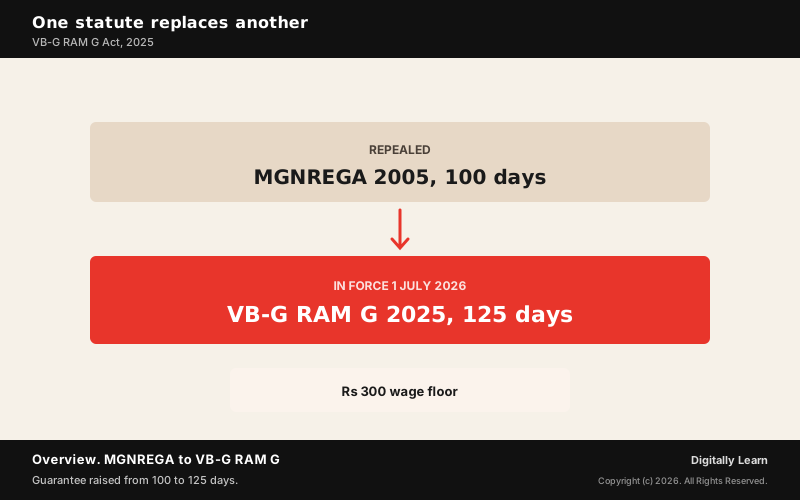
The Viksit Bharat – Guarantee for Rozgar and Ajeevika Mission (Gramin) Act, 2025, known as the VB-G RAM G Act, is the Union statute that guarantees wage employment to rural households. It came into force on 1 July 2026 across all rural areas of India and repealed the Mahatma Gandhi National Rural Employment Guarantee Act as the governing law for the rural employment guarantee.
The VB-G RAM G Act, 2025: The Statute That Replaced MGNREGA
Commencement and the 125-Day Statutory Guarantee
The Viksit Bharat – Guarantee for Rozgar and Ajeevika Mission (Gramin) Act, 2025, known by the abbreviation VB-G RAM G, is the Union law that now governs India's rural employment guarantee. It came into force across all rural areas of the country with effect from 1 July 2026. The Act repeals the Mahatma Gandhi National Rural Employment Guarantee Act, which had been the governing statute since 2005, and subsumes its programmes, assets and institutional structures.
The central promise of the Act is a legal entitlement to wage employment. Every eligible rural household is guaranteed 125 days of wage employment in a financial year, raised from the 100 days that the previous statute guaranteed. The guarantee attaches to the household rather than to the individual worker, and it operates for a financial year.
The reason this change matters is that the rural employment guarantee is the largest statutory social protection instrument in India and a principal source of wage income in the lean agricultural season for rural households . A change in the governing statute therefore alters the legal position of tens of millions of households at once, and it does so through an entitlement that a worker can demand rather than a benefit that an administration may choose to extend.
Mission Framing, Administering Ministry and Stated Objectives
The Act is administered by the Ministry of Rural Development. The Union Minister for Rural Development and Agriculture and Farmers' Welfare, Shri Shivraj Singh Chouhan, led both the commencement and the national launch. The programme is referred to in official communication as the VB-G RAM G Yojana, and the short name is also rendered in Hindi in official notifications.
The statute is framed as a mission rather than only as an employment programme. Its stated objectives extend beyond wage payment to durable asset creation, natural resource management, water conservation, agriculture and allied activities, rural infrastructure, and the strengthening of village economies. The framing situates the Act within the stated national goal of Viksit Bharat by 2047.
Legislative Passage: Introduction, Voice Vote and Presidential Assent
Parliamentary Timeline and the Long Title of the Act
The Bill was introduced in the Lok Sabha on 16 December 2025 by the Minister of Rural Development, Shri Shivraj Singh Chouhan. After approximately eight hours of debate on 17 December, the Minister delivered his concluding statement on 18 December, and the Lok Sabha passed the Bill by voice vote the same day.
The Bill was introduced in the Rajya Sabha later the same day and, after nearly six hours of debate, the Rajya Sabha passed it shortly after midnight on 19 December 2025. The President assented on 21 December 2025.
The long title of the Act states its purpose in statutory language. It is an Act to establish a rural development framework aligned with the national vision of Viksit Bharat @2047, by providing a statutory guarantee of one hundred and twenty-five days of wage employment in every financial year to every rural household whose adult members volunteer to undertake unskilled manual work, and to promote empowerment, growth, convergence and saturation for a prosperous and resilient rural Bharat.
Those four words in the long title are the Act's own framing of its objectives. Empowerment refers to enhanced employment security, growth to the creation of durable rural assets, convergence to the combination of multiple rural development schemes at village level, and saturation to full coverage of eligible households and infrastructure needs.
From MGNREGA to VB-G RAM G: What Actually Changed in the Statutory Guarantee
Substantive Departures from the 2005 Act
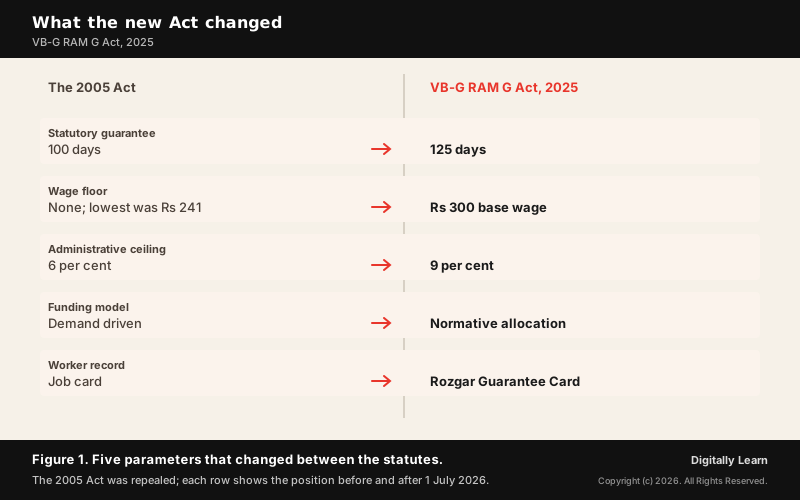
The significance of changing the statute rather than the scheme is that the entitlement itself was rewritten rather than merely re-funded. Successive governments had adjusted wage rates, coverage and administrative rules under the 2005 Act without altering the statutory guarantee of 100 days; the full treatment of that Act, its design and the critiques the new statute inherits is in the briefing on MGNREGA, 2005 to 2026. The 2025 Act changes the guarantee, the wage floor and the administrative cost ceiling together, which makes it a legislative reset rather than a programmatic revision.
| Parameter | Position under the previous statute | Position under VB-G RAM G Act, 2025 |
|---|---|---|
| Statutory guarantee | 100 days per rural household in a financial year | 125 days per rural household in a financial year |
| National wage floor | No interim base wage; lowest notified wage was Rs 241 per day | Interim base wage of Rs 300 per day, below which no wage may be notified |
| Administrative expenditure | 6 per cent of programme expenditure | 9 per cent of programme expenditure |
| Worker record | Job card | Gramin Rozgar Guarantee Card, with e-KYC verified job cards valid until the new card is issued |
| Choice of works | Programme guidelines with State and district planning | Gram Sabha decides the works to be taken up in the village |
| Funding model | Demand-driven funding of work actually sought | Annual normative allocation to States, with expenditure beyond the allocation borne by the State |
| Cost sharing | Centrally sponsored with a State share | 60:40 Centre-State for most States; 90:10 for north-eastern States and Union Territories |
One provision of the 2005 Act is worth stating precisely because it is often misremembered. That Act provided that at least one-third of beneficiaries be women, not one-half.
Whether the 2025 Act carries an equivalent quota is not established by the sources read for this briefing, and it should not be assumed to have carried over. What the Act does state is that women's empowerment through Self Help Groups is among the activities it emphasises. Eligibility itself was never narrowed by caste or poverty line under either statute: the entitlement has always run to the adult members of any rural household volunteering for unskilled manual work.
The transition was designed so that entitlements did not lapse between statutes. Existing e-KYC verified job cards remain valid until the new Gramin Rozgar Guarantee Cards are issued, and ongoing works continued without interruption on the date of commencement.
The Statutory Architecture: Cost Sharing, Normative Allocation and the Agricultural Suspension Window
Cost-Sharing Ratios and the Shift to Normative Allocation
The Act repeals the Mahatma Gandhi National Rural Employment Guarantee Act, 2005 and subsumes its programmes, assets and institutional structures. It is implemented as a centrally sponsored programme with a 60:40 Centre-State cost-sharing ratio for most States, and 90:10 for the north-eastern States and the Union Territories.
The Act introduces annual normative financial allocations to States. Expenditure beyond the allocation is to be borne by the State government. This is the single most consequential structural change, because the previous framework funded whatever demand materialised, whereas a normative allocation fixes a sum in advance and places the residual liability on the State.
A further provision permits States to notify up to 60 days annually, during sowing or harvesting seasons, when employment under the scheme may be temporarily suspended. The stated purpose is to balance rural wage employment against agricultural labour requirements at peak farming times, since the programme competes with farm labour demand in exactly those weeks.
Viksit Gram Panchayat Plans, Guarantee Councils and Social Audit
The Act mandates preparation of village-level development plans known as Viksit Gram Panchayat Plans, and their integration into a national rural infrastructure planning system. State governments are required to notify implementing schemes within six months of the Act coming into force.
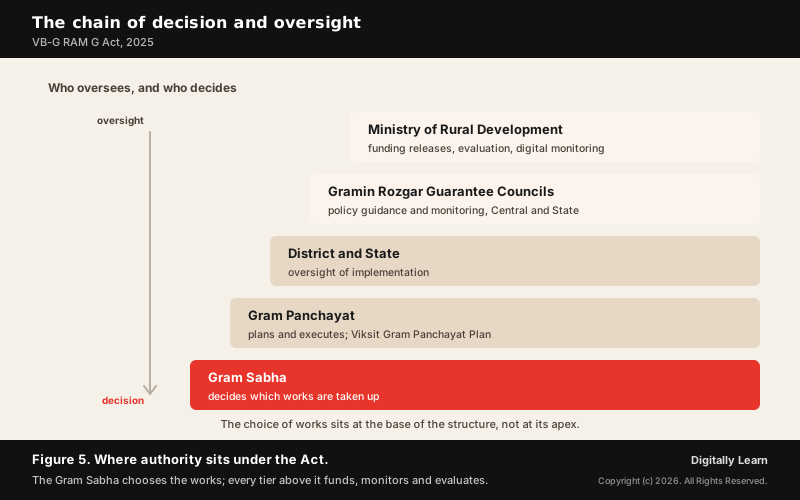
Central and State Gramin Rozgar Guarantee Councils are to be constituted for policy guidance and monitoring. Alongside the expanded administrative expenditure limit, the Act mandates technology-based monitoring, social audits, and public disclosure mechanisms at the Gram Panchayat level. Employment planning and execution run primarily through Gram Panchayats, with oversight from district, State and central authorities.
The 125-Day Guarantee and the Enforceable Rights of the Rural Worker
Household Eligibility and the Statutory Character of the Entitlement
The Act states its own coverage in its long title. The guarantee runs to every rural household whose adult members volunteer to undertake unskilled manual work, in every financial year. Three features follow from that formulation. Eligibility is universal among rural households rather than targeted by caste, income or a poverty line. The unit is the household, not the individual. And the work contemplated is unskilled manual work that a person volunteers for.
The legal character of the entitlement is as important as its size, and it is commonly misstated. The guarantee is a statutory right, created by an Act of Parliament and enforceable against the administration through the mechanisms the Act provides. It is not a fundamental right under Part III of the Constitution, and it is not justiciable in the way Part III rights are.
That distinction has a practical edge. A statutory right can be amended or repealed by the same Parliament that created it, which is precisely what happened to the 2005 Act. The 125-day guarantee therefore rests on continuing legislative will rather than on constitutional entrenchment, and the same is true of the Rs 300 wage floor and the fifteen-day rule.
The Fifteen-Day Rule, Unemployment Allowance and Delay Interest
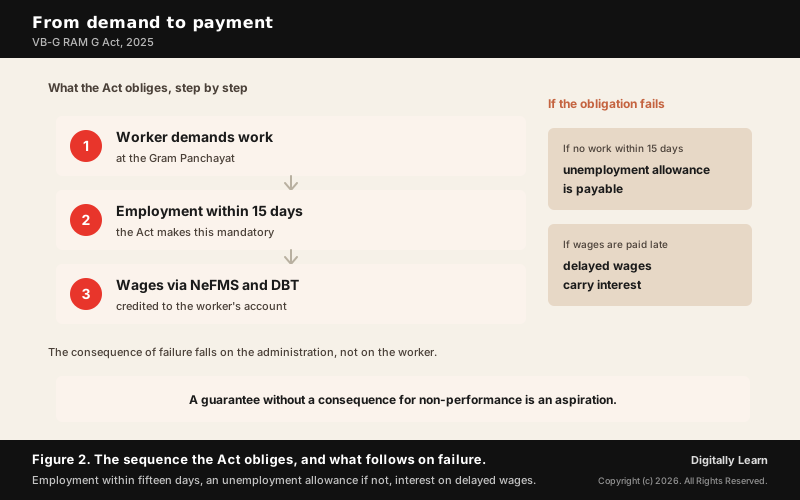
The Act converts the promise of work into a set of enforceable obligations on the administration. The distinguishing features of the entitlement are three.
- On a demand for work being made, it is mandatory to provide employment within fifteen days.
- Where work is not provided within that period, the worker must be paid an unemployment allowance.
- Where wages are delayed, the worker is to be paid the delayed wages together with interest.
These three provisions matter because they place the cost of administrative failure on the administration rather than on the worker. A guarantee without a consequence for non-performance is an aspiration. The interest provision in particular addresses delayed wage payment, which is a long-standing grievance in rural employment programmes.
Payment Machinery: NeFMS, Direct Benefit Transfer and Timelines
Payment runs through the National Electronic Fund Management System and Direct Benefit Transfer, under which wages are credited directly to the bank accounts of workers. The Ministry has issued Standard Operating Procedures prescribing timelines and responsibilities at each level for processing wage payments. A comprehensive online Management Information System supports real time monitoring of implementation and of pendency at different stages.
The design intent is to remove the discretionary steps where a wage payment could previously stall. Crediting wages directly to a worker's bank account removes the intermediary who once handled cash, and a real time management information system makes pendency visible at each stage rather than only at the end. Whether that visibility translates into faster payment depends on whether anyone is held to the timelines the Standard Operating Procedures prescribe.
This matters more under the new Act than it did before, because the Act attaches a financial consequence to delay. Where wages are late the worker is owed interest, so a payment system that stalls now creates a liability rather than merely a grievance. The machinery and the entitlement are therefore parts of the same provision, and neither works without the other.
The Rs 300 Interim Base Wage and the Redesign of Rural Wage Determination
The National Wage Floor and Its Effect on Low-Wage States
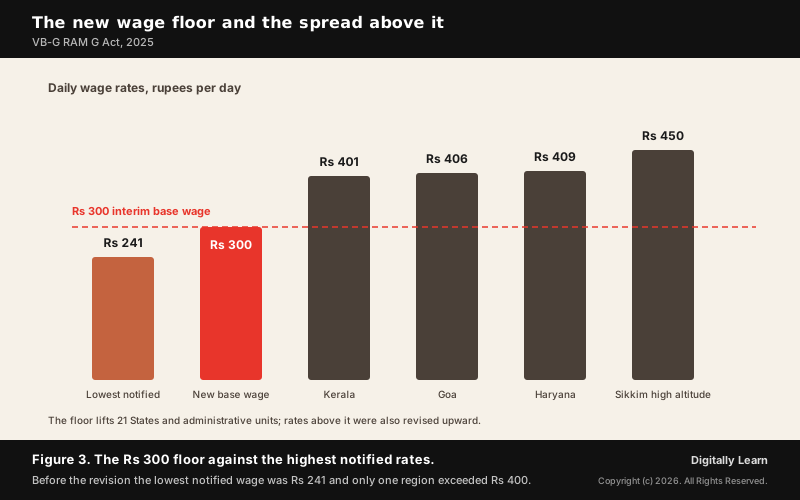
The revised wage rates were notified with effect from 1 July 2026, coinciding with the commencement of the Act. The defining feature of the notification is an interim base wage rate of Rs 300 per day, which establishes that no notified wage under the programme may fall below that figure. Before the notification, wage rates in several States were below Rs 300, and the lowest notified wage was Rs 241 per day.
The observable outcomes of the notification are visible in three groups of States.
- The interim base wage directly benefits 21 States and administrative units that were previously below the floor.
- The largest proportionate gains accrue to historically lower-wage States, with Arunachal Pradesh and Nagaland receiving increases of nearly 24.5 per cent.
- States already above the floor also received upward revision under the prescribed methodology.
| State or wage region | Notified wage rate per day |
|---|---|
| Sikkim, High Altitude Gram Panchayats | Rs 450 |
| Haryana | Rs 409 |
| Goa | Rs 406 |
| Kerala | Rs 401 |
Before this revision only one wage region carried a notified rate above Rs 400 per day. The average increase across the country was approximately 10 per cent. The methodology combines annual indexation with the newly introduced interim base wage, which is the mechanism by which the notification narrows regional disparity while still adjusting higher-wage regions.
Financing the Guarantee: The Central Share, the State Contribution and the Five-Year Outlay
Central Allocation, State Share and the Five-Year Outlay
For the financial year 2026-27 a Central share of Rs 95,692.31 crore has been provided, which the Ministry describes as the highest-ever Budget Estimate for rural employment. With the corresponding estimated State share, the total programme outlay is expected to exceed Rs 1.51 lakh crore. The stated five-year target is Rs 7.5 lakh crore.
Those figures sit consistently with the Act's cost-sharing ratio. At 60:40, a central share of Rs 95,692.31 crore implies a total pool of about Rs 1.59 lakh crore, which is why the Ministry's formulation is that the outlay exceeds Rs 1.51 lakh crore rather than equalling it. To secure the transition, the same sum was released as an interim allocation so that wage payments and ongoing works would not be disrupted from the first day.
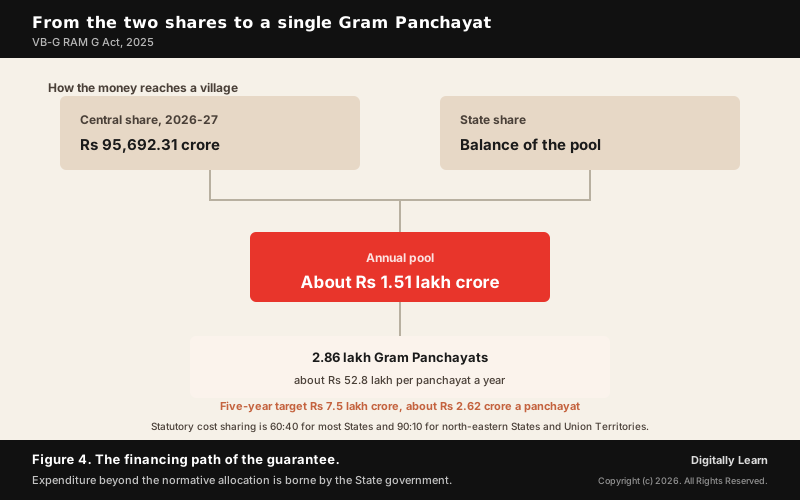
The Minister stated at the national launch that the money would reach 2.86 lakh panchayats, giving each an average of more than Rs 2 crore a year. That figure is worth handling carefully.
On the stated annual outlay, the arithmetic gives about Rs 52.8 lakh per panchayat in a year; the Rs 2 crore order of magnitude corresponds to the five-year target, which works out at about Rs 2.62 crore per panchayat. Readers should treat the higher figure as a cumulative rather than an annual flow.
The first instalment, described in official communication as the Mother Sanction, amounted to Rs 25,863 crore. States were additionally advised that they may grade their panchayats into A, B and C categories and direct larger allocations to those lagging in development, which introduces a deliberate element of intra-State redistribution.
Gram Panchayats and Gram Sabhas as the Decision-Making Core of the Act
Gram Sabha Choice of Works and Permissible Categories
The Act places Gram Panchayats at the centre of implementation, and the choice of works rests with the Gram Sabha rather than with the Union or the State capital. The stated principle is that the village decides what is built in the village, whether that is an Anganwadi, a school, a hospital, a road, a farm road, a structure for a Farmer Producer Organisation, a pond, a check dam or a protective wall against natural disasters.
The work categories the Act emphasises are durable asset creation, natural resource management, water conservation, agriculture and allied activities, rural infrastructure, women's empowerment through Self Help Groups, convergence with flagship rural development programmes, and technology-enabled transparent governance. The emphasis on durable assets is the clearest continuity with the design logic of the previous statute.
Constitutional Basis: Part IX and the Eleventh Schedule
The Act's decision rights sit on an existing constitutional foundation. Part IX of the Constitution, inserted by the Seventy-third Amendment, provides for the devolution of powers and responsibilities to Panchayats, both for the preparation of plans for economic development and social justice and for implementation in relation to the 29 subjects listed in the Eleventh Schedule.
The same amendment provides for the appointment of a State Finance Commission to make recommendations regarding the financial powers of Panchayats, and for the constitution of a District Planning Committee. Those two bodies set the fiscal and planning context in which a village body decides anything at all.
Programme funds are not the only money a Panchayat commands, and the distinction matters when judging its autonomy. The Seventy-third Amendment gives Panchayats the ability to levy and collect appropriate taxes, duties, tolls and fees. That own-source revenue sits alongside State devolution and Finance Commission transfers, and it is the part of a Panchayat's budget that does not arrive as a grant.
Administrative Machinery: The Nine Per Cent Cost Ceiling and the Field Staff It Funds
The Nine Per Cent Administrative Ceiling and Field Staff
Administrative expenditure has been increased from 6 per cent to 9 per cent of programme expenditure. More than Rs 13,000 crore has been earmarked within this for the salaries and facilities of Gram Rozgar Sahayaks, who are contractual workers at the Gram Panchayat level, along with mates and other field-level employees.
The reasoning offered is that the staff who record demand, supervise works and process payments must themselves be paid regularly if the guarantee is to function at the last mile. This is a structural argument rather than a welfare one. Where field staff are unpaid or irregularly paid, the recording of work demand is the first function to fail, and an unrecorded demand cannot mature into either employment or an unemployment allowance.
Rollout and Early Implementation: A Single-Day National Transition and the States That Lagged
State Readiness, the Andhra Pradesh Launch and First Review
State readiness was assessed before commencement at the Rashtriya Gramin Vikas Sammelan. At that stage 29 States and Union Territories had made budgetary provisions and 24 States had notified the VB-G RAM G State Scheme. The national launch was held on 2 July 2026 at Mukkavaripalli village in Obulavaripalle Mandal, Tirupati district, Andhra Pradesh.
The Ministry's own comparison is instructive on pace. The previous statute took nearly three years to be implemented across the country, whereas VB-G RAM G was rolled out nationwide in a single day. Andhra Pradesh received a special central allocation of Rs 7,707 crore for a nine-month period, and its notified wage was set between Rs 312 and Rs 315.
Early performance was uneven across States. Andhra Pradesh, Kerala and Rajasthan were noted for generating a large number of employment opportunities on the first day. Odisha and West Bengal were urged to begin works in the remaining Gram Panchayats, and Jharkhand was asked to notify the scheme and make the necessary budgetary provisions. Some States had yet to complete Reserve Bank of India account formalities.
Convergence, Durable Assets and Climate Work: Where Parliament Wants the Act to Reach
Joint Convergence Guidelines and the Standing Committee Recommendation
The Act carries Joint Convergence Guidelines that allow its works and funds to be combined with other rural development programmes. The Department-related Parliamentary Standing Committee, in its 412th Report, treated these guidelines as a potentially significant vehicle for embedding forest fire prevention within the rural livelihood and employment guarantee architecture.
The Committee's recommendation was specific. It proposed that a fixed minimum share of convergence funds be ring-fenced for fire-prone districts rather than the allocation being left entirely to State discretion. It further suggested that pirul collection, the gathering of pine needles that form the fuel load in Himalayan forest fires, be listed as extreme-weather-mitigation work under the Act and its guidelines, which would shift part of that labour cost to central allocation.
Read against current policy, this indicates how the Act is expected to function beyond wage payment. An employment guarantee directed at fuel-load reduction, water conservation and watershed work becomes an instrument of climate adaptation financed through a labour entitlement. The same convergence logic connects the Act to Self Help Group mobilisation, rural road and housing programmes, and drinking water and sanitation works.
Person-Days Generated Under the Previous Programme: A Five-Year Record
The Ministry Annexure on Employment Generated Before the Act
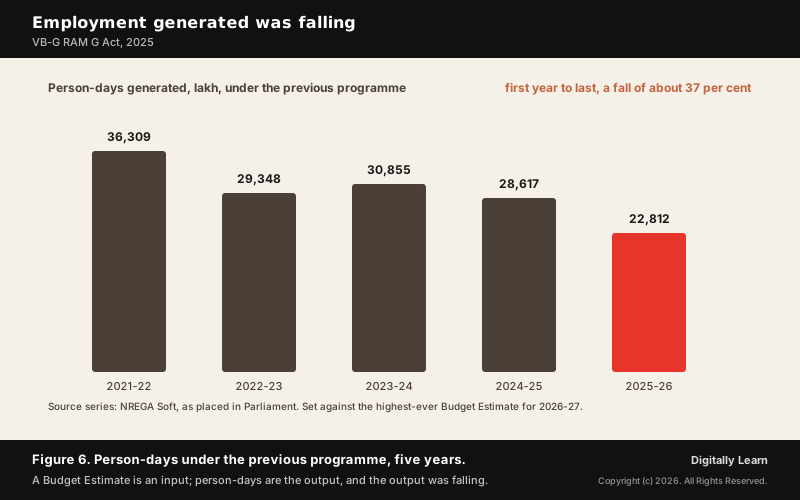
A budget figure means little without the quantity of work it bought. The Ministry's own answer in Parliament carries a State-wise annexure of person-days generated under the previous programme, and the national totals fall over the period. In lakh person-days the series runs 36,309.03, then 29,347.68, then 30,854.86, then 28,617.08, and then 22,812.1 across the last five financial years, drawn from NREGA Soft.
That is a decline of roughly 37 per cent in employment actually generated. Set beside it is the Ministry's description of the new Act's central share as the highest-ever Budget Estimate for rural employment. The two facts sit at different ends of the same question: a Budget Estimate is an input, person-days are the output, and the previous programme's output was falling. Whether the VB-G RAM G Act reverses that is the measure by which it should be judged.
The annexure also shows how uneven the programme became across States. West Bengal falls from 3,642.27 lakh person-days to 378.75, then to 1.65, and then to zero in the last two years, while Rajasthan, Uttar Pradesh and Tamil Nadu remain among the largest generators throughout. A national average conceals a distribution in which some States effectively stopped using the programme altogether.
Read against the wage revision, this is the benchmark against which the Rs 300 interim base wage should also be read. A higher notified wage raises the value of a day worked, but it does not by itself raise the number of days demanded or sanctioned. The two levers are separate, and the Act moves the wage lever with more certainty than the employment lever.
Parliamentary Criticism and the Contest Over Normative Allocation
Objections on Funding, State Burden and the Renaming
The passage of the Bill generated significant debate. Opposition parties criticised three things in particular: the replacement of MGNREGA itself, the removal of Mahatma Gandhi's name from the legislation, and the shift from a demand-driven funding model to normative allocations. Following that controversy, the government introduced a separate Mahatma Gandhi Gram Swaraj scheme directed at khadi, handloom and handicraft.
Members of the Indian National Congress, the Left parties and other opposition groups argued that the Bill could weaken the legal guarantee of employment and impose a greater financial burden on States. Economists and civil society representatives expressed concern that the revised framework could reduce effective access to guaranteed employment. The government defended the Act as a modernisation that strengthens guarantees, improves asset creation and aligns employment generation with long-term development planning.
Unresolved Questions on Allocation, Suspension and Demand Recording
The substance of the criticism can be stated without taking a side, because it turns on the architecture rather than on intent. A guarantee funded by demand obliges the exchequer to meet whatever work is sought. A guarantee funded by a normative allocation fixes the sum first, and where demand exceeds it the residual falls on the State. Whether that changes what a household actually receives is an empirical question, and it is the central one to watch.
The 60-day suspension window raises a second question. Sowing and harvesting are the periods when farm wages are highest and distress is lowest, so suspension in those weeks may be defensible. They are also the weeks when a landless household without farm work has the fewest alternatives. The practical effect will depend on which 60 days each State notifies and on how narrowly it draws them.
A third question concerns the recording of demand. Raising the administrative ceiling to 9 per cent funds the field staff who register work demand, but registration is precisely where a guarantee is most easily suppressed. Whether the higher ceiling improves the recording of demand, or only the processing of work already sanctioned, is a question the mandated social audits and the Management Information System should be able to answer.
Two further limits are visible in the official record. Notification was incomplete at commencement, with 24 States having notified the State Scheme and Jharkhand still being asked to notify and budget. The Rs 300 figure is described as an interim base wage, so the durable method for fixing and revising the floor remains to be settled.
UPSC Relevance: GS-II Welfare Architecture, GS-III Rural Economy and the Prelims Pointers
Where the Act Sits in the GS-II and GS-III Syllabus
In GS Paper II, the Act falls under welfare schemes for vulnerable sections, the mechanisms and laws constituted for the protection of those sections, and issues relating to the development and management of social sector services. It is also directly relevant to the devolution of powers and finances to local levels, because the choice of works rests with the Gram Sabha and funds flow to 2.86 lakh panchayats.
In GS Paper III, the Act is examinable under inclusive growth, employment and government budgeting. The Rs 1.51 lakh crore annual expenditure, the 40 per cent State share and the Rs 7.5 lakh crore five-year target are fiscal facts with implications for Centre-State financial relations. The convergence provisions connect it to disaster management and to climate adaptation.
For Prelims, the reliable pointers are the commencement date of 1 July 2026, the increase from 100 to 125 days, the Rs 300 interim base wage against the earlier Rs 241 floor, the increase in administrative expenditure from 6 to 9 per cent, and the replacement of the job card by the Gramin Rozgar Guarantee Card. For Mains, the productive framing compares a legal entitlement with a budgetary allocation, and asks what makes a guarantee enforceable in practice.
Previous Year UPSC-CSE Questions By the end you will be able to draft model answers for the following UPSC questions. Each question carries a collapsible framework showing how to approach it in the exam.
- UPSC Mains 2018 GS-IIAssess the importance of the Panchayat system in India as a part of local government. Apart from government grants, what sources the Panchayats can look out for financing developmental projects?
How to structure the answer in the exam
Introduction: Open with Part IX and the Eleventh Schedule, and state that the importance of Panchayats turns on the gap between assigned functions and controlled finances.
Body (sub-themes to develop):
- Constitutional foundation: Part IX and the Seventy-third Amendment, the Eleventh Schedule's 29 subjects, and the Gram Sabha as the deliberative body of the village.
- Assessment of importance: the VB-G RAM G Act, 2025 places the choice of works with the Gram Sabha and requires Viksit Gram Panchayat Plans, which is devolution of decision rather than of funds alone.
- Own-source revenue, which is what the question asks for: the Seventy-third Amendment gives Panchayats the ability to levy and collect appropriate taxes, duties, tolls and fees.
- Devolved transfers: State Finance Commission recommendations on the financial powers of Panchayats, which are grants and therefore outside the question's scope but needed to frame the gap.
- Programme-linked flows: under VB-G RAM G funds reach 2.86 lakh panchayats, averaging about Rs 52.8 lakh per panchayat a year on the annual pool and about Rs 2.62 crore across the five-year target.
- Constraints: dependence on tied grants, weak local tax collection, staff vacancies, and the capacity limits that decide whether a Gram Sabha can plan and execute at all.
Conclusion: Conclude that the importance of Panchayats rests less on functions assigned than on money and staff commanded, and that statutes routing both decision and finance to the village are the practical test of Part IX.
- UPSC Prelims 2006Consider the following statements in respect of the National Rural Employment Guarantee Act, 2005:
- Under the provisions of the Act, 100 days of employment in a year to every household whose adult members volunteer to do unskilled manual work has become a fundamental right.
- Under the provisions of the Act, women are to get priority to the extent that one-half of persons who are given employment are women who have asked for work.
Which of the statements given above is/are correct?
How to approach this Prelims question
Approach: Separate the legal character of the guarantee from its numerical content, then check each figure.
Trap to watch: Statement 1 calls the guarantee a fundamental right. It is a statutory right, not a fundamental right. Statement 2 says one-half of persons employed must be women; the 2005 Act provided that at least one-third of beneficiaries be women.
Key facts to recall:
- Under the 2005 Act the guarantee was 100 days per household per financial year, and under the VB-G RAM G Act, 2025 it is 125 days.
- The entitlement is a statutory right enforceable against the administration, not a fundamental right under Part III.
- The 2005 Act's women's provision was at least one-third of beneficiaries, not one-half.
Answer signal: Both statements are wrong, so the answer is Neither 1 nor 2.
- UPSC Prelims 2011Among the following who are eligible to benefit from the “Mahatma Gandhi National Rural Employment Guarantee Act”?
How to approach this Prelims question
Approach: Ask what unit the entitlement attaches to and whether any group is excluded.
Trap to watch: Three options narrow eligibility by caste, poverty line or backwardness. The guarantee has never been targeted in that way.
Key facts to recall:
- Eligibility rests on adult members of any rural household volunteering for unskilled manual work.
- The entitlement attaches to the household, not to the individual, and the VB-G RAM G Act retains that basis.
Answer signal: Eligibility is universal among rural households, so the answer is adult members of any household.
Sources
- VB-G RAM G Act to Come into Force from July 1, 2026
- Government Notifies Revised Wage Rates under the VB-G RAM G Act, 2025
- Nationwide launch of the Viksit Bharat Guarantee for Rozgar and Ajeevika Mission (Gramin)
- First Installment of Rs 25,863 Crore Released to States
- Employment Generation under VB-G RAM G Scheme
- Press release on the 412th Report of the Department-related Parliamentary Standing Committee
- President gives assent to the VB-G RAM G Bill, 2025
- Viksit Bharat-Guarantee for Rozgar and Ajeevika Mission (Gramin) Act, 2025
- Mahatma Gandhi National Rural Employment Guarantee Act, 2005
- President Murmu assents to VB-G RAM G Bill, 2025
- Panchayati raj in India
Editorial Disclaimer
This briefing is prepared for examination preparation. Readers should consult the Act and official notifications for authoritative provisions.


