


Overview
An Aadhaar-seeded database, a Universal Account Number and a nationwide e-Shram card
Launched on 26 August 2021 by the Ministry of Labour and Employment, e-Shram is the national database of unorganised workers, giving each informal worker a Universal Account Number and an e-Shram card that carries social security across states and schemes.
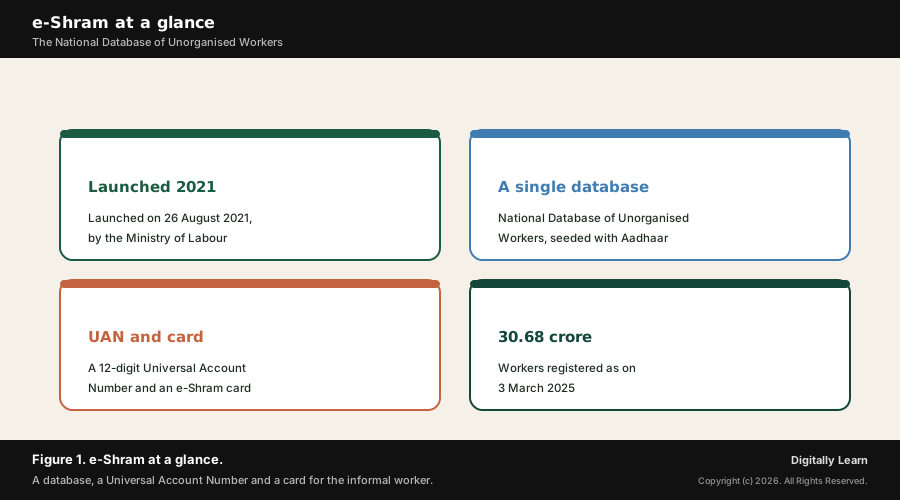
e-Shram is the first National Database of Unorganised Workers, launched on 26 August 2021 by the Ministry of Labour and Employment and seeded with Aadhaar. It registers India's unorganised workers, from construction labour and farm hands to domestic workers, street vendors, migrant workers and gig and platform workers, and gives each a 12-digit Universal Account Number on a self-declaration basis along with a nationwide e-Shram card. The card carries a built-in accident insurance cover and is designed to become the single window through which social security reaches the informal worker, with over 30.68 crore workers registered as on 3 March 2025.
What e-Shram Is: The 26 August 2021 National Database of Unorganised Workers
The 26 August 2021 launch by the Ministry of Labour and Employment, the National Database of Unorganised Workers seeded with Aadhaar, and the Universal Account Number and the e-Shram card
e-Shram is the first National Database of Unorganised Workers, launched on 26 August 2021 by the Ministry of Labour and Employment. Its purpose is to identify and register every worker in the informal economy, from the construction labourer and the farm hand to the domestic worker, the street vendor and the platform delivery rider. The database is seeded with Aadhaar, so that each worker is uniquely identified across the country.
On registration, every worker receives a 12-digit Universal Account Number, granted on a self-declaration basis, and a nationwide e-Shram card that is valid in any State. The Ministry has described e-Shram as the world's largest database of unorganised workers, covering migrant, construction, gig and platform workers within a single record. The card is meant to follow the worker, not the workplace, which matters most for those who move for work.
What is the significance of this database is that it treats the informal worker as a countable, reachable citizen for the first time. Before e-Shram, there was no single list of the unorganised workforce, so welfare often missed those it was meant to help. By giving each worker a Universal Account Number and a card, e-Shram builds the foundation on which targeted, portable social security can be delivered. The figure below sets out e-Shram at a glance.
Why India Needs a Database of Unorganised Workers: An Informal Majority Without a Record
The overwhelmingly informal workforce of about 43.99 crore, the absence of a single record, the invisibility exposed during the pandemic, and the need to track migrant workers and make benefits portable
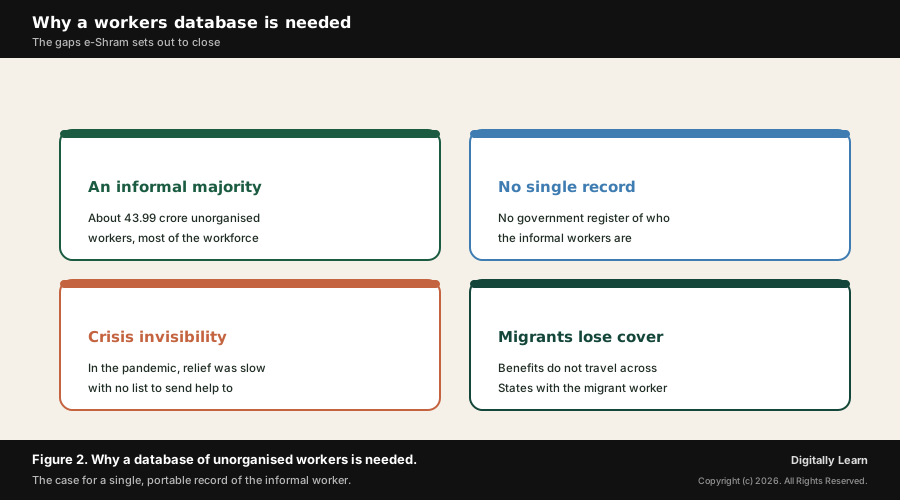
India's workforce is overwhelmingly informal. By the Economic Survey 2021-22, about 43.99 crore people worked in the unorganised sector in 2019-20, and by the World Bank's account more than 90 per cent of Indian workers have long been informal. These workers carry no formal contract, no provident fund and, until recently, no entry in any government register, so the State could not easily see them or serve them.
Why it matters is that invisibility becomes dangerous in a crisis. When the pandemic struck and work stopped, governments had no list of informal workers to whom relief could be sent, so help reached them slowly and unevenly. The problem is sharpest for the migrant worker, who moves between States and loses access to local welfare on the way; without a portable record, the ration, the pension and the insurance do not travel with the worker.
What is the significance of this gap is that it defines what a database must do. The informal worker needs a single, portable identity that any State and any scheme can read, so that recognition in one place is recognised everywhere. e-Shram is built to supply exactly this: one record, one Universal Account Number and one card, against which social security can be attached and carried. The figure below sets out why such a database is needed.
Who Is Eligible and What They Receive: The 16 to 59 Unorganised Worker, the UAN and the Card
The eligibility conditions of age 16 to 59, work in the unorganised sector, and exclusion of EPFO or ESIC members and income-tax payers, set against the 12-digit Universal Account Number and the nationwide e-Shram card, and how e-Shram sits beside EPFO and ESIC
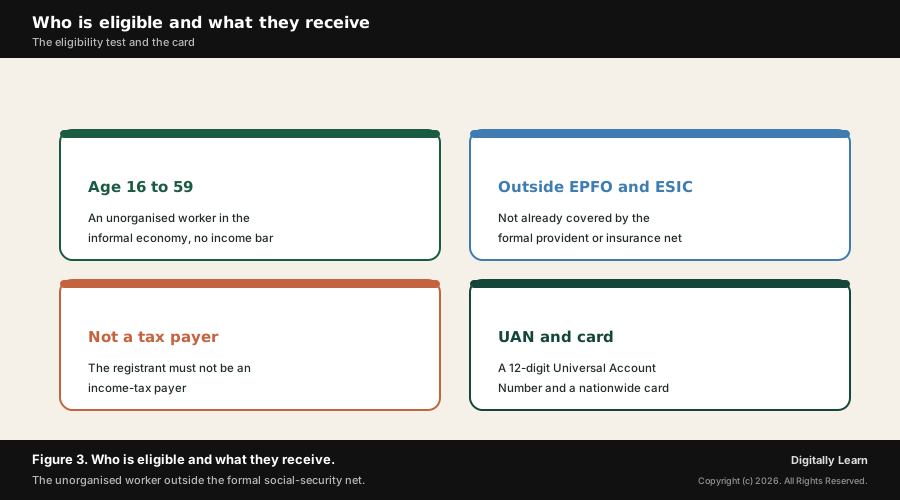
Eligibility is drawn to fit the informal worker. The applicant must be an unorganised worker aged between 16 and 59 years, working in the informal economy on a wage or self-employed basis. There is no income ceiling for registration, because the aim is to capture every informal worker, however small the earnings.
Two exclusions mark the boundary of the formal sector. A registrant must not be a member of the EPFO or the ESIC, the contributory provident-fund and health-insurance bodies that already cover organised-sector employees, and must not be an income-tax payer. In effect, e-Shram is built for those who fall outside the formal social-security net, the workers whom the Employees' Provident Fund Organisation and the Employees' State Insurance Corporation do not reach. To register, the worker needs an Aadhaar number linked to a mobile, and a bank account.
What is the significance of these rules is that they keep e-Shram focused on the uncovered worker. Each registrant receives a 12-digit Universal Account Number and an e-Shram card valid across the country, a single identity that any State or scheme can verify. The card is the worker's passport into welfare, which is why the eligibility test turns on whether the worker is already protected elsewhere. The table contrasts e-Shram with the EPFO and the ESIC, and the figure sets out who is eligible and what they receive.
| Feature | e-Shram (National Database of Unorganised Workers) | EPFO and ESIC |
|---|---|---|
| Whom it serves | Unorganised workers aged 16 to 59 outside the formal net | Organised-sector employees in covered establishments |
| Nature | A registration database and identity, not a contributory fund | Contributory provident-fund, pension and health-insurance bodies |
| Worker pays | Nothing; registration is free and self-declared | A monthly contribution deducted from wages, matched by the employer |
| What it gives | A Universal Account Number, an e-Shram card and a gateway to welfare schemes | Provident fund and pension (EPFO) and medical and cash benefits (ESIC) |
| Administering body | Ministry of Labour and Employment | EPFO and ESIC, statutory bodies under the same Ministry |
Sectors and Occupations Covered: Construction, Agriculture, Domestic, Gig, Street Vending and Migrant Work
The National Classification of Occupations basis and the broad sectors of work covered, from construction and agriculture to domestic work, street vending, gig and platform work, transport and migrant labour
e-Shram aims to be comprehensive, so it spreads across the whole of the informal economy. At registration the worker selects an occupation, classified under the National Classification of Occupations, which lets the database sort workers by the work they actually do. The same occupation also signals the skill and the sector, so the record is useful for both welfare and job matching.
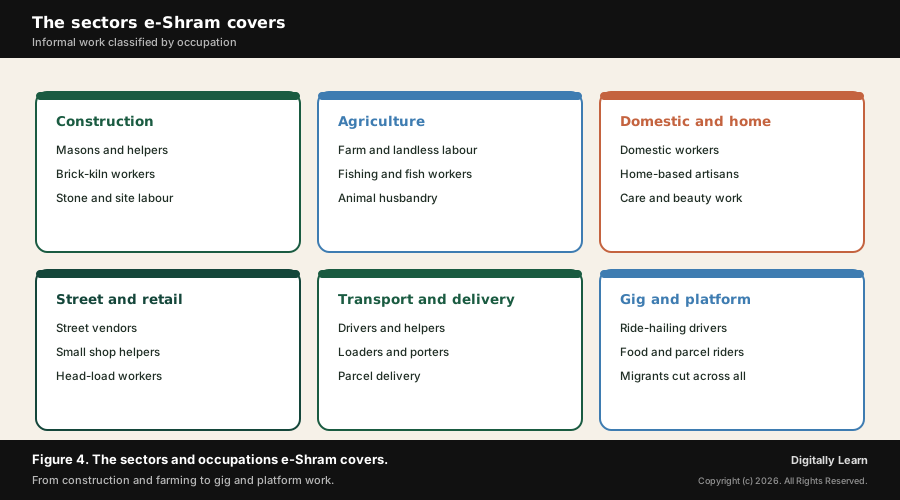
The work covered spans many sectors. It includes construction and brick-kiln labour; agriculture, fishing and animal husbandry; domestic and home-based work; street vending and small retail; transport, loading and delivery; and the fast-growing gig and platform work of ride-hailing and food and parcel delivery. Migrant workers, who often move between these sectors and across States, are a particular focus, because their need for a portable record is the greatest.
What is the significance of this breadth is that it lets one database serve a highly varied workforce. A single record that holds the mason, the farm hand, the domestic worker and the delivery rider together makes it possible to direct a scheme at a chosen group, by sector, occupation or location. The breadth is also why e-Shram can act as a bridge to skilling and employment services, not welfare alone. The figure groups the sectors that e-Shram covers.
How a Worker Registers: Self-Registration, the Common Service Centre, Aadhaar Seeding and Bank Linkage
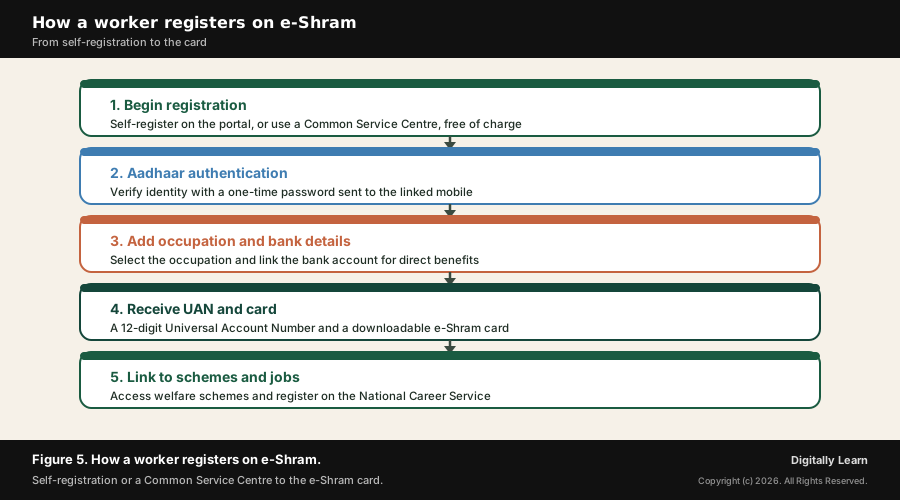
The free self-registration on the portal and the assisted Common Service Centre route, the Aadhaar one-time-password seeding, the mobile and bank-account linkage, and the issue of the Universal Account Number and the e-Shram card
Registration is meant to be simple and free. A worker can register directly on the e-Shram portal by self-declaration, or take the assisted route at a Common Service Centre, where an operator enrols the worker for those who lack a smartphone or the confidence to do it alone. No fee is charged at either route, which matters for workers on thin earnings.
The core of the process is Aadhaar seeding. The worker's Aadhaar number is authenticated through a one-time password sent to the linked mobile, after which basic details are pulled in and the worker adds occupation, address and bank details. Linking the bank account at this stage is what later allows benefits to be paid directly. On completion, the worker is issued a 12-digit Universal Account Number and can download the e-Shram card at once.
What is the significance of this design is that it lowers the barrier to entry while keeping the record clean. Self-registration scales fast and cheaply, the Common Service Centre reaches those who are offline, and Aadhaar authentication prevents duplicates so each worker appears once. The same Universal Account Number then lets the worker register on the National Career Service for jobs, so the database doubles as a doorway to employment services. The figure traces the registration flow.
The Benefits and the Accident Insurance: The PMSBY Cover and the 2024 One Stop Solution
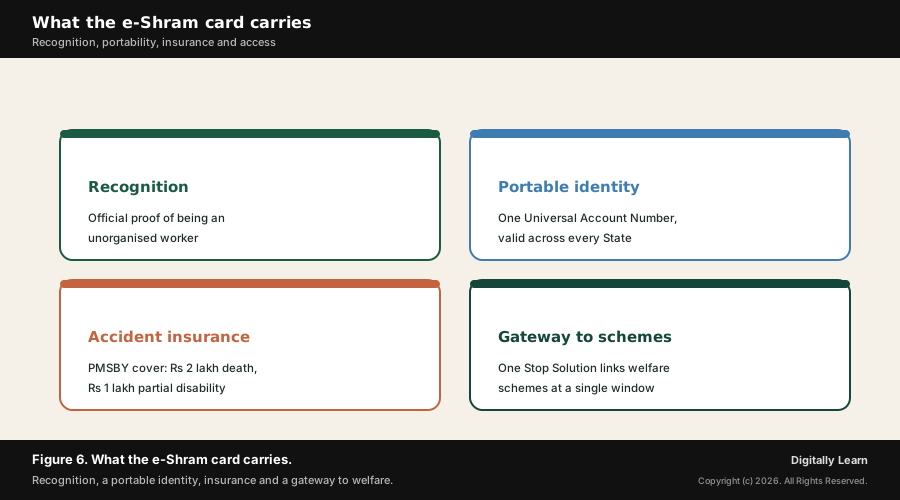
The recognition and portable identity the card gives, the built-in accident insurance under the Pradhan Mantri Suraksha Bima Yojana of Rs 2 lakh on accidental death and Rs 1 lakh on partial disability, and the 2024 e-Shram One Stop Solution that integrates welfare schemes at a single window
The e-Shram card carries more than an identity. Its first value is recognition: the worker now holds an official, nationwide proof of being an unorganised worker, which is the precondition for claiming any targeted benefit. Because the card is read by a single Universal Account Number, that recognition travels with the worker from one State to another.
The card also carries a built-in accident insurance cover. Registered workers are linked to the Pradhan Mantri Suraksha Bima Yojana, which pays Rs 2 lakh on accidental death or full disability and Rs 1 lakh on partial disability, the most basic protection for a worker whose income depends on physical work. In October 2024 the Ministry launched the e-Shram One Stop Solution, which brings multiple social-security and welfare schemes onto a single portal so a registered worker can see and reach them in one place.
What is the significance of these benefits is that they turn a list into a gateway. The database is most useful not for what it pays directly, which is modest, but for what it can unlock: a pension, a life and accident cover, a job search and State welfare-board benefits, each attached to the same record. The One Stop Solution is the attempt to make that gateway real, so the worker meets one window rather than many. The figure sets out what the e-Shram card carries.
Gig and Platform Workers and the Code on Social Security, 2020
The recognition of gig and platform workers, the Code on Social Security 2020 provisions and the aggregator-funded Social Security Fund, and e-Shram as the registration and portability backbone for platform workers, alongside the schemes a worker can reach through the database
A defining recent use of e-Shram is for gig and platform workers. The Code on Social Security, 2020 was the first Indian law to define a gig worker and a platform worker and to provide for their social security, covering accident and life cover, health and maternity benefits and old-age protection. The Code came into force on 21 November 2025, giving these provisions statutory teeth.
The Code creates a distinctive funding model. Platform aggregators, the ride-hailing, delivery and services apps, are required to contribute between 1 and 2 per cent of their annual turnover, capped at 5 per cent of the amount paid to workers, into a Social Security Fund. e-Shram is the registration and identity rail for this design: each gig or platform worker gets an Aadhaar-linked Universal Account Number, so the benefits a fund pays can be made portable across apps rather than tied to one employer.
What is the significance of this link is that it shows how a database becomes policy infrastructure. Without a register of platform workers, an aggregator levy has no clean way to reach the worker; with e-Shram, the contribution can be matched to a verified identity that follows the worker. This is the clearest case of e-Shram acting not as a welfare scheme in itself but as the backbone on which new social-security schemes are built. The table lists the main schemes a registered worker can reach through e-Shram.
| Scheme (nodal) | What it provides | Who it is for |
|---|---|---|
| PM Shram Yogi Maan-dhan (Labour and Employment) | A minimum pension of Rs 3,000 a month after the age of 60 | Unorganised workers aged 18 to 40 earning up to Rs 15,000 a month |
| Pradhan Mantri Suraksha Bima Yojana (Finance) | Accident cover of Rs 2 lakh on death, Rs 1 lakh on partial disability | The e-Shram card carries this built-in accident insurance |
| Pradhan Mantri Jeevan Jyoti Bima Yojana (Finance) | Life insurance cover of Rs 2 lakh on death from any cause | Account holders aged 18 to 50 who opt in |
| National Career Service (Labour and Employment) | A job-search and placement platform linked through the UAN | Workers seeking employment and skilling links |
| e-Shram One Stop Solution (Labour and Employment) | A single window that integrates multiple welfare schemes | All registered unorganised workers |
Who Runs and Funds e-Shram: The Labour Ministry, the Delivery Rails and the Legal Backbone
The Ministry of Labour and Employment as owner, the National Informatics Centre and Common Service Centres as delivery rails, the Unorganised Workers' Social Security Act 2008 and the Code on Social Security 2020 as the legal backbone, and convergence with State welfare boards and other ministries
e-Shram is owned and run by the Ministry of Labour and Employment, which sets the rules, holds the database and links it to schemes. The portal and its data are built and maintained on the government's technology rails, with the National Informatics Centre providing the digital infrastructure and the network of Common Service Centres handling assisted, last-mile registration in villages and small towns.
The database rests on a legal backbone. The idea of a national register of informal workers was first mandated by the Unorganised Workers' Social Security Act, 2008, which provided for social-security schemes and a worker identification number. That intent was carried forward and widened by the Code on Social Security, 2020, which subsumes the 2008 Act and explicitly provides for registering unorganised, gig and platform workers, making e-Shram the practical expression of the Code's promise.
What is the significance of this architecture is that delivery depends on convergence, not on the Labour Ministry alone. The database is most powerful when other actors read it: the State welfare boards for construction and other workers, the Finance Ministry for insurance, and several ministries that run schemes for the poor. e-Shram is therefore a shared public good whose value rises as more schemes plug into it, and falls where they do not. The strength of the system is set by its weakest convergence link.
e-Shram at Scale: Registration, the Women's Share and Coverage by Early 2025
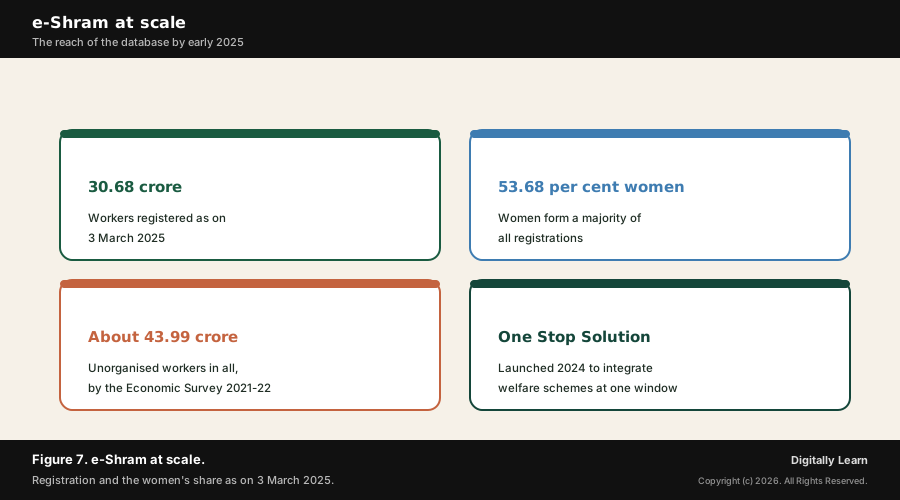
The over 30.68 crore workers registered as on 3 March 2025, the 53.68 per cent women's share of registrations, and what the numbers say about the reach of the database against the size of the unorganised workforce
e-Shram has scaled to a vast register. As on 3 March 2025, more than 30.68 crore unorganised workers had registered, making it one of the largest welfare databases anywhere. Registration crossed ten crore within the first hundred days of launch, a pace that reflects strong demand among informal workers for an official identity and a route to benefits.
A striking feature is the women's share. Of the registered workers, about 53.68 per cent are women, a majority, which reflects the heavy presence of women in domestic work, agriculture, home-based work and care work. Read against the Economic Survey's estimate of around 43.99 crore unorganised-sector workers, the register already covers a large part of the informal workforce, though some way short of the whole.
What is the significance of the numbers is that they show reach running ahead of delivery. Registering more than thirty crore workers is a genuine administrative feat, yet a number on a database is not the same as a benefit in a hand. The real test is not how many cards are issued but how many registered workers actually draw a pension, an insurance payout or a portable State benefit through the record. The figure sets out e-Shram at scale.
Limits and Criticisms: Registration Is Not Benefit Delivery, Digital Exclusion and Dormant Cards
The gap between a database and delivered social security, the Aadhaar and digital exclusion of the poorest workers, the problem of dormant and out-of-date records, and the thin direct benefit attached to the card
Judged honestly, e-Shram faces real limits. The deepest is the gap between a database and delivery: registration creates a record, not an entitlement, and a worker can hold an e-Shram card yet receive no new benefit, because the card mainly points to schemes that have their own separate eligibility and enrolment. A list of workers is necessary for social security, but it is far from sufficient.
Two further gaps stand out. The scheme depends on Aadhaar, a mobile and a bank account, so the very poorest and most remote workers, who lack one of these, can be excluded at the door, the digital divide reappearing inside a welfare tool. Records also go stale: a worker's occupation, address or phone number changes, and a card that is never updated becomes a dormant entry that cannot reliably receive a benefit. Self-declared data, unverified against employment, can also be patchy.
What is the significance of these criticisms is that they show why a register alone does not secure a worker. The hard part is not enrolment, which is quick and easy to count, but the steady work of attaching a real pension, insurance payout or portable benefit to each living record and keeping it current. e-Shram will be judged not by the count of cards but by the social security actually delivered through them.
Significance for Social Security: Turning an Invisible Workforce into a Securable One
How a single Aadhaar-seeded database makes the informal worker visible and securable, how it advances inclusion of the unorganised workforce, and how it links to old-age security through the PM Shram Yogi Maan-dhan pension
The deeper purpose of e-Shram, and the heart of the social-security debate, is to make the informal worker visible so that the State can finally reach the workers it has long missed. For most of India's history the unorganised worker was a statistic without a name; a single Aadhaar-seeded database turns that statistic into an addressable citizen with a record, an account number and a card.
What is the significance of this for the informal economy is that visibility is the first step to inclusion. Once a worker is on the register, a pension, an insurance cover or a portable benefit can be attached to the same identity; the e-Shram link to the PM Shram Yogi Maan-dhan pension, which promises Rs 3,000 a month after the age of 60 to unorganised workers, shows how the database can carry old-age security to those who never had it. The model is to recognise first, then connect the worker to schemes that protect.
Read this way, e-Shram is one strand of India's attempt to build a social-security floor for the informal majority. It sits alongside the Jan Suraksha insurance and pension schemes and the Code on Social Security, 2020, and it speaks to debates on the formalisation of work, the protection of migrant and platform workers and the design of a State that can see and serve its poorest workers. The promise is real, but it rests on turning a register into delivered protection.
The Way Forward: From a Database to Delivered, Portable Social Security
Closing the registration-to-benefit gap, keeping the database current, deepening scheme convergence and benefit portability, reaching the digitally excluded, and tracking the social security actually delivered
The task ahead is to make sure a registration becomes a delivered benefit, by strengthening the harder pieces of convergence, portability and currency of the data. The measures below set out a balanced way to deepen e-Shram without diluting its focus on the unorganised worker.
- Close the gap between registration and benefit by auto-linking each e-Shram record to the schemes a worker is eligible for, so the card delivers entitlements rather than merely pointing to them.
- Keep the database current through periodic, low-friction updates of occupation, address and bank details, and by retiring or refreshing dormant records.
- Deepen scheme convergence so that State welfare boards, the Finance Ministry insurance schemes and pension schemes such as PM Shram Yogi Maan-dhan all read and write to the same record.
- Make benefits genuinely portable for migrant workers, so that a ration, an insurance cover or a pension follows the Universal Account Number across State borders.
- Reach the digitally excluded by taking assisted registration camps to worksites and clusters and supporting workers who lack a smartphone, a linked mobile or a bank account.
- Operationalise the gig and platform worker provisions of the Code on Social Security, 2020, channelling the aggregator Social Security Fund to verified e-Shram identities.
- Track the social security actually delivered, not just registration counts, by measuring how many workers draw a pension, an insurance payout or a portable benefit through the record.
UPSC Relevance: GS-II Welfare Schemes, GS-III Informal Economy and the Social-Security Pointers
The GS-II and GS-III fit, the Prelims facts on the launch, the Universal Account Number, eligibility, the PMSBY cover and the PM Shram Yogi Maan-dhan pension, and the social-security framing for Mains answers on the unorganised sector
For the examination, e-Shram sits across GS-II and GS-III. It is a welfare and social-security measure for a vulnerable group, which places it in GS-II, and it is also a tool for the informal economy and the formalisation of labour, which places it in GS-III. The facts worth fixing for Prelims are the 26 August 2021 launch, the Ministry of Labour and Employment as the nodal ministry, the 12-digit Universal Account Number, the age band of 16 to 59 and the exclusion of EPFO and ESIC members and income-tax payers.
Other Prelims pointers are the built-in accident insurance under the Pradhan Mantri Suraksha Bima Yojana, of Rs 2 lakh on accidental death and Rs 1 lakh on partial disability, and the link to old-age security through the PM Shram Yogi Maan-dhan pension, which pays Rs 3,000 a month after the age of 60 to unorganised workers aged 18 to 40 who contribute. Aspirants should be able to tell e-Shram, a database, apart from these contributory schemes that pay benefits.
For Mains, e-Shram is a ready example for any answer on social security, the unorganised sector, the informalisation of work or migrant-worker welfare. A student can use it to show how a single database can make an invisible workforce visible and securable, then weigh the limits of registration without delivery, digital exclusion and dormant records, the honest balance an examiner rewards on questions about welfare delivery for the informal worker.
Previous Year UPSC-CSE Questions By the end you will be able to draft model answers for the following UPSC questions. Each question carries a collapsible framework showing how to approach it in the exam.
- UPSC Prelims 2024 GS Paper IIdentify which statements about the Pradhan Mantri Shram Yogi Maan-dhan pension for unorganised workers are correct: the entry age band, whether the beneficiary makes an age-specific contribution, the minimum pension after the age of 60, and whether family pension extends to unmarried daughters as well as the spouse.
How to approach this Prelims question
Approach: Test each statement against the scheme's design. The entry age band is 18 to 40 years, not 21 to 40, so statement 1 is wrong. The beneficiary makes an age-specific monthly contribution, matched equally by the government, so statement 2 is correct. The assured pension is a minimum of Rs 3,000 a month after the age of 60, so statement 3 is correct. Family pension goes only to the spouse, at 50 per cent of the pension, not to unmarried daughters, so statement 4 is wrong. Hence 2 and 3 only, option (b).
Trap to watch: The trap is the precise age band in statement 1. PM Shram Yogi Maan-dhan opens to unorganised workers aged 18 to 40, but the statement says 21 to 40; a near-miss number is the classic Prelims trick. Statement 4 sets a second trap by widening family pension beyond the spouse.
Key facts to recall:
- PM Shram Yogi Maan-dhan is a voluntary, contributory pension for unorganised workers earning up to Rs 15,000 a month, run by the Ministry of Labour and Employment with the Life Insurance Corporation as fund manager.
- Entry is open at ages 18 to 40; the beneficiary pays an age-specific contribution of about Rs 55 to Rs 200 a month, matched equally by the Central Government.
- The assured minimum pension is Rs 3,000 a month after the age of 60; on the subscriber's death the spouse receives 50 per cent of the pension as family pension.
- e-Shram, the database of unorganised workers, is integrated with PM Shram Yogi Maan-dhan, so the register can channel old-age security to the same workers.
Answer signal: Statements 2 and 3 describe the real design of PM Shram Yogi Maan-dhan, an age-specific contribution and a Rs 3,000 minimum pension after 60; statement 1 mis-states the age band and statement 4 over-extends the family pension, so the answer is 2 and 3 only, option (b).
Sources and Further Reading
- Ministry of Labour and Employment: about the e-Shram portal and the National Database of Unorganised Workers
- Ministry of Labour and Employment: the Pradhan Mantri Shram Yogi Maan-dhan (PM-SYM) pension for unorganised workers
- Press Information Bureau: over 30.68 crore unorganised workers registered on e-Shram, women 53.68 per cent
- Press Information Bureau: the Code on Social Security, 2020 and social security for gig and platform workers
- Ministry of Finance: Economic Survey 2021-22 on the size of the unorganised workforce
- Ministry of Statistics and Programme Implementation: the Periodic Labour Force Survey 2023-24 annual report
- International Labour Organization: the informal economy and social protection
- World Bank: a programme to protect India's informal-sector workers and make benefits portable
- Wikipedia: the unorganised sector in India
Editorial Disclaimer
This briefing is for UPSC preparation. Verify the eligibility rules, the insurance cover and the coverage figures against the official e-Shram portal, the Ministry of Labour and Employment and Press Information Bureau sources before relying on them.


