


Overview
India's flagship micro-finance scheme for the small enterprise
The Pradhan Mantri MUDRA Yojana, launched in 2015 under the Department of Financial Services, gives collateral-free institutional loans to non-farm micro and small enterprises through the Shishu, Kishore, Tarun and Tarun Plus categories, refinanced by MUDRA and backed by a credit guarantee fund to fund first-time, women and SC and ST entrepreneurs.
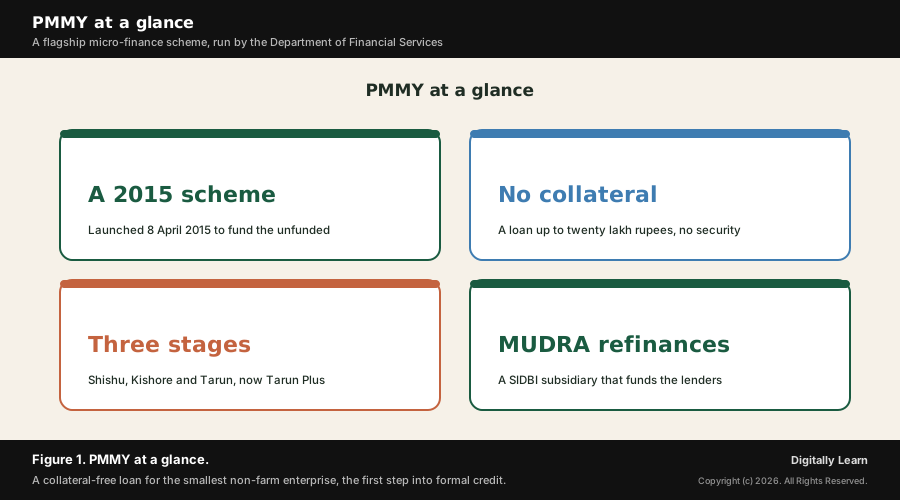
PMMY, the Pradhan Mantri MUDRA Yojana, is India's flagship micro-finance scheme, launched on 8 April 2015 to bring the unfunded small business into the formal credit system. It is run by the Department of Financial Services, and its core offer is a collateral-free loan of up to twenty lakh rupees to a non-farm micro or small enterprise in manufacturing, trading, services or activities allied to agriculture. The loans are graded by size into Shishu, Kishore, Tarun and the newer Tarun Plus stages, and they are delivered through banks, non-banking financial companies, micro-finance institutions and small finance banks. Standing behind these lenders is MUDRA, the Micro Units Development and Refinance Agency, a subsidiary of SIDBI that refinances the sector, and the Credit Guarantee Fund for Micro Units that lets banks lend without security.
What PMMY Is: A National Scheme to Fund the Unfunded Micro Enterprise
The 2015 scheme, the micro-enterprise credit gap and why collateral-free lending matters
The Pradhan Mantri MUDRA Yojana, known as PMMY, is the scheme through which the Indian state set out to give the smallest non-farm businesses access to institutional credit without demanding security against the loan. It was launched on 8 April 2015 as a flagship micro-finance scheme, run by the Department of Financial Services in the Ministry of Finance, under the guiding idea of funding the unfunded. Its target is the non-corporate, non-farm micro and small enterprise, the tea-stall, the tailor, the small workshop and the trader, that earns an income but has never qualified for a formal loan.
The problem PMMY attacks is the micro-enterprise credit gap, the long-standing failure of formal banks to lend to the smallest producers. A great many such units sit in what is often called the missing middle, too large for charity yet too small and too informal for a bank that wants collateral, audited accounts and a credit history. Why it matters is that these excluded units, denied a formal loan, were left to the moneylender, who charged ruinous rates and held the borrower in a cycle of debt, so the want of credit choked the very enterprises that create most of the country's self-employment.
Collateral-free lending, the device PMMY uses, means a loan advanced on the strength of the business itself rather than on land or gold pledged against it. By removing the demand for security, the scheme opens the door to the borrower who has a viable trade but nothing to mortgage, and it shifts the risk of default away from the lender through a separate guarantee fund examined later. By making the collateral-free loan the first step, the scheme aims to draw the informal producer into a system that can fund growth, build a credit record and end the grip of the informal lender. The figure below sets out the headline features of the scheme before the detail that follows.
The Loan Categories: Shishu, Kishore, Tarun and the New Tarun Plus Stage
The three graded stages, the Tarun Plus ceiling raised to twenty lakh and the eligible activities
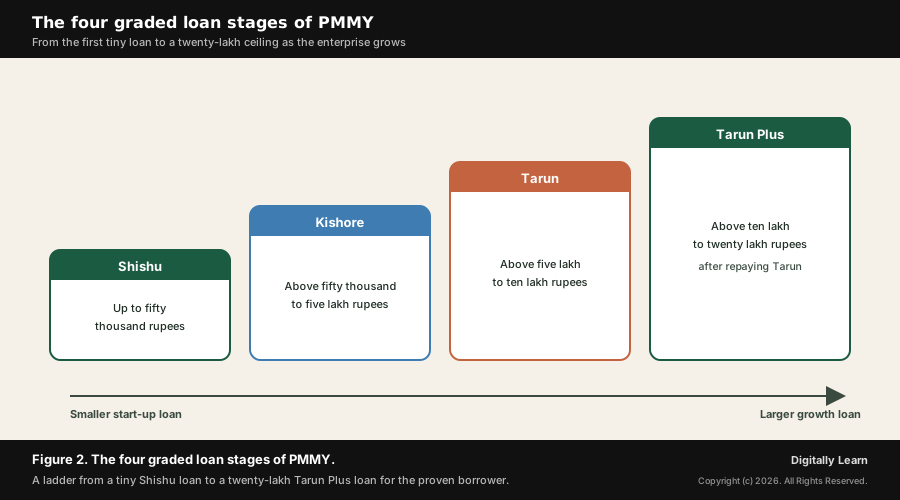
PMMY grades its loans by size into named stages, so that an enterprise can move up as it grows. The first stage is Shishu, meaning infant, which covers loans of up to fifty thousand rupees for the very smallest start-up need; the second is Kishore, meaning adolescent, which covers loans above fifty thousand and up to five lakh rupees for a unit ready to expand; and the third is Tarun, meaning young adult, which covers loans above five lakh and up to ten lakh rupees for an established small business. The graded design lets the borrower begin with a tiny loan and graduate to a larger one as the trade and the credit record mature.
The scheme was deepened in the Union Budget of 2024-25, which raised the loan ceiling from ten lakh to twenty lakh rupees and created a fourth stage, Tarun Plus, for loans above ten lakh and up to twenty lakh rupees. This higher stage is open to an entrepreneur who has already availed and repaid a loan under the Tarun stage, so it rewards a proven record and funds the borrower whose enterprise has outgrown the earlier ceiling. The raised limit answered a clear need, since a growing micro unit that had exhausted the ten-lakh cap had nowhere within the scheme to turn for its next round of working capital.
The loan is for an income-generating activity, not for consumption, and the eligible field is wide. It covers manufacturing, trading and services, and it covers activities allied to agriculture such as poultry, dairy, beekeeping, fisheries, livestock-rearing, sorting and grading, agri-clinics and food and agro-processing, while leaving crop cultivation itself to the separate farm-credit channels. The borrower is the non-corporate, non-farm micro or small enterprise, so the scheme reaches the proprietor and the partnership rather than the large company. The table below sets out the four stages, and the figure that follows maps them onto the growth of an enterprise.
| Stage | Loan size | Whom it serves |
|---|---|---|
| Shishu | Up to fifty thousand rupees | The smallest start-up need at the first step into credit |
| Kishore | Above fifty thousand and up to five lakh rupees | A unit ready to expand its trade |
| Tarun | Above five lakh and up to ten lakh rupees | An established small business |
| Tarun Plus | Above ten lakh and up to twenty lakh rupees | A borrower who has repaid an earlier Tarun loan |
The Design of the Loan: Collateral-Free Credit and the MUDRA Card
The collateral-free term loan, the working-capital MUDRA card and the absence of a fixed subsidy
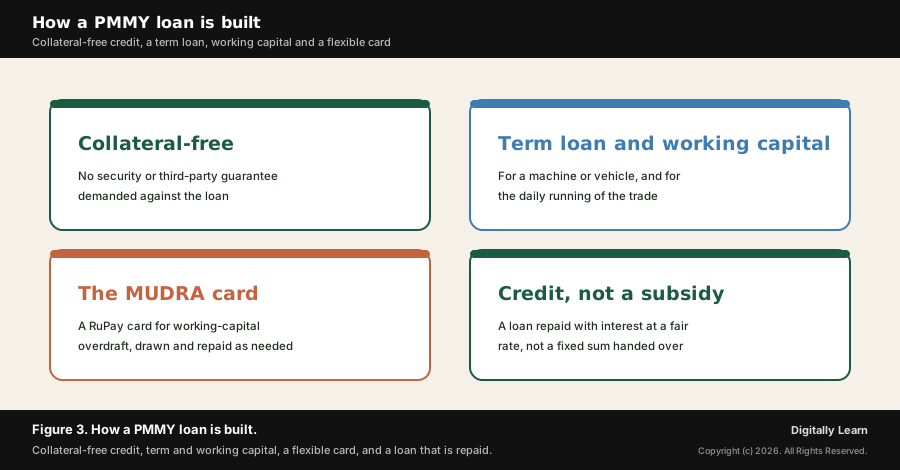
The defining feature of a PMMY loan is that it is collateral-free. The lender may not demand land, gold or any other security against the loan, nor a third-party guarantee, so a borrower with a viable trade but no asset to pledge can still be funded. The risk that the bank carries is instead absorbed by a separate guarantee fund, examined in the next section, and the loan is priced at a reasonable rate set within the lending norms of the Reserve Bank, well below the rate a moneylender would charge. This single design choice is what makes the scheme reach the borrower the formal system had always turned away.
Within this design, the scheme funds both kinds of need a small enterprise has. It gives a term loan for an asset such as a machine, a vehicle or a shop fitting, and it gives working capital for the day-to-day running of the trade, the stock and the wages and the small recurring costs. To make the working-capital side flexible, the scheme offers the MUDRA card, a RuPay debit card issued against a working-capital limit that the borrower can draw upon as an overdraft, using it at an ATM, at a business correspondent or at a point-of-sale machine, and repay as cash comes in. The card turns a fixed sanction into a revolving line the trader can manage day by day.
It is important to read PMMY for what it is and is not. It is a credit scheme, not a grant or a subsidy programme: the borrower receives a loan that must be repaid with interest, not a fixed sum handed over. Its generosity lies not in free money but in access, in giving the unfunded a loan at a fair rate without the collateral that had locked them out. This distinction matters in the exam and in policy, because it places PMMY among the instruments that build institutional credit for the poor rather than among the direct-transfer welfare schemes. The figure below sets out how the loan is built.
The Institutional Architecture: MUDRA, SIDBI, the Lending Channels and the Guarantee Fund
MUDRA the SIDBI refinance body, the banks NBFCs MFIs and small finance banks, and the Credit Guarantee Fund for Micro Units
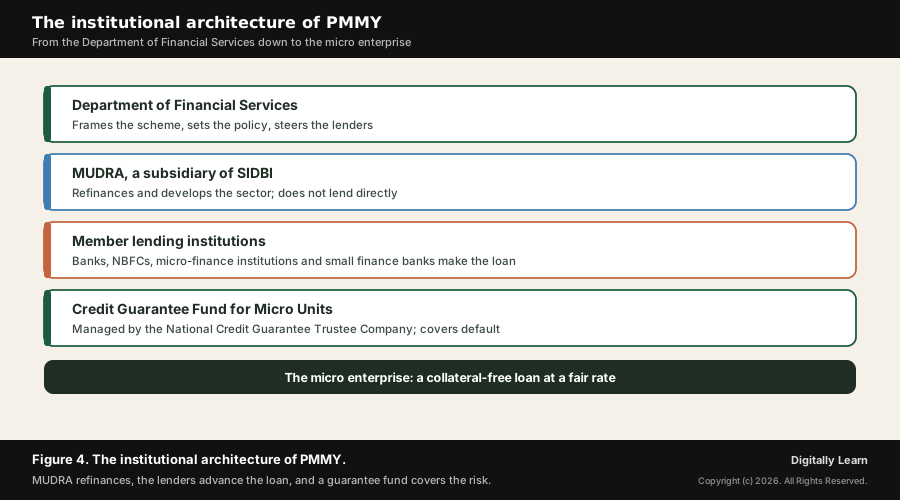
PMMY is delivered through a chain that the borrower never sees in full. At the top, the Department of Financial Services, the wing of the Ministry of Finance that oversees banking, frames the scheme and steers the lenders that carry it out. Below it stands MUDRA, the Micro Units Development and Refinance Agency, set up on 8 April 2015 as a wholly owned subsidiary of the Small Industries Development Bank of India, the SIDBI, the national development bank for small industry. MUDRA was created to develop and refinance the whole micro-enterprise sector, and it carries the guiding promise of funding the unfunded that gives the scheme its name.
It is essential to grasp what MUDRA does and does not do. MUDRA is a refinancing institution; it does not lend directly to the entrepreneur. The actual loan is made by a member lending institution, and MUDRA provides those lenders with low-cost funds and development support so they can lend more cheaply to the micro unit. The lenders are of four broad kinds: the banks, including public-sector banks, regional rural banks and small finance banks; the non-banking financial companies; and the micro-finance institutions that specialise in tiny loans to the poor. Through this spread of channels, the scheme reaches the borrower wherever a formal lender of some kind can be found, in the city and the village alike.
The collateral-free promise is made workable by the Credit Guarantee Fund for Micro Units, the CGFMU, created to stand behind the loans. The fund is managed by the National Credit Guarantee Trustee Company, a government-owned trustee, and it guarantees the eligible micro-loans against default so that a lender who advances a loan without security is still protected if the borrower cannot repay. The guarantee is given on a portfolio basis rather than loan by loan, covering a defined share of the default in a lender's whole book of micro-loans, which lets the bank lend to many small borrowers while holding the risk of the pool. The figure below maps this architecture.
Financial Inclusion: Women, First-Time and SC and ST Entrepreneurs
The reach to women borrowers, first-time entrepreneurs and SC, ST and OBC borrowers
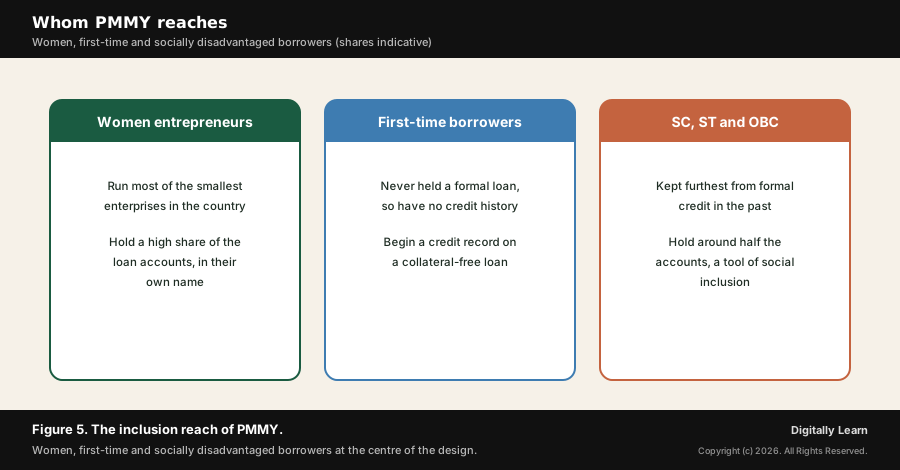
The deepest purpose of PMMY is financial inclusion on the credit side, the drawing of the excluded producer into the formal lending system. The scheme was framed to reach the borrower whom the bank had always passed over, and three groups stand at the centre of this design. The first is women, who run a very large share of the country's smallest enterprises yet hold few formal loans, and a high share of the loan accounts under the scheme are held by women entrepreneurs, giving them their own line of credit and a record in their own name.
The second group is the first-time entrepreneur, the borrower who has never held a formal loan and so has no credit history for a bank to read. By lending without collateral and against the trade itself, the scheme lets a new borrower begin a credit record, and a substantial share of the loans go to such first-time borrowers. The third group is the socially disadvantaged, the borrowers from the Scheduled Castes, the Scheduled Tribes and the Other Backward Classes, who have historically been kept furthest from formal credit; a large share of the accounts are held by these groups, which makes the scheme an instrument of social as well as financial inclusion.
The precise shares move with each official report and are best read as indicative of scale rather than as fixed figures, but the direction is consistent across the reporting: the majority of the accounts are held by women, around half by SC, ST and OBC borrowers, and a meaningful share by first-time entrepreneurs. By funding these groups the scheme links to the wider architecture of inclusion, sitting alongside the Stand-Up India scheme, which lends a larger sum to at least one SC or ST and one woman borrower per bank branch, and resting on the JAM base of bank accounts and digital identity that made mass small lending feasible. The figure below sets out the inclusion design.
The Outcomes: Loans Sanctioned, Self-Employment and Formalisation
Mass credit to the unfunded, self-employment and the pull into the formal economy
The first and most visible outcome of PMMY is the scale of credit it has pushed to the unfunded. Tens of crores of loans have been sanctioned since the scheme began, carrying lakhs of crores of rupees to borrowers who had never qualified for a formal loan, and the bulk of those loans by number fall in the smallest Shishu stage, confirming that the scheme reaches the very bottom of the enterprise pyramid. The precise totals move with each official report and are best read as indicative of magnitude, but the direction is unmistakable: institutional credit now reaches a class of borrower the formal system once ignored.
A second outcome lies in self-employment and livelihood. Because the loan funds an income-generating micro enterprise, each sanction supports a small business that can sustain its owner and, in many cases, a few additional hands, so the scheme works as an instrument of employment generation in a country where most jobs are created not by large firms but by the self-employed and the tiny unit. By easing the binding constraint of credit, the scheme lets a viable trade buy a machine, hold more stock or take a larger order, turning a precarious living into a steadier one.
A third outcome is the pull towards formalisation. A borrower who takes a formal loan acquires a bank relationship and a credit record, the documents and the history that open the door to larger and cheaper credit in future, and that record draws the once-informal unit a step closer to the formal economy and its protections. The data the scheme generates also gives lenders and the state a clearer view of a sector that was previously invisible, which can sharpen later policy. Read together, mass credit, self-employment and formalisation are the principal gains the scheme is credited with, even as the debates examined next qualify how deep each gain runs.
The Critiques and Debates: Ticket Size, Asset Quality and Enterprise Building
Small average ticket size, rising defaults and asset quality, over-indebtedness and the want of mentoring
A balanced reading sets the achievements against persistent critiques, presented here as they are argued by independent economists, researchers and the banking regulator. The most common concerns the average ticket size: a very large share of the loans are tiny Shishu sums, which critics read as a sign that the scheme finances survival and consumption smoothing more than it builds durable enterprises, and they ask whether so small a loan can ever turn a hand-to-mouth unit into a growing business. Supporters reply that the average loan size has risen over the years as borrowers graduate to the larger stages, which they read as evidence that enterprises are indeed maturing.
A second debate is over asset quality and the risk of rising defaults. Because the loans are collateral-free and lent at scale to borrowers with thin records, critics and the regulator have at times cautioned that non-performing micro-loans could build up and strain the lenders, and the official response has been to make credit quality and enterprise sustainability an explicit priority for the scheme going forward. A related worry is over-indebtedness: pushing easy credit to a poor borrower whose income is unsteady can deepen distress if the loan cannot be repaid, so the very ease that defines the scheme carries a risk that must be managed with care.
Further concerns cluster around enterprise building and the quality of jobs. Critics argue that a loan alone, without mentoring, skill support, market linkage and hand-holding, often leaves the borrower no better equipped to run a growing business, so credit without capability may not create lasting livelihoods. Others question whether the self-employment the scheme supports yields good jobs or merely spreads thin, low-productivity work. On the central question, whether PMMY has turned mass micro-credit into durable, growing enterprises and quality employment, a careful answer treats the matter as open and weighs the real expansion of credit access against these honest doubts about depth and durability.
Understanding the Significance: Credit Access, Self-Employment and Inclusion
A gateway to institutional credit, an engine of self-employment and a tool of social inclusion
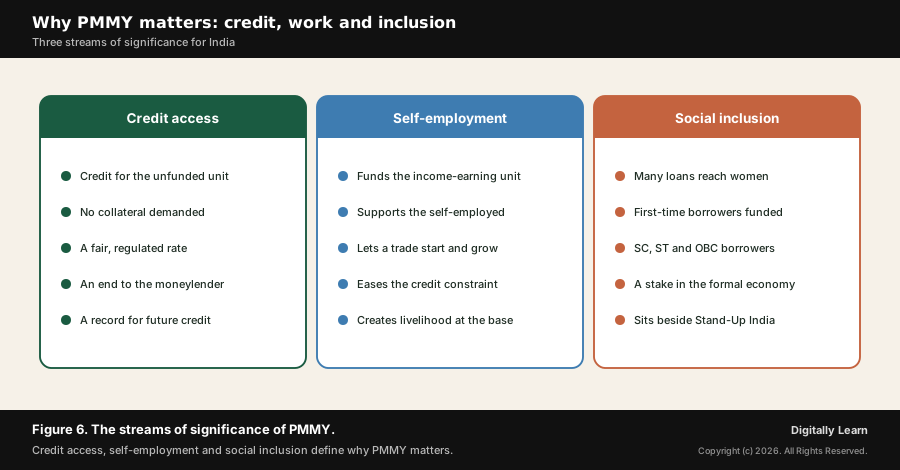
What is the significance of PMMY lies first in its character as a gateway to institutional credit. By lending without collateral to the smallest non-farm units, the scheme brought a vast excluded class of producers into the formal lending system, replacing the moneylender's ruinous rate with a fair, regulated loan and giving the borrower a record that can build future creditworthiness. This widening of credit access is its deepest contribution: it makes formal credit, long the preserve of the collateralised, a concrete possibility for the unfunded micro enterprise.
Its second significance is as an engine of self-employment. Because each loan funds an income-generating enterprise, the scheme works on the part of the economy that creates most of the country's livelihoods, the self-employed and the tiny unit, and by easing the credit constraint it lets those units start, survive and grow. This makes PMMY more than a banking programme; it is an instrument of employment and livelihood policy, aimed at the structural truth that India must create work for its young through its smallest businesses as much as through its largest firms.
Its third significance is for social inclusion. Because so many of the loans reach women, first-time borrowers and the SC, ST and OBC communities, the scheme gives the historically excluded a direct stake in the formal economy and a route out of dependence on the informal lender. Sitting alongside Stand-Up India and resting on the bank-account base of the wider inclusion drive, it deepens the credit side of a development project that had earlier concentrated on accounts and transfers. Read together, credit access, self-employment and inclusion are why PMMY is treated as a landmark in India's micro-finance policy. The figure below maps these strands.
The Way Forward: From Credit to Capability, Better Asset Quality and Deeper Reach
Pairing credit with mentoring, guarding asset quality and deepening the reach of formal finance
The way forward follows directly from the critiques. The first priority is to move from credit to capability: to pair the loan with skill support, mentoring, market linkage and hand-holding, so that the funded borrower is equipped not merely to receive a loan but to run and grow an enterprise, turning a survival loan into a building block of a durable business.
The second priority is to guard asset quality while keeping access wide. Strengthening appraisal, monitoring repayment, and using the data the scheme generates to lend more wisely would keep defaults in check without slamming the door the scheme worked to open, and the official emphasis on credit quality and enterprise sustainability points in this direction. Alongside this, the guarantee architecture should be kept sound so that lenders remain willing to extend collateral-free credit, while borrowers are protected from the over-indebtedness that careless lending can bring.
The third priority is to deepen the reach rather than rest on the loan count. Extending the scheme further to the women, first-time and SC, ST and OBC borrowers still outside formal credit, encouraging borrowers to graduate from the smallest Shishu loans to the larger stages as their trades mature, and linking the funded units to digital payments, markets and larger finance would turn the scheme from a drive that disbursed loans into one that genuinely built enterprises. Pursued together, these measures would move PMMY closer to its founding promise: not merely a loan for the unfunded, but a real, growing place for the smallest enterprise in the formal economy.
UPSC Relevance and Exam Focus
Where PMMY fits in the UPSC-CSE syllabus
This topic maps most directly to General Studies Paper III: inclusive growth and issues arising from it, and the mobilisation of resources, since PMMY is a flagship micro-finance instrument whose design and credit channels are core to financial inclusion and small-enterprise growth. It also links strongly to General Studies Paper II, government policies and interventions for development and welfare schemes for vulnerable sections, where the reach of the scheme to women and SC and ST borrowers is examined, and it supplies rich material on the MSME sector, employment generation and the role of development finance.
For Prelims, hold the high-yield facts: PMMY is a 2015 micro-finance scheme run by the Department of Financial Services aimed at bringing small entrepreneurs into the formal financial system; it gives collateral-free loans graded into Shishu (up to fifty thousand rupees), Kishore (up to five lakh), Tarun (up to ten lakh) and Tarun Plus (up to twenty lakh, after the Budget 2024-25 raise); the loans are made by banks, NBFCs, micro-finance institutions and small finance banks and refinanced by MUDRA, a subsidiary of SIDBI that does not lend directly; and they are backed by the Credit Guarantee Fund for Micro Units managed by the National Credit Guarantee Trustee Company.
For Mains, the recurring framing is to assess whether the scheme has delivered genuine, durable micro-enterprise growth: how collateral-free credit and the guarantee fund brought the unfunded into formal lending, how the graded stages let an enterprise grow, and how far small ticket size, asset quality and the want of mentoring have limited the depth of the gains. A strong answer treats PMMY as a case study in credit-side financial inclusion and MSME policy, weighing its real expansion of credit access and self-employment against the unresolved questions of enterprise building and loan quality.
Recurring linked concepts an aspirant should keep in working memory:
- Micro-finance: The provision of small-scale credit, savings and allied services to low-income and self-employed borrowers, of which PMMY is India’s flagship credit instrument.
- MUDRA: The Micro Units Development and Refinance Agency, a subsidiary of SIDBI that refinances and develops the sector but does not lend directly to borrowers.
- Credit Guarantee Fund for Micro Units: The fund, managed by the National Credit Guarantee Trustee Company, that guarantees the collateral-free loans against default.
- Stand-Up India: The allied scheme that lends a larger sum to at least one SC or ST and one woman borrower per bank branch, refinanced through SIDBI.
A common Prelims trap is to confuse the bodies and the bands; hold that PMMY is run by the Department of Financial Services, that MUDRA is a refinance body that does not lend directly, that the categories are Shishu, Kishore, Tarun and Tarun Plus by loan size, that the loan is collateral-free rather than a subsidy, and that crop cultivation is funded through separate farm-credit channels while only activities allied to agriculture qualify under PMMY.
A common Mains trap is to praise the loan count and stop there. The exam value lies in a balanced judgment: the real achievements in credit access, self-employment and the reach to women and SC and ST borrowers, set honestly against the open problems of small ticket size, asset quality and whether credit alone builds lasting enterprises.
Previous Year UPSC-CSE Questions By the end you will be able to draft model answers for the following UPSC questions. Each question carries a collapsible framework showing how to approach it in the exam.
- UPSC Prelims 2016 GS Paper IIdentify the central aim of the Pradhan Mantri MUDRA Yojana from the four options, distinguishing it from a crop-loan scheme, a pension scheme and a scheme funding voluntary skill-development organisations.
How to approach this Prelims question
Approach: Read MUDRA as a micro-finance credit-access scheme for the smallest non-farm enterprise. PMMY, launched in 2015, gives collateral-free institutional loans to non-corporate, non-farm micro and small enterprises, so its central aim is to bring small entrepreneurs into the formal financial system, which is option (a). Reject each distractor on what the scheme is not: it funds only activities allied to agriculture, not crop cultivation; it is a loan, not a pension; and it funds enterprises through lenders, not voluntary skill-development organisations.
Trap to watch: The crop-loan distractor is the classic near-miss: PMMY does touch agriculture, but only allied activities such as poultry, dairy and fisheries, never crop cultivation, which is served by separate farm-credit channels. Do not let the word agriculture pull you to the crop-loan option; the scheme is about enterprise credit, not seasonal crop finance.
Key facts to recall:
- PMMY is a 2015 micro-finance scheme run by the Department of Financial Services, aimed at collateral-free credit for non-farm micro and small enterprises.
- It funds manufacturing, trading, services and activities allied to agriculture, but not crop cultivation, which has separate farm-credit channels.
- It is a loan repaid with interest, not a pension or a fixed transfer, and the lenders are banks, NBFCs, MFIs and small finance banks refinanced by MUDRA.
Answer signal: The giveaway phrase is small entrepreneurs and the formal financial system; an option naming crop loans, pensions or voluntary organisations describes a different scheme, so option (a) is correct.
Sources and Further Reading
- Department of Financial Services: Pradhan Mantri MUDRA Yojana (PMMY) scheme page
- Press Information Bureau: Pradhan Mantri Mudra Yojana completes ten years of empowering small and micro entrepreneurs
- Press Information Bureau: Loan limit under Pradhan Mantri Mudra Yojana increased to Rs.20 lakh from Rs.10 lakh
- Press Information Bureau: Cabinet approves creation of a Credit Guarantee Fund for MUDRA loans
- Reserve Bank of India: FAQs on Priority Sector Lending
- Ministry of Finance: Summary of the Union Budget 2024-2025
- World Bank: Global Findex Database, account ownership and small-business finance
- Wikipedia: Pradhan Mantri Mudra Yojana
Editorial Disclaimer
This briefing is for UPSC preparation. Verify the facts and figures against the official Department of Financial Services, PMMY and PIB sources before relying on them.


