


Overview
A classical language is a language to which the Government of India confers a special status in recognition of its deep antiquity and the richness of its ancient literary heritage. On 3 October 2024 the Union Cabinet conferred this status on five more languages, Marathi, Pali, Prakrit, Assamese and Bengali, taking the total number of classical languages in India to eleven. The status is administered by the Ministry of Culture, on the recommendation of a Linguistic Experts Committee under the Sahitya Akademi, which judges a language against criteria of antiquity, ancient literature and inscriptional evidence. A classical language enjoys promotion through awards, university chairs and centres of study. This recognition is distinct from the Eighth Schedule of the Constitution, which lists the twenty-two scheduled languages.
Cabinet Confers Classical Status on Five More Languages
Marathi, Pali, Prakrit, Assamese and Bengali join the list
India has widened the small circle of its classical languages. On 3 October 2024 the Union Cabinet approved conferring Classical Language status on five more languages: Marathi, Pali, Prakrit, Assamese and Bengali. With this decision the total number of classical languages in India rose from six to eleven.
The five form a varied group. Marathi is the principal language of Maharashtra, while Assamese and Bengali are the great literary languages of the eastern states of Assam and West Bengal. Pali and Prakrit are ancient languages of early Indian texts, Pali the language of much of the Buddhist canon and Prakrit of important Jain and other early literature.
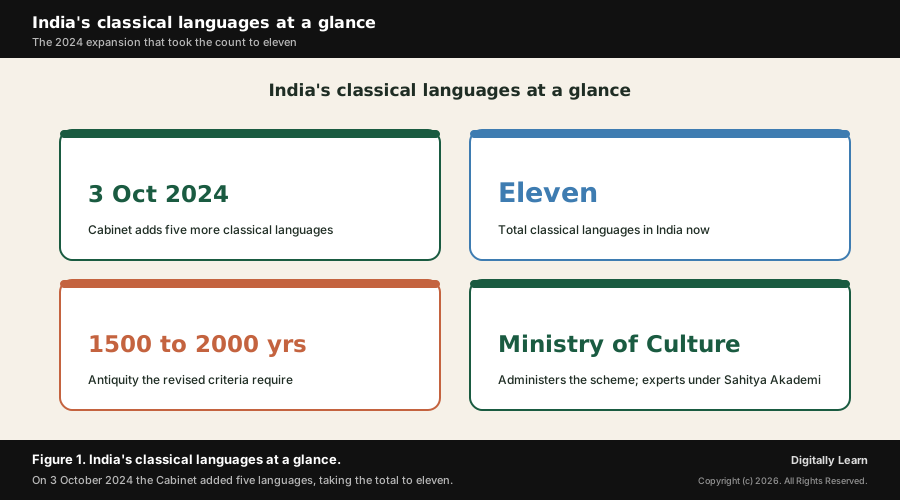
The recognition followed years of demand from these language communities and a fresh examination of the rules. The Government framed the decision as a tribute to the depth of each language's literary heritage and to the pride of its speakers. The figure below sets out the position at a glance.
Why Classical Languages Are in the News: A Revised Yardstick
A revised set of criteria opened the door to five languages
Why it matters now is that the addition came through a revised yardstick. In a meeting on 25 July 2024, the Linguistic Experts Committee, which works under the Sahitya Akademi for the Ministry of Culture, revised the criteria a language must meet to be called classical. It is on these revised criteria that the five new languages were judged to qualify.
The revision drew the count of classical languages to eleven for the first time since the category began in 2004. It also reopened a long-running debate about what should count as a classical language, since each addition is closely watched by the communities that speak the languages still seeking the status. The start of this wider list is therefore a live issue in cultural policy.
Understanding the Significance of Classical-Language Status for India
Recognising a heritage and funding its survival
What is the significance of classical-language status lies first in recognition. The status declares that a language carries a literary heritage of national importance, stretching back many centuries, and so deserves to be studied, preserved and celebrated. For the speaker communities, it is a source of pride and an affirmation that their tongue belongs to the front rank of India's heritage.
Its second significance is practical. The status unlocks real support: awards for scholars, professional chairs in universities, and dedicated centres that study and revive the ancient literature. In a country where many languages and their old texts are at risk of neglect, this funding can be the difference between a living tradition and a forgotten one.
Third, the recognition matters for India's cultural identity. A nation of extraordinary linguistic diversity uses the status to assert that its many literary traditions, southern and eastern, Sanskritic and Buddhist, are a shared national inheritance rather than the concern of one region alone.
What Classical-Language Status Means: How It Is Conferred and Its Benefits
How the status is conferred and who decides
Classical-language status is conferred by the Government of India, and the work of judging a language sits with the Ministry of Culture. The category itself was created in 2004, when the Government decided to set apart languages of exceptional antiquity and literary depth, and Tamil was the first to be declared classical in that year.
The expert assessment is carried out by a Linguistic Experts Committee constituted under the Sahitya Akademi, the national academy of letters. A language community, often through its State government, proposes a language for the status. The Committee then examines whether it meets the criteria of antiquity, literature and inscriptional evidence, and recommends accordingly.
On the Committee's recommendation, the Union Cabinet takes the final decision to confer the status, as it did for the five new languages in 2024. The Ministry of Culture then administers the schemes that flow from the status, so that recognition is followed by support.
The benefits a classical language receives
The chief value of the status is the promotion it brings to a language and its old literature. The Government offers two annual international awards for scholars of eminence in classical Indian languages, honouring the lifetime study that keeps these traditions alive.
The status also builds institutions. The Government has set up Centres of Excellence for the study of classical languages under the Central Institute of Indian Languages in Mysuru, and a dedicated Central Institute of Classical Tamil for Tamil. These centres translate ancient texts, train scholars and carry out research that would otherwise lack a home.
Finally, the status reaches into higher education. The University Grants Commission may be asked to create professional chairs for classical languages in central universities, so that each language has scholars and teaching posts devoted to it. The figure below lists the main benefits and the actors behind them.
| Benefit | What it provides | Who delivers it |
|---|---|---|
| International awards | Two annual awards for scholars of eminence in a classical language | Ministry of Culture |
| Centres of Excellence | Centres that study, translate and revive the ancient literature | Central Institute of Indian Languages, Mysuru |
| Professional chairs | Dedicated teaching and research chairs in central universities | University Grants Commission |
| Research and revival | Funding to translate texts, train scholars and promote the language | Ministry of Culture |
Read together, the rows show the design: recognition is matched by money, institutions and posts, so that the status protects not only the name of a language but the scholarship that keeps its literature alive.
The Revised Criteria: From the 2004 Rules to the 2024 Yardstick
The original 2004 criteria and their 2024 revision
When the category was created in 2004, the Government set out criteria a language had to satisfy to be declared classical. The original test required a high antiquity of early texts and recorded history over a band of about 1,000 to 1,500 years, a body of ancient literature held as a heritage by speakers, and a literary tradition that was original and not borrowed from another community.
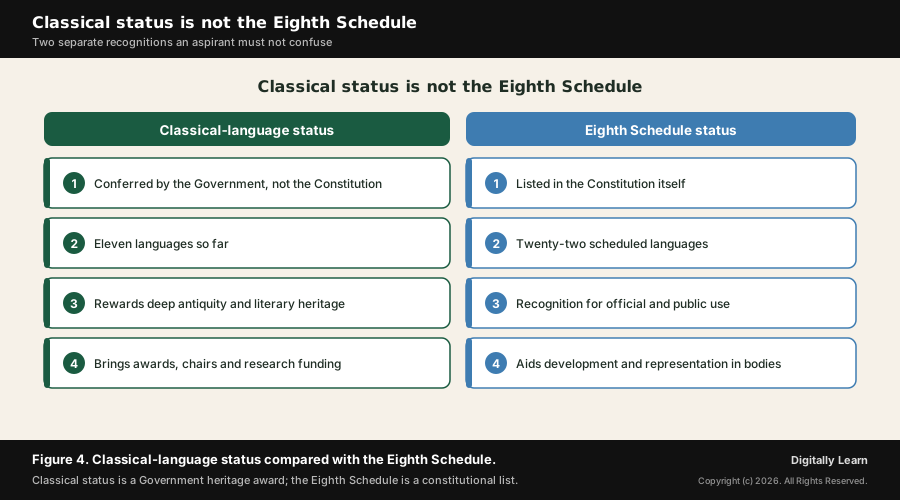
In its meeting of 25 July 2024, the Linguistic Experts Committee revised these criteria. The most discussed change widened the antiquity band to a recorded history of roughly 1,500 to 2,000 years, and the revision added an explicit place for knowledge texts and for inscriptional evidence. These are the criteria against which the five new languages were judged.
The five tests a classical language must now meet
Under the revised yardstick, a language is assessed on a short list of tests, taken together rather than in isolation. The first is antiquity: early texts or a recorded history reaching back over 1,500 to 2,000 years, which sets classical languages apart from those of more recent literary growth.
The second is a body of ancient literature, regarded as a valued heritage by generations of speakers. The third widens the test beyond poetry to knowledge texts, especially prose works on subjects such as grammar, philosophy and science, recognising that a classical tradition is more than verse.
The fourth test looks for epigraphical and inscriptional evidence, the witness of old stone and copper-plate records to the language's age and use. The fifth allows that the classical language and its literature may be distinct from, or discontinuous with, the language's later forms or offshoots, so that an ancient form can be honoured even where the modern tongue has moved on.
- (a) High antiquity. Early texts or a recorded history over a period of about 1,500 to 2,000 years.
- (b) Ancient literature. A body of ancient literature or texts held a valuable heritage by generations of speakers.
- (c) Knowledge texts and prose. Knowledge texts, especially prose, in addition to poetry.
- (d) Epigraphical evidence. Support from inscriptions and other epigraphical records of the language.
- (e) Distinct from later forms. The classical form may differ from, or be discontinuous with, the language’s later forms or offshoots.
Read together, these tests describe a language with a long, documented and literary past. The figure below sets out the revised criteria.
The Eleven Classical Languages: The Six Earlier and the Five New
The six languages declared between 2004 and 2014
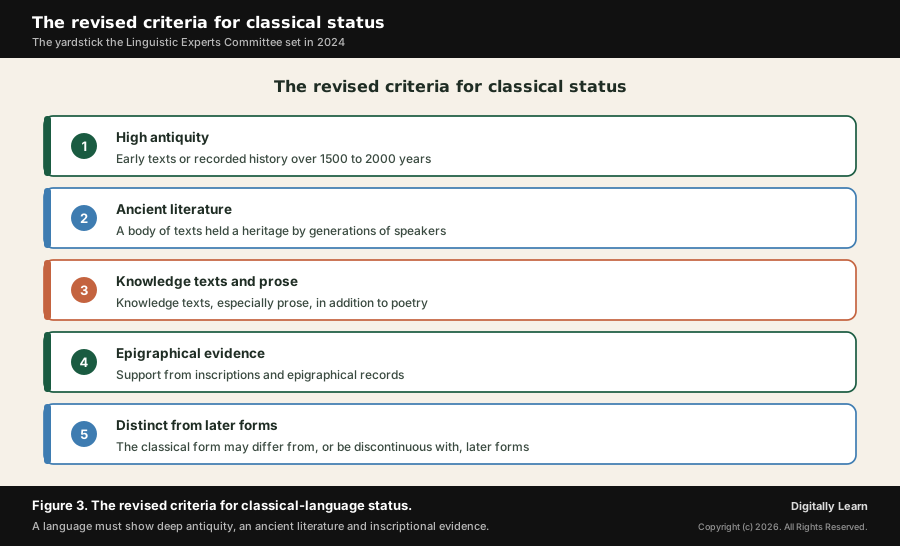
The eleven classical languages fall into two groups by the time of their recognition. The six earlier languages were declared one by one over a decade. Tamil, an ancient Dravidian language with a literature reaching back to the Sangam age, was the first, declared classical in 2004. Sanskrit, the language of the Vedas and of a vast body of classical Indian thought, followed in 2005.
The next pair came from the south in 2008. Telugu, the major language of Andhra Pradesh and Telangana, and Kannada, the language of Karnataka with an old literary tradition, were both declared classical that year. Malayalam, the language of Kerala, was added in 2013, and Odia, the language of Odisha and the first from the eastern Indo-Aryan family, in 2014.
The five languages added in 2024
The five new languages of 2024 broadened the list in both region and family. Marathi, the language of Maharashtra, has a literary heritage of saints and scholars going back many centuries. Assamese and Bengali, the eastern Indo-Aryan languages of Assam and West Bengal, brought two of India's richest modern literatures into the classical fold.
Two of the five are ancient languages rather than the everyday speech of a present-day State. Pali is the language of the Theravada Buddhist canon, a vehicle of early Indian thought across Asia, and Prakrit names a family of early languages that carry much Jain and other ancient literature. Their inclusion recognises traditions that shaped Indian religion and philosophy. The figure below lists all eleven languages with their years.
Classical Status Versus the Eighth Schedule, and the Debates Around It
How classical status differs from the Eighth Schedule
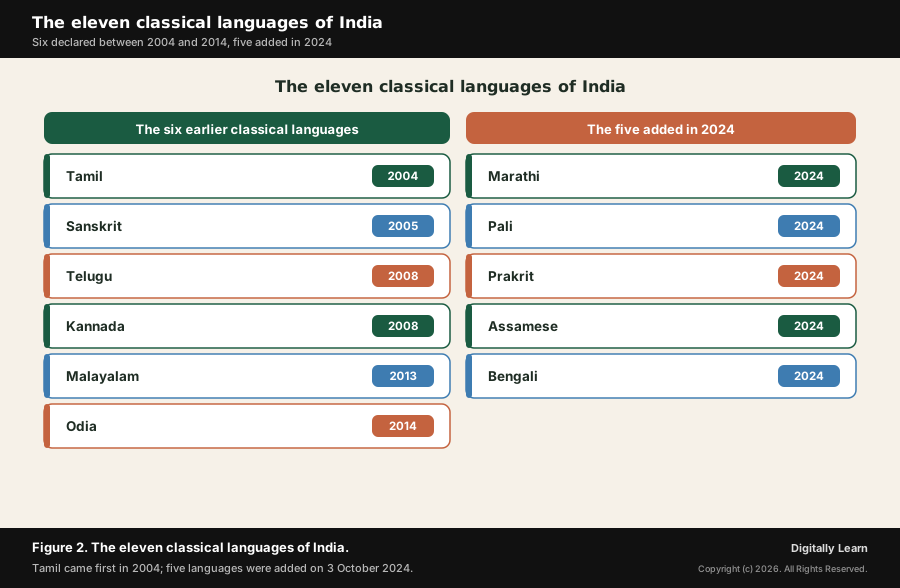
A common confusion is to treat classical-language status as the same thing as a place in the Eighth Schedule of the Constitution. They are different recognitions, with different sources and different effects, and an aspirant must keep them apart.
The Eighth Schedule is a list set out in the Constitution itself. It began with fourteen languages in 1950 and now contains twenty-two scheduled languages, after additions such as Sindhi, the Konkani, Manipuri and Nepali group, and Bodo, Dogri, Maithili and Santali. Scheduled status carries constitutional consequences, for instance for the languages in which official business and examinations may be conducted and for the development the State is to promote.
Classical-language status, by contrast, is conferred by the Government, not written into the Constitution. It rewards antiquity and literary heritage rather than current official use, and it brings awards, chairs and research funding rather than constitutional recognition. A language may hold one status, the other, or both: Tamil, Sanskrit, Kannada and others are both scheduled and classical, while Pali and Prakrit are classical but not in the Eighth Schedule. The figure below sets the two side by side.
The debates over dilution, politics and funding
A balanced reading must weigh the debates the expansion has drawn, since these are exactly the angles an exam answer should test. The most discussed concern is whether the 2024 revision diluted the criteria. Critics argue that widening the antiquity band and the tests made it easier for languages to qualify, so that the status risks losing the exclusivity that gave it meaning.
A second concern is the political dimension of language recognition. Because a classical tag carries prestige and funding, decisions on which languages receive it are entangled with regional sentiment and electoral politics, and critics ask whether merit or pressure drives a given addition. Supporters reply that long-standing, well-documented claims, not politics, lay behind the 2024 languages.
A third concern is the risk of tokenism. The status is only as valuable as the funding and institutions that follow it, and observers warn that a language can be declared classical yet see little real support for studying and reviving its literature. The fair assessment is that the expansion is a genuine act of cultural recognition whose worth will depend on the resources that back it and on holding the criteria to a consistent standard.
Classical Languages in Context: Heritage, the Constitution and Cultural Policy
Linguistic diversity, the constitutional scheme and the safeguarding of heritage
Contemporary linkages tie the classical-language question to several wider themes. The first is India's extraordinary linguistic diversity, with hundreds of languages and a long record of multilingual coexistence, of which the classical languages are the most ancient literary strands.
The second is the constitutional scheme for language. Beyond the Eighth Schedule, the Constitution provides for the official languages of the Union and the States, for the protection of minorities' language and script under Article 29, and for the duty to develop the languages of the Eighth Schedule. Classical-language status sits alongside this framework as a separate, heritage-based recognition.
The third is the broader effort to safeguard cultural heritage. Language and its literature are a form of intangible heritage, as much a part of the national inheritance as monuments and crafts, and the classical-language scheme is one instrument through which the State protects that heritage from loss. The wider global concern with language preservation, reflected in UNESCO's work on intangible heritage and endangered languages, gives this national effort an international frame.
The framework connects, finally, to the place of language in cultural identity and in education. The National Education Policy's stress on learning in the mother tongue, and the steady demand from communities for recognition of their languages, both reflect how deeply language is bound up with identity, and how cultural policy must balance pride, preservation and unity.
UPSC Relevance and Exam Focus
Where this fits in the UPSC-CSE syllabus
This topic maps most directly to General Studies Paper I: Indian heritage and culture, art forms, literature and architecture, with strong links to the salient features of Indian society and its diversity. It also reaches into General Studies Paper II, where the constitutional scheme for languages and government cultural policy belong.
For Prelims, hold the high-yield facts: there are now eleven classical languages; the five added in 2024 are Marathi, Pali, Prakrit, Assamese and Bengali; Tamil was the first, in 2004; the status is conferred by the Government on the advice of a Linguistic Experts Committee under the Sahitya Akademi; and it is distinct from the twenty-two languages of the Eighth Schedule.
For Mains, the recurring framing is to discuss why safeguarding India's literary and linguistic heritage matters, how the classical-language scheme does it, and the debates over criteria, politics and funding. A strong answer treats the status as a tool of cultural preservation while testing how well it is used in practice.
Recurring linked concepts an aspirant should keep in working memory:
- Classical-language status: A Government recognition of a language’s deep antiquity and literary heritage, held by eleven languages.
- Eighth Schedule: The constitutional list of twenty-two scheduled languages, a separate recognition from classical status.
- Linguistic Experts Committee: The body under the Sahitya Akademi that examines languages against the classical criteria.
- Intangible cultural heritage: Living traditions such as language, literature and performance, which the State seeks to safeguard.
A common Prelims trap is to confuse classical-language status with the Eighth Schedule. The Schedule is a constitutional list of twenty-two languages for official and developmental purposes; classical status is a Government award to eleven languages for their heritage, and the two lists do not coincide.
A common Mains trap is to praise the expansion without testing it. Its exam value lies in a balanced judgment: a genuine act of recognising and funding heritage, set honestly against the concerns over diluted criteria, political pressure and the risk that the tag is not matched by real support.
Previous Year UPSC-CSE Questions By the end you will be able to draft model answers for the following UPSC questions. Each question carries a collapsible framework showing how to approach it in the exam.
- UPSC Mains 2018 GS-ISafeguarding the Indian art heritage is the need of the moment. Discuss.
How to structure the answer in the exam
Body (sub-themes to develop):
- What the heritage is: India's intangible heritage includes its classical languages and their ancient literature, recognised for an antiquity of 1,500 to 2,000 years, a body of ancient texts and inscriptional evidence.
- Why safeguarding is urgent: old texts, manuscripts and lesser-spoken classical languages such as Pali and Prakrit face neglect, loss of speakers and decay unless actively preserved and studied.
- How the State safeguards it: the classical-language scheme funds international awards, Centres of Excellence under the Central Institute of Indian Languages, professional chairs in central universities and the translation and revival of texts.
- The wider framework: constitutional protection of language and script under Article 29, the Eighth Schedule, the National Education Policy's stress on the mother tongue, and bodies such as the Sahitya Akademi and the Archaeological Survey for tangible heritage.
- A balanced caution: recognition must be matched by real funding and consistent criteria, or safeguarding risks becoming tokenism, the very concern raised about the 2024 expansion.
Sources and Further Reading
- Press Information Bureau: Cabinet approves conferring status of Classical Language to Marathi, Pali, Prakrit, Assamese and Bengali languages
- Press Information Bureau / Ministry of Culture: Status of Classical Language, An Explainer
- Press Information Bureau: Benefits Accorded to Classical Language
- Press Information Bureau: Protection and Promotion of Classical Languages
- Ministry of Culture: Government of India
- Ministry of Education: Promotion of Indian Languages
- National Portal of India: Languages of India
- Wikipedia: Classical languages of India
- Wikipedia: Eighth Schedule to the Constitution of India
- UNESCO: Language preservation and intangible cultural heritage
Editorial Disclaimer
This briefing is for UPSC preparation. Verify the dates, the list of languages and the criteria against the official Ministry of Culture and PIB sources before relying on them.