

Overview
There are four processes of erosion: Hydraulic action, corrasion, attrition and corrosion. Corrasion, also called abrasion, is erosion by the load a river, wave, glacier or wind carries, as sand and pebbles grind against the rock like sandpaper. The first three are mechanical; corrosion, or solution, is chemical, dissolving soluble rock such as limestone.
Erosion: Meaning, Agents and the Four Processes
Agents of Erosion and How They Attack Rock
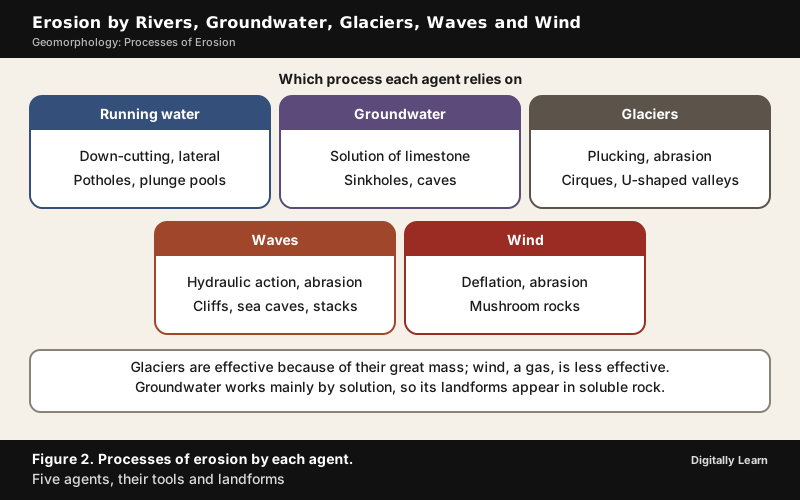
Erosion involves the acquisition and transportation of rock debris. Once rock has been broken into fragments, the geomorphic agents, running water, groundwater, glaciers, wind and waves, remove it and carry it elsewhere, and by erosion the relief is worn down.
- Energy of erosion: Erosion is the application of the kinetic energy of the agent to the land it moves over; kinetic energy is half the mass times the square of the velocity.
- Effectiveness: Glaciers move very slowly but are effective agents of erosion because of their tremendous mass, while wind, a gas, is less effective.
- Climate-controlled agents: Wind, running water and glaciers; the work of waves depends on the coast and that of groundwater on the rock.
Erosion and weathering are linked but different. Weathering breaks rock down where it lies; erosion removes it. Weathering aids erosion but is not a precondition for it, and weathering, mass wasting and erosion together are the degradational processes that wear the land down.
Agents attack rock in four main ways, and wind and glaciers have processes of their own, deflation and plucking. Removal of rock as clastic sediment is mechanical erosion; removal by dissolution is chemical erosion.

Hydraulic Action, Corrasion, Attrition and Corrosion Explained
Hydraulic Action: How Moving Water Erodes
Moving water can erode by its force alone, a process called hydraulic action. A current or a wave dislodges rock particles and carries them away; in a river, the current flows against the bed and banks and adds the particles it removes to the stream's load.
On coasts it works with air. A wave striking a cliff compresses the air in cracks, which presses on the surrounding rock; when the wave retreats, the air decompresses suddenly with explosive force. Each cycle widens the cracks, so every wave traps more air, and over time the cracks may grow into a sea cave. In coastal areas hydraulic action is often the most important form of erosion.
Corrasion: Abrasion by the Load
Corrasion works wherever an agent carries a load. Sand, pebbles and boulders are dragged or thrown against the rock, and the intensity of the wear depends on the hardness, concentration, velocity and mass of the moving particles.
- Rivers: Objects carried in the channel scrape the bed and walls.
- Glaciers: Ice grinds the rocks it has picked up against the bedrock.
- Waves: Rock debris is thrown against the cliff face.
- Wind: Sand and small stones are driven against rock surfaces.
Waves hurling their load at a cliff make corrasion a highly effective and rapid form of shoreline erosion. In river beds it cuts potholes. Over rocky hill-stream beds, circular depressions form through stream erosion aided by the abrasion of rock fragments, and pebbles caught in them are rotated by the water until the holes deepen and join.
Attrition and the Difference Between Attrition and Abrasion
Erosion of the load itself is attrition. As rock fragments are carried by water or wind, they collide, chipping and grinding each other until they become smaller, smoother and rounder, and over time attrition turns boulders into smaller rocks and eventually into sand. The rounded pebbles of a beach or a river bed are its work.
| Point | Attrition | Abrasion (corrasion) |
|---|---|---|
| What wears | The carried particles themselves | The bed, banks, cliff or bedrock |
| How | Particles hit each other | Particles rub against a surface |
| Result | Smaller, rounder, smoother load | A worn, scratched or hollowed surface |
Corrosion vs Corrasion: Solution, Carbonation and Karst
Where corrasion wears rock mechanically with the load an agent carries, corrosion, also called solution, is chemical erosion, in which water dissolves the rock. It works best on soluble rock such as limestone and chalk, and on coasts it occurs when sea water is slightly acidic.
The chemistry is carbonation. Carbon dioxide from the air and soil air dissolves in water to form carbonic acid, a weak acid, and calcium and magnesium carbonates dissolve in it and are carried away in solution.
Groundwater erodes almost entirely by corrosion. Physical removal by moving groundwater is insignificant, so its landforms appear only in soluble rock such as limestone and dolomite, where solution and precipitation shape the land. Such a region is called karst, after the Karst region of the Balkans next to the Adriatic Sea.
- Swallow holes: Small round depressions formed on limestone by solution.
- Sinkholes: Funnel-shaped openings from a few square metres to a hectare, some formed solely by solution.
- Caves: Hollowed out by solution underground, later decorated by stalactites and stalagmites.
Caves form where water percolates through cracks and joints and moves along bedding planes, dissolving the limestone into long passages that range from narrow cracks to wide caverns. On the surface, solution along parallel joints leaves a field of lapies, which may eventually turn into smooth limestone pavements.
Rain attacks rock in the same chemical way even before any agent carries it off, and that is weathering, not erosion. Rainwater holds dissolved carbon dioxide, which makes it a weak carbonic acid, and dissolved oxygen, which combines with minerals such as iron in oxidation.
| Process | Type | How it works |
|---|---|---|
| Hydraulic action | Mechanical | Moving water dislodges rock; waves compress air in cracks |
| Corrasion (abrasion) | Mechanical | The carried load grinds the bed, banks or cliff |
| Attrition | Mechanical | Pieces of the load collide and wear each other down |
| Corrosion (solution) | Chemical | Water dissolves soluble rock such as limestone and chalk |
Processes of Erosion by Rivers, Glaciers, Waves and Wind
Processes of Erosion in a River: Down-Cutting, Lateral and Headward
Running water erodes in two forms, overland flow as a sheet and linear flow in streams. Sheet erosion concentrates into rills, rills grow into gullies, and gullies deepen, widen and join into valleys. Once a stream has a valley, it erodes in three directions.
- Vertical (down-cutting): Dominant early on, giving V‑shaped valleys, gorges and canyons.
- Lateral: As the gradient eases, the river wears its banks by lateral corrasion, widens its valley and begins to meander.
- Headward: The valley extends back into the hillside.
Valley shape depends on the rock. A gorge is a deep valley with very steep, straight sides, almost as wide at the top as at the bottom, and forms in hard rock; a canyon has steep step-like sides, is wider at the top, and forms commonly in horizontally bedded sedimentary rock. At the foot of a waterfall, the impact of water and rotating boulders cuts a deep plunge pool, and the waterfall itself is transitory, receding gradually upstream.
Most stream erosion happens during floods, when more and faster water carries a larger load. Over a very long time erosion can reduce a landscape to a peneplain, a lowland of faint relief with low resistant remnants called monadnocks.
On farmland erosion becomes soil erosion, the accelerated removal of topsoil by water, wind and tillage. Erosion by water passes through four stages, in order of severity.
- Splash erosion: Raindrops loosen and splash the soil.
- Sheet erosion: Running water removes the soil in thin sheets.
- Rill erosion: The flow cuts small channels called rills.
- Gully erosion: The rills deepen into gullies.
Soil erosion happens naturally, but intensive agriculture, deforestation, overgrazing and poor land use can speed it up as much as 1,000 times, and it can cut crop yields by up to 50 per cent.
Glacial Erosion: Plucking and Abrasion
Erosion by glaciers is tremendous, because the sheer weight of the ice causes great friction against the bed. Glaciers erode in two ways. In plucking, also called quarrying, the ice pulls away blocks of bedrock, exploiting existing fractures; in abrasion, the angular blocks dragged along the valley floor and sides scrape the rock.
The result is a distinct set of landforms. Cirques, the most common landform in glaciated mountains, are deep basins with steep walls at the heads of glacial valleys, and glaciated valleys are trough-like and U‑shaped with broad floors. Glaciers can wear even unweathered rock and reduce high mountains to low hills and plains.
- Horns: Where three or more glaciers cut headward until their cirques meet, sharp peaks form; the Matterhorn and Everest are horns.
- Aretes: Divides between cirques narrow into saw-toothed ridges.
- Hanging valleys: Side valleys left at a height above the main glacial valley.
- Fjords: Very deep glacial troughs filled with sea water, in high latitudes.
Wave Erosion and Processes of Wind Erosion
On high rocky coasts, waves break with great force and shape the land into cliffs. Pounding makes the cliffs recede, leaving a wave-cut platform in front; waves and the debris they hurl hollow out sea caves, cave roofs collapse, and isolated remnants are left as sea stacks.
Wind erodes by three processes. Deflation lifts and removes dust and small particles, abrasion uses sand and silt as tools, and impact is the sheer force of sand blown against rock, much like sand-blasting. Deflation leaves hollows; together, deflation and abrasion wear outcrops into mushroom rocks with slender stalks and broad caps.
Rock faces struck by wind-borne sand first develop shallow depressions called blow outs, and some grow deep and wide enough to be called caves. Where the top of a worn outcrop is broad, it is a table rock; other remnants stand out as pedestal rocks.
Coastal Erosion in India: Extent, Causes and Management
Shoreline Change Along India's Coast: Extent and Causes
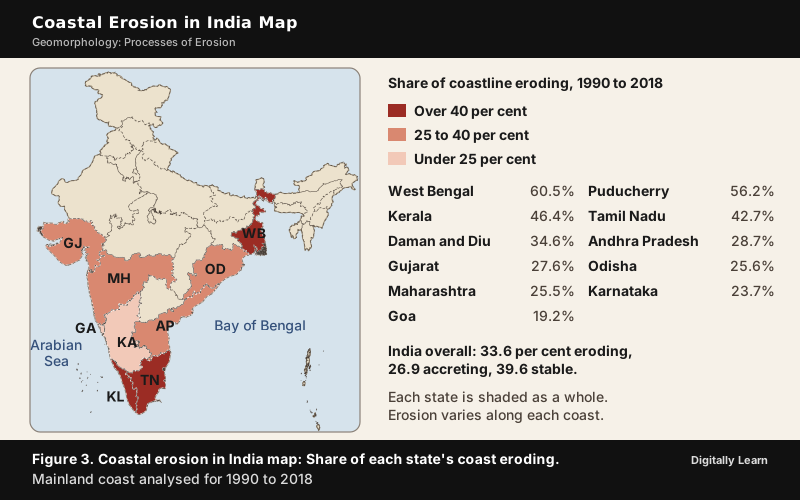
The National Centre for Coastal Research in Chennai, under the Ministry of Earth Sciences, monitored India's shoreline for 1990 to 2018 using satellite images and field surveys. Of the 6,907 km of mainland coast studied, about 33.6 per cent was eroding, 26.9 per cent was growing by accretion and 39.6 per cent was stable.
- Worst affected: West Bengal (60.5 per cent of its coast eroding), Puducherry (56.2), Kerala (46.4) and Tamil Nadu (42.7).
- Natural causes: More frequent cyclones and rising sea level.
- Human causes: Construction of harbours, beach mining and the building of dams.
- Effects of coastal erosion: Loss of land and habitat, and loss of space for fishermen to park boats, mend nets and fish.
Coastal Erosion Management: Hard, Soft and Nature-Based Methods
Coastal erosion is managed by hard structures, soft measures, nature-based protection and relocation away from the retreating shore. Hard structures such as seawalls and groynes last longest, on average 50 to 100 years for a seawall and 30 to 40 for a groyne, but they can block access to the beach and alter it drastically.
- Soft and temporary: Beach nourishment and sandbags, not meant as permanent solutions.
- Nature-based: Mangrove forests and coral reefs, a natural form of protection.
- Indian pilots: A submerged reef with beach nourishment restored 1.5 km of Puducherry's city beach, which had been lost for about 30 years; an offshore submerged dyke protected three fishing villages at Kadalur Periya Kuppam, Tamil Nadu.
- Regulation: A hazard line drawn for the whole coast, the Coastal Regulation Zone Notification, 2019, with its No Development Zones, and Shoreline Management Plans.
- Funding: Central guidelines of 20 June 2024, based on the Fifteenth Finance Commission's recommendations, fund erosion mitigation and the resettlement of displaced people, with ₹1,500 crore recommended for 2021‑26.
Previous Year UPSC‑CSE Questions
Each Prelims question is explained option by option, and each Mains question comes with an answer outline.
- UPSC Prelims 2024Consider the following statements :
- Statement‑I: Rainfall is one of the reasons for weathering of rocks.
- Statement‑II: Rain water contains carbon dioxide in solution.
- Statement‑III: Rain water contains atmospheric oxygen.
Which one of the following is correct in respect of the above statements ?
How to approach this Prelims question
Approach: Check Statements II and III first, then ask whether each explains Statement I. Rainwater holds dissolved carbon dioxide, which makes it a weak carbonic acid, so Statement II is correct and explains weathering by carbonation. Rainwater also holds dissolved atmospheric oxygen, which combines with minerals in oxidation, so Statement III is correct and explains Statement I as well.
Trap to watch: Option (b) tempts those who link weathering only with carbonic acid and forget that dissolved oxygen also weathers rock, by oxidation.
Why each option is right or wrong:
- (a) Both Statement‑II and Statement‑III are correct and both of them explain Statement‑I: Correct. Dissolved carbon dioxide makes carbonic acid (carbonation) and dissolved oxygen drives oxidation, so both explain weathering by rain.
- (b) Both Statement‑II and Statement‑III are correct, but only one of them explains Statement‑I: Wrong. Both gases take part in chemical weathering.
- (c) Only one of the Statements II and III is correct and that explains Statement‑I: Wrong. Rainwater carries both gases.
- (d) Neither Statement‑II nor Statement‑III is correct: Wrong. Statements II and III are both correct.
Answer: (a) Both Statement‑II and Statement‑III are correct and both of them explain Statement‑I. Dissolved carbon dioxide weathers rock by carbonation and dissolved oxygen by oxidation.
- UPSC Prelims 2001Identify the correct order of the processes of soil erosion from the following:
How to approach this Prelims question
Approach: Order the stages from the first impact of rain to the deepest channels. Raindrops striking bare soil cause splash erosion, running water then removes soil in thin sheets, the flow concentrates into small channels called rills, and the rills deepen into gullies.
Trap to watch: The reversed sequences in options (c) and (d) tempt anyone who thinks erosion starts with gullies; gullies are its last and most severe stage.
Why each option is right or wrong:
- (a) Splash erosion, Sheet erosion, Rill erosion, Gully erosion: Correct. Raindrop impact starts splash erosion, running water then removes soil in sheets, and the flow concentrates into rills that grow into gullies.
- (b) Sheet erosion, Splash erosion, Gully erosion, Rill erosion: Wrong. Splash comes before sheet erosion, and rills come before gullies.
- (c) Rill erosion, Gully erosion, Sheet erosion, Splash erosion: Wrong. It starts with rill and gully erosion, which are the late stages.
- (d) Gully erosion, Rill erosion, Sheet erosion, Splash erosion: Wrong. It is the exact reverse of the sequence.
Answer: (a) Splash erosion, Sheet erosion, Rill erosion, Gully erosion. Soil erosion begins with the splash of raindrops and ends in gullies.
- UPSC Mains 2022 GS‑IIIExplain the causes and effects of coastal erosion in India. What are the available coastal management techniques for combating the hazard?
Answer outline
The outline sets out what the question asks, the main arguments, relevant examples and the direction of the conclusion; it is not a full model answer.
Introduction: About a third of India's mainland coast, 33.6 per cent, was eroding over 1990 to 2018.
Body (sub-themes to develop):
- Causes: Cyclones and sea-level rise; harbours, beach mining and dams.
- Effects: Loss of land, habitat and fishermen's working space; West Bengal and Puducherry worst hit.
- Hard methods: Seawalls and groynes, long-lasting but damaging to beaches.
- Soft and nature-based: Beach nourishment, mangroves and submerged reefs (Puducherry).
- Regulation: The hazard line and the Coastal Regulation Zone Notification, 2019.
Conclusion: A hazard line with nature-based and soft measures, backed by the 2024 funding guidelines, is more sustainable than walls alone.
Sources
- NCERT: Fundamentals of Physical Geography (Class XI), Geomorphic Processes; Landforms and their Evolution
- FAO: Global Symposium on Soil Erosion, key messages
- National Centre for Coastal Research: Coastal Processes and Shoreline Management
- PIB: Coastal erosion, state-wise details (31 March 2022)
- PIB: Coastal Erosion (4 December 2023)
- PIB: Parliament question, studies for coastal erosion (11 February 2026)
- Wikipedia: Erosion
- Wikipedia: Abrasion (geology)
- Wikipedia: Hydraulic action
- Wikipedia: Attrition (erosion)
- Wikipedia: Coastal erosion
- Wikipedia: Aeolian processes
- Wikipedia: Glacial plucking
- Wikipedia: Soil erosion
- UPSC: Previous year question papers
Editorial Disclaimer
This article explains the processes of erosion for UPSC preparation, drawing on standard physical-geography sources. Definitions reflect the cited authorities.
See more of our UPSC articles in Google Search
Add to Preferred Sources

