


Overview
Geomorphology is the scientific study of the origin and evolution of landforms, the features of the earth's surface and the sea floor. It reconstructs the history of the surface from its forms, the materials they are made of and the processes that shape them. Its fundamental concepts explain those processes: endogenic forces from within the earth build the land up, exogenic forces driven by the sun and gravity wear it down, and landforms evolve through stages over long spans of time.
Geomorphology Meaning, Definition, Nature and Scope
What Is Geomorphology? Meaning, Definition, Nature and Scope
The word geomorphology comes from three Greek words: ge, earth, morphe, form, and logos, study. Geomorphology is the scientific study of the origin and evolution of topographic and bathymetric features, the forms of the land and of the sea floor, produced by physical, chemical or biological processes at or near the earth's surface.
Geomorphology deals with the reconstruction of the history of the surface of the earth through a study of its forms, the materials of which it is made up and the processes that shape it. Its basic unit is the landform: a small to medium tract or parcel of the earth's surface. Several related landforms together make up a landscape, a large tract of the surface.
Geomorphology sits where the land meets the air, water and life. The earth's surface is modified by surface processes, the work of water, wind, ice, wildfire and life together with the chemical reactions that form soils, and by geologic processes that cause tectonic uplift and subsidence. The surface is thus an intersection of the lithosphere with the hydrosphere, atmosphere and biosphere, and geomorphologists work alongside physical geography, geology, geodesy, engineering geology, archaeology and climatology.
- Fluvial geomorphology: The work of rivers and running water; see riverine landforms.
- Glacial geomorphology: Glacial deposits such as moraines and eskers, and glacial erosional features.
- Aeolian geomorphology: The work of wind, most important in arid environments such as deserts.
- Hillslope and mass movement studies: How slopes form and change, and how debris moves down them.
- Tectonic geomorphology: How uplift and faulting shape the land; see plate tectonics.
Since the middle of the twentieth century the subject has become quantitative, measuring rivers and hillslopes directly. Terrain is now measured with differential GPS, remotely sensed digital terrain models and laser scanning.
Fundamental Concepts of Geomorphology
Uniformitarianism: The Present Is the Key to the Past
The starting point among the fundamental concepts of geomorphology is uniformitarianism: the processes working on the earth today also worked in the past, so the present is the key to the past. The idea began with the geologist James Hutton in the late eighteenth century, in contrast to catastrophism, was refined by John Playfair and popularised by Charles Lyell's Principles of Geology in 1830. William Whewell coined the name.
Uniformitarianism lets a geomorphologist read old landforms by watching present processes, but modern geologists no longer hold to a strict gradualism: processes need not have acted at the same rates in the past. Most geomorphic processes are slow and imperceptible and can be seen and measured only through their results, the landforms.
Endogenic and Exogenic Forces: Building Up and Wearing Down
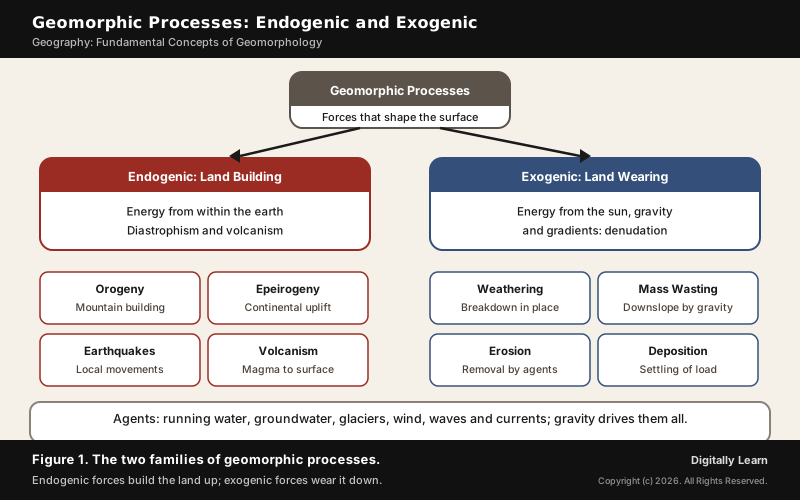
The earth's surface is uneven because two sets of forces work on it at once. Endogenic forces come from within the earth, from energy generated mostly by radioactivity, rotational and tidal friction and primordial heat; they are mainly land building. Exogenic forces derive their energy from the atmosphere, ultimately from the sun, and from gradients created by tectonics; they are mainly land wearing.
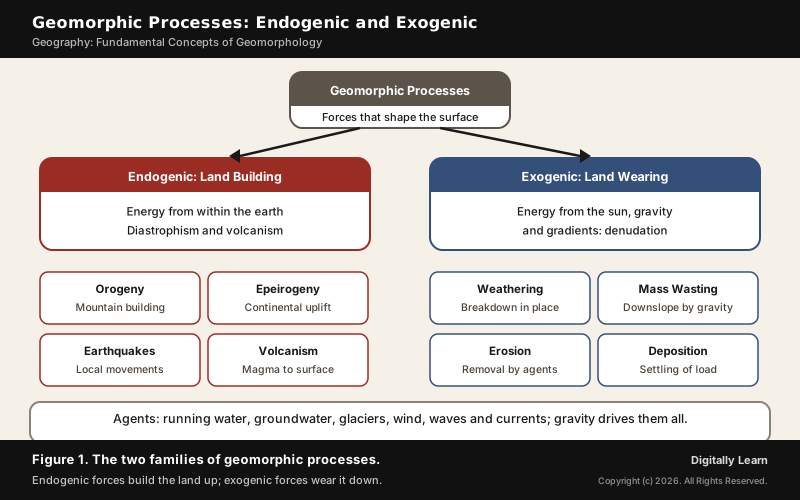
- Diastrophism: All processes that move, elevate or build up the crust: orogeny (mountain building by severe folding), epeirogeny (uplift or warping of large parts of the crust), earthquakes and plate tectonics.
- Volcanism: The movement of molten rock onto or towards the surface, and the intrusive and extrusive forms it builds.
- Gradation: Exogenic forces wear down relief (degradation) and fill up basins (aggradation).
Because endogenic forces keep raising parts of the surface, exogenic processes never manage to even it out, and relief survives as long as the two opposing forces continue. How the crust itself floats and adjusts is explained in the theory of isostasy.
Geomorphic Processes and Geomorphic Agents
The endogenic and exogenic forces that cause physical stresses and chemical actions on earth materials and change the shape of the surface are called geomorphic processes. Diastrophism and volcanism are the endogenic processes; weathering, mass wasting, erosion and deposition are the exogenic ones. A geomorphic agent is a mobile medium, such as running water, groundwater, glaciers, wind, waves and currents, that removes, transports and deposits earth materials.
- Process and agent: A process is a force applied on earth materials; an agent is the mobile medium that carries the material.
- Gravity: It activates all downslope movement; without gravity and gradients there would be no erosion, transportation or deposition.
- Denudation: The general term for all exogenic processes, meaning to strip off or uncover; it includes weathering, mass wasting, erosion and transportation.
Factors Controlling Landform Development: Structure, Climate and Time
The same process does not make the same landform everywhere. Climatic factors being equal, the intensity of exogenic processes depends on the type and structure of rocks: folds, faults, the dip of beds, joints and bedding planes, the hardness of minerals and permeability. A rock may resist one process and yield to another, so processes act at different rates and create differences in topography.
- Climate: Temperature and precipitation control the exogenic processes, which therefore vary from one climatic region to another, and even with altitude and slope aspect.
- Independent controls: The stability of sea level, the tectonic stability of landmasses and climate influence landform evolution; a disturbance in any of them can upset the sequence of stages.
- Time and stage: Each landform has a beginning and a history of development; it may change slowly or fast as processes continue.
- Equifinality: Similar landforms may arise from quite different sets of processes, so a landform alone does not always reveal its origin.
Exogenic Geomorphic Processes: Weathering, Mass Movement, Erosion and Deposition
Weathering: Chemical, Physical and Biological
Weathering is the mechanical disintegration and chemical decomposition of rocks by the elements of weather and climate. Very little material moves, so it is an in-situ, on-site process. Climate is of particular importance: both the processes and the depth of the weathering mantle change from one climate to another.
| Type | Main processes | Example |
|---|---|---|
| Chemical | Solution, carbonation, hydration, oxidation and reduction | Limestone dissolves in carbonic acid, forming caves |
| Physical | Unloading, temperature change, frost wedging, salt weathering | Exfoliation domes; tors in granite |
| Biological | Burrowing, root pressure, acids from decaying matter | Earthworms and termites expose fresh surfaces |
Chemical weathering needs water and air with heat. Carbon dioxide from the air and soil is absorbed by water to form carbonic acid, which dissolves limestone; in oxidation, minerals such as iron combine with oxygen, and red iron turns brown or yellow. Weathering prepares the way for soils, erosion and mass movement, and it enriches ores of iron, manganese, aluminium and copper; see leaching of soil and soil formation.
Mass Movement and Landslides: Types and Causes
Mass movements transfer rock debris down slopes under the direct influence of gravity. No agent such as running water or ice carries the debris; instead the debris may carry air, water or ice with it. So mass movements are not counted as erosion, though weathering aids them, and they are most active on weathered slopes.
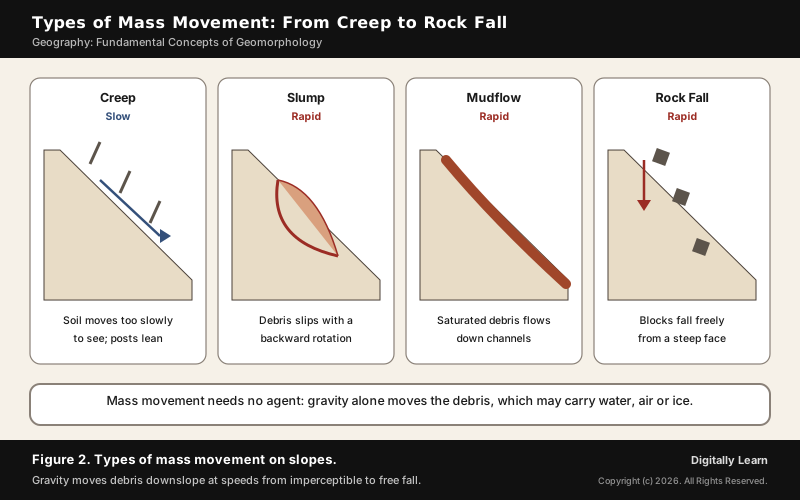
The speeds differ enormously. Creep is so slow that it shows only in fence posts and telephone poles leaning downslope; solifluction is the slow flow of soil saturated or lubricated with water. Rapid movements are commonest in humid regions: mudflows occur frequently on erupting or recently erupted volcanoes, and a debris avalanche can be much faster than a mudflow.
| Class | Types |
|---|---|
| Slow movements | Creep (soil, talus, rock) and solifluction |
| Rapid movements | Earthflow, mudflow and debris avalanche |
| Landslides | Slump, debris slide, debris fall, rockslide and rock fall |
- Activating causes: Removal of support from below, steeper and higher slopes, overloading by material or heavy rain, earthquakes and explosions, excessive seepage, rapid drawdown of reservoirs and removal of natural vegetation.
- Falls: Abrupt movements of rocks and boulders that become detached from steep slopes or cliffs, separating along fractures, joints and bedding planes.
Landslides in the Himalayas and Western Ghats: Why They Differ
Debris avalanches and landslides occur very frequently in the Himalayas. The range is tectonically active, made mostly of sedimentary rocks and unconsolidated and semi-consolidated deposits, and its slopes are very steep. The Western Ghats and the Nilgiris are tectonically stable and made mostly of very hard rocks, yet they also have landslides, though less often.

The Ghats have their own reasons: many slopes are steep, with almost vertical cliffs and escarpments; mechanical weathering by temperature change is pronounced; and they receive heavy rain over short periods, so rock falls come often along with landslides and debris avalanches. About 0.42 million sq km, or 12.6 per cent of India's land outside snow-covered areas, is prone to landslides, most of it in the Himalaya.
| Point | Himalayas | Western Ghats and Nilgiris |
|---|---|---|
| Tectonics | Active | Relatively stable |
| Rocks | Sedimentary rocks, loose deposits | Very hard rocks |
| Main trigger | Steep slopes on weak material | Cliffs, weathering, short heavy rain |
| Prone area | 0.18 million sq km (North-East), 0.14 (North-West) | 0.09 million sq km with the Konkan hills |
Erosion, Transportation and Deposition
Erosion is the acquisition and transportation of rock debris by the agents: running water, groundwater, glaciers, wind and waves. It wears the landscape down, and it is erosion that is largely responsible for the continuous changes on the earth's surface. Weathering aids erosion but is not a precondition for it. The processes are covered in detail in processes of erosion.
Erosion can be defined as the application of the kinetic energy of an agent to the land surface along which it moves, where kinetic energy is half the mass times the square of the velocity. So a glacier, though slow, is a powerful eroder because of its great mass, while wind, being a gas, is the least effective.
- Climate-controlled agents: Wind, running water and glaciers, the three states of matter.
- Agents not controlled by climate: Waves, set by the coast, and groundwater, set by rock type; karst develops only where rocks are permeable and soluble.
- Deposition: A consequence of erosion; agents lose velocity on gentler slopes, dropping coarser material first and finer later, and filling depressions.
Landform Evolution: Davis's Cycle of Erosion and Its Rivals
Davis's Cycle of Erosion: Youth, Maturity and Old Age
The best-known model of landform evolution is the geographical cycle, or cycle of erosion, developed by William Morris Davis between 1884 and 1899. It pictures a single uplift followed by a long wearing down, in which a landmass passes through stages comparable to the stages of life: youth, maturity and old age.
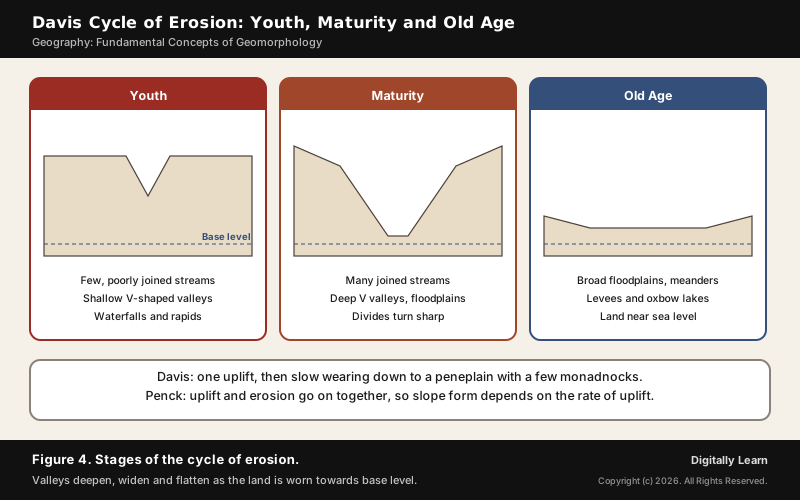
- Youth: Few, poorly integrated streams in shallow V-shaped valleys with little or no floodplain; waterfalls and rapids where hard rock is exposed.
- Maturity: Many well-integrated streams in deep V-shaped valleys with wider floodplains; stream divides turn sharp and waterfalls disappear.
- Old age: Few tributaries with gentle gradients; streams meander over vast floodplains with natural levees and oxbow lakes, and most of the land is at or just above sea level.
The end of the cycle is a peneplain, an almost plain, a lowland of faint relief with a few resistant remnants called monadnocks. Erosion works down towards the base level, a term introduced by John Wesley Powell in 1875: the ultimate base level is sea level projected under the land, while a lake or basin far from the sea can act as a local base level.
Penck, King and Gilbert: Alternative Models of Landform Evolution
Davis's model did not go unchallenged. In the 1920s Walther Penck argued that uplift and denudation go on together, at gradual and continuous rates, rather than one uplift followed by decay. His Morphological Analysis of Landforms was published after his death, in 1924. In his model the steepness of valley slopes depends on the rate of uplift, not on the stage reached, and slopes retreat parallel to themselves.
| Point | Davis | Penck |
|---|---|---|
| Uplift | A single uplift, then decay | Uplift and erosion together, gradual and continuous |
| What sets slope form | The stage: youth, maturity, old age | The rate of uplift |
| Slope change | Slopes flatten as the stage advances | Slopes retreat parallel to themselves |
| End form | Peneplain with monadnocks | Peneplains where uplift is slow, Alpine forms where it is rapid |
- Lester Charles King: In South African Scenery (1942) he described the pediplain, an extensive plain formed by the coalescence of pediments, and held that peneplains do not exist.
- Grove Karl Gilbert: His monograph on the Henry Mountains (1877) and later work began the measured study of processes that grew into modern quantitative geomorphology.
Why Geomorphology Matters: Applications in India
The land surface is sensitive, and humans depend on it for their sustenance. Most of it was shaped over very long periods, and misuse diminishes its potential fast, so understanding the processes that shape it is the first step to using it without disturbing its balance.
- Landslide hazard mapping: Under the National Landslide Susceptibility Mapping programme, begun in 2014-15, the Geological Survey of India has mapped 4.3 lakh sq km of landslide-prone areas, including about 42,093 sq km in Himachal Pradesh.
- Satellite inventories: The Landslide Atlas of India (2023) maps about 80,000 landslides from 1998 to 2022 and ranks 147 districts in 17 states and 2 Union Territories by their exposure.
- Soils and resources: Weathering forms regolith and soils and enriches ores of iron, manganese, aluminium and copper.
- Biodiversity: Forests, and so biomes and biodiversity, depend on the depth of the weathering mantle.
Previous Year UPSC-CSE Questions
Previous Year UPSC-CSE Questions By the end you will be able to draft model answers for the following UPSC questions. Each question carries a collapsible framework showing how to approach it in the exam.
- UPSC Mains 2021 GS-IDifferentiate the causes of landslides in the Himalayan region and Western Ghats.
Answer outline: how to structure the answer
What the question asks, the main arguments, relevant examples and the direction of the conclusion. This is not a full model answer.
Introduction: Landslides are rapid mass movements of debris under gravity; about 12.6 per cent of India's land is prone to them, mostly in the Himalaya and the Western Ghats.
Body (sub-themes to develop):
- Himalayas: tectonically active, young folded mountains; weak sedimentary and unconsolidated rocks; very steep slopes.
- Western Ghats: tectonically stable hard rocks, but vertical cliffs and escarpments.
- Ghats triggers: strong mechanical weathering and very heavy rain over short periods, causing rock falls.
- Common triggers: monsoon rain, road cutting and removal of vegetation.
Conclusion: Conclude that the Himalayas slide because of what they are made of and where they sit, the Ghats because of their cliffs and rain, so mitigation must differ too.
- UPSC Mains 2013 GS-IBring out the causes for more frequent landslides in the Himalayas than in the Western Ghats.
Answer outline: how to structure the answer
What the question asks, the main arguments, relevant examples and the direction of the conclusion. This is not a full model answer.
Introduction: Open with the landslide-prone area: 0.32 million of India's 0.42 million sq km lie in the Himalaya.
Body (sub-themes to develop):
- Tectonically active range with frequent earthquakes.
- Sedimentary rocks and unconsolidated, semi-consolidated deposits.
- Very steep slopes and heavy monsoon rain.
Conclusion: Conclude that the Ghats are harder and more stable, so landslides there are fewer.
- UPSC Prelims 2024 Prelims-GSConsider the following statements :
- Statement-I : Rainfall is one of the reasons for weathering of rocks.
- Statement-II : Rain water contains carbon dioxide in solution.
- Statement-III : Rain water contains atmospheric oxygen.
Which one of the following is correct in respect of the above statements ?
How to approach this Prelims question
Approach: Check each statement, then check whether it explains weathering by rain.
Trap to watch: Both dissolved gases drive chemical weathering, so both explain Statement I.
Key facts to recall:
- (a) Both II and III correct, both explain I: right. Carbon dioxide in rainwater forms carbonic acid (carbonation and solution) and dissolved oxygen drives oxidation, and both weather rock.
- (b) Both correct, only one explains I: wrong. Both gases take part in chemical weathering, not just one.
- (c) Only one of II and III correct: wrong. Rainwater carries both carbon dioxide and oxygen.
- (d) Neither II nor III correct: wrong. Both statements are correct.
Answer signal: Both statements are correct and both explain weathering by rain, so the answer is option (a).
Sources
- NCERT: Fundamentals of Physical Geography (Class XI), Geomorphic Processes
- NCERT: Fundamentals of Physical Geography (Class XI), Landforms and their Evolution
- ISRO / NRSC: Landslide Atlas of India, 2023
- PIB (Ministry of Environment, Forest and Climate Change): National Landslide Susceptibility Mapping, 18 December 2023
- USGS: Landslide Types and Processes (Fact Sheet 2004-3072)
- Wikipedia: Geomorphology
- Wikipedia: Uniformitarianism
- Wikipedia: William Morris Davis
- Wikipedia: Walther Penck
- Wikipedia: Base level
- Wikipedia: Peneplain
- Wikipedia: Pediplain
- Wikipedia: Grove Karl Gilbert
- Wikipedia: Equifinality
- Wikipedia: Denudation
- Wikipedia: Weathering
- Wikipedia: Mass wasting
- Wikipedia: Landslide
- Wikipedia: Erosion
- Wikipedia: Landform
- UPSC: Civil Services Examination question papers
Editorial Disclaimer
This article draws on the NCERT geography textbooks, ISRO, the Geological Survey of India, USGS and the other sources listed on this page. Landslide figures are those of the national atlas and mapping programmes cited.


