


Overview
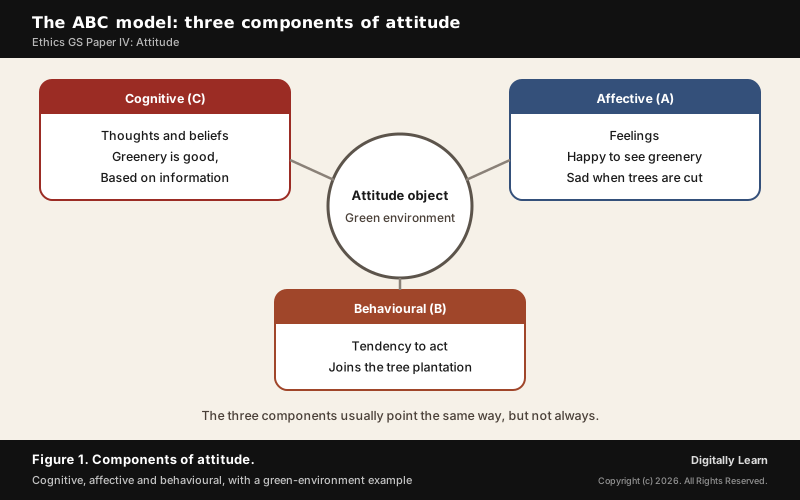
The attitude meaning in psychology is a state of mind: a set of views about some object, person or issue, called the attitude object, that carries an evaluation (positive, negative or neutral), an emotion and a tendency to act in a certain way. These three parts are the cognitive, affective and behavioural components, the ABC model. Attitudes are learned, can change, and do not always show in behaviour.
What Is Attitude? Meaning and Definition
Attitude Meaning and Definition in Psychology
An attitude is more than an opinion. All definitions agree that it is a state of the mind, a set of views or thoughts about a topic, the attitude object, with an evaluative feature: positive, negative or neutral. It comes with an emotion and a tendency to act in a particular way towards that object. If your views on a topic are only thoughts, they are opinions; once they carry feelings and a readiness to act, they are attitudes.
Attitudes cannot be seen from outside. They are part of our thinking, and they represent a tendency to behave rather than the behaviour itself. Their use is practical: an attitude gives a person a ready background, a kind of mental blueprint, that makes it easier to decide how to act in a new situation.
Attitude, Belief, Value, Opinion and Aptitude: The Difference
Several words sit close to attitude, and examiners like to test the difference. The key is what each one adds: a belief is only the thinking part, a value adds an 'ought', and an aptitude is about ability rather than evaluation.
| Term | What it means | Example |
|---|---|---|
| Opinion | A view on a topic without strong feeling or action | I think this film was long |
| Belief | The cognitive part of an attitude, the ground it stands on | Belief in democracy |
| Attitude | Thought, feeling and a tendency to act together | Liking and supporting tree planting |
| Value | An attitude or belief with a 'should' or 'ought' | One should always be honest |
| Aptitude | Underlying potential for acquiring skills | A flair for learning languages |
Values are the hardest of these to change, because a value forms when a belief or attitude becomes an inseparable part of a person's outlook on life. Aptitude is different in kind: it predicts what a person will be able to do with proper training, while attitude describes how a person evaluates something.
Structure of Attitude: Components and Properties
Three Components of Attitude: The ABC Model
The structure of an attitude has three components. The thought component is the cognitive aspect, the emotional component the affective aspect, and the tendency to act the behavioural, or conative, aspect. Together they are called the A-B-C components.
- Cognitive: Based on information about the environment, your view of a green environment is positive.
- Affective: You feel happy when you see greenery and sad or angry when trees are cut down.
- Behavioural: You join the tree plantation campaign in your neighbourhood.
We usually expect all three components to point the same way, but they need not: consistency is not guaranteed. The cognitive side of an attitude may be strong while the feeling and the action are weak, or thought and feeling may be positive while behaviour stays neutral. That is why predicting one component from the other two does not always give the right picture.
Properties of Attitude: Valence, Extremeness, Complexity and Centrality
Beyond its three components, every attitude has four properties. They describe how positive, how strong, how many-sided and how important the attitude is, and they decide how easily it can be changed.
- Valence: Whether the attitude is positive, negative or neutral. On a 5-point scale about nuclear research, 4 or 5 is positive, 1 or 2 negative and 3 neutral.
- Extremeness: How positive or negative it is; ratings of 1 and 5 are equally extreme, in opposite directions.
- Simplicity or complexity: How many member attitudes it contains. An attitude towards health and well-being is complex; an attitude towards one person is usually simple.
- Centrality: How much it influences the other attitudes in the system. A negative attitude towards high military spending may be central to a person’s attitude towards world peace.
Explicit and Implicit Attitudes
Some attitudes are held consciously and some are not. Explicit attitudes are formed deliberately and are easy to report; implicit attitudes work below awareness and can be measured only indirectly. Both shape behaviour, but implicit attitudes matter most when a person must act under heavy demands and has little time to think.
For a public servant this distinction is practical. A person may sincerely believe in treating everyone equally, yet an unconscious attitude learned in childhood can colour a quick decision about a complainant. Knowing that such attitudes exist is the first step to checking them.
Functions of Attitude
Functions of Attitude: Katz's Functional Theory
Why do people hold attitudes at all? The functional approach, set out by Daniel Katz in 1960 and by Smith, Bruner and White in 1956, says that attitudes serve psychological needs. Five functions are usually listed:
| Function | What the attitude does | Example |
|---|---|---|
| Utilitarian | Helps gain rewards and avoid punishments | Liking ice cream for its taste, wary of weight gain |
| Knowledge | Gives order and meaning to a complex world | A simple view of how an office works |
| Ego-defensive | Protects self-esteem from unpleasant truths | Blaming others for one's own failure |
| Value-expressive | Expresses values central to who one is | Supporting a cause one believes in |
| Social-adjustive | Helps fit in with valued groups | Adopting a group's tastes to be accepted |
Knowing the function tells you how to change an attitude. An attitude held for utilitarian reasons changes when rewards change; one held to protect the ego resists facts and needs reassurance; one that expresses values changes only when the values are engaged. A campaign that argues the wrong way misses its audience.
Attitude Formation: How Attitudes Are Learned
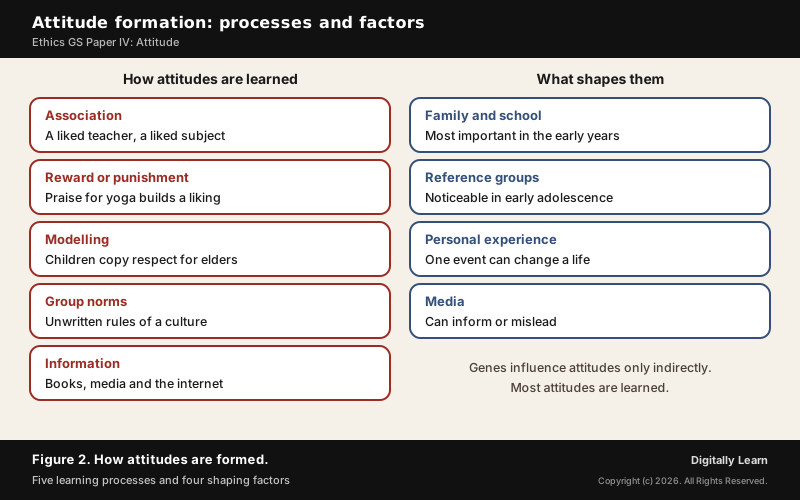
Processes of Attitude Formation
Attitudes are formed as we interact with others. Some research shows an inborn aspect, but genetic factors influence attitudes only indirectly, along with learning, so attitudes are mostly learned through one's own experiences and through other people. Five processes do the learning:
- Association: Students often come to like a subject because they like the teacher; the teacher’s positive qualities get linked to the subject.
- Reward and punishment: A teenager praised as ‘Miss Good Health’ for regular yoga develops a positive attitude towards yoga; a child who keeps falling ill from junk food learns a negative attitude towards it.
- Modelling: Children form a respectful attitude towards elders by watching their parents show respect and being appreciated for it.
- Group or cultural norms: Unwritten rules of behaviour, such as offerings at a place of worship, become part of our thinking as attitudes.
- Exposure to information: Reading the biographies of self-actualised people can build a positive attitude towards hard work.
Factors in Attitude Formation: Family, Reference Groups, Experience and Media
The learning processes work through four settings. Each explains why people from the same society can hold opposite attitudes towards the same issue.
- Family and school: In the early years parents and family members play a significant role; later the school environment becomes important.
- Reference groups: They show what thinking and behaviour are acceptable, and shape political, religious and social attitudes, especially at the start of adolescence.
- Personal experience: An army driver who narrowly escaped death while his companions were killed returned to his village in Maharashtra and became a community leader who transformed it.
- Media: Television, the internet and even textbooks strengthen the cognitive and affective parts first; the media can inform, but can also spread consumerist attitudes with no check on the information.
These factors explain the contrasting attitudes found in society. Take caste: a person raised in a family and reference group that observes caste rules may learn to accept them as normal, while another whose school, friends or personal experience expose the injustice of caste learns to reject them. Education and exposure to information can loosen attitudes learned early; group norms and fear of exclusion keep them in place. The policy side of this debate is covered in reservation in India.
Attitude Change and Persuasion
Theories of Attitude Change: Balance, Cognitive Dissonance and Two-Step
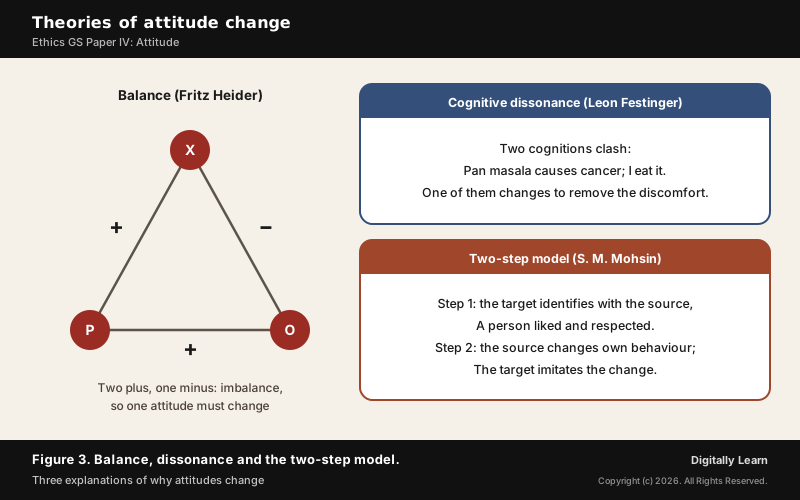
Attitudes still forming, more like opinions, change easily; attitudes that have become part of a person's values resist change. Three ideas explain how change happens:
- Balance (Fritz Heider): In the P-O-X triangle, P is the person, O another person and X the attitude object. If two links are positive and one negative, or all three negative, the triangle is unbalanced and one attitude changes. If P favours dowry, O opposes it and O likes P, either P turns against dowry, O comes to accept it, or O starts disliking P.
- Cognitive dissonance (Leon Festinger): Two clashing cognitions, such as ‘pan masala causes fatal mouth cancer’ and ‘I eat pan masala’, create discomfort, and one of them changes; the sensible change is to stop eating pan masala.
- Two-step concept (S. M. Mohsin): First the target identifies with a liked and respected source; then the source changes its own behaviour, and the target imitates it.
Festinger and Carlsmith showed dissonance at work. Students who told others that a boring experiment was interesting for only $1 later rated it more interesting than those paid $20; the $1 group had no good reason for the lie, so they changed their attitude instead. Balance and dissonance are both forms of cognitive consistency: the mind wants its attitudes to agree.
Factors That Influence Attitude Change: Source, Message and Target
Whether an attitude changes, and how far, depends on four sets of factors. They are the practical toolkit of anyone trying to persuade, from an advertiser to a district officer.
- The existing attitude: Its valence, extremeness, complexity and centrality; a congruent change, in the same direction as the attitude, is easier than an incongruent one.
- Source: Credibility and attractiveness; a computer engineer persuades adult buyers of a laptop, but schoolchildren may trust another child more.
- Message: Just enough information, a rational or emotional appeal, and the motives it activates; fear works only up to a point before it turns people off.
- Mode: Face-to-face talk works better than letters or even mass media; social workers and doctors spreading the word about ORS do better than radio alone.
- Target: Open, flexible people and those with low self-esteem change more easily; people with strong prejudices change least.
Social Influence and Persuasion: Compliance, Identification, Internalisation
Social influence is how other people change our attitudes and behaviour. Herbert Kelman in 1958 described three levels, which differ in how deep the change goes:
| Level | What happens | Why the person changes |
|---|---|---|
| Compliance | Agrees in public but keeps private doubts | To gain a reward or avoid a punishment |
| Identification | Adopts the view of a liked, respected person | To be like the admired person |
| Internalisation | Accepts the belief in public and in private | It fits the person's own values |
Persuasion works by two routes in the elaboration likelihood model. By the central route a person weighs the arguments carefully; by the peripheral route the attractiveness of the source does the work. Change through the central route lasts longer and resists counter-arguments better.
The Swachh Bharat Mission, launched on 2 October 2014, shows these ideas in use. Celebrities and brand ambassadors invited identification; Swachhagrahis, village-level volunteers, promoted toilets through community-led total sanitation, face-to-face; and the mission set out to change sanitation behaviour, not only to build toilets. Internalisation, where people use toilets because they value clean surroundings, is the level that keeps a village open-defecation free.
Attitude and Behaviour: When Attitudes Predict Action
Relation of Attitude With Thought and Behaviour
We expect behaviour to follow attitude, but it often does not. In a classic study by LaPiere, a Chinese couple travelling in the United States was refused service only once, yet when hotel managers in the same areas were later asked by questionnaire, a very large percentage said they would not accommodate Chinese guests. The stated attitude and the actual behaviour did not match.
- Strong and central: The attitude occupies a central place in the attitude system.
- Awareness: The person is aware of the attitude.
- Little outside pressure: No group pressure to follow a particular norm.
- Not watched: The behaviour is not being observed or judged by others.
- Good result expected: The person expects a positive consequence and so intends to act.
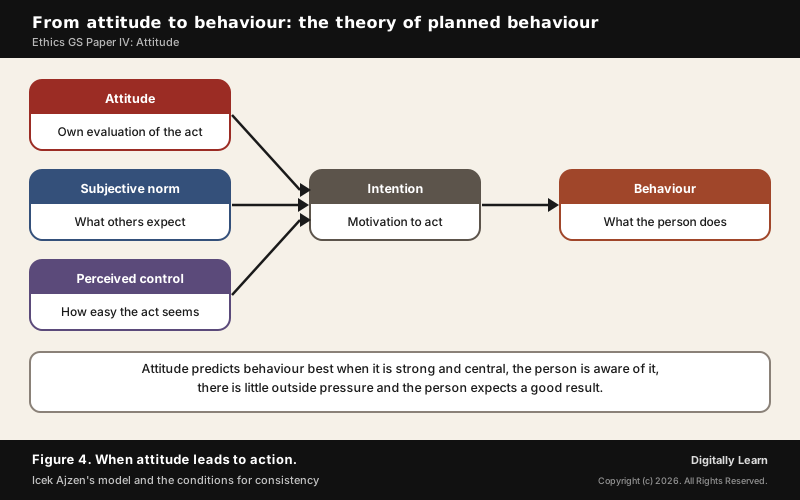
The theory of planned behaviour, proposed by Icek Ajzen in 1985, explains this gap. Attitude towards the act, the subjective norm (what important others expect) and perceived behavioural control together shape an intention, and intention is the nearest predictor of behaviour. Sometimes the arrow runs backwards: behaviour decides attitude, as the $1 students in the dissonance experiment showed.
Moral, Political and Civil Service Attitudes
Moral Attitudes and Political Attitudes: Values and Ideology
The syllabus asks separately about moral and political attitudes. A moral attitude is one tied to a value, a belief with a 'should' or 'ought' such as 'one should always be honest'; because it has become part of a person's outlook, it is central and hard to change. A political attitude is an attitude towards political groups, leaders, issues and ideologies, such as belief in democracy.
Political attitudes are shaped heavily by reference groups: attitudes towards political, religious and social groups, occupations and national issues are often developed through them. That is why political attitudes tend to run in families and communities, and why exposure to other views, through education and a free media, matters for a democracy.
Attitude for Civil Servants: Building a Positive and Suitable Attitude
The attitude a public servant needs is spelt out in the syllabus's list of foundational values: integrity, impartiality and non-partisanship, objectivity, dedication to public service, and empathy, tolerance and compassion towards the weaker sections. Building these is an application of the formation and change processes above.
- Training and reward: Recognition for honest, citizen-friendly work reinforces the right attitudes, the reward route of learning.
- Role models: Seeing respected seniors act with integrity teaches by modelling, and identification makes the lesson stick.
- Organisational norms: An office culture that expects fairness turns a norm into an attitude over time.
- Exposure: Field visits and contact with the poor build empathy that information alone cannot.
- Reflection: Noticing the gap between one’s values and one’s conduct creates dissonance that pushes conduct towards the values.
A positive attitude under stress grows from the same roots: a supportive family and school background, reference groups that value service, personal experiences of problems solved, and high self-esteem, which makes a person less easily swayed. For the whole GS Paper IV syllabus and what it asks, see UPSC GS 4 syllabus.
Government training now aims at attitude as well as skill. Mission Karmayogi, the National Programme for Civil Services Capacity Building approved by the Union Cabinet on 2 September 2020, seeks to build both functional and behavioural competencies by moving from a rules-based to a roles-based system. It works through the iGOT Karmayogi online platform and a Capacity Building Commission, and set aside Rs 510.86 crore over five years to cover about 46 lakh central employees.
Previous Year UPSC-CSE Questions
Previous Year UPSC-CSE Questions By the end you will be able to draft model answers for the following UPSC questions. Each question carries a collapsible framework showing how to approach it in the exam.
- UPSC Mains 2021 GS-IVAttitude is an important component that goes as input in the development of human being. How to build a suitable attitude needed for a public servant?
Answer outline: how to structure the answer
What the question asks, the main arguments, relevant examples and the direction of the conclusion. This is not a full model answer.
Introduction: An attitude is a learned state of mind with thought, feeling and a tendency to act; the syllabus names integrity, impartiality, objectivity, empathy and dedication.
Body (sub-themes to develop):
- Reward and recognition for fair, citizen-friendly work.
- Modelling and identification with respected seniors.
- Organisational norms and training that make fairness routine.
- Field exposure for empathy; reflection and dissonance to align conduct with values.
Conclusion: Conclude that suitable attitudes are built, not inborn, and need institutions that reward them.
- UPSC Mains 2020 GS-IVA positive attitude is considered to be an essential characteristic of a civil servant who is often required to function under extreme stress. What contributes to a positive attitude in a person?
Answer outline: how to structure the answer
What the question asks, the main arguments, relevant examples and the direction of the conclusion. This is not a full model answer.
Introduction: A positive attitude is a favourable evaluation with matching feeling and readiness to act, even under pressure.
Body (sub-themes to develop):
- Family and school background; reference groups that value service.
- Personal experiences of problems solved.
- High self-esteem, which makes a person less easily swayed.
- Supportive organisational norms and recognition.
Conclusion: Conclude that a positive attitude can be cultivated deliberately through these channels.
- UPSC Mains 2016 GS-IVHow could social influence and persuasion contribute to the success of Swachh Bharat Abhiyan?
Answer outline: how to structure the answer
What the question asks, the main arguments, relevant examples and the direction of the conclusion. This is not a full model answer.
Introduction: Swachh Bharat, launched on 2 October 2014, aimed at behaviour change, not only construction.
Body (sub-themes to develop):
- Identification: celebrities and brand ambassadors as credible, attractive sources.
- Face-to-face persuasion: Swachhagrahis and community-led total sanitation.
- Group norms and compliance moving towards internalisation.
- Central route: health arguments; peripheral route: popular figures.
Conclusion: Conclude that lasting sanitation needs internalised attitudes, which persuasion can seed.
- UPSC Mains 2014 GS-IVWhat factors affect the formation of a person’s attitude towards social problems? In our society, contrasting attitudes are prevalent about many social problems. What contrasting attitudes do you notice about the caste system in our society? How do you explain the existence of these contrasting attitudes?
Answer outline: how to structure the answer
What the question asks, the main arguments, relevant examples and the direction of the conclusion. This is not a full model answer.
Introduction: Attitudes are learned through association, reward, modelling, norms and information.
Body (sub-themes to develop):
- Factors: family and school, reference groups, personal experience, media.
- Contrasting attitudes to caste: acceptance of caste rules versus rejection of caste injustice.
- Explanation: different families, groups and experiences teach different attitudes; education and exposure loosen early ones.
- Group norms and fear of exclusion keep old attitudes in place.
Conclusion: Conclude that education and contact across groups are the main levers for change.
Sources and Further Reading
- NCERT: Psychology (Class XII), Chapter 6, Attitude and Social Cognition
- NCERT: Psychology (Class XII), Chapter 1, Variations in Psychological Attributes
- UPSC: Civil Services Examination 2026 notification (GS Paper IV syllabus)
- PIB: Cabinet approves Mission Karmayogi, National Programme for Civil Services Capacity Building (2 September 2020)
- Prime Minister's Office: Cabinet approves Mission Karmayogi
- Department of Personnel and Training: Mission Karmayogi (NPCSCB)
- Wikipedia: Attitude (psychology)
- Wikipedia: Functional attitude theory
- Wikipedia: Elaboration likelihood model
- Wikipedia: Social influence
- Wikipedia: Attitude change
- Wikipedia: Theory of planned behavior
- Wikipedia: Swachh Bharat Mission
- UPSC: Previous year question papers
Editorial Disclaimer
This article explains attitude for the ethics paper from the NCERT Psychology textbook, the UPSC syllabus and the other sources listed below. Examples are for learning, not clinical advice.


