


Overview
A saturation mission carrying housing, water, roads, power, health and livelihoods to the 75 PVTGs
Launched on 15 November 2023 by the Ministry of Tribal Affairs, PM-JANMAN is a saturation mission that delivers housing, water, roads, electricity, health and livelihoods to the 75 Particularly Vulnerable Tribal Groups, the most isolated Scheduled Tribes long missed by mainstream schemes.
PM-JANMAN, the Pradhan Mantri Janjati Adivasi Nyaya Maha Abhiyan, is a saturation mission launched on 15 November 2023 by the Ministry of Tribal Affairs for the 75 Particularly Vulnerable Tribal Groups, the most isolated of India's Scheduled Tribes. Announced in the Budget 2023-24 and backed by an outlay of Rs 24,104 crore over three years, it delivers 11 critical interventions, from pucca houses, roads and piped water to electricity, health, education and livelihoods, through nine line ministries, so that the basic services the Constitution promises reach the remotest tribal habitation.
What PM-JANMAN Is: The 15 November 2023 Saturation Mission for Particularly Vulnerable Tribal Groups
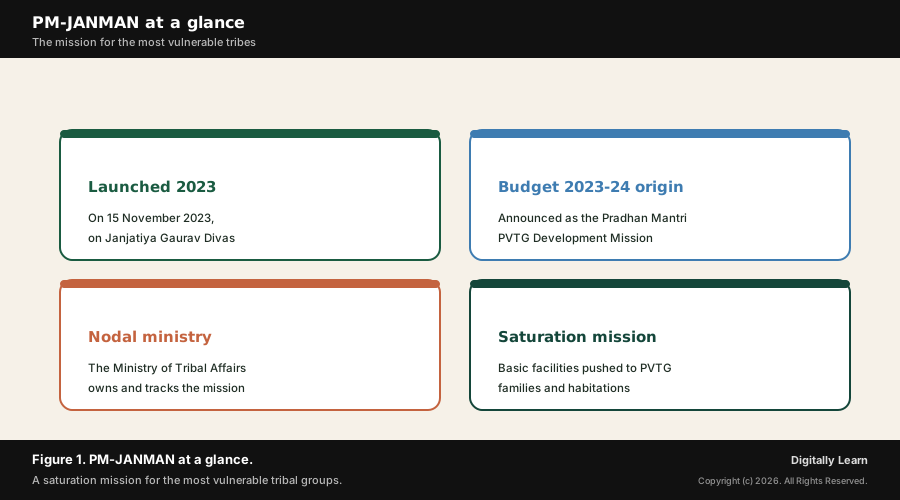
The 15 November 2023 launch on Janjatiya Gaurav Divas by the Ministry of Tribal Affairs, the Budget 2023-24 origin as the Pradhan Mantri PVTG Development Mission, and the saturation approach to basic facilities
PM-JANMAN, the Pradhan Mantri Janjati Adivasi Nyaya Maha Abhiyan, is a saturation mission for India's most vulnerable tribal communities. It was launched on 15 November 2023, on Janjatiya Gaurav Divas, the birth anniversary of the tribal icon Birsa Munda. The Ministry of Tribal Affairs is the nodal ministry, and the aim is to carry basic facilities to the Particularly Vulnerable Tribal Groups who have long lived beyond the easy reach of the State.
The mission grew out of a Budget announcement. In the Union Budget 2023-24, the Government announced the Pradhan Mantri PVTG Development Mission, with about Rs 15,000 crore set aside from the tribal development plan over three years. The Cabinet then approved it as PM-JANMAN, widening the design into a multi-ministry saturation drive. The mission is therefore both a welfare promise and a test of whether the State can reach the hardest-to-reach citizen.
What is the significance of this mission is that it treats the Particularly Vulnerable Tribal Group as a citizen with a claim on the State, not a community to be left aside. Most welfare reaches people through area-based or income-based schemes; the most isolated tribes slip through these nets. PM-JANMAN answers with saturation: every targeted household and habitation is to receive a fixed set of basic facilities. The figure below sets out PM-JANMAN at a glance.
Who the Particularly Vulnerable Tribal Groups Are: The 75 PVTGs and the Four Identification Criteria
The 75 PVTGs as the most vulnerable sub-category of the Scheduled Tribes notified under Article 342, the four identification criteria of pre-agricultural technology, low literacy, a stagnant population and a subsistence economy, the Dhebar Commission origin and the 2006 renaming, and the spread across 18 states and one Union Territory
The Particularly Vulnerable Tribal Groups, or PVTGs, are a special category within India's Scheduled Tribes. Tribals are recognised in the Constitution as Scheduled Tribes, notified by the President under Article 342. Within these tribes, some communities are far more vulnerable than others, and the State marks them out as PVTGs, the most fragile of the Scheduled Tribes. There are 75 PVTGs today, out of about 705 Scheduled Tribe communities in all.
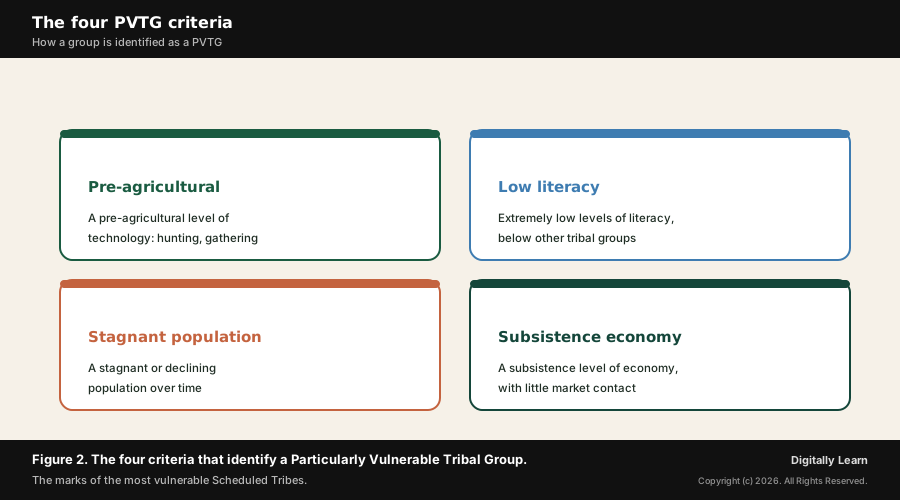
Four criteria mark a group as a PVTG. The first is a pre-agricultural level of technology, where people still live mainly by hunting, gathering and shifting cultivation. The second is extremely low literacy, well below that of other tribes. The third is a stagnant or declining population, a sign of deep distress.
The fourth is a subsistence economy, with little surplus or market contact. The category was shaped by the Dhebar Commission of 1960-61 and was renamed Particularly Vulnerable Tribal Groups in 2006.
What is the significance of this classification is that it tells the State exactly whom to protect first. A community that hunts and gathers, cannot read and is shrinking in number cannot wait for benefits to trickle down through ordinary schemes. By naming the 75 PVTGs, the State accepts a duty to reach them directly.
The 75 groups are spread across 18 states and one Union Territory, from the Andaman islands to central India. The table contrasts a PVTG with a general Scheduled Tribe, and the figure sets out the four identifying criteria.
| Feature | Particularly Vulnerable Tribal Group (PVTG) | General Scheduled Tribe |
|---|---|---|
| Status | A sub-category of Scheduled Tribe, identified as the most vulnerable | A tribal community notified as a Scheduled Tribe under Article 342 |
| How many | 75 groups, out of about 705 Scheduled Tribes | About 705 Scheduled Tribe communities in all |
| Identifying marks | Pre-agricultural technology, low literacy, a stagnant population and a subsistence economy | Distinctive culture, geographical isolation and social or economic backwardness |
| Main risk | Isolation and small numbers leave them missed by area-based schemes | Better reached by general tribal and area-based welfare schemes |
| Flagship effort | PM-JANMAN, the saturation mission launched in 2023 | The wider Development Action Plan for Scheduled Tribes |
Why a Dedicated Mission for PVTGs: Isolation, Subsistence Living and Exclusion from Mainstream Saturation
The geographical isolation in forests and hill tracts, the subsistence way of life that leaves little cash, the low literacy and weak political voice, and the way ordinary area-based and income-based schemes pass the PVTG household by
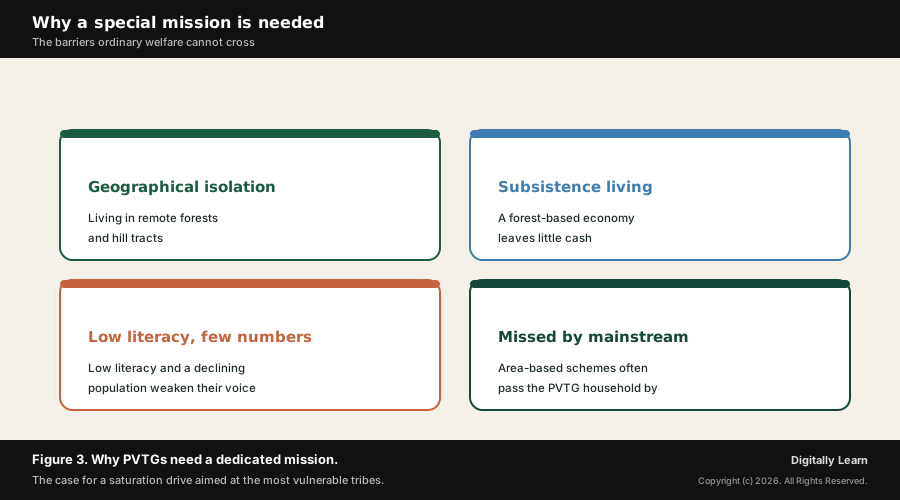
PVTGs need a dedicated mission because ordinary welfare passes them by. Many live deep in forests and hill tracts, far from the road, the school and the health centre. Distance alone makes them invisible to schemes that assume a village with an address, a market and a bank. The cost of reaching a scattered, remote household is high, so the easiest places are served first and the PVTG habitation is served last, if at all.
Their way of life deepens the exclusion. A subsistence economy built on forest produce leaves little cash, so any service that asks the user to pay stays out of reach. Low literacy means forms, portals and entitlements are hard to claim without help. A declining population and weak political voice mean their needs rarely set the agenda. Each feature, taken alone, slows delivery; taken together, they keep the PVTG household at the very back of the queue.
What is the significance of this gap is that it explains the saturation design. If isolation and low capacity are the problem, then a scheme that waits for people to apply will keep failing them.
PM-JANMAN instead pushes a fixed set of basic facilities to every targeted household and habitation, so that recognition does not depend on the worker's own effort. The aim is to close the gap between a right on paper and a service in the hand. The figure sets out why a special mission is needed.
The Eleven Critical Interventions and the Benefits They Deliver
The eleven interventions grouped by need, from pucca houses, all-weather roads and piped water to electrification, solar lighting, mobile medical units, anganwadi centres, hostels, Van Dhan Vikas Kendras, multipurpose centres and telecom connectivity, and the delivering ministry behind each
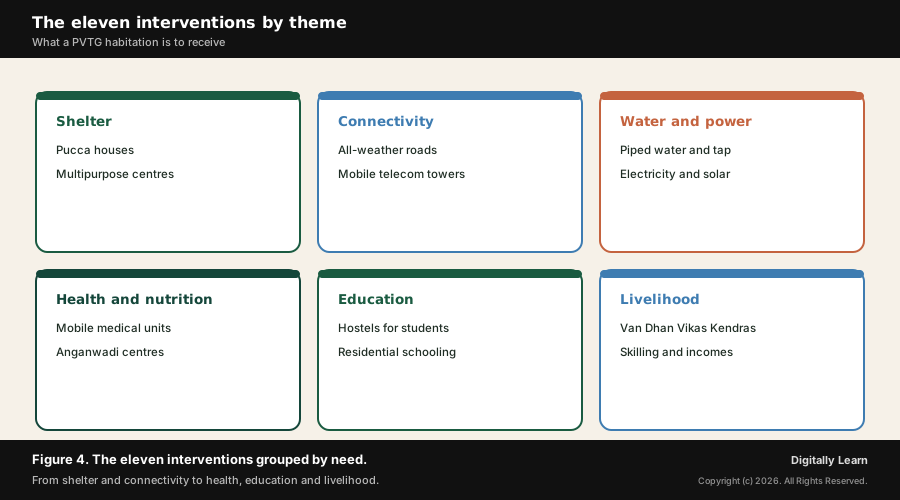
PM-JANMAN delivers 11 critical interventions, each aimed at one basic need. For shelter, it builds pucca houses under the rural housing scheme and sets up multipurpose centres in the habitation. For connectivity, it lays all-weather roads and installs mobile telecom towers so the habitation is no longer cut off. These are the works that turn a remote settlement into a place the State and the market can reach.
The other interventions cover services and incomes. For water and power, there is piped drinking water under the Jal Jeevan Mission, household electrification and off-grid solar lighting. For health and nutrition, mobile medical units visit the habitation and anganwadi centres feed and care for children. For education there are hostels, and for incomes there are Van Dhan Vikas Kendras that help tribal families add value to forest produce and learn new skills.
What is the significance of these interventions is that they are delivered through nine line ministries, not by the Tribal Affairs Ministry alone. Housing and roads come from Rural Development, water from Jal Shakti, power from the energy ministries, and health, nutrition and education from their own ministries.
PM-JANMAN's task is to converge these separate schemes onto the same PVTG household at the same time. The table maps each intervention to its delivering ministry, and the figure groups the eleven interventions by theme.
| Intervention | Delivering ministry or scheme | What the PVTG household gets |
|---|---|---|
| Pucca houses | Rural Development (PMAY-G) | A permanent, safe home in place of a temporary hut |
| All-weather roads | Rural Development (PMGSY) | A motorable link to the nearest road and market |
| Piped drinking water | Jal Shakti (Jal Jeevan Mission) | A tap water connection and safer drinking water |
| Household electricity | Power | An on-grid or off-grid electricity connection |
| Solar lighting | New and Renewable Energy | Solar street lights and off-grid solar power |
| Mobile medical units | Health and Family Welfare | Doctor visits and medicines at the habitation |
| Anganwadi centres | Women and Child Development | Nutrition, early care and supplementary feeding |
| Hostels | Tribal Affairs and Education | Residential schooling for tribal students |
| Multipurpose centres | Tribal Affairs | A shared centre for services and meetings |
| Van Dhan Vikas Kendras | Tribal Affairs | Skilling and value addition for forest produce |
| Mobile telecom towers | Telecommunications | Mobile and internet connectivity in remote areas |
Who Runs and Funds PM-JANMAN: The Ministry of Tribal Affairs, the Nine-Ministry Convergence and the States
The Ministry of Tribal Affairs as nodal owner, the nine line ministries that deliver their own schemes, the central and state shares, the role of districts and the gram sabha, and the survey that lists the PVTG families to be served
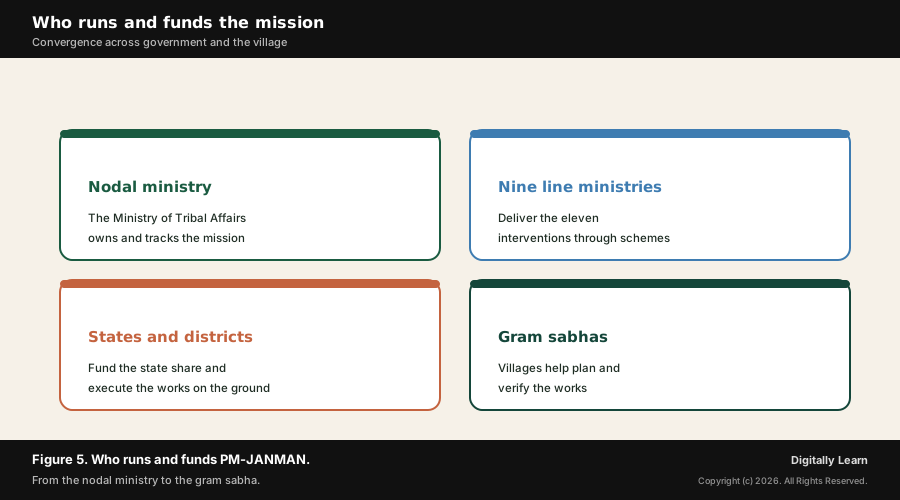
The mission runs on convergence. The Ministry of Tribal Affairs owns PM-JANMAN, sets the targets and tracks the works, but it does not build the houses or lay the pipes itself. Instead, nine line ministries deliver their own schemes in the chosen habitations, while the Tribal Affairs Ministry stitches them together so the PVTG household receives them as one package rather than as scattered, unrelated benefits.
States and districts carry the mission to the ground. The outlay is shared, with a central share and a state share, and the State machinery executes most works. The district administration identifies habitations and households, the line departments build, and the gram sabha, the village assembly, helps plan and verify the works. A survey of PVTG families gives the mission its list of who is to be served and with what.
What is the significance of this architecture is that delivery depends on the weakest link in the chain. A mission that needs nine ministries, two tiers of government and the village to act together is only as strong as its slowest partner.
Convergence is the source of PM-JANMAN's reach, since it brings the full weight of the State to one household, and also its main risk, because one missing service leaves the saturation incomplete. The figure sets out who runs and funds the mission.
Tribal Justice in Law: Articles 342, 46 and 275(1), the Fifth Schedule, the Forest Rights Act and PESA
Why tribals are notified as Scheduled Tribes under Article 342, the constitutional provisions for their upliftment in Article 46, Article 275(1), the Fifth Schedule and Article 338A, and the Forest Rights Act of 2006 and the PESA Act of 1996 that PM-JANMAN works alongside
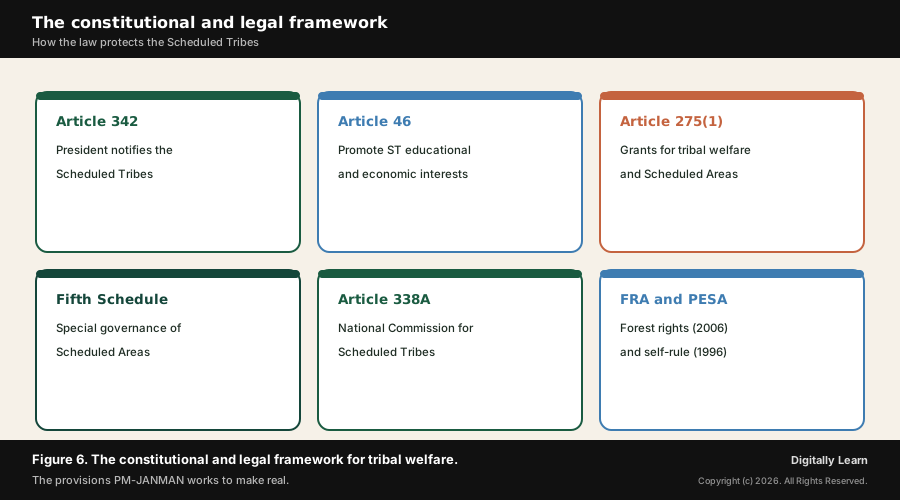
PM-JANMAN sits inside a deep constitutional framework for tribal welfare. Tribals are named Scheduled Tribes because the President, under Article 342, notifies the communities that carry the marks of tribal life: distinctive culture, geographical isolation and social or economic backwardness. This notification is the legal act that turns a tribal community into a Scheduled Tribe with a claim on special protection, and the PVTGs are the most vulnerable groups within that list.
The Constitution then provides for their upliftment. Article 46, a Directive Principle, asks the State to promote with special care the educational and economic interests of the Scheduled Tribes and to protect them from injustice. Article 275(1) gives grants from the central fund for tribal welfare and for the administration of Scheduled Areas. The Fifth Schedule sets up a special governance for Scheduled Areas, and Article 338A creates the National Commission for Scheduled Tribes to guard these safeguards.
- Article 15(4) lets the State make special provision for the educational advancement of the Scheduled Tribes, the basis for reserved seats and fee support in schools, colleges and universities.
- Article 16(4) provides reservation for the Scheduled Tribes in public employment, set at 7.5 per cent in direct central recruitment, opening government posts to communities long kept out of the formal workforce.
- Articles 330 and 332 reserve seats for the Scheduled Tribes in the Lok Sabha and in the State Legislative Assemblies, giving tribal communities a guaranteed political voice.
What is the significance of this framework is that it makes PM-JANMAN a duty, not a favour. Two laws extend the constitutional promise: the Forest Rights Act of 2006 recognises the land and forest rights of tribal and other traditional forest-dwelling communities, and the PESA Act of 1996 gives Scheduled-Area villages self-rule through the gram sabha.
PM-JANMAN is the saturation mission that tries to make these rights real on the ground, delivering the basic services the Constitution and these laws promise. The figure sets out the constitutional and legal framework.
PM-JANMAN at Scale: The Rs 24,104 Crore Outlay, the Three-Year Window and the Saturation Targets
The total outlay of Rs 24,104 crore split between a central share of Rs 15,336 crore and a state share of Rs 8,768 crore over 2023-24 to 2025-26, the coverage of 75 PVTGs and about 11 lakh families across 18 states and one Union Territory, and the saturation design
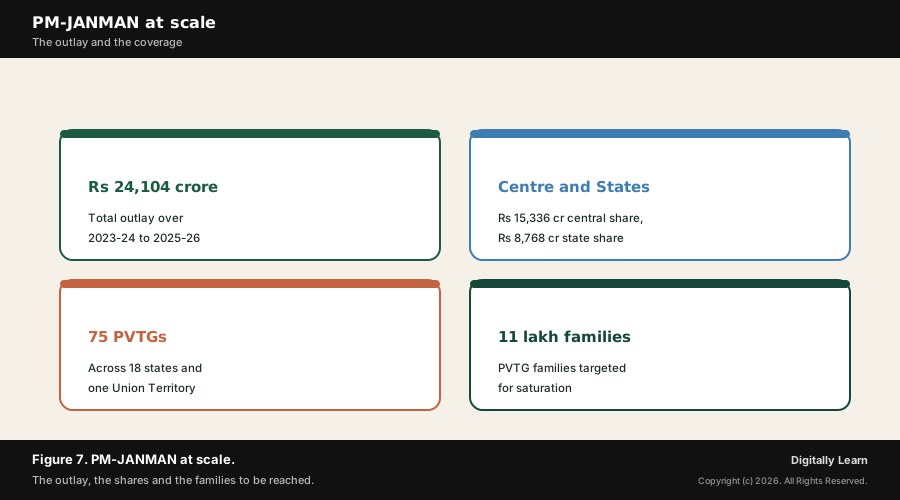
PM-JANMAN is backed by a large outlay. The total budget is Rs 24,104 crore, split as a central share of Rs 15,336 crore and a state share of Rs 8,768 crore, drawn from the tribal development plan. The money is spread over three years, from 2023-24 to 2025-26, which gives the mission a fixed window in which to complete its works rather than an open-ended timeline.
The reach is set by the number of people to be served. The mission targets the 75 PVTGs across 18 states and one Union Territory, covering about 11 lakh PVTG families who live in remote and forest habitations. The design is one of saturation: rather than reaching a sample, the mission aims to cover every targeted family and habitation with the full set of basic facilities within the three-year window.
What is the significance of the scale is that it makes the mission both ambitious and finite. A fixed outlay and a three-year window force pace, but they also raise the risk that the hardest habitations are reached last or left short when the clock runs out.
The real measure is not the money sanctioned but the share of PVTG families who actually receive a house, a tap, a road and a clinic. The figure sets out PM-JANMAN at scale.
Limits and Criticisms: Saturation Targets Versus Last-Mile Delivery, Land Rights and Data Gaps
The gap between sanctioned targets and finished works, the tension between saturation and forest and land rights, the absence of a separate PVTG census and weak baseline data, the coordination risk across nine ministries, and the question of sustaining gains after the mission window
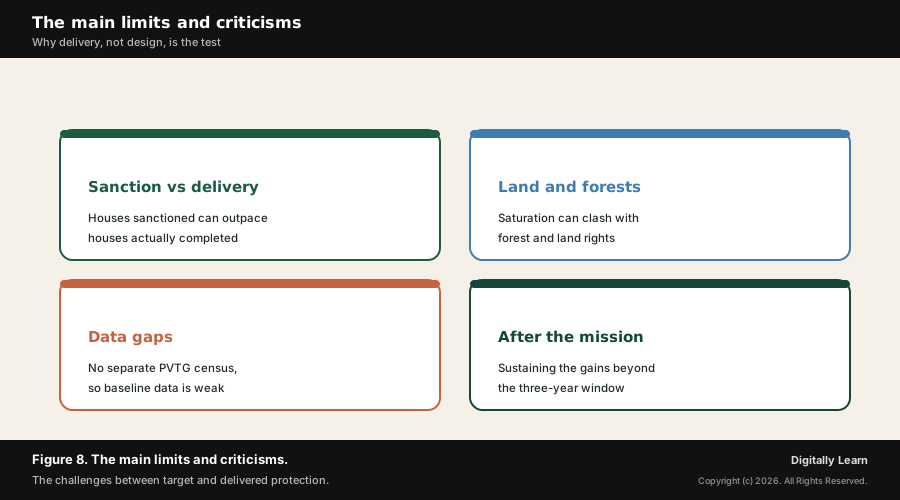
Judged honestly, PM-JANMAN faces real limits. The first is the gap between sanction and delivery: a house approved on file is not a house a family lives in, and saturation counted as targets met can hide works that are slow, incomplete or of poor quality. The hard part is not announcing the mission but finishing the last house, road and water line in the remotest habitation.
Other concerns run deeper. Building roads and houses on forest land can clash with land and forest rights, so saturation must move with the Forest Rights Act, not against it, or it risks displacement. There is also a data gap: India has no separate census of PVTGs, so baseline numbers are weak and some scattered groups may be missed. Finally, a mission that needs nine ministries to act together carries a real risk of coordination failure.
What is the significance of these criticisms is that they show why delivery, not design, is the test. The mission's promise is sound, but its value depends on steady execution, honest measurement and respect for tribal rights.
There is also the question of what happens after the mission window: gains in housing, water and health must be maintained and staffed, or a one-time push will fade. PM-JANMAN will be judged by what survives in the habitation, not by what is sanctioned on paper. The figure sets out the main limits.
Significance for Tribal Justice: Reaching the Last Person in the Remotest Habitation
How PM-JANMAN turns the count of the most vulnerable tribes into care, how it moves the constitutional promise of upliftment from guarantee to delivery, and how it sits within the wider tribal-development effort alongside the Forest Rights Act and PESA
The deeper purpose of PM-JANMAN, and the heart of the tribal-justice debate, is to reach the last person in the remotest habitation. India's tribals number more than 10 crore, about 8.6 per cent of the population by the 2011 Census, and within them the PVTGs are the most fragile. For most of independent India, these groups were counted but not served; PM-JANMAN is an attempt to turn that count into care.
What is the significance of this for tribal justice is that it moves the constitutional promise from guarantee to delivery. Articles 46 and 275(1) and the Fifth Schedule have long promised special care for the Scheduled Tribes.
PM-JANMAN tries to make that care visible as a house, a tap, a road and a clinic in the PVTG habitation. It treats the most vulnerable tribe as the first claimant on the State, in the spirit of reaching the weakest first.
Read this way, PM-JANMAN is one strand of India's wider tribal-development effort. It sits alongside the Forest Rights Act, the self-rule of PESA and the tribal sub-plan, and it speaks to debates on displacement, forest rights and the inclusion of indigenous communities. The promise is real, but it rests, as ever, on turning a scheme into delivered protection for the people who have waited the longest.
The Way Forward: From Saturation Targets to Durable, Rights-Based Tribal Development
Closing the gap between sanction and completion, moving saturation in step with forest and land rights, building sound PVTG data, tightening convergence, strengthening the gram sabha, and planning for life after the mission window
The task ahead is to make sure a sanction becomes a delivered service, by strengthening the harder pieces of convergence, data and durability. The measures below set out a balanced way to deepen PM-JANMAN without losing its focus on the most vulnerable tribes.
- Close the gap between sanction and completion, so that every approved house, road, water line and clinic in a PVTG habitation is actually built, staffed and used.
- Move saturation in step with the Forest Rights Act and PESA, so that roads and houses recognise tribal land and forest rights rather than triggering displacement.
- Build a sound PVTG database through a careful survey, so that baseline numbers are reliable and no small or scattered group is left off the list.
- Tighten convergence across the nine line ministries and the States, with a single habitation-level plan so that one missing service does not leave saturation incomplete.
- Strengthen the role of the gram sabha in planning and verifying works, so that communities shape and check the delivery meant for them.
- Plan for life after the mission window, with funds and staff to maintain the housing, water, power and health gains so that a one-time push does not fade.
Read together, these measures point to one shift: from a time-bound saturation drive to a permanent standard of service that outlasts the mission window. The lasting test of PM-JANMAN is not the number of works sanctioned but whether the school, clinic, road and water line keep running in the habitation, staffed and used, once the special funds end. On that measure, tribal justice becomes a durable, rights-based entitlement rather than a one-time campaign.
UPSC Relevance: GS-I Tribal Society, GS-II Vulnerable-Section Welfare and the Prelims Pointers
The GS-I and GS-II fit, the Prelims facts on the launch, the nodal ministry, the 75 PVTGs, the outlay and the identification criteria, and the Mains framing on Scheduled Tribe upliftment and vulnerable-section welfare
For the examination, PM-JANMAN sits across GS-I and GS-II. It is a measure for a vulnerable tribal group, which places it in GS-I society, and a welfare scheme for vulnerable sections, which places it in GS-II. The facts worth fixing for Prelims are the 15 November 2023 launch, the Ministry of Tribal Affairs as nodal, the 75 PVTGs across 18 states and one Union Territory, and the outlay of Rs 24,104 crore over 2023-24 to 2025-26.
Other Prelims pointers are the four PVTG criteria, a pre-agricultural technology, low literacy, a stagnant population and a subsistence economy, and the 11 interventions delivered through nine ministries. Aspirants should be able to tell PM-JANMAN, a saturation mission, apart from the constitutional provisions, Articles 342, 46 and 275(1) and the Fifth Schedule, that frame tribal welfare.
For Mains, PM-JANMAN is a ready example for any answer on tribal development, vulnerable-section welfare or the upliftment of the Scheduled Tribes. A student can use it to show how the State identifies the most vulnerable tribes and tries to deliver the constitutional promise of upliftment, then weigh the limits of saturation without last-mile delivery, the honest balance an examiner rewards on questions about tribal welfare.
Previous Year UPSC-CSE Questions By the end you will be able to draft model answers for the following UPSC questions. Each question carries a collapsible framework showing how to approach it in the exam.
- UPSC Mains 2016 GS-IExplain why tribals in India are referred to as the Scheduled Tribes, and set out the major provisions in the Constitution of India for their upliftment.
How to structure the answer in the exam
Introduction: Tribals are constitutionally recognised as Scheduled Tribes when the President notifies them under Article 342, and within these tribes the Particularly Vulnerable Tribal Groups are the most fragile, a framing that sets up both halves of the answer.
Body (sub-themes to develop):
- Why tribals are Scheduled Tribes: the President notifies communities as Scheduled Tribes under Article 342, drawing on indicators such as distinctive culture, geographical isolation and social and economic backwardness; the 75 PVTGs are the most vulnerable sub-set.
- Constitutional provisions for upliftment: Article 46 (a Directive Principle promoting ST educational and economic interests), Article 275(1) (grants for tribal welfare and Scheduled Areas), the Fifth Schedule (special governance of Scheduled Areas) and Article 338A (the National Commission for Scheduled Tribes). The reservation provisions complete the picture: Article 15(4) for educational advancement, Article 16(4) for reservation in public employment, and Articles 330 and 332 for reserved seats in the Lok Sabha and the State Legislative Assemblies.
- The statutory and policy layer that gives effect to these provisions: the Forest Rights Act of 2006, the PESA Act of 1996 and the Development Action Plan for Scheduled Tribes.
- PM-JANMAN as the contemporary upliftment instrument: a saturation mission delivering 11 interventions to the most vulnerable Scheduled Tribes, showing the constitutional promise moving from guarantee to delivery.
Conclusion: The constitutional provisions protect the Scheduled Tribes, but their worth lies in delivery; PM-JANMAN shows the promise of upliftment becoming a house, a road and a clinic for the most vulnerable tribes, and the real test is last-mile saturation.
Relevance to this topic. PM-JANMAN is the flagship upliftment mission for the Particularly Vulnerable Tribal Groups, the most vulnerable Scheduled Tribes. The article explains why tribals are notified as Scheduled Tribes and the constitutional provisions, Articles 46 and 275(1) and the Fifth Schedule, for their upliftment.
Sources and Further Reading
- Ministry of Tribal Affairs: operational guidelines for PM-JANMAN and the development of Particularly Vulnerable Tribal Groups
- Press Information Bureau: PM-JANMAN has a total outlay of Rs 24,104 crore, implemented through nine line ministries
- Press Information Bureau: the Pradhan Mantri PVTG Development Mission announced in the Union Budget 2023-24
- Ministry of Finance: highlights of the Union Budget 2023-24 and the implementation of budget announcements
- NITI Aayog: the Social Justice and Empowerment Division and the development of vulnerable tribal communities
- Office of the Registrar General and Census Commissioner: Census 2011 tables on the Scheduled Tribe population
- Wikipedia: Particularly Vulnerable Tribal Groups, the identification criteria and the 75 groups
Editorial Disclaimer
This briefing is for UPSC preparation. Verify the outlay, the coverage and the intervention details against the Ministry of Tribal Affairs and Press Information Bureau sources before relying on them.


