


Overview
India's 45th property
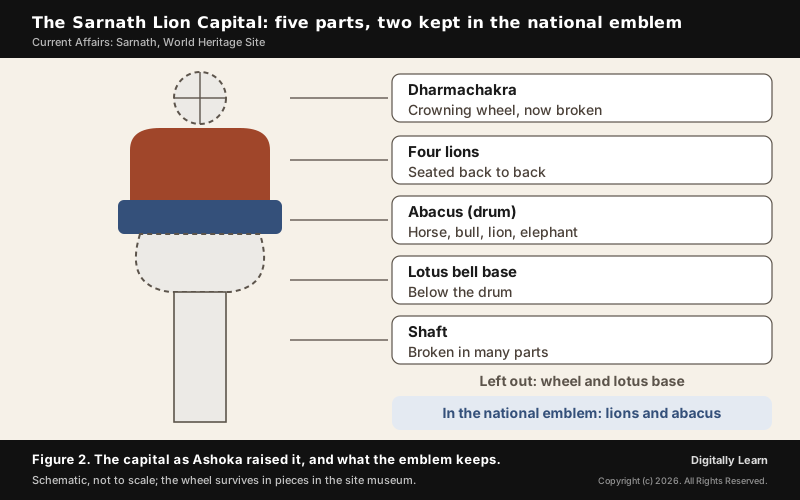
The Sarnath UNESCO World Heritage Site, inscribed as the Ancient Buddhist Site of Sarnath on 25 July 2026, is the Deer Park near Varanasi where the Buddha gave his first sermon. Its stupas, monasteries and the Ashokan Pillar span about sixteen centuries, and the inscription made it India's 45th World Heritage property.
Sarnath UNESCO World Heritage Site: The Inscription of July 2026
The 48th World Heritage Committee at Busan and India's 45th Property
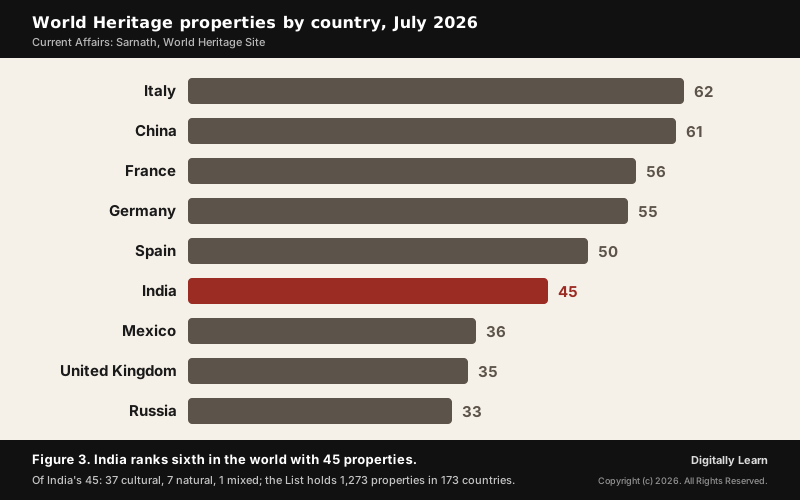
The Ancient Buddhist Site of Sarnath was inscribed on the evening of 25 July 2026, at the 48th session of the World Heritage Committee in Busan, South Korea. India's count rose to 45 World Heritage properties, sixth in the world and second in the Asia-Pacific region; a year earlier the Maratha Military Landscapes of India had been inscribed at the 47th session in Paris.
Sarnath had waited a long time. It entered India's Tentative List in 1998, and the nomination went to the World Heritage Committee in January 2025. An eighteen-month process followed, with technical meetings with UNESCO's advisory bodies and an evaluation mission by ICOMOS, the body that assesses cultural and mixed properties.
Two Components and Criteria (iii) and (vi)
The property is serial, with two connected parts: the Chaukhandi Stupa and the Archaeological Remains of Sarnath, which include the Dhamek Stupa, the Dharmarajika Stupa, the Mulagandhakuti Vihara and the Ashokan Pillar. It was inscribed under two cultural criteria.
- Criterion (iii): Sarnath’s enduring spiritual significance as one of the four principal destinations of Buddhist pilgrimage, seen in the religious buildings raised and rebuilt there over the centuries.
- Criterion (vi): Its direct association with events in the Buddha’s life of outstanding significance to Buddhists, above all the first sermon and the meeting with his first disciples after enlightenment at Bodh Gaya.
With the inscription, three of the four principal Buddhist pilgrimage sites are on the List: Lumbini in Nepal, the Mahabodhi Temple at Bodh Gaya and now Sarnath. India has undertaken to manage tourism sustainably and to prevent unplanned development in the buffer zone, so that the site keeps its authenticity and integrity.
Sarnath Deer Park and the Buddha's First Sermon near Varanasi
Dharmachakra Pravartana: Turning the Wheel of the Law
After attaining enlightenment under a peepal tree at Bodh Gaya, the Buddha went to Sarnath, near Varanasi, and taught for the first time. Buddhist tradition knows the place as Rishipatana, Ishipatana and Mrigadava, the Deer Park. The sermon, the Dharmachakra Pravartana or "Turning of the Wheel of the Law", was given to his first five disciples, marked the beginning of the Buddhist Sangha and set out the principles of the Noble Eightfold Path.
Royal, monastic and lay patrons kept building around the spot for nearly sixteen centuries. The monuments run from the pre-Mauryan period of the 4th to 3rd century BCE to the 12th century CE, when Sarnath declined and was destroyed; the site then stayed obscure until its rediscovery in the 18th century.
Dhamek Stupa, Chaukhandi Stupa and the Ashoka Pillar, Sarnath
A stupa is a mound, usually built over a small relic casket that holds bodily remains of the Buddha or his followers, or objects they used. Sarnath's stupas mark the events of the first sermon.
- Dhamek Stupa: The most massive structure at Sarnath, a solid cylinder of brick and stone 43.6 metres high and 28 metres across, with stone facing carved in floral patterns of the Gupta era; it is dated to the 5th to 6th century.
- Dharmarajika Stupa: In January 1794 workers of Jagat Singh, dewan of the Raja of Benares, dismantled it for building material; a green marble reliquary was found inside, and the relics were thrown into the Ganges.
- Ashokan Pillar: Excavations in March 1905 recovered parts of the pillar’s base and shaft with its Schism Edict, the Lion Capital and remnants of the wheel, dated to about 241 to 233 BCE.
- Chaukhandi Stupa: Built in the 7th and 8th centuries as a terraced temple to mark where the Buddha met his first disciples on the way from Bodh Gaya; an octagonal tower was added later to commemorate the visit of the Mughal ruler Humayun.
Travellers recorded the site at its height. Xuanzang, visiting around 640 CE, saw hundreds of small shrines and votive stupas, a vihara about 61 metres high with a large statue of the Buddha, and some 1,500 monks of the Sammatiya school.
Sarnath Lion Capital and the Sarnath School of Sculpture
Sarnath Lion Capital, the National Emblem and the Sarnath School
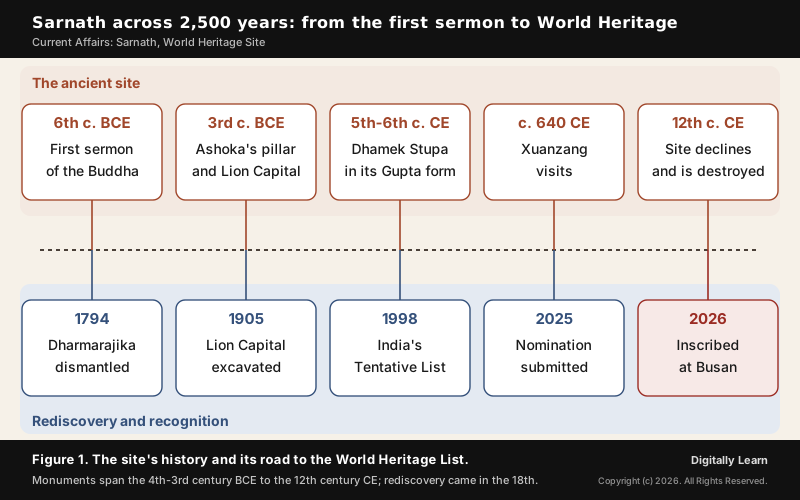
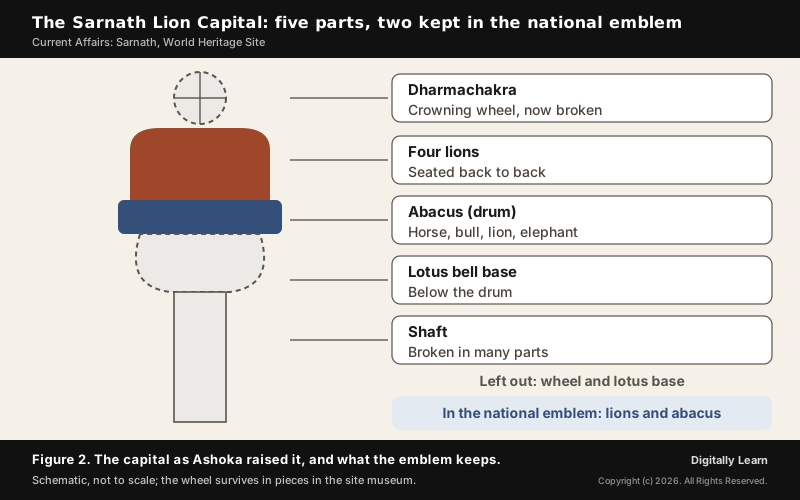
The Lion Capital, raised by Ashoka to commemorate the first sermon, is the finest example of the Mauryan sculptural tradition. It had five parts: the shaft, a lotus bell base, a drum carved with four animals moving clockwise, four majestic lions seated back to back, and a crowning wheel, the Dharmachakra, which now lies broken in the site museum.
The abacus carries a horse, a bull, a lion and an elephant in vigorous movement, and the lions' facial musculature shows close observation of nature. Independent India adopted the capital, without the crowning wheel and the lotus base, as its national emblem; the capital itself is kept in the archaeological museum at Sarnath.
Sarnath also gave its name to a school of Buddhist sculpture. Its seated Buddha of the late fifth century CE, carved in Chunar sandstone and kept in the site museum, sits in padmasana with his hands in the dhammachakrapravartana mudra; a wheel and a deer on either side below the throne recall the first sermon.
The style is marked by slender, well-proportioned bodies, delicate and rhythmic outlines, and transparent drapery that clings to the body. Many standing Buddha images of this kind once stood around the Dharmarajika Stupa and are now in the Sarnath Museum.
World Heritage Sites in India: The 45 Properties and How Sites Are Chosen
The World Heritage Convention, 1972, and the Global List
UNESCO's Convention concerning the Protection of the World Cultural and Natural Heritage, adopted in 1972, protects places of Outstanding Universal Value for present and future generations; 196 States Parties had ratified it by October 2024. As of July 2026 the List carried 1,273 properties across 173 countries: 991 cultural, 240 natural and 42 mixed.
- Tentative List: A country first places a site on its Tentative List, the mandatory first step; India’s Tentative List stands at 69 properties.
- Nomination and evaluation: The nomination dossier is evaluated by an advisory body, ICOMOS for cultural and mixed properties.
- Decision: The World Heritage Committee decides at its annual session, as it did at Busan.
How Many World Heritage Sites in India: All 45, Year by Year
India has 45 World Heritage properties: 37 cultural, 7 natural and 1 mixed. The first four came together in 1983, when Agra Fort, the Taj Mahal and the Ellora and Ajanta caves were inscribed.
| Year | Property | State or UT | Type |
|---|---|---|---|
| 1983 | Agra Fort; Taj Mahal | Uttar Pradesh | Cultural |
| 1983 | Ajanta Caves; Ellora Caves | Maharashtra | Cultural |
| 1984 | Sun Temple, Konarak | Odisha | Cultural |
| 1984 | Group of Monuments at Mahabalipuram | Tamil Nadu | Cultural |
| 1985 | Kaziranga National Park; Manas Wildlife Sanctuary | Assam | Natural |
| 1985 | Keoladeo National Park | Rajasthan | Natural |
| 1986 | Khajuraho Group of Monuments | Madhya Pradesh | Cultural |
| 1986 | Fatehpur Sikri | Uttar Pradesh | Cultural |
| 1986 | Churches and Convents of Goa | Goa | Cultural |
| 1986 | Group of Monuments at Hampi | Karnataka | Cultural |
| 1987 | Sundarbans National Park | West Bengal | Natural |
| 1987 | Elephanta Caves | Maharashtra | Cultural |
| 1987 | Group of Monuments at Pattadakal | Karnataka | Cultural |
| 1987, 2004 | Great Living Chola Temples | Tamil Nadu | Cultural |
| 1988, 2005 | Nanda Devi and Valley of Flowers National Parks | Uttarakhand | Natural |
| 1989 | Buddhist Monuments at Sanchi | Madhya Pradesh | Cultural |
| 1993 | Humayun's Tomb; Qutb Minar and its Monuments | Delhi | Cultural |
| 1999, 2005, 2008 | Mountain Railways of India | West Bengal, Tamil Nadu, Himachal Pradesh | Cultural |
| 2002 | Mahabodhi Temple Complex at Bodh Gaya | Bihar | Cultural |
| 2003 | Rock Shelters of Bhimbetka | Madhya Pradesh | Cultural |
| 2004 | Champaner-Pavagadh Archaeological Park; Chhatrapati Shivaji Terminus | Gujarat; Maharashtra | Cultural |
| 2007 | Red Fort Complex | Delhi | Cultural |
| 2010 | The Jantar Mantar, Jaipur | Rajasthan | Cultural |
| 2012 | Western Ghats | Karnataka, Kerala, Maharashtra, Tamil Nadu | Natural |
| 2013 | Hill Forts of Rajasthan | Rajasthan | Cultural |
| 2014 | Great Himalayan National Park Conservation Area | Himachal Pradesh | Natural |
| 2014 | Rani-ki-Vav (the Queen's Stepwell) at Patan | Gujarat | Cultural |
| 2016 | Archaeological Site of Nalanda Mahavihara | Bihar | Cultural |
| 2016 | Khangchendzonga National Park | Sikkim | Mixed |
| 2016 | The Architectural Work of Le Corbusier | Chandigarh | Cultural |
| 2017 | Historic City of Ahmedabad | Gujarat | Cultural |
| 2018 | Victorian Gothic and Art Deco Ensembles of Mumbai | Maharashtra | Cultural |
| 2019 | Jaipur City | Rajasthan | Cultural |
| 2021 | Dholavira: a Harappan City | Gujarat | Cultural |
| 2021 | Kakatiya Rudreshwara (Ramappa) Temple | Telangana | Cultural |
| 2023 | Sacred Ensembles of the Hoysalas | Karnataka | Cultural |
| 2023 | Santiniketan | West Bengal | Cultural |
| 2024 | Moidams, the Mound-Burial System of the Ahom Dynasty | Assam | Cultural |
| 2025 | Maratha Military Landscapes of India | Maharashtra, Tamil Nadu | Cultural |
| 2026 | Ancient Buddhist Site of Sarnath | Uttar Pradesh | Cultural |
Safeguarding India's Heritage: The ASI, the Laws and the Programmes
Ministry of Culture, the Archaeological Survey and the Two Laws
The Ministry of Culture, the apex body for preserving and promoting India's cultural heritage, leads India's engagement with UNESCO on cultural matters and coordinates nominations of World Heritage sites and of intangible heritage. The Archaeological Survey of India (ASI) is the nodal agency for World Heritage matters; it conserves and maintains 3,688 centrally protected monuments, 28 of them World Heritage properties.
- Ancient Monuments and Archaeological Sites and Remains Act, 1958: The law under which monuments of national importance are protected and maintained.
- Antiquities and Art Treasures Act, 1972: The law that regulates antiquities and art treasures; the ASI enforces both Acts.
Sarnath's own past shows why this matters: a stupa was pulled down for building material in 1794 and its relics were lost, long before any law protected the site.
Repatriation, Adopt a Heritage and the National Mission on Monuments
- Repatriation: India has brought back 669 antiquities, 656 of them since 2014, including a Chola-period Shiva Nataraja.
- Adopt a Heritage: Launched in September 2017 and revamped in September 2023, it lets companies, public sector units, NGOs and trusts develop amenities at protected monuments, with 30 MoUs signed by March 2026.
- National Mission on Monuments and Antiquities: Run under the ASI, it had documented 1.84 lakh monuments and 17.20 lakh antiquities by March 2026.
- Gyan Bharatam Mission: Launched in 2025 to preserve, digitise and share India’s manuscript heritage.
Sarnath UPSC Relevance: GS Paper I and Prelims Links
Art, Culture and Heritage in the UPSC and PCS Syllabus
Sarnath sits in General Studies Paper I: Indian culture, covering art forms, literature and architecture from ancient to modern times, and in the history of Buddhism; State PCS papers ask about the same heritage.
- Prelims facts: Inscribed 25 July 2026 at the 48th session, Busan; India’s 45th property (37 cultural, 7 natural, 1 mixed); criteria (iii) and (vi); two components, Chaukhandi Stupa and the Archaeological Remains; Tentative List 1998; Lion Capital without the wheel and lotus base is the national emblem.
- Mains analysis: Heritage as living tradition, the duties that come with inscription, conservation against tourism pressure, and Buddhist sites in India’s cultural diplomacy.
Previous Year UPSC-CSE Questions By the end you will be able to draft model answers for the following UPSC questions. Each question carries a collapsible framework showing how to approach it in the exam.
- UPSC Mains 2018 GS-ISafeguarding the Indian art heritage is the need of the moment. Discuss.
Answer outline: how to structure the answer
What the question asks, the main arguments, relevant examples and the direction of the conclusion. This is not a full model answer.
Introduction: Introduce India's art heritage as a living legacy, with 45 World Heritage properties and 3,688 centrally protected monuments.
Body (sub-themes to develop):
- Why now: loss and neglect (Sarnath's Dharmarajika Stupa pulled down in 1794), theft and illicit trade (669 antiquities brought back), tourism and building pressure around sites.
- Institutions and laws: the ASI as nodal agency; the Ancient Monuments and Archaeological Sites and Remains Act, 1958; the Antiquities and Art Treasures Act, 1972.
- Programmes: World Heritage nominations with buffer zones and management plans, Adopt a Heritage, the National Mission on Monuments and Antiquities, Gyan Bharatam for manuscripts.
- Gaps: documentation, funding, local participation and visitor management.
Conclusion: Conclude that heritage is a shared trust; protection needs laws, institutions and communities working together, as Sarnath's inscription shows.
- UPSC Prelims 2024 Prelims-GSConsider the following properties included in the World Heritage List released by UNESCO:
- Shantiniketan
- Rani-ki-Vav
- Sacred Ensembles of the Hoysalas
- Mahabodhi Temple Complex at Bodhgaya
How many of the above properties were included in 2023?
How to approach this Prelims question
Approach: Step 1: Santiniketan, 2023: yes. Step 2: Rani-ki-Vav at Patan, 2014: no. Step 3: Sacred Ensembles of the Hoysalas, 2023: yes. Step 4: Mahabodhi Temple Complex, 2002: no. Two properties were added in 2023.
Trap to watch: All four are on the List; the question asks only which came in 2023.
Key facts to recall:
- (a) Only one: wrong. Both Santiniketan and the Hoysala temples were inscribed in 2023.
- (b) Only two: right. Santiniketan and the Sacred Ensembles of the Hoysalas.
- (c) Only three: wrong. Rani-ki-Vav (2014) and Mahabodhi (2002) came earlier.
- (d) All four: wrong. Only two of the four are from 2023.
Answer signal: Only two: option (b), the official answer.
- UPSC Prelims 2005 Prelims-GSConsider the following statements:
- Champaner – Pavagadh Archaeological Park
- Chhatrapati Shivaji Railway Station, Mumbai
- Mamallapuram
- Sun Temple (Konark Temple)
Which of the above are included in the World Heritage List of UNESCO?
How to approach this Prelims question
Approach: Step 1: Champaner-Pavagadh Archaeological Park: inscribed in 2004. Step 2: Chhatrapati Shivaji Terminus, Mumbai: 2004. Step 3: Mamallapuram (Mahabalipuram): 1984. Step 4: Sun Temple, Konarak: 1984. All four are on the List.
Trap to watch: The 2004 inscriptions were recent when the question was set; the older two date from 1984.
Key facts to recall:
- (a) 1, 2 and 3: wrong. The Sun Temple at Konarak is also on the List.
- (b) 1, 3 and 4: wrong. Chhatrapati Shivaji Terminus is also on the List.
- (c) 2 and 4: wrong. Champaner-Pavagadh and Mahabalipuram are also on the List.
- (d) 1, 2, 3 and 4: right. All four are World Heritage properties.
Answer signal: All four: option (d), the official answer.
Sources
- PIB: Turning the Wheel of Heritage, Sarnath's Path to the World Heritage List (26 August 2026)
- Ministry of Culture: About the Ministry
- NCERT: An Introduction to Indian Art, Part I (Class XI), Chapters 3 and 4
- NCERT: Our Pasts I (Class VI), Chapters 7 and 12
- Wikipedia: Sarnath
- Wikipedia: Dhamek Stupa
- Wikipedia: Chaukhandi Stupa
- The Hindu, Delhi, 26 July 2026: Sarnath added to UNESCO Heritage List
- The Hindu, Delhi, 28 and 29 July 2026: quiz on India's World Heritage sites, with answers
- UPSC: Civil Services Examination question papers
Editorial Disclaimer
This article draws on the PIB backgrounder, NCERT and the other sources listed on this page.


