


Overview
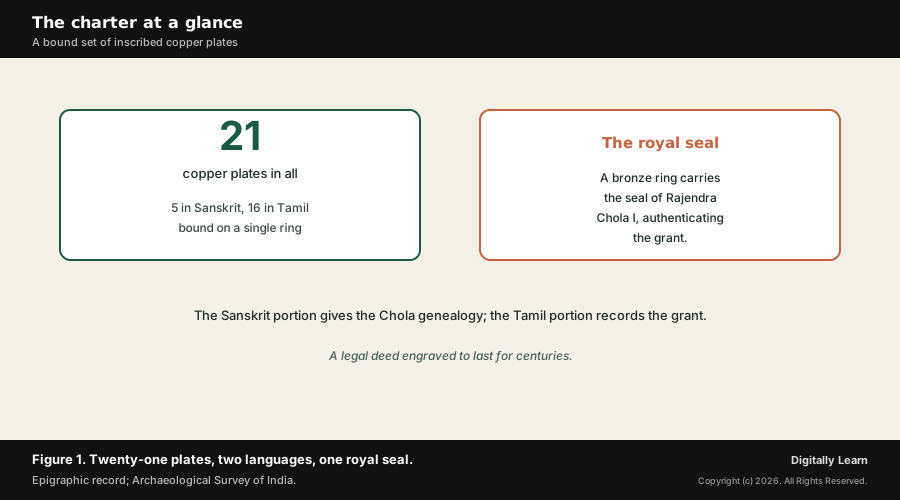
The Chola copper plates returned in 2026, known as the Anaimangalam plates or the Larger Leiden Plates, are an 11th-century set of copper-plate charters of the Chola dynasty. The Netherlands handed them to India during Prime Minister Modi's visit in May 2026, ending a long campaign to recover them from the University of Leiden. The set of twenty-one plates, in Sanskrit and Tamil and bound by a bronze ring bearing the seal of Rajendra Chola I, records a royal land grant, and stands among the most valuable records of Chola administration.
Why the Chola plates' return is in focus
An 11th-century charter comes home
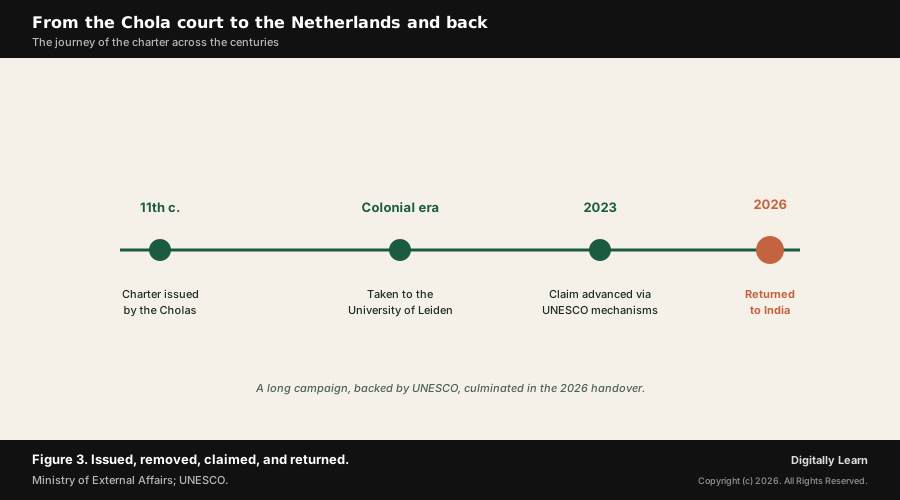
During Prime Minister Modi's visit to the Netherlands in May 2026, the Dutch side returned a set of 11th-century Chola copper plates to India. The handover ended a long effort to bring the charter home.
Copper-plate charters were the official deeds of medieval Indian kingdoms. Engraved on copper and strung on a sealed ring, they recorded royal grants of land and revenue with legal force.
These plates, the Anaimangalam plates or Larger Leiden Plates, had been held at the University of Leiden. Their return was confirmed in the India-Netherlands Joint Statement issued during the visit.
The headline facts about the plates are:
- Origin: an 11th-century charter of the Chola dynasty of southern India.
- Form: twenty-one copper plates bound by a bronze ring bearing the seal of Rajendra Chola I.
- Language: inscribed in both Sanskrit and Tamil.
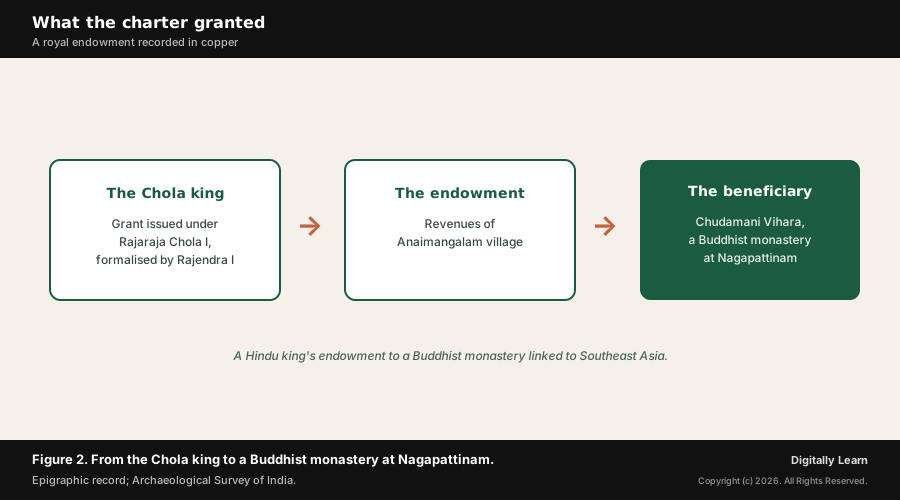
- Content: a royal grant of Anaimangalam village to a Buddhist monastery at Nagapattinam.
Why the return matters
A record of Chola statecraft restored
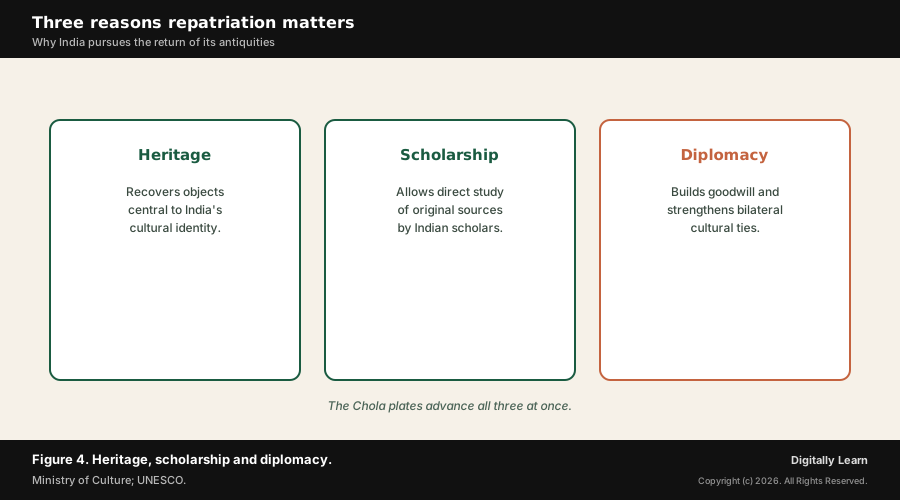
The plates are not just an artefact; they are a primary source. They document how the Cholas administered land, revenue and religion, so their return restores a key record for historians.
The charter also reflects the Chola state's reach. Its grant to a Buddhist monastery linked to maritime Southeast Asia shows the dynasty's pluralism and its wide commercial and cultural connections.
The return matters symbolically as well. Recovering a treasured charter affirms India's claim over its cultural heritage and strengthens the case for repatriating other antiquities held abroad.
What the charter signifies
Administration, pluralism and maritime reach
Three threads carry the weight: the detail of Chola administration, the religious pluralism it reveals, and the maritime links it records.
First, administration. The Tamil portion records the grant of revenues from Anaimangalam village, showing how the Cholas assigned land, assessed taxes and endowed institutions with precision.
Second, pluralism. A Hindu Chola king endowed a Buddhist monastery, the Chudamani Vihara at Nagapattinam, evidence of a tolerant and cosmopolitan court.
Third, maritime reach. The monastery was tied to Southeast Asian patrons, reflecting the Chola dynasty's trade and diplomatic links across the Bay of Bengal.
Distinguishing features of the charter
The plates at a glance
The table sets out the key facts of the Anaimangalam plates, so their form and content are visible at a glance.
| Feature | Detail |
|---|---|
| Also known as | Anaimangalam plates / Larger Leiden Plates |
| Period | 11th century, Chola dynasty |
| Number of plates | Twenty-one, bound by a bronze ring |
| Languages | Sanskrit and Tamil |
| Royal seal | Rajendra Chola I |
Three features that define the plates
Three elements set this charter apart as a historical source:
- (i) Bilingual record. A Sanskrit section traces the Chola genealogy, while a Tamil section sets out the administrative detail of the grant.
- (ii) Authenticated by seal. The bronze ring carries the royal seal of Rajendra Chola I, giving the deed legal authority.
- (iii) Cross-cultural grant. A Hindu monarch endowed a Buddhist monastery tied to Southeast Asian patrons, a rare window into Chola pluralism.
Observable outcomes
Three trackable outcomes
The return translates into three visible developments for heritage and scholarship.
- (a) Conservation and display. The plates can be conserved in India and made accessible to scholars and the public.
- (b) Fresh research. Direct study of the original charter aids work on Chola administration, epigraphy and Tamil history.
- (c) Momentum for repatriation. A high-profile return strengthens India’s pursuit of other antiquities held in foreign collections.
Repatriation is a long process. Each case turns on provenance, the holding institution's cooperation and the legal mechanisms invoked, so outcomes vary widely.
Antiquities repatriation and cultural diplomacy
UNESCO, provenance and India's heritage drive
The return fits India's wider antiquities-repatriation drive, under which a growing number of idols, sculptures and artefacts have been brought back from collections abroad.
It connects to international heritage law, especially the UNESCO framework on the illicit transfer of cultural property and the body that promotes the return of objects to their countries of origin.
The episode also illustrates cultural diplomacy. Returning a cherished artefact builds goodwill between states and ties heritage to the broader bilateral relationship.
UPSC relevance and exam focus
Where this fits in the UPSC-CSE syllabus
This topic maps to General Studies Paper I: Indian art, culture and heritage, and ancient and medieval Indian history, with a link to cultural diplomacy in international relations.
For Prelims, hold the high-yield facts: the Chola dynasty and its kings, the copper-plate charter form, the languages of the plates, and the fact of the 2026 return from the Netherlands.
For Mains, two framings recur: the achievements of the Cholas in administration and culture, and the rationale and mechanisms for repatriating cultural antiquities.
Recurring linked concepts an aspirant should keep in working memory:
- Chola administration: land grants, local self-government and revenue recorded in inscriptions.
- Copper-plate charters: legal deeds of royal grants, a key epigraphic source.
- Rajendra Chola I: known for naval expeditions, including the campaign against Srivijaya.
- Antiquities repatriation: the return of cultural property under UNESCO frameworks.
The plates are inscribed in both Sanskrit and Tamil, not Tamil alone. Assuming a single language, or attributing the seal to the wrong Chola king, is a frequent error.
Do not reduce the Cholas to temple architecture alone. Their administrative records, like these plates, are equally central to their legacy.
Previous Year UPSC-CSE Questions By the end you will be able to draft model answers for the following UPSC questions. Each question carries a collapsible framework showing how to approach it in the exam.
- UPSC Prelims 2025Who among the following led a successful military campaign against the kingdom of Srivijaya, the powerful maritime State, which ruled the Malay Peninsula, Sumatra, Java and the neighbouring islands?
How to approach this Prelims question
Approach: Recall which dynasty and ruler mounted a naval expedition against Srivijaya in Southeast Asia.
Trap to watch: The Rashtrakuta, Kakatiya and Hoysala rulers were powerful but did not lead the Srivijaya campaign; the answer is the Chola king.
Key facts to recall:
- Rajendra Chola I extended Chola naval power across the Bay of Bengal.
- He led a campaign against the Srivijaya empire of Southeast Asia.
- His seal authenticates the Anaimangalam copper plates.
Answer signal: The Srivijaya campaign was led by Rajendra I (Chola). Correct answer: Rajendra I (Chola).
- UPSC Mains 2022 GS-IDiscuss the main contributions of Gupta period and Chola period to Indian heritage and culture.
How to structure the answer in the exam
Introduction: Open with the Gupta and Chola periods as two high points of Indian heritage, separated by centuries yet both foundational.
Body (sub-themes to develop):
- Gupta: classical art, literature, science and the golden-age temple form.
- Chola architecture: the great temples, such as the Brihadeeswara temple at Thanjavur.
- Chola bronzes: the Nataraja and the lost-wax sculpture tradition.
- Chola administration: local self-government and land-grant records like the copper plates.
- Maritime and cultural reach: Chola naval power and links across the Bay of Bengal.
Conclusion: Conclude that the Gupta and Chola periods together shaped India's artistic, administrative and cultural heritage.
Sources and Further Reading
Editorial Disclaimer
This article is compiled from the reference materials listed in the Sources section. It is an explainer for UPSC preparation and is not a substitute for primary documents (NCERTs, GoI ministry releases, IMD bulletins, RBI / CEA / MoEFCC publications, and Standing-Committee reports).


