

Overview
pH scale, indicators, acid rain and everyday salts
How acidity is measured and why it matters from blood to rain.
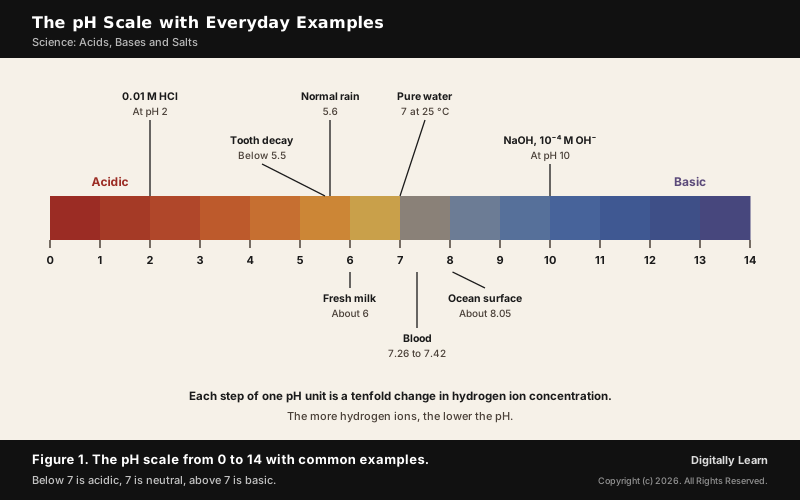
The pH scale measures how acidic or basic a solution is by its hydrogen ion concentration, from 0, very acidic, through 7, neutral, to 14, very basic; pH is the negative logarithm of the hydrogen ion concentration. Acids release hydrogen ions, bases release hydroxide ions, and the two neutralise each other to form a salt and water.
Properties of Acids and Bases
Arrhenius, Brønsted-Lowry and Lewis Concepts of Acids and Bases
Sour foods owe their taste to acids and bitter ones to bases, and the two cancel each other's effect. Acids turn blue litmus red; bases turn red litmus blue. Chemists have explained what makes a substance an acid in three steps, each wider than the last.
- Arrhenius concept: An acid gives hydrogen ions, H⁺(aq), in water and a base gives hydroxide ions, OH⁻. Hydrogen ions cannot exist alone: they join water to form hydronium ions, H₃O⁺. The limitation is that it works only in water and cannot explain why ammonia, which has no hydroxyl group, is a base.
- Brønsted-Lowry concept: Proposed independently in 1923 by the Danish chemist Johannes Brønsted and the English chemist Thomas Lowry. An acid is a proton donor and a base a proton acceptor; a pair that differs by one proton, such as NH₄⁺ and NH₃, is a conjugate acid-base pair.
- Lewis concept: An acid accepts a pair of electrons and a base donates one. Boron trifluoride has no proton yet acts as an acid by accepting the lone pair of ammonia; electron-deficient species such as AlCl₃ are Lewis acids, and H₂O, NH₃ and OH⁻ are Lewis bases.
Reactions of Acids and Bases: Metals, Carbonates and Oxides
Acids and bases react in predictable ways. The key is the ions they release: hydrogen ions give acids their common properties, and an acid solution conducts electricity because its ions carry the current. Glucose and alcohol also contain hydrogen but do not release it as ions, so they are not acids.
- Acid and metal: Salt and hydrogen gas, as zinc gives in dilute sulphuric acid. Zinc also reacts with sodium hydroxide to give hydrogen and sodium zincate.
- Acid and carbonate: A metal carbonate or hydrogencarbonate gives a salt, carbon dioxide and water; the gas turns lime water milky. Limestone, chalk and marble are all forms of calcium carbonate.
- Acid and base: They neutralise each other to give a salt and water.
- Oxides: Metal oxides react with acids like bases, so they are basic oxides; non-metal oxides such as carbon dioxide react with bases, so they are acidic.
Strong and Weak Acids, Alkalis and Safe Dilution
The strength of an acid depends on how many hydrogen ions it releases, not on how much of it there is. At the same concentration, hydrochloric acid releases far more hydrogen ions than acetic acid: the first is a strong acid and the second a weak one. Strong and weak bases differ in the same way in the hydroxide ions they produce.
- Formic acid and acetic acid: Both are organic acids, but formic acid is about ten times stronger; being organic does not make an acid weak or strong.
- Dilution: Mixing an acid or base with water lowers the concentration of ions per unit volume.
Dissolving a concentrated acid or base in water releases a great deal of heat. The rule is always to add the acid to water, slowly and with stirring. Water has a higher heat capacity than the acid, so a vessel of water absorbs the heat; adding water to concentrated acid can make the mixture splash out and cause burns, or crack the glass.
Acid-Base Indicators: Litmus, Phenolphthalein and Methyl Orange
Chemists read acidity with acid-base indicators: dyes, or mixtures of dyes, whose colour shows whether a solution is acidic or basic. Litmus, a purple dye extracted from lichen, is the best known; red cabbage leaves, turmeric and the petals of Hydrangea, Petunia and Geranium are other natural indicators.
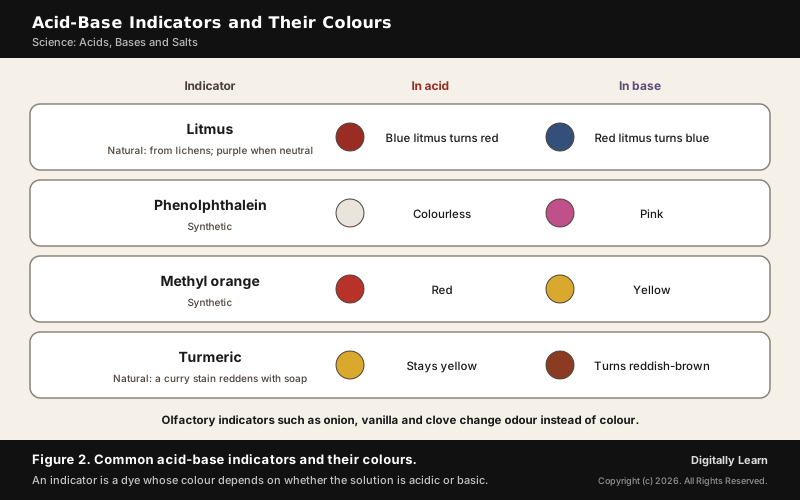
- Synthetic indicators: Phenolphthalein is colourless in acid and pink in base; methyl orange is red in acid and yellow in base.
- Turmeric: A curry stain turns reddish-brown when soap, a base, is scrubbed on it and yellow again when washed with plenty of water.
- Olfactory indicators: Some substances, such as onion, vanilla and clove, change their odour in acidic or basic media.
- Universal indicator: A mixture of several indicators that shows a different colour at each hydrogen ion concentration, which is how pH paper works.
- In the laboratory: Phenolphthalein is often used as the indicator in acid-base titrations, where an acid is added to a base until the colour changes at the point of neutralisation.
The pH Scale and Why pH Matters
pH Scale: Meaning, Formula and the 0 to 14 Range
The pH scale measures the hydrogen ion concentration of a solution on a scale from 0, very acidic, to 14, very alkaline. The p stands for potenz, German for power. A neutral solution has a pH of 7, values below 7 are acidic, and values above 7 are basic: the higher the hydronium ion concentration, the lower the pH.
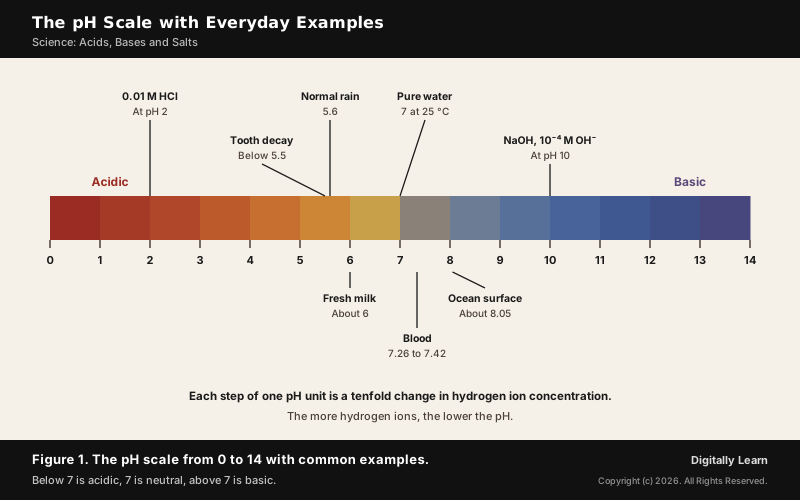
- The formula: Written pH = −log[H⁺], it is the negative logarithm to base 10 of the hydrogen ion concentration.
- Pure water: At 25 °C it has [H⁺] = 10⁻⁷ M, so its pH is 7.
- Worked examples: A 0.01 M (10⁻² M) solution of HCl has pH 2; a NaOH solution with [OH⁻] = 10⁻⁴ M has [H₃O⁺] = 10⁻¹⁰ M and pH 10.
- Ionic product of water: At 298 K, Kw = [H₃O⁺][OH⁻] = 10⁻¹⁴, which is why the scale runs from 0 to 14.
pH of Blood, Digestion and Tooth Decay
Living things survive only in a narrow range of pH, and the body works within 7.0 to 7.8. Blood is kept slightly alkaline by the carbonic acid-bicarbonate buffer (H₂CO₃/HCO₃⁻), which holds it between pH 7.26 and 7.42. Prelims 2008 took 7.35 to 7.45 as the normal range. The kidneys, explained under the excretory system, also help keep this balance.
- Buffer solutions: Solutions that resist a change in pH on dilution or on adding a little acid or alkali. A mixture of acetic acid and sodium acetate buffers around pH 4.75; ammonium chloride with ammonium hydroxide, around pH 9.25.
- Digestion: The stomach produces hydrochloric acid, which helps digest food. Too much of it causes indigestion, relieved by antacids: mild bases such as magnesium hydroxide (milk of magnesia) and sodium hydrogencarbonate.
- Tooth decay: Tooth enamel, calcium phosphate, is the hardest substance in the body, but it corrodes when the pH in the mouth falls below 5.5. Bacteria make acids from sugar left in the mouth; basic toothpaste neutralises them.
Acid Rain pH, Soil pH and Ocean Acidification
Normal rain is already slightly acidic, pH 5.6, because it dissolves carbon dioxide to form carbonic acid. When the pH of rain falls below 5.6 it is acid rain. Oxides of sulphur and nitrogen from burning fossil fuels react with water in the air to form acids, which wind can carry far before they fall.
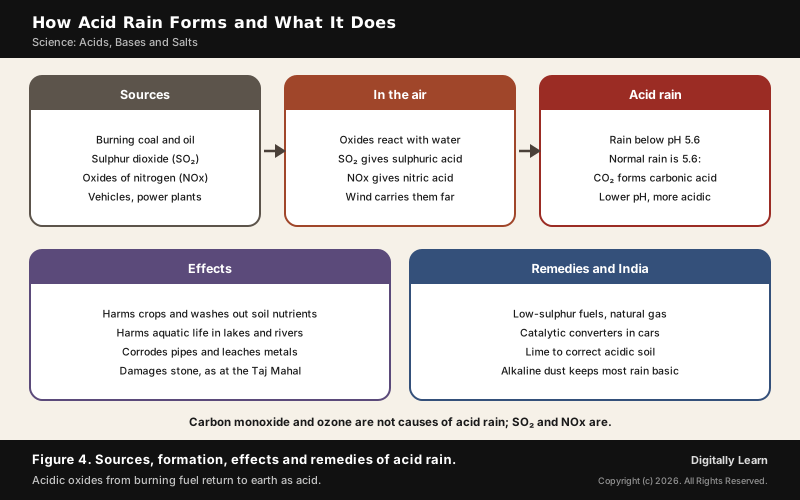
- Effects: Acid rain washes away nutrients plants need, harms aquatic life, corrodes water pipes so that iron, lead and copper leach into drinking water, and damages stone buildings; the Taj Mahal has been affected.
- Remedies: Cut sulphur dioxide and nitrogen dioxide emissions: use fewer fossil fuel vehicles, low-sulphur fuels, natural gas in place of coal, and catalytic converters in cars.
- India’s rain: A 1984 IMD study found rain over unpolluted parts of India at pH 6 to 7, with acidic rain limited to industrial cities such as Bombay (pH 4.5), because basic dust in the air neutralises the acid; Indian soils are normally basic.
Soil pH decides what grows. Farmers treat acidic soil with quicklime, slaked lime or chalk, and liming acid soils lets crops use fertiliser better, saving about half of it in oilseeds and pulses. About twenty-five million hectares of India's cultivated land has pH below 5.5. pH is one of the 12 parameters reported on the Soil Health Card, introduced on 19 February 2015.
The oceans are acidifying too. Seawater absorbs carbon dioxide, forming carbonic acid; between 1950 and 2020 the average pH of the ocean surface fell from about 8.15 to 8.05, though seawater is still alkaline. A fall of 0.1 means a 26 per cent rise in hydrogen ions. Organisms that build calcium carbonate shells and skeletons, such as corals, molluscs and coccolithophores, a phytoplankton, are the most vulnerable; the larvae of some animals, such as brittle stars, survive poorly in more acidic water.
Salts: Acids, Bases and Salts in Daily Life
Neutralisation Reaction and the pH of Salt Solutions
A neutralisation reaction is the reaction of an acid with a base to give a salt and water: NaOH + HCl → NaCl + H₂O. At heart it is H⁺ joining OH⁻ to form water. Salts with the same positive or negative radical form a family: NaCl and Na₂SO₄ are sodium salts, and NaCl and KCl are chloride salts.
A salt solution need not be neutral. Its ions can react with water, a process called hydrolysis, which changes the pH. The rule follows from which parent was strong.
| Salt made from | Example | pH of solution |
|---|---|---|
| Strong acid and strong base | Sodium chloride | 7, neutral |
| Strong acid and weak base | Ammonium chloride; copper sulphate | Below 7, acidic |
| Weak acid and strong base | Sodium acetate; sodium hydrogencarbonate | Above 7, basic |
Common Salt and the Chlor-Alkali Process
The everyday common salt, sodium chloride, is separated from sea water or mined as rock salt, formed where seas of past ages dried up. It was a symbol of the freedom struggle through Mahatma Gandhi's Dandi March, and it is the raw material for sodium hydroxide, baking soda, washing soda and bleaching powder.
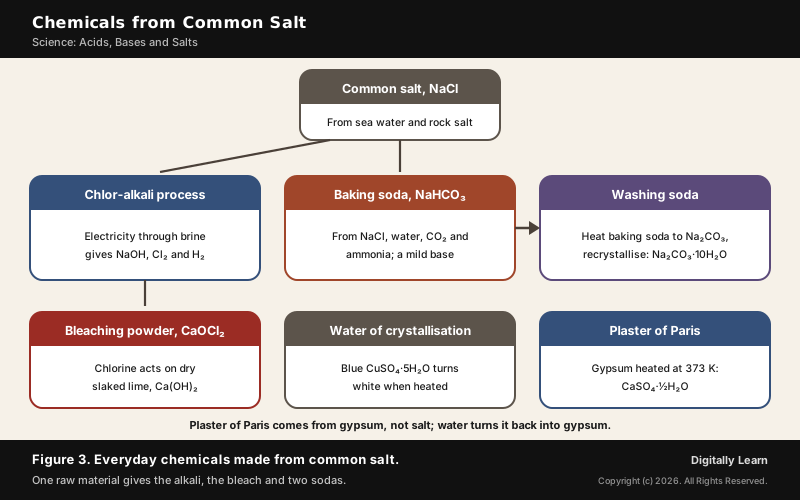
When electricity is passed through brine, a solution of sodium chloride, it decomposes: the chlor-alkali process, named after chlorine and the alkali, sodium hydroxide. Chlorine is given off at the anode and hydrogen at the cathode, where sodium hydroxide solution forms: 2NaCl + 2H₂O → 2NaOH + Cl₂ + H₂.
- All three products are useful: Sodium hydroxide, chlorine and hydrogen each feed further industries; the chlorine, for instance, makes bleaching powder.
- Main source of chlorine: The chlor-alkali process became the principal source of chlorine in the twentieth century.
- Cleaner cells: The older diaphragm and mercury cells were environmentally unfriendly because they used asbestos and mercury; the newer membrane cell is more energy efficient and avoids those chemicals.
Baking Soda, Washing Soda and the Difference Between Baking Soda and Baking Powder
The kitchen's baking soda is sodium hydrogencarbonate, NaHCO₃, made from sodium chloride, water, carbon dioxide and ammonia. It is a mild, non-corrosive base. On heating it gives sodium carbonate, water and carbon dioxide, which is why it makes pakoras crisp and speeds cooking.
- Antacid: Being alkaline, it neutralises excess acid in the stomach.
- Fire extinguishers: It is used in soda-acid fire extinguishers, where acid releases carbon dioxide from it.
- Baking powder: A mixture of baking soda and a mild edible acid such as tartaric acid.
| Baking soda | Baking powder |
|---|---|
| A single compound, NaHCO₃ | A mixture of baking soda and a mild edible acid |
| A base; needs an acid from the food to release gas | Carries its own acid, so water or heat releases CO₂ |
| Also an antacid and fire extinguisher | Makes bread and cake rise, soft and spongy |
The laundry's washing soda is Na₂CO₃·10H₂O, obtained by heating baking soda to sodium carbonate and recrystallising it; the anhydrous form is soda ash. It is a basic salt used in the glass, soap and paper industries, to make sodium compounds such as borax, for cleaning, and to remove the permanent hardness of water. Ordinary window and bottle glass, soda-lime glass, is made with soda and lime: calcium oxide, or quicklime, is added to make the glass durable.
Bleaching Powder and Plaster of Paris
The disinfectant called bleaching powder, written CaOCl₂ though its real composition is complex, is made by the action of chlorine from the chlor-alkali process on dry slaked lime: Ca(OH)₂ + Cl₂ → CaOCl₂ + H₂O. It bleaches cotton and linen, wood pulp and washed clothes, works as an oxidising agent in industry, and disinfects drinking water.
The plaster that holds fractured bones, Plaster of Paris, comes from gypsum, CaSO₄·2H₂O. Heated at 373 K, gypsum loses water and becomes calcium sulphate hemihydrate, CaSO₄·½H₂O, a white powder; two formula units share one water molecule, hence the half. Mixed with water it sets back into gypsum, a hard solid, which is why doctors use it to hold fractured bones and why it is stored in moisture-proof containers. It is also used for toys, decorations and smooth surfaces.
| Common name | Chemical | Formula |
|---|---|---|
| Baking soda | Sodium hydrogencarbonate | NaHCO₃ |
| Washing soda | Sodium carbonate decahydrate | Na₂CO₃·10H₂O |
| Caustic soda | Sodium hydroxide | NaOH |
| Bleaching powder | Written as CaOCl₂; composition complex | CaOCl₂ |
| Plaster of Paris | Calcium sulphate hemihydrate | CaSO₄·½H₂O |
| Gypsum | Calcium sulphate dihydrate | CaSO₄·2H₂O |
| Blue vitriol | Copper sulphate pentahydrate | CuSO₄·5H₂O |
| Epsom salt | Magnesium sulphate heptahydrate | MgSO₄·7H₂O |
| Quicklime | Calcium oxide | CaO |
Acids in Daily Life: Food Acids, Antacids and Stings
Acids and bases are part of ordinary life, and neutralisation is the everyday remedy. Many foods owe their sour taste to natural acids, and many small pains are eased by a mild base.
| Natural source | Acid |
|---|---|
| Vinegar | Acetic acid |
| Curd (sour milk) | Lactic acid |
| Lemon and orange | Citric acid |
| Tamarind | Tartaric acid |
| Tomato | Oxalic acid |
| Ant sting and nettle sting | Methanoic acid |
- Antacids: They neutralise stomach acidity to relieve heartburn and indigestion; marketed antacids contain salts of aluminium, calcium, magnesium or sodium, such as milk of magnesia and baking soda.
- Stings: A bee sting leaves an acid, eased by a mild base such as baking soda. Nettle leaves inject methanoic acid; the traditional remedy is to rub the spot with a leaf of the dock plant, which often grows beside the nettle.
- Toothpaste: It is generally basic, so it neutralises the acids that cause tooth decay.
- Beyond Earth: The atmosphere of Venus is made up of thick white and yellowish clouds of sulphuric acid.
Previous Year UPSC-CSE Questions
Previous Year UPSC-CSE Questions By the end you will be able to draft model answers for the following UPSC questions. Each question carries a collapsible framework showing how to approach it in the exam.
- UPSC Prelims 2008 Prelims-GSWhat is the pH level of blood of a normal person?
How to approach this Prelims question
Approach: Blood is slightly alkaline; pick the band just above 7.
Trap to watch: Values near 4.5 or 8.3 would be fatal.
Key facts to recall:
- Blood is buffered
- Slightly alkaline
Answer signal: 7.35 to 7.45, option (c).
- UPSC Prelims 1999 Prelims-GSConsider the following Assertion (A) and Reason (R):
- Assertion (A): To dilute sulphuric acid, acid is added to water and not water to acid.
- Reason (R): Specific heat of water is quite large.
Select the correct answer using the codes given below.
How to approach this Prelims question
Approach: Check whether R explains A.
Trap to watch: R is the reason: water absorbs the heat released.
Key facts to recall:
- Dissolving acid releases much heat
- Water has a higher heat capacity than the acid
Answer signal: Both true and R explains A, option (a).
- UPSC Prelims 1998 Prelims-GSConsider the following Assertion (A) and Reason (R):
- Assertion (A): Formic acid is a stronger acid than acetic acid.
- Reason (R): Formic acid is an organic acid.
Select the correct answer using the codes given below.
How to approach this Prelims question
Approach: Test A and R, then the link.
Trap to watch: Being organic does not decide strength.
Key facts to recall:
- Formic acid about ten times stronger than acetic acid
Answer signal: Both true, R does not explain A, option (b).
- UPSC Prelims 2001 Prelims-GSAn aqueous solution of copper sulphate is acidic in nature because the salt undergoes
How to approach this Prelims question
Approach: Link the acidity of a salt solution to its ions reacting with water.
Trap to watch: Electrolysis needs current; photolysis needs light.
Key facts to recall:
- Hydrolysis changes pH
- CuSO₄: strong acid, weak base
Answer signal: Hydrolysis, option (c).
- UPSC Prelims 1998 Prelims-GSMatch List I with List II and select the correct answer using the codes given below the lists: List II: A) Sodium bicarbonate, B) Sodium hydroxide, C) Magnesium sulphate, D) Copper sulphate.
- I. Blue vitriol
- II. Epsom salt
- III. Baking soda
- IV. Caustic soda
Codes:
How to approach this Prelims question
Approach: Recall each common name.
Trap to watch: Do not swap Epsom salt (magnesium) and blue vitriol (copper).
Key facts to recall:
- Blue vitriol: CuSO₄·5H₂O
- Epsom salt: MgSO₄·7H₂O
- Baking soda: NaHCO₃
- Caustic soda: NaOH
Answer signal: I-D, II-C, III-A, IV-B, option (b).
- UPSC Prelims 2004 Prelims-GSConsider the following statements:
- Banking soda is used in fire extinguishers.
- Quicklime is used in the manufacture of glass.
- Gypsum is used in the manufacture of Plaster of Paris.
Which of the statements given above is/are correct?
How to approach this Prelims question
Approach: Check each use.
Trap to watch: Statement 1 misspells baking soda; read it as baking soda.
Key facts to recall:
- Baking soda in soda-acid fire extinguishers
- Lime in soda-lime glass
- Gypsum heated to Plaster of Paris
Answer signal: 1, 2 and 3, option (d).
- UPSC Prelims 2012 Prelims-GSThe acidification of oceans is increasing. Why is this phenomenon a cause of concern?
- The growth and survival of calcareous phytoplankton will be adversely affected.
- The growth and survival of coral reefs will be adversely affected.
- The survival of some animals that have phytoplanktonic larvae will be adversely affected.
- The cloud seeding and formation of clouds will be adversely affected.
Which of the statements given above is/are correct?
How to approach this Prelims question
Approach: Ask which organisms need calcium carbonate or have fragile larvae.
Trap to watch: Cloud seeding is not linked to ocean pH.
Key facts to recall:
- Corals and coccolithophores build CaCO₃
- Larvae survive poorly
Answer signal: 1, 2 and 3 only, option (a).
- UPSC Prelims 2010 Prelims-GSConsider the following:
- Oxides of Hydrogen
- Oxides of Nitrogen
- Oxides of Sulphur
Which of the above causes/cause acid rain?
How to approach this Prelims question
Approach: Only acidic oxides of sulphur and nitrogen form acid rain.
Trap to watch: 'Oxides of hydrogen' (water) is a distractor.
Key facts to recall:
- SO₂ gives sulphuric acid
- NOx gives nitric acid
Answer signal: 2 and 3 only, option (c).
- UPSC Prelims 2022 Prelims-GSConsider the following:
- Carbon monoxide
- Nitrogen oxide
- Ozone
- Sulphur dioxide Excess of which of the above in the environment is/are cause(s) of acid rain?
How to approach this Prelims question
Approach: Keep only acidic oxides.
Trap to watch: Ozone and CO are pollutants but not acid-rain gases.
Key facts to recall:
- Nitrogen oxide and sulphur dioxide
Answer signal: 2 and 4 only, option (b).
Sources
- NCERT: Science (Class X), Acids, Bases and Salts
- NCERT: Chemistry Part I (Class XI), Equilibrium (acids, bases, pH, buffers, hydrolysis)
- NCERT: Chemistry Part II (Class XI), Environmental Chemistry (acid rain)
- PIB: Celebrating a decade of Soil Health Cards (18 February 2025)
- ICAR: Annual Report 2005-06, Natural Resource Management (acid soils and liming)
- India Meteorological Department, MAUSAM: Prospects of acid rain over India (1984)
- India Meteorological Department, MAUSAM: Importance of natural dust in controlling the acidity of rain over India (1986)
- Wikipedia: Ocean acidification
- Wikipedia: Sulfuric acid
- Wikipedia: Formic acid
- Wikipedia: Baking powder
- Wikipedia: Sodium carbonate
- UPSC: Civil Services Examination question papers
Editorial Disclaimer
This article draws on the NCERT science and chemistry textbooks, ICAR, the India Meteorological Department, the Press Information Bureau and the other sources listed on this page. Sources give slightly different normal ranges for blood pH.


