The UPSC GS 4 syllabus covers ethics and human interface, attitude, aptitude and foundational values, emotional intelligence, moral thinkers, public service values and probity in governance, with case studies on all of them. The paper prints twelve questions that become 19 answers for 250 marks in three hours. The 152 answers set between 2019 and 2026 show which of these clauses the ethics paper actually asks.
What Is GS Paper 4 in UPSC? Marks, Questions and Word Limits
GS Paper 4 at a Glance: 250 Marks, 19 Answers, Three Hours
General Studies Paper IV is the ethics paper of the UPSC Mains. Its full title is Ethics, Integrity and Aptitude, and it is the last of the four General Studies papers.
| Point | Figure |
|---|---|
| Total marks | 250, the same as each of the other three General Studies papers |
| Share of the written Mains | 14.3 per cent of the 1,750 marks |
| Time | Three hours |
| Questions printed | Twelve, in two sections |
| Answers a candidate writes | 19 |
| Section A: Theory | 13 parts, each 10 marks and 150 words (130 marks) |
| Section B: Case studies | Six cases, each 20 marks and 250 words (120 marks) |
The 250 marks count for exactly as much as history, polity or economy. They are 14.3 per cent of the 1,750 marks of the written Mains; the final ranking then adds a 275-mark Personality Test, for 2,025 in all. Nothing in the scheme treats this as a lesser paper, even though it is written last.
Questions in GS Paper 4: Twelve Printed, 19 Answered
The paper prints twelve questions in two sections, and a candidate writes 19 answers. Section A has six theory questions, most of them split into parts that are answered and marked separately, which makes 13 theory answers. Section B has six case studies.
Both the marks and the word limit are printed on the question paper against each part.
Why Method Matters More Than Reading in the UPSC Ethics Paper
This paper differs from the other three General Studies papers in one important way. It tests no specialist knowledge. In history or economy, a topic you have not read becomes a question you cannot attempt. In ethics you will understand almost every question, so what separates a strong answer from a weak one is method.
- Reading: How carefully you read the question and notice what it actually asks.
- Structure: How you organise the answer inside the word limit.
- Position: Whether you take a clear position and hold it to the last line.
A candidate who has not practised rarely leaves an ethics question blank. They write a loose answer to a question they understood perfectly well, and timed practice fixes exactly that weakness.
The Official UPSC GS 4 Syllabus: Ethics, Integrity and Aptitude
The Ethics, Integrity and Aptitude Syllabus as the Commission Prints It
The Ethics, Integrity and Aptitude syllabus is reproduced here word for word from Examination Notice 05/2026, Section III. Its opening paragraph is more than a preamble. It states what the paper tests and names the case study method before any topic.
Tick a clause when it is prepared; ticks are saved on this device.
- Ethics and Human Interface: Essence, determinants and consequences of Ethics in-human actions; dimensions of ethics; ethics - in private and public relationships. Human Values - lessons from the lives and teachings of great leaders, reformers and administrators; role of family society and educational institutions in inculcating values.
- Attitude: Content, structure, function; its influence and relation with thought and behaviour; moral and political attitudes; social influence and persuasion.
- Aptitude and foundational values for Civil Service, integrity, impartiality and non-partisanship, objectivity, dedication to public service, empathy, tolerance and compassion towards the weaker-sections.
- Emotional intelligence-concepts, and their utilities and application in administration and governance.
- Contributions of moral thinkers and philosophers from India and world.
- Public/Civil service values and Ethics in Public administration: Status and problems; ethical concerns and dilemmas in government and private institutions; laws, rules, regulations and conscience as sources of ethical guidance; accountability and ethical governance; strengthening of ethical and moral values in governance; ethical issues in international relations and funding; corporate governance.
- Probity in Governance: Concept of public service; Philosophical basis of governance and probity; Information sharing and transparency in government, Right to Information, Codes of Ethics, Codes of Conduct, Citizen's Charters, Work culture, Quality of service delivery, Utilization of public funds, challenges of corruption.
- Case Studies on above issues.
There is no separate UPSC GS 4 syllabus PDF. The syllabus is part of the examination notice, which the Commission publishes as a PDF each year, and the Civil Services Examination Rules that carry the same scheme are notified in the Gazette of India.
Case Studies Are Written Into the Syllabus
Most syllabus lines name a subject. This syllabus also names a method, saying that questions may utilise the case study approach. The Commission has told candidates in advance how it intends to test them, and has then given the method its own clause at the end of the list.
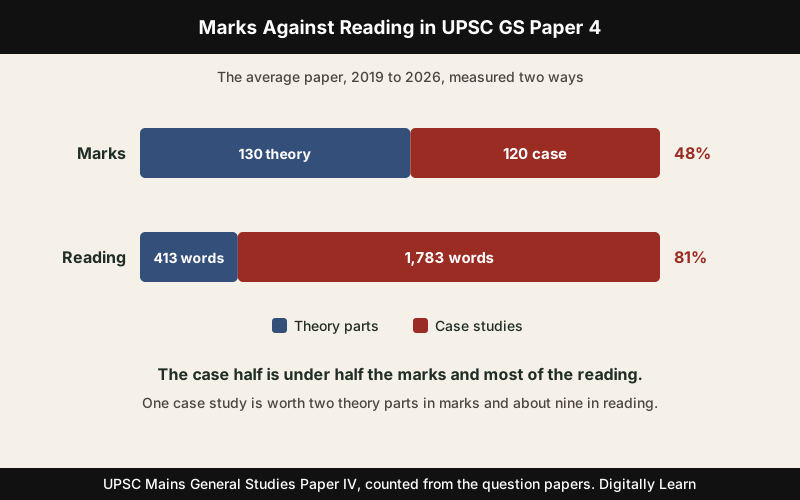
That is why the case half is not an add-on to this paper. It is the paper's declared instrument, and it carries 120 of 250 marks.
GS 4 Syllabus Decoded: Which Clauses the Paper Actually Asks
Theory Questions by Syllabus Clause, 2019 to 2026
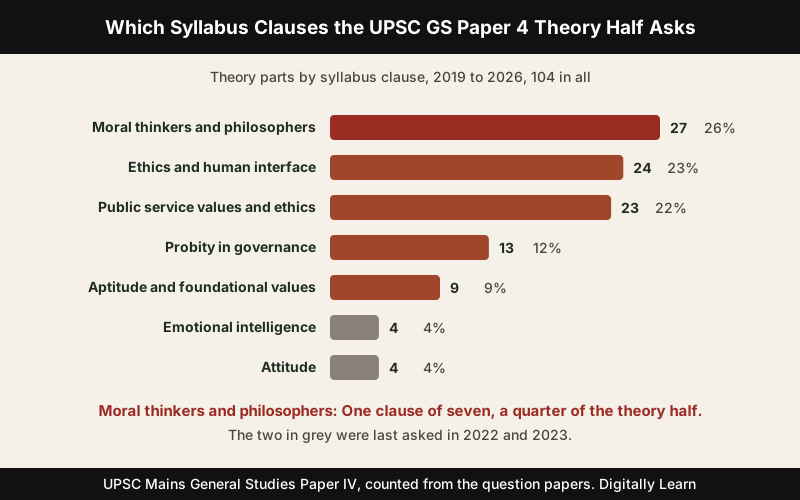
The eight GS Paper 4 question papers of 2019 to 2026 each had 13 theory parts and six case studies, 152 answers in all: 104 theory answers and 48 case studies. The 104 theory questions are not spread equally across the seven topic clauses of the syllabus. Case studies have a clause of their own, because they are a format rather than a topic.
| Clause | Theory questions | Share | 2019 to 2022 | 2023 to 2026 |
|---|---|---|---|---|
| Moral thinkers and philosophers | 27 | 26% | 13 | 14 |
| Ethics and human interface | 24 | 23% | 11 | 13 |
| Public service values and ethics in administration | 23 | 22% | 7 | 16 |
| Probity in governance | 13 | 12% | 9 | 4 |
| Aptitude and foundational values | 9 | 9% | 5 | 4 |
| Emotional intelligence | 4 | 4% | 3 | 1 |
| Attitude | 4 | 4% | 4 | 0 |
Moral Thinkers: One Syllabus Line, a Quarter of the Theory Questions
Moral thinkers and philosophers is one line of the seven, and it produces 27 of the 104 theory questions, 26 per cent. It has appeared at least twice in every paper since 2019. This fits another pattern of the paper: 36 of the 104 theory questions are built around a quotation, and a quotation is usually a thinker speaking.
Attitude and Emotional Intelligence: Two Clauses Not Asked Since 2023
The syllabus names attitude and emotional intelligence as separate clauses, yet together they account for only 8 of the 104 theory questions, 8 per cent. Attitude was last asked in 2022 and emotional intelligence in 2023, so the last three papers have carried neither.
Public Service Values: The Clause That Is Growing
Public service values and ethics in administration has gone from 7 questions across 2019 to 2022 to 16 across 2023 to 2026, and it led the last two papers outright at 5 apiece. It is also the widest clause in the notice, running from status and problems through ethical dilemmas in government and private institutions to accountability, international relations and corporate governance. A paper drifting towards it is drifting towards applied administrative ethics and away from abstract theory.
GS 4 Case Study: Half the Marks, Most of the Reading
Why Are Case Studies Important in GS Paper 4?
Case studies are important because they carry 120 of the 250 marks and about 81 per cent of the reading in the paper, so they decide how the three hours are spent. On marks alone the paper looks evenly balanced, with theory slightly ahead, and many candidates divide their preparation and their time roughly in half. The question papers show why that is a mistake.
| Point | Section A: Theory | Section B: Case studies |
|---|---|---|
| Answers | 13 | 6 |
| Marks | 130 (52 per cent) | 120 (48 per cent) |
| Words to read | 413 | 1,783 |
The six case studies together run to about 1,783 words in an average paper, while all 13 theory questions together run to 413. Put another way, a single case study is roughly nine times as long as a theory question but carries only twice the marks.
Planning the Three Hours Around Section B
Dividing the time equally among 19 answers gives about 9 minutes each. An equal split ignores the fact that Section B needs about 1,783 words of reading before any writing can begin, so the plan has to lean towards the case studies.
- Time split: Give the theory section somewhat less than half of the three hours and the case studies somewhat more.
- Reading load: Count the minutes spent reading a case as part of its time; they come out of the time left to write.
- Preparation: Practise case studies against the clock first. Most candidates leave them for last, after the theory, which is the wrong order for this paper.
Six Settings That Keep Returning in UPSC GS 4 Case Studies
The 48 case studies set since 2019 return to a small number of settings. A case can fall in two settings at once (a health crisis in a border district counts under both), so the counts add up to more than 48.
| Setting | Case studies | Share |
|---|---|---|
| Border, policing and security | 14 of 48 | 29% |
| Health and medical ethics | 13 of 48 | 27% |
| Environment and clearances | 10 of 48 | 21% |
| Welfare delivery | 8 of 48 | 17% |
| Disaster and relief | 5 of 48 | 10% |
| Procurement and contracts | 4 of 48 | 8% |
Border, policing and security leads at 14 of 48, and the top three settings between them touch most of the section. None of it is exotic. A candidate who has read GS Paper 2 and GS Paper 3 already knows the institutions these cases run on.
Decide as the Officer, or Judge the Officer: Two Kinds of Case
Ten of the 48 case studies address the candidate directly. You are the municipal commissioner, you are heading the rescue operation, you are the district magistrate who has rushed to the spot. The other 38 describe someone else and ask what should be done about them. The difference changes the answer.
- Second person: The case wants a decision, written in the first person and owned.
- Third person: The case wants an evaluation of the official described. An answer that slips into "what I would have done" has changed the question.
Neither 2025 nor 2026 used the second person at all, so the recent drift is towards judging another official rather than being one.
Cases Set Outside Government, and What a Case Does Not Ask For
A quiet assumption in most preparation is that every case study is an administrative one. Eight of 48 are not. They include a marketing vice president at a multinational, the chairman of a missiles company, a biotechnology scientist, a chief executive weighing a product that is legal abroad and harmful at home. These cases test the same reasoning, and they deny a candidate the usual escape route of quoting a service rule.
Underneath the settings the structure repeats. Nearly every case sets a duty against a relationship, or a rule against a consequence, such as an officer who is right and a superior who is senior, a procedure that is lawful and an outcome that is unjust. Reading five cases for their structure teaches more than reading twenty for their subject, because the subject is the part that will be new on the day.
Quotations and Thinkers in the Ethics Paper
One Theory Question in Three Is a Quotation
Of the 104 theory questions set since 2019, 36 carry a quoted passage, 35 per cent. In several of them the question is little more than the quotation, such as the lines from Thiruvalluvar and William James in 2025, which carry only a general lead-in and a word limit. That is a different task from answering a posed question. There is no specific directive such as discuss or examine, so the first decision, what the line means, is already part of the answer.
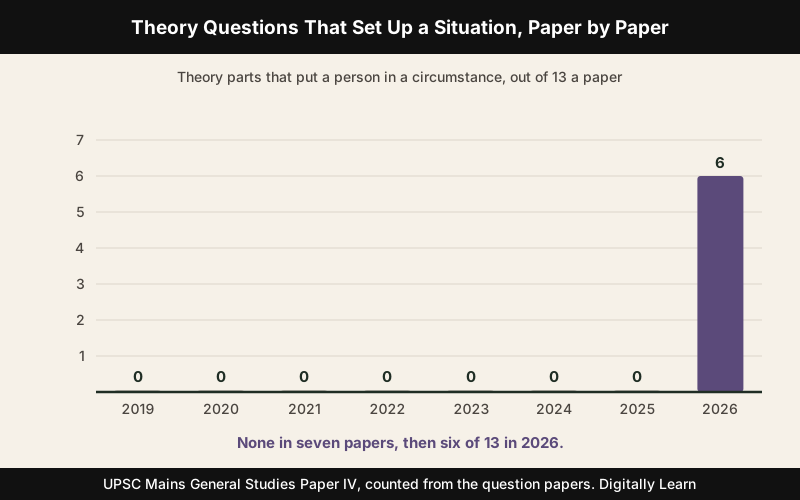
Across the eight papers, the theory parts carrying a quotation ranged from one in 2026 to seven in 2024 and 2025, and only the 2026 paper set situational theory parts.
| Year | Parts carrying a quotation | Situational parts |
|---|---|---|
| 2019 | 5 | 0 |
| 2020 | 4 | 0 |
| 2021 | 5 | 0 |
| 2022 | 2 | 0 |
| 2023 | 5 | 0 |
| 2024 | 7 | 0 |
| 2025 | 7 | 0 |
| 2026 | 1 | 6 |
How to Answer a Bare Quotation in 150 Words
The structure that works is short and always the same, which is why it can be rehearsed until it costs no thinking time on the day.
- Interpret: Say what the line claims, in your own words, in one or two sentences.
- Take a stand: Agree, qualify or disagree, and say so plainly rather than circling.
- Apply: Relate it to administration, which is what the paper tests.
- Close: End with one sentence that answers the line rather than summarising the answer.
Which Thinkers Are Asked: Fourteen Names in Eight Papers
The syllabus clause reads "Contributions of moral thinkers and philosophers from India and world", and in practice the paper leans Indian. Across eight papers it has named Indian figures 18 times and figures from elsewhere six times.
| India or world | Name | Mentions |
|---|---|---|
| India | Vivekananda | 5 |
| Gandhi | 5 | |
| Kalam | 2 | |
| Nehru | 1 | |
| Buddha | 1 | |
| Patel | 1 | |
| Thiruvalluvar | 1 | |
| Mahavir | 1 | |
| Ambedkar | 1 | |
| World | Socrates | 2 |
| Kant | 1 | |
| Clausewitz | 1 | |
| William James | 1 | |
| Shakespeare | 1 |
The list is 14 names long over eight papers, which makes the reading finite. Vivekananda and Gandhi lead it, and a candidate who knows those two properly is better placed than one who has skimmed twenty.
GS Paper 4 PYQ Analysis: What Changed in 2026
Situational Theory Questions: Seven Papers at Zero, Then Six
A theory question is situational when it puts a specific person in a specific circumstance and asks what should be done, rather than asking about a concept, a quotation or a general claim. The term is not the Commission's own.
No paper from 2019 to 2025 set a situational theory question. Theory questions asked about concepts, unpacked quotations or tested a general claim, and the scenarios stayed in Section B where the syllabus puts them. The 2026 paper then ran six of its 13. That is not a rise; it is a break.
The Six 2026 Questions in Full
Each of the six 2026 questions puts a named actor in a circumstance and asks what should follow. None can be answered by defining a term, which separates them from the other seven theory questions of the same paper.
| Number | The question as printed |
|---|---|
| Q1(a) | Owing to paucity of time, a university professor generates a Ph.D. evaluation report using Artificial Intelligence and submits it with some modifications. Discuss this from the perspective of accountability and integrity. |
| Q1(b) | A business house is working on a project that could displace a forest community from their habitat. As the administrative officer of that district, what ethical challenges are you likely to face? |
| Q2(a) | An endangered tribe has developed a severe skeletal deformity. A university research has identified a mineral supplement as a possible remedy, though clinical trials are yet to be conducted. Should the District Magistrate (DM) use this research on the tribe? Discuss from the perspective of medical and administrative ethics. |
| Q4(a) | Citing the serious adverse effects of long-term medication, a doctor convinces the family of a female patient for surgery. This led the patient to reluctantly consent for the surgery, though her original choice was to opt for medication. Explain the concepts of paternalism and beneficence by analysing the doctor's action. |
| Q5(a) | Usually schools, working in remote areas, do not fully comply with government regulations. However, if the rules are enforced strictly, it would lead to most schools closing down. How should an administrator strike a balance between enforcement of rules and educational rights of children? |
| Q6(a) | On the request of his Personal Assistant (PA), the District Magistrate (DM) stops the transfer of a schoolteacher who takes private tuition for his daughter diagnosed with learning disability. In this context, discuss the aspects of empathy versus compliance with rules. |
What One Paper Does and Does Not Prove
One paper is one observation, not a trend. The 2025 paper ran none, and so did the six before it, so nothing here establishes that 2026 is the new shape of the paper rather than an experiment. What it does establish is that the Commission is willing to ask a scenario outside Section B, and a candidate who has only rehearsed abstract theory answers is not ready for that.
GS 4 Theory Questions, 2022 to 2026, in Full
The theory half is easiest to understand from its own questions, the 65 Section A questions of 2022 to 2026, listed newest first.
Choose a year to see one paper's theory half.
| Year | Question |
|---|---|
| 2026 | Owing to paucity of time, a university professor generates a Ph.D. evaluation report using Artificial Intelligence and submits it with some modifications. Discuss this from the perspective of accountability and integrity. |
| 2026 | A business house is working on a project that could displace a forest community from their habitat. As the administrative officer of that district, what ethical challenges are you likely to face? |
| 2026 | An endangered tribe has developed a severe skeletal deformity. A university research has identified a mineral supplement as a possible remedy, though clinical trials are yet to be conducted. Should the District Magistrate (DM) use this research on the tribe? Discuss from the perspective of medical and administrative ethics. |
| 2026 | Discuss how national security can be balanced with concerns of human rights. |
| 2026 | Dr. B. R. Ambedkar had cautioned that employing civil disobedience within a constitutional democracy equates to endorsing 'anarchy'. How should modern democracies navigate the ethical dilemmas posed by civil disobedience movements that aim to promote social justice against policies that may raise genuine concerns? |
| 2026 | In what ways can an Indian Administrative Officer apply Gandhi's notion of 'trusteeship' to ensure fairness in governance? |
| 2026 | Shakespeare in Henry IV says, "The arms are fair when the intent of bearing them is just". What ethical implications does this have in governance? |
| 2026 | Citing the serious adverse effects of long-term medication, a doctor convinces the family of a female patient for surgery. This led the patient to reluctantly consent for the surgery, though her original choice was to opt for medication. Explain the concepts of paternalism and beneficence by analysing the doctor's action. |
| 2026 | Efficiency is doing things right, while effectiveness is doing the right thing. How do you strike a balance between the two to enhance productivity? |
| 2026 | Usually schools, working in remote areas, do not fully comply with government regulations. However, if the rules are enforced strictly, it would lead to most schools closing down. How should an administrator strike a balance between enforcement of rules and educational rights of children? |
| 2026 | In international relations, ethical considerations are often subjugated to the strategic interests of nation-states. Discuss this from an ethical perspective. |
| 2026 | On the request of his Personal Assistant (PA), the District Magistrate (DM) stops the transfer of a schoolteacher who takes private tuition for his daughter diagnosed with learning disability. In this context, discuss the aspects of empathy versus compliance with rules. |
| 2026 | Some moral philosophers argue that spending some of your resources, without significantly affecting your financial stability, to help other people who badly suffer is our moral duty and not merely a matter of charity. Justify this claim by explaining the distinction between duty and charity. |
| 2025 | In the present digital age, social media has revolutionised our way of communication and interaction. However, it has raised several ethical issues and challenges. Describe the key ethical dilemmas in this regard. |
| 2025 | "Constitutional morality is not a natural sentiment but a product of civil education and adherance of the rule of law." Examine the significance of constitutional morality for public servant highlighting the role in promoting good governance and ensuring accountability in public administration. |
| 2025 | Carl von Clausewitz once said, "War is a diplomacy by other means." Critically analyse the above statement in the present context of contemporary geo-political conflict. |
| 2025 | Keeping the national security in mind, examine the ethical dilemmas related to controversies over environmental clearance of development projects in ecologically sensitive border areas in the country. |
| 2025 | Given below are three quotations of great thinkers. What do each of these quotations convey to you in the present context? (a) "Those who in trouble untroubled are, Will trouble trouble itself." – Thiruvalluvar |
| 2025 | (b) "The greatest discovery of my generation is that a human being can alter his life by altering his attitudes." – William James |
| 2025 | (c) "The strength of a society is not in its laws, but in the morality of its people." – Swami Vivekananda |
| 2025 | "For any kind of social re-engineering by successfully implementing welfare schemes, a civil servant must use reason and critical thinking in an ethical framework." Justify this statement with suitable examples. |
| 2025 | What are the major teachings of Mahavir? Explain their relevance in the contemporary world. |
| 2025 | "One who is devoted to one's duty attains highest perfection in life." Analyse this statement with reference to sense of responsibility and personal fulfilment as a civil servant. |
| 2025 | To achieve holistic development goal, a civil servant acts as an enabler and active facilitator of growth rather than a regulator. What specific measures will you suggest to achieve this goal? |
| 2025 | It is said that for an ethical work culture, there must be code of ethics in place in every organisation. To ensure value-based and compliance-based work culture, what suitable measures would you adopt in your work place? |
| 2025 | India is an emerging economic power of the world as it has recently secured the status of fourth largest economy of the world as per IMF projection. However, it has been observed that in some sectors, allocated funds remain either under-utilised or misutilised. What specific measures would you recommend for ensuring accountability in this regard to stop leakages and gaining the status of third largest economy of the world in near future? |
| 2024 | The application of Artificial Intelligence as a dependable source of input for administrative rational decision-making is a debatable issue. Critically examine the statement from the ethical point of view. |
| 2024 | "Ethics encompasses several key dimensions that are crucial in guiding individuals and organizations towards morally responsible behaviour." Explain the key dimensions of ethics that influence human actions. Discuss how these dimensions shape ethical decision-making in the professional context. |
| 2024 | "It is not enough to talk about peace, one must believe in it; and it is not enough to believe in it, one must act upon it." In the present context, the major weapon industries of the developed nations are adversely influencing continuation of number of wars for their own self-interest, all around the world. What are the ethical considerations of the powerful nations in today's international arena to stop continuation of ongoing conflicts? |
| 2024 | Global warming and climate change are the outcomes of human greed in the name of development, indicating the direction in which extinction of organisms including human beings is heading towards loss of life on Earth. How do you put an end to this to protect life and bring equilibrium between the society and the environment? |
| 2024 | Given below are three quotations of great thinkers. What do each of these quotations convey to you in the present context? (a) "Learn everything that is good from others, but bring it in, and in your own way absorb it, do not become others." – Swami Vivekananda |
| 2024 | (b) "Faith is of no avail in the absence of strength. Faith and strength, both are essential to accomplish any great work." – Sardar Patel |
| 2024 | (c) "In law, a man is guilty when he violates the rights of others. In ethics, he is guilty if he only thinks of doing so." – Immanuel Kant |
| 2024 | "The concept of Just and Unjust is contextual. What was just a year back, may turn out to be unjust in today's context. Changing context should be constantly under scrutiny to prevent miscarriage of justice." Examine the above statement with suitable examples. |
| 2024 | "Mindless addiction to Form, ignoring the Substance of the matter, results in rendering of injustice. A perceptive civil servant is one who ignores such literalness and carries out true intent." Examine the above statement with suitable illustrations. |
| 2024 | The 'Code of Conduct' and 'Code of Ethics' are the sources of guidance in public administration. There is code of conduct already in operation, whereas code of ethics is not yet put in place. Suggest a suitable model for code of ethics to maintain integrity, probity and transparency in governance. |
| 2024 | The soul of the new law, Bharatiya Nyaya Sanhita (BNS) is Justice, Equality and Impartiality based on Indian culture and ethos. Discuss this in the light of major shift from a doctrine of punishment to justice in the present judicial system. |
| 2024 | "In Indian culture and value system, an equal opportunity has been provided irrespective of gender identity. The number of women in public service has been steadily increasing over the years." Examine the gender-specific challenges faced by female public servants and suggest suitable measures to increase their efficiency in discharging their duties and maintaining high standards of probity. |
| 2024 | Mission Karmayogi is aiming for maintaining a very high standard of conduct and behaviour to ensure efficiency for serving citizens and in turn developing oneself. How will this scheme empower the civil servants in enhancing productive efficiency and delivering the services at the grassroots level? |
| 2023 | What do you understand by 'moral integrity' and 'professional efficiency' in the context of corporate governance in India? Illustrate with suitable examples. |
| 2023 | 'International aid' is an accepted form of helping 'resource-challenged' nations. Comment on 'ethics in contemporary international aid'. Support your answer with suitable examples. |
| 2023 | "Corruption is the manifestation of the failure of core values in the society." In your opinion, what measures can be adopted to uplift the core values in the society? |
| 2023 | In the context of work environment, differentiate between 'coercion' and 'undue influence' with suitable examples. |
| 2023 | Given below are three quotation of great thinkers. What do each of these quotations convey to you in the present context? (a) "The simplest acts of kindness are by far more powerful than a thousand heads bowing in prayer." – Mahatma Gandhi |
| 2023 | (b) "To awaken the people, it is the women who must be awakened. Once she is on the move, the family moves, the village moves, the nation moves." – Jawaharlal Nehru |
| 2023 | (c) "Do not hate anybody, because that hatred that comes out from you must, in the long run, come back to you. If you love, that love will come back to you, completing the circle." – Swami Vivekananda |
| 2023 | "What really matters for success, character, happiness and lifelong achievements is a definite set of emotional skills – your EQ – not just purely cognitive abilities that are measured by conventional IQ tests." Do you agree with this view? Give reasons in support of your answer. |
| 2023 | Differentiate 'moral intuition' from 'moral reasoning' with suitable examples. |
| 2023 | Is conscience a more reliable guide when compared to laws, rules and regulations in the context of ethical decision-making? Discuss. |
| 2023 | 'Probity is essential for an effective system of governance and socio-economic development.' Discuss. |
| 2023 | What were the major teachings of Guru Nanak? Explain their relevance in the contemporary world. |
| 2023 | Explain the term social capital. How does it enhance good governance? |
| 2022 | Wisdom lies in knowing what to reckon with and what to overlook. An officer being engrossed with the periphery, ignoring the core issues before him, is not rare in the bureaucracy. Do you agree that such preoccupation of an administrator leads to travesty of justice to the cause of effective service delivery and good governance? Critically evaluate. |
| 2022 | Apart from intellectual competency and moral qualities, empathy and compassion are some of the other vital attributes that facilitate the civil servants to be more competent in tackling the crucial issues or taking critical decisions. Explain with suitable illustrations. |
| 2022 | The Rules and Regulations provided to all the civil servants are same, yet there is difference in the performance. Positive minded officers are able to interpret the Rules and Regulations in favour of the case and achieve success, whereas negative minded officers are unable to achieve goals by interpreting the same Rules and Regulations against the case. Discuss with illustrations. |
| 2022 | It is believed that adherence to ethics in human actions would ensure in smooth functioning of an organization/system. If so, what does ethics seek to promote in human life? How do ethical values assist in the resolution of conflicts faced by him in his day-to-day functioning? |
| 2022 | What does each of the following quotations mean to you? (a) "Ethics is knowing the difference between what you have the right to do and what is right to do." – Potter Stewart |
| 2022 | (b) "If a country is to be corruption free and become a nation of beautiful minds, I strongly feel that there are three key societal members who can make a difference. They are father, mother and teacher." – A. P. J. Abdul Kalam |
| 2022 | (c) "Judge your success by what you had to give up in order to get it." – Dalai Lama |
| 2022 | What do you understand by the term 'good governance'? How far recent initiatives in terms of e-Governance steps taken by the State have helped the beneficiaries? Discuss with suitable examples. |
| 2022 | Online methodology is being used for day-to-day meetings, institutional approvals in the administration and for teaching and learning in education sector to the extent telemedicine in the health sector is getting popular with the approvals of the competent authority. No doubt, it has advantages and disadvantages for both the beneficiaries and the system at large. Describe and discuss the ethical issues involved in the use of online method particularly to the vulnerable section of the society. |
| 2022 | Russia and Ukraine war has been going on for the last seven months. Different countries have taken independent stands and actions keeping in view their own national interests. We are all aware that war has its own impact on the different aspects of society, including human tragedy. What are those ethical issues that are crucial to be considered while launching the war and its continuation so far? Illustrate with justification the ethical issues involved in the given state of affair. |
| 2022 | Write short notes on the following in 30 words each: (i) Constitutional morality (ii) Conflict of interest (iii) Probity in public life (iv) Challenges of digitalization (v) Devotion to duty |
| 2022 | Whistle-blower, who reports corruption and illegal activities, wrongdoing and misconduct to the concerned authorities, runs the risk of being exposed to grave danger, physical harm and victimization by the vested interests, accused persons and his team. What policy measures would you suggest to strengthen protection mechanism to safeguard the whistle-blower? |
| 2022 | In contemporary world, corporate sector's contribution in generating wealth and employment is increasing. In doing so, they are bringing in unprecedented onslaught on the climate, environmental sustainability and living conditions of human beings. In this background, do you find that Corporate Social Responsibility (CSR) is efficient and sufficient enough to fulfill the social roles and responsibilities needed in the corporate world for which the CSR is mandated? Critically examine. |
Many of these questions are a quotation or a short claim followed by a directive. Each needs, within 150 words, the four moves of a bare quotation answer in order: Interpret the claim, take a stand, apply it to administration and close.
Directive Words and Word Limits in GS Paper 4
The Directives This Paper Uses
Discuss is the commonest directive, at 23 of the 104 theory questions, followed by examine at 11 and explain at 9. Critically appears 7 times, always attached to another verb rather than standing alone. The verb sets the shape of the answer: Discuss wants both sides, examine wants causes and effects, justify wants a position and its defence.
| Directive | Questions containing it |
|---|---|
| Discuss | 23 |
| Examine | 11 |
| Explain | 9 |
| Critically | 7 |
| Justify | 6 |
| Suggest | 5 |
| Illustrate | 3 |
| Comment | 2 |
| Evaluate | 2 |
| Analyse | 2 |
| Elaborate | 1 |
What 150 Words and 250 Words Each Have Room For
Each word limit fits a fixed number of moves, and the commonest way to lose marks in either half is to spend the space on something else.
| Answer | Room for | Commonest waste |
|---|---|---|
| Theory, 150 words | Four short moves: What the line or claim means, a clear stand, one application to administration, and a closing sentence | Defining a word the examiner also knows |
| Case study, 250 words | Stakeholders, the options actually available, a decision, and the defence of that decision, four moves | Listing the options and stopping |
An ethics answer that spends thirty words defining integrity has spent a fifth of its space agreeing with the question. A case answer that lists options and stops has described a dilemma rather than resolved one, and the fourth move, the defence of the decision, is the one most often dropped.
How to Prepare the UPSC Ethics Paper
Rehearse Case Studies Against a Clock
The constraint in this paper is reading speed under pressure, not ethical reasoning. Practising six full case studies to time teaches more than reading forty-eight of them without writing.
- Write at least one full case answer a week to the 250-word limit, by hand, timed.
- Read the case once for the facts and once for who stands to lose, then start writing.
- Decide before you write, because an answer that decides in its last sentence reads as one that could not.
- Treat the 150-word theory questions as compressed cases, as six of the 13 were in 2026.
Keep the Stock of Thinkers Small
The paper has named 14 figures in eight years and leans heavily Indian. A candidate who can apply Vivekananda, Gandhi and three others is better placed than one carrying a list of twenty names and no positions.
Do Not Prepare Ethics as a Theory Subject
Ethics terminology is widely taught, but the paper asks for almost none of it. The marks are for judgement applied to a situation, and terminology is at best the shortest way to name the judgement. A candidate who can name six schools of moral philosophy and cannot decide what a district magistrate should do in a real case has prepared the wrong paper.
Where GS Paper 2, GS Paper 3 and the Essay Help
The other papers feed this one unevenly, and it helps to know which reading transfers.
- GS Paper 2: Supplies the institutional detail a case study assumes, such as who can transfer whom, what a charter commits to, where an appeal goes.
- GS Paper 3: Supplies the environment, procurement and security settings that recur in the case studies.
- GS Paper 1: Supplies less, though its modern history covers several of the Indian figures this paper names.
- The Essay paper: Supplies the most transferable thing of all, the habit of taking a position and defending it at length.
Common Questions About the UPSC GS 4 Syllabus
What is GS Paper 4 in UPSC?
GS Paper 4 is the Ethics, Integrity and Aptitude paper of the UPSC Civil Services Mains. It carries 250 marks in three hours, tests judgement rather than specialist knowledge, and is the only General Studies paper whose syllabus names the case study method as a way of testing.
How many questions are there in UPSC Mains GS Paper 4?
The Commission prints twelve questions in two sections. They resolve into 19 answers: 13 theory parts at 10 marks with a 150-word limit, and six case studies at 20 marks with 250 words, for 250 marks in three hours.
How many marks are the case studies in GS Paper 4?
120 of 250, which is 48 per cent, from six questions. They also carry about 81 per cent of the reading in the paper, which matters more for planning than the marks do.
What is the word limit in the UPSC ethics paper?
150 words for each theory question and 250 words for each case study. Both are printed on the question paper against the part, along with the marks it carries.
Which thinkers are asked in UPSC GS Paper 4?
From 2019 to 2026 the paper named 14 figures, nine Indian and five from elsewhere; Indian figures were named 18 times and the others six times. Vivekananda and Gandhi appear most often.
Is GS Paper 4 easier than the other General Studies papers?
It assumes no specialist knowledge, which is not the same as being easier. Because nobody arrives with an advantage in material, the marks separate on method, and method is the thing candidates practise least.
Sources
- Union Public Service Commission: Examination Notice No. 05/2026-CSE, Civil Services Examination 2026
- Union Public Service Commission: Civil Services (Main) question papers, General Studies Paper IV, 2019 to 2026
- Union Public Service Commission: Civil Services Examination 2025, minimum qualifying marks
- Gazette of India: Civil Services Examination Rules 2026
Editorial Disclaimer
The GS Paper 4 syllabus is reproduced from the Commission's current examination notice. Counting answers rather than printed questions, classifying a theory question as situational and grouping case studies by setting are this site's own analysis and are not published by the Commission; each theory question is counted under the clause its core demand belongs to. The notice in the Gazette of India is the final authority.