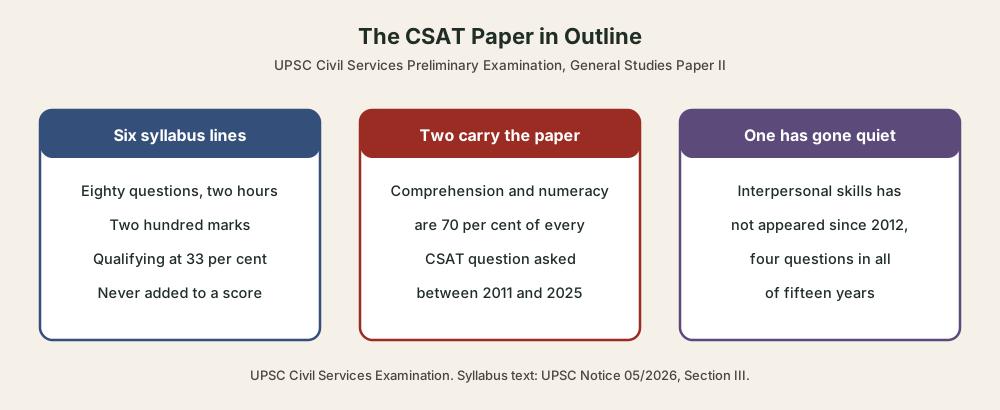
The CSAT syllabus is the six-line syllabus of General Studies Paper II of the Preliminary Examination: comprehension, interpersonal skills, logical reasoning, decision making, general mental ability, and basic numeracy with data interpretation. The paper carries eighty questions and two hundred marks and is qualifying at 33 per cent. This guide sets the six lines against what the paper has actually asked across 1,195 questions between 2011 and 2025.
What the CSAT Paper Is, and Why It Ends Candidatures
Two Hundred Marks That Never Count
General Studies Paper II of the Preliminary Examination, universally called the CSAT, carries eighty questions and two hundred marks over two hours. Not one of those marks is ever added to a candidate's score. The paper is qualifying only, at 33 per cent, which is 66 marks.
Why a Qualifying Paper Deserves Real Preparation
A paper that cannot raise a rank is easy to treat as a paper that does not matter. The logic runs the other way. It cannot help and it can end a year, which is the worst risk profile in the examination, and it is the one most candidates choose to carry.
The marks themselves, the negative marking and the cut-offs the pattern produces are set out in the exam pattern guide. This page is about what the paper asks.
The Six Official Syllabus Lines
The Syllabus, as the Commission Prints It
The whole of the CSAT syllabus is six lines. It has carried the same wording for years, which is part of why what follows is surprising.
- Comprehension;
- Interpersonal skills including communication skills;
- Logical reasoning and analytical ability;
- Decision making and problem solving;
- General mental ability;
- Basic numeracy (numbers and their relations, orders of magnitude, etc.) (Class X level), Data interpretation (charts, graphs, tables, data sufficiency etc., Class X level); Note 1: Paper-II of the Civil Services (Preliminary) Examination will be a qualifying paper with minimum qualifying marks fixed at 33%. Note 2: The questions will be of multiple choice, objective type. Note 3: It is mandatory for the candidate to appear in both the Papers of Civil Services (Preliminary) Examination for the purpose of evaluation. Therefore a candidate will be disqualified in case he/she does not appear in both the papers of Civil Services (Preliminary) Examination.
How This Page Counts Them
We sorted every CSAT question from 2011 to 2025, 1,195 questions in all, into the syllabus line it turns on. The bank holds between 77 and 81 questions for each of those fifteen years, against an eighty-question paper, so the sample is close to complete.
Six Lines on Paper, Two in Practice
Comprehension and Numeracy Are Seventy Per Cent of It
Of the 1,195 questions, comprehension accounts for 442 and basic numeracy with data interpretation for 392. Together they are 70 per cent of every CSAT question asked in fifteen years. The other four lines share what is left.
| Official syllabus line | Questions | A year | 2011 to 2015 | 2021 to 2025 | Shift |
|---|---|---|---|---|---|
| Comprehension | 442 | 29.5 | 33.4 | 27.4 | -6.0 |
| Basic numeracy and data interpretation | 392 | 26.1 | 13.8 | 34.0 | +20.2 |
| Logical reasoning and analytical ability | 247 | 16.5 | 24.2 | 12.4 | -11.8 |
| General mental ability | 87 | 5.8 | 3.8 | 6.0 | +2.2 |
| Decision making and problem solving | 23 | 1.5 | 4.2 | 0.2 | -4.0 |
| Interpersonal skills including communication skills | 4 | 0.3 | 0.8 | 0.0 | -0.8 |
The Paper as It Stands Today
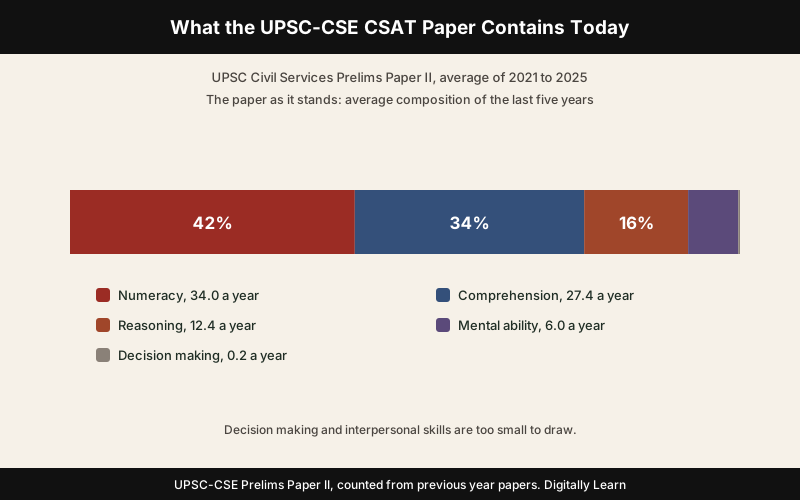
Averaged over the last five years the paper is numeracy first at 34.0 questions, comprehension second at 27.4, then reasoning at 12.4 and general mental ability at 6.0. The remaining two lines do not reach one question a year between them.
The Change Nobody Announced
Numeracy Has More Than Doubled Since 2015
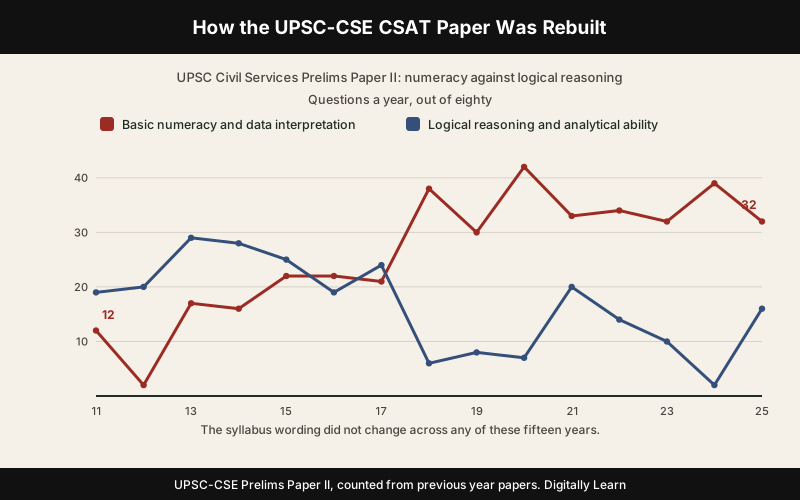
Basic numeracy and data interpretation ran at 13.8 questions a year between 2011 and 2015. Across 2021 to 2025 it has run at 34.0. That is a shift of +20.2 questions a year, and it is the largest single movement in either Preliminary paper.
Reasoning Fell by Almost as Much
Over the same period logical reasoning and analytical ability went from 24.2 questions a year to 12.4, and comprehension fell from 33.4 to 27.4. The paper traded reasoning and reading for arithmetic, question for question.
The Year the Paper Turned
Five-year averages hide when it happened. Year by year, the crossing is 2018: numeracy went to 38 questions and logical reasoning collapsed to six in a single paper. Before that year numeracy had never passed 22; after it, it has never come back below 30.
| Year | Comprehension | Numeracy | Reasoning | Mental ability | The other two |
|---|---|---|---|---|---|
| 2011 | 37 | 12 | 19 | 1 | 11 |
| 2012 | 40 | 2 | 20 | 10 | 8 |
| 2013 | 28 | 17 | 29 | 0 | 6 |
| 2014 | 33 | 16 | 28 | 4 | 0 |
| 2015 | 29 | 22 | 25 | 4 | 0 |
| 2016 | 27 | 22 | 19 | 11 | 0 |
| 2017 | 31 | 21 | 24 | 1 | 0 |
| 2018 | 25 | 38 | 6 | 9 | 1 |
| 2019 | 30 | 30 | 8 | 12 | 0 |
| 2020 | 25 | 42 | 7 | 5 | 0 |
| 2021 | 27 | 33 | 20 | 0 | 0 |
| 2022 | 27 | 34 | 14 | 5 | 0 |
| 2023 | 27 | 32 | 10 | 11 | 0 |
| 2024 | 27 | 39 | 2 | 12 | 0 |
| 2025 | 29 | 32 | 16 | 2 | 1 |
The table also shows why the five-year windows understate the change. 2012 ran two numeracy questions out of eighty, which drags the early average down, and 2024 ran thirty-nine. The paper a candidate sits today has almost nothing in common with the paper of 2012 except its syllabus.
Why the Paper Got Harder Without the Syllabus Changing
This is the honest answer to the complaint that CSAT became a different examination after 2015. The wording is identical and a candidate reading only the syllabus would see nothing. The composition changed, and composition is what a candidate actually sits.
It also explains who it hit. A candidate strong in reading and reasoning and weak in arithmetic cleared this paper comfortably in 2012 and can fail it now. Our Prelims test series includes CSAT papers built to the current composition rather than the old one.
The Two Lines That Have Gone Quiet
Interpersonal Skills: Four Questions in Fifteen Years
Interpersonal skills including communication skills is a named line of the official syllabus. It has produced four questions in fifteen years, and it has not appeared since 2012. A candidate preparing today has never sat a paper containing it.
Decision Making Survives, Barely
Decision making and problem solving has 23 questions across the period, and nearly all of them came before 2014. It appeared once in the last five years. Those questions are also the paper's only ones without negative marking in the years they were set, which is why they are remembered out of proportion to their number.
What a Dormant Line Does and Does Not Licence
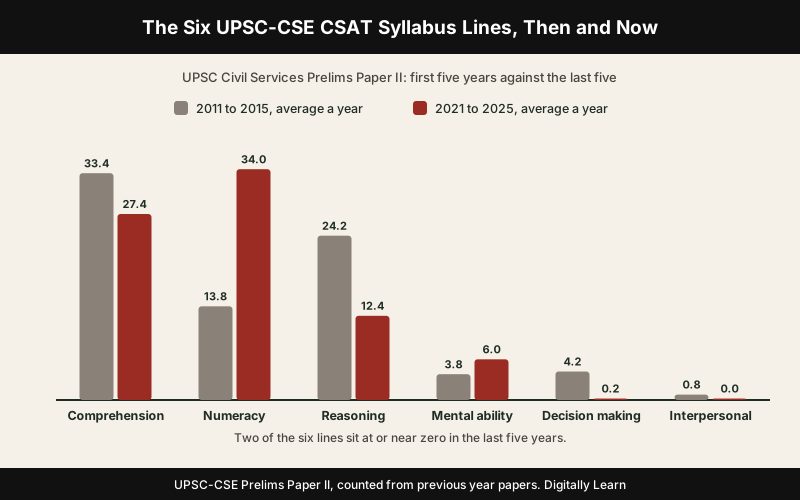
Both lines remain in the notice, so both can return, and a page that told a candidate to ignore them would be overreaching. What the data supports is narrower: neither deserves a preparation block of its own, and time budgeted to them is better spent on the two lines that carry seventy per cent of the paper.
Comprehension: The Largest Single Block
Four Hundred and Forty-Two Questions, Falling Slowly
Comprehension is still the largest single line at 442 questions, 29.5 a year on average and 27.4 in the last five. It is the most stable part of the paper, and the part a candidate can least afford to be slow at.
What Makes a CSAT Passage Hard
The passages are not hard in vocabulary. They are hard in density: an argument stated once, in a register closer to a policy note than to journalism, followed by questions that turn on a qualifier rather than on the main claim.
The commonest trap is an option that is true in the world but not stated in the passage. A candidate with subject knowledge is more exposed to it than one without, because the plausible answer is already in their head before they read the lines that rule it out.
Reading Speed Is the Constraint, Not Reading Ability
Eighty questions in two hours is ninety seconds each, and a comprehension set spends much of that on the passage rather than the question. Most candidates who run out of time do so here. The difficulty sits in density and inference rather than in vocabulary, so reading more widely helps less than reading faster with retention.
Numeracy and Data Interpretation, the Line That Now Leads
The Reasoning Types That Recur
Logical reasoning is 12.4 questions a year now, down from 24.2, and the types that survive are narrow: seating and ordering arrangements, sequences and series, blood relations and directions, and syllogisms. Analytical puzzles with several constraints appear most years.
General mental ability sits beside it at 6.0 a year and has quietly risen. In practice it is arithmetic reasoning: number properties, counting, and the small set-theory questions that look like puzzles.
The Arithmetic of Qualifying
How Many Correct Answers 66 Marks Needs
Two hundred marks over eighty questions is 2.5 marks a question, with a penalty of one third of that for a wrong answer. Those two numbers decide how many questions a candidate should attempt, and the answer is not the one usually given.
| Attempted | Correct needed | Accuracy needed | Wrong answers allowed |
|---|---|---|---|
| 30 | 28 | 93% | 2 |
| 40 | 30 | 75% | 10 |
| 50 | 33 | 66% | 17 |
| 60 | 35 | 58% | 25 |
| 70 | 38 | 54% | 32 |
| 80 | 40 | 50% | 40 |
Attempt all eighty and forty correct answers clear the line, which is fifty per cent accuracy. Attempt thirty and twenty-eight of them must be right, which is ninety-three per cent. Every question left blank raises the accuracy the rest must carry.
Why Selective Attempting Is Usually the Wrong Advice
The standard advice is to attempt selectively and protect accuracy. The arithmetic says the opposite for any question a candidate can do better than chance on, because a blank raises the accuracy the rest must carry while a guess above one in four has positive expected value.
The limit is time, not risk. A candidate who can read and answer sixty questions in two hours needs 35 correct; one who manages eighty needs 40, at a much lower accuracy. Speed, in this paper, is worth more than caution.
Numeracy and Data Interpretation, the Line That Now Leads
What Class X Level Means in Practice
The notice puts basic numeracy and data interpretation at Class X level, and on content that is accurate. Percentages, ratios, averages, time and work, simple probability and reading a table or chart are all school arithmetic.
What is not Class X is the pace. A school paper gives a candidate time to work carefully; this one gives ninety seconds including the reading, which turns familiar arithmetic into a speed exercise.
The Question Types Inside the Line
| Question type | Questions | Share of the paper |
|---|---|---|
| Comprehension | 442 | 37.0% |
| Logical Reasoning Analytical | 247 | 20.7% |
| Basic Numeracy | 183 | 15.3% |
| General Mental Ability | 87 | 7.3% |
| Arithmetic | 75 | 6.3% |
| Data Interpretation | 51 | 4.3% |
| Time Distance Time Work | 41 | 3.4% |
| Permutation Combination Probability | 26 | 2.2% |
| Decision Making Problem Solving | 23 | 1.9% |
| Geometry Mensuration | 16 | 1.3% |
| Interpersonal Communication | 4 | 0.3% |
Basic numeracy leads, then general arithmetic, then data interpretation, time and work, counting and probability, and a small amount of geometry and mensuration.
Where the Marks Are Won Now
This line is about 42 per cent of the paper as it currently stands, and it is the part that responds fastest to practice. Arithmetic accuracy under time pressure improves measurably in weeks, which is not true of reading speed or of reasoning.
What This Means for Preparing the CSAT
Aim Above the Line, Not At It
The target is 66 marks of 200. Aiming at exactly that is a mistake, because comprehension accuracy varies on the day in a way arithmetic does not. A candidate who plans for a comfortable margin absorbs a bad passage; one who plans for 66 does not.
The one-third negative marking applies to this paper as it does to the other, so guessing carries the same arithmetic cost.
Where the First Ten Hours Go
Ordered by what the paper now contains rather than by the order the syllabus lists, and offered as a sequence rather than a rule.
- Arithmetic under time: Percentages, ratios, averages, time and work.
- Comprehension practice against the clock, with full-length passages.
- Data interpretation, which is arithmetic with a reading step in front of it.
- Logical reasoning, at its reduced but still real weight.
- General mental ability, the one small line that has grown.
The full Preliminary General Studies syllabus, which is the other paper of the same morning, is covered in Part 2 of this series.
What Not to Build a Block For
Interpersonal skills and decision making, on the evidence above. Both stay in the notice and both can return, so the judgement is about proportion rather than exclusion. Between them they have produced 27 questions in fifteen years against 834 from the two leading lines.
Common Questions About the CSAT Paper
Is CSAT counted in the UPSC Prelims score?
No. The paper is qualifying only, at 33 per cent, and its marks are never added to any score. The Preliminary cut-off is calculated on General Studies Paper I alone.
What are the qualifying marks for CSAT?
Thirty-three per cent of 200, which is 66 marks. The threshold is the same for every category, unlike the General Studies cut-off, which differs by category.
How many maths questions come in CSAT?
Basic numeracy and data interpretation has averaged 34.0 questions a year across 2021 to 2025, against 13.8 a year in 2011 to 2015. In the current paper it is the largest line, ahead of comprehension.
Has the CSAT paper become harder?
Its composition has changed sharply, which is not the same as difficulty but produces the same effect for many candidates. Numeracy has more than doubled and logical reasoning has halved, with no change to the syllabus wording.
Can I skip the CSAT paper?
No. A candidate must appear in both Preliminary papers to be evaluated at all, so skipping this one disqualifies the candidate from the Preliminary Examination and spends the attempt.
Official Sources
- Union Public Service Commission: Examination Notice No. 05/2026-CSE, Civil Services Examination 2026
- Union Public Service Commission: Programme of Examinations and Recruitment Tests 2027
- Union Public Service Commission: Civil Services Examination 2025, minimum qualifying marks
- Union Public Service Commission: 74th Annual Report 2023-24 (Appendix 9, profile of candidates, Civil Services Examination 2022)
- Legislative Department, Ministry of Law and Justice: The Constitution of India
- Department of Personnel and Training: Gazette notifications (the Civil Services Examination Rules are notified here each year)
- National Council of Educational Research and Training: school textbooks, the Class X level the notice refers to
- Union Public Service Commission: online registration and application portal
- Wikipedia: Civil Services Examination
Editorial Disclaimer
The syllabus on this page is reproduced from the Commission's current examination notice, with the notice's dashes replaced by commas and colons for readability. Sorting past questions into syllabus lines is our own analysis and is not published by the Commission. The notice in the Gazette of India is the final authority.