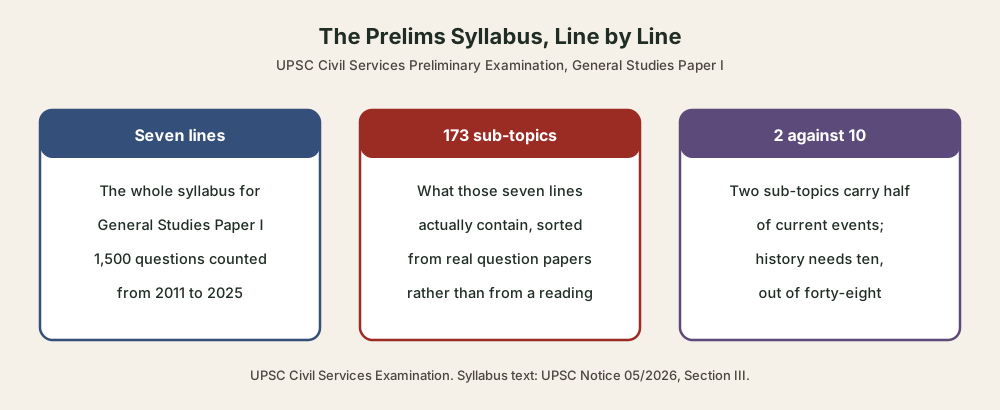
The UPSC Prelims syllabus for General Studies Paper I is seven lines long, and those seven lines have to account for all hundred questions asked each year. This guide takes each line in turn, quotes it from the Commission's notice, and then shows the sub-topics it has actually contained across 1,500 questions asked between 2011 and 2025, with a measure of how few of those sub-topics carry half of each line.
How to Read the Prelims Syllabus Before Reading Anything Else
The Seven Lines, and What Each One Is Doing
The syllabus for General Studies Paper I of the Preliminary Examination is seven lines long. Those seven lines have to account for every one of the hundred questions asked each year, which is why the same seven words can generate a question about a river system and a question about a central bank instrument.
- Current events of national and international importance.
- History of India and Indian National Movement.
- Indian and World Geography-Physical, Social, Economic Geography of India and the World.
- Indian Polity and Governance-Constitution, Political System, Panchayati Raj, Public Policy, Rights Issues, etc.
- Economic and Social Development-Sustainable Development, Poverty, Inclusion, Demographics, Social Sector Initiatives, etc.
- General issues on Environmental ecology, Bio-diversity and Climate Change - that do not require subject specialization.
- General Science.
The overview of the whole examination, including the CSAT paper and the Main Examination, is in the complete UPSC syllabus guide. This page is only about the paper that screens.
Why the Syllabus Cannot Tell You Where to Spend Time
A syllabus line states what may be asked. It says nothing about how often, and nothing about which part of the line does the work. General Science is two words and has carried 205 questions. Indian and World Geography has five clauses and has carried 168. Length of wording and weight of questions are unrelated.
How This Page Measures a Line
We sorted every question in the Preliminary General Studies Paper I from 2011 to 2025, 1,500 questions, into the sub-topic each one actually turns on. That produced 173 distinct sub-topics across the seven lines. For each line we then asked a single question: how many of its sub-topics do you need before you have covered half the questions it has ever asked?
That number is the concentration of a line. A low number means a handful of blocks decide it. A high number means the line is spread thin and rewards breadth over depth. It is a description of the past, not a prediction, and it says nothing about how hard any individual question was.
Current Events of National and International Importance
Two Sub-topics Carry Half of This Line
| Sub-topic | Questions | Share of the line |
|---|---|---|
| International organisations | 26 | 31.7% |
| International relations | 19 | 23.2% |
| Government schemes | 12 | 14.6% |
| Conflicts and security | 10 | 12.2% |
| Disasters and relief | 4 | 4.9% |
| Sport and personalities | 4 | 4.9% |
This is the lightest line in the paper at 5.5 questions a year, and the most concentrated: just two sub-topics cover half of it, out of 10. It is also the line that has grown fastest, from 3.2 a year in the first five years to 8.0 in the last five.
International Organisations and Groupings Lead It
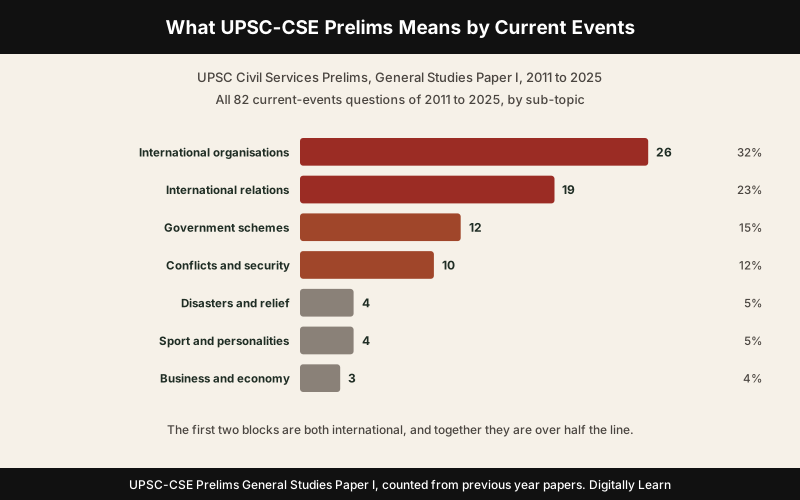
International organisations and groupings alone take 32 per cent of the line, and international relations and treaties another 23. Together they are more than half. Indian government schemes come third.
So the paper reads this line outward. A candidate tracking membership, mandate and recent decisions of the bodies India belongs to is reading the right thing. One tracking domestic political news is not.
What This Line Does Not Ask
Across fifteen years the line has produced four questions on sport and personalities, two on awards and honours and one on books and authors. Seven questions in fifteen years, against twenty-six on international organisations alone. The compilations that lead with awards, appointments and sporting results are answering a paper the Commission does not set.
History of India and the Indian National Movement
The Most Scattered Line in the Paper
| Sub-topic | Questions | Share of the line |
|---|---|---|
| Philosophy and Religion | 19 | 7.6% |
| Gandhian Mass Movements (1915-1942) | 18 | 7.2% |
| Constitutional Developments and British Plans (1909-1947) | 17 | 6.8% |
| Architecture and World Heritage | 15 | 6.0% |
| British Administration and Economic Policies | 13 | 5.2% |
| Early Nationalism and Indian National Congress (1885-1915) | 12 | 4.8% |
History has carried 250 questions, 16.7 a year, across 48 sub-topics, more than any other line. Ten of them are needed to reach half its questions and twenty-five to reach eighty per cent. On the concentration measure it is the least efficient line in the paper.
Culture Is Far Larger Than Candidates Expect
The largest single block is philosophy and religion at 19 questions, just ahead of Gandhian mass movements at 18. Add architecture and world heritage, literature and languages, and festivals and crafts, and the cultural blocks come to 54 questions of the 250.
That does not make culture the larger half. Counted the same way, the blocks of the freedom struggle and colonial administration come to 71. The point is narrower and more useful: culture is roughly a fifth of the history line, which is far more than the share of reading time it usually gets.
The Freedom Struggle Blocks That Do Recur
Within the national movement the recurring blocks are Gandhian mass movements between 1915 and 1942, constitutional developments and the British plans from 1909 onwards, and early nationalism with the Congress from 1885. Those three are dependable. Beyond them the line fragments quickly into single-question topics.
Because of that fragmentation, history is the line where a test series earns the most: you cannot read forty-eight sub-topics evenly, and the only honest way to find your gaps is to be asked. Our Prelims test series is sectional by syllabus line for this reason.
Indian and World Geography
The Lightest of the Traditional Subjects
| Sub-topic | Questions | Share of the line |
|---|---|---|
| Atmosphere and Climatology | 30 | 17.9% |
| Indian Agriculture and Land Use | 20 | 11.9% |
| Indian Physical Geography | 15 | 8.9% |
| Indian Rivers and Water Resources | 14 | 8.3% |
| World Political Geography and Borders | 12 | 7.1% |
| Physical Geography and Geomorphology | 11 | 6.5% |
Geography has carried 168 questions, 11.2 a year, which is fewer than any traditional subject in this paper. It is also one of the few lines that has grown, from 12.6 a year to 13.6. Candidates who allot it a third of their Prelims time are working from the Main Examination weighting, where geography sits inside General Studies Paper I and carries far more.
Atmosphere and Climatology Carries the Line
Winds, pressure systems, cyclones and the monsoon are 18 per cent of the line between them, the largest share any single sub-topic takes in any traditional subject. They are also the part of geography that connects straight to the environment line, which is why the two are worth reading together.
Indian Agriculture, Rivers and Physical Geography
After climatology the line runs through Indian agriculture and land use, Indian physical geography, and rivers and water resources. World political geography appears mostly as borders and locations. Five sub-topics reach half the line, so geography rewards depth in a small number of blocks rather than an atlas read end to end.
Indian Polity and Governance
One Sub-topic Carries a Fifth of the Line
| Sub-topic | Questions | Share of the line |
|---|---|---|
| Parliament and State Legislatures | 40 | 18.5% |
| Constitutional Framework and Development | 27 | 12.5% |
| Judiciary | 19 | 8.8% |
| Union and State Executive | 19 | 8.8% |
| Constitutional and Statutory Bodies | 12 | 5.6% |
| Federalism and Centre-State Relations | 11 | 5.1% |
Polity has carried 216 questions, 14.4 a year, and it is one of the two lines that has risen. Parliament and State legislatures alone is 40 of those questions, 19 per cent, the largest single block in the paper outside current events.
Constitutional Framework, the Judiciary and the Executive
The next three blocks are the constitutional framework and its development, the judiciary, and the union and state executive. Those four together are over half the line. They are also the blocks where the question style is most stable: composition, powers, procedure and the article that governs them.
Our polity articles follow that order, because it is the order the paper has used.
The Long Tail: Bodies, Federalism and Rights
Beyond those four the line spreads across 29 further sub-topics: constitutional and statutory bodies, federalism and Centre-State relations, the directive principles, social justice, and political theory. Eleven sub-topics are needed to reach eighty per cent, so the tail is long but each part of it is small.
Economic and Social Development
The Heaviest Line, and the Flattest
| Sub-topic | Questions | Share of the line |
|---|---|---|
| Agriculture and Rural Development | 33 | 11.0% |
| Human Development, Poverty and Employment Schemes | 30 | 10.0% |
| Fiscal Policy and Budget | 26 | 8.7% |
| Banking and Financial Sector | 23 | 7.7% |
| External Sector and Balance Of Payments | 23 | 7.7% |
| Infrastructure and Industry | 23 | 7.7% |
Economy is the heaviest line in the paper at 299 questions, 19.9 a year. It is also the flattest: 27 sub-topics and nothing above 11 per cent. No block dominates, and six are needed before half the line is covered.
Agriculture, Welfare Schemes and Fiscal Policy Lead
Agriculture and rural development leads, then human development and employment schemes, then fiscal policy and the budget. Banking, the external sector, infrastructure, financial markets, digital payments and monetary policy follow closely behind, each within a few questions of the next.
That flatness is the finding. An economy question is as likely to come from the balance of payments as from a rural employment scheme, and a candidate cannot tell in advance which.
Why This Line Cannot Be Shortcut
Eleven sub-topics are needed to reach eighty per cent of the economy line, the same as polity but spread over more questions. Combined with its weight, that makes economy the line where under-preparation costs most: it is the largest line and it offers no shortcut. It is the one place where reading the whole of a standard source pays for itself.
Environmental Ecology, Biodiversity and Climate Change
A Heavy Line With the Narrowest Spread
| Sub-topic | Questions | Share of the line |
|---|---|---|
| Ecosystems and Ecology Concepts | 36 | 13.1% |
| Biodiversity and Conservation | 33 | 12.0% |
| Pollution and Waste Management | 31 | 11.3% |
| Protected Areas and Wildlife | 31 | 11.3% |
| International Environmental Treaties and Summits | 29 | 10.6% |
| Climate Change and Greenhouse Gases | 26 | 9.5% |
Environment has carried 274 questions, 18.3 a year, across only 16 sub-topics, the narrowest spread of the traditional subjects. Five reach half the line and eight reach eighty per cent, so it is both heavy and tractable, which is an unusual combination.
Ecosystems, Biodiversity, Pollution and Protected Areas
Ecosystems and ecology concepts lead, followed by biodiversity and conservation, pollution and waste management, and protected areas and wildlife. International environmental treaties and summits, climate change, and sustainable agriculture and forestry make up most of the rest.
The line rewards a species-and-site memory more than a conceptual one: protected areas, convention names and pollutant limits recur in a way that ecosystem theory does not.
The Line That Has Fallen Furthest
Environment has lost more weight than any other line, from 20.2 questions a year in 2011 to 2015 to 16.6 in 2021 to 2025. It remains a heavy line even after that fall, and the fall is a reason to stop over-weighting it rather than a reason to drop it.
General Science
Two Words of Syllabus, Eighteen Sub-topics of Questions
| Sub-topic | Questions | Share of the line |
|---|---|---|
| Computer and Information Technology | 35 | 17.1% |
| Biotechnology and Genetics | 27 | 13.2% |
| Health and Diseases | 26 | 12.7% |
| Energy and Environment | 25 | 12.2% |
| Space Technology and Astronomy | 23 | 11.2% |
| Biology | 16 | 7.8% |
General Science is the shortest line in the syllabus and has carried 205 questions, 13.7 a year. It is the steadiest line of the seven, moving by less than a question a year across fifteen years, and four sub-topics reach half of it.
Applied Technology Outweighs School Science
The first five blocks are computing and information technology, biotechnology and genetics, health and diseases, energy and environment, and space technology. Applied technology dominates, and the school subjects sit behind it: biology 16 questions, physics 11, chemistry fewer still.
That does not mean the school science is optional. The paper asks the concept through the application, so a question about a vaccine platform is a question about immunity, and a question about a battery is a question about electrochemistry.
Where Physics, Chemistry and Biology Actually Appear
Counted as school subjects rather than as applications, foundation science is about one question in fifteen of the paper. The rest of this line is the technology of the year. A candidate who reads only the technology news struggles with the reasoning, and one who reads only the textbook struggles with the framing. Our Study Library covers both sides.
What the Breakdown Means for a Study Plan
The Concentration Table, Ranked
All seven lines in one place, ordered by how few sub-topics it takes to cover half of them. The last two columns are the ones to read.
| Syllabus line | Questions | A year | Sub-topics | To reach half | To reach 80% |
|---|---|---|---|---|---|
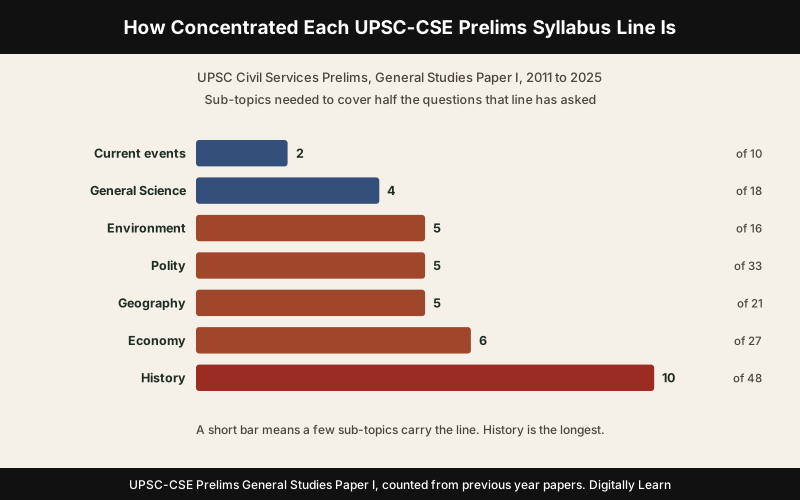
| Current events | 82 | 5.5 | 10 | 2 | 4 |
| General Science | 205 | 13.7 | 18 | 4 | 7 |
| Environment | 274 | 18.3 | 16 | 5 | 8 |
| Polity | 216 | 14.4 | 33 | 5 | 11 |
| Geography | 168 | 11.2 | 21 | 5 | 10 |
| Economy | 299 | 19.9 | 27 | 6 | 11 |
| History | 250 | 16.7 | 48 | 10 | 25 |
The Lines That Reward Breadth, and the Lines That Punish It
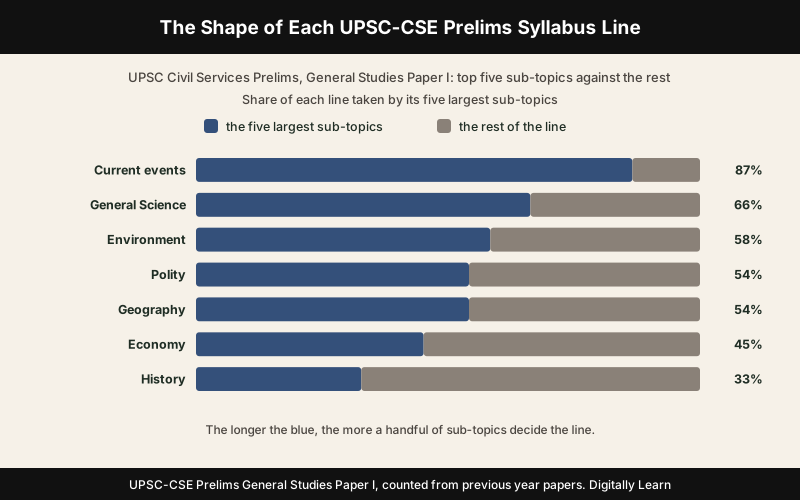
Current events and General Science convert fastest. Two and four sub-topics respectively reach half their questions, and both lines are stable year to year. History and economy convert slowest, for opposite reasons: history because it has forty-eight sub-topics, economy because none of its twenty-seven is large.
Environment sits in the useful middle: heavy in questions, narrow in spread. Polity and geography each have one dominant block and a long tail behind it.
A Reading Order That Follows the Data
If time is short, this is the order the numbers suggest, and it is a sequence rather than a rule. Start with the two lines that convert fastest, secure the heavy line that is narrow, then take the dominant block of each remaining line before its tail.
- Current events, restricted to international organisations, relations and Indian schemes.
- General Science, through the applied face rather than the textbook.
- Environment, which is heavy and narrow at the same time.
- Polity, starting with Parliament and State legislatures.
- Geography, starting with atmosphere and climatology.
- Economy, read whole, because it offers no shortcut.
- History, last and longest, with the cultural blocks given their real weight.
This ordering is about where effort converts first, not about what matters most. Every line appears in every paper. The pattern of the paper itself, including negative marking and the cut-offs it produces, is set out in the exam pattern guide.
Common Questions About the Prelims Syllabus
Which subject has the most questions in UPSC Prelims?
Economic and Social Development, at 299 questions between 2011 and 2025, about 19.9 a year. Environment is second at 18.3 and history third at 16.7. Geography is the lightest of the traditional subjects at 11.2.
Is the UPSC Prelims syllabus the same every year?
The text has not changed across the fifteen years measured here. What has changed is the distribution: current events has more than doubled and environment has fallen by more than three questions a year, with no amendment to the syllabus itself.
How many questions come from current affairs in Prelims?
As a line of its own, 5.5 a year on average and 8.0 in the last five years. That undercounts it, because current material also frames questions inside the economy, environment and science lines, where it is tagged to the subject rather than to current events.
Which Prelims subject is the hardest to cover?
History, on the evidence. It has 48 sub-topics, needs ten of them to reach half its questions and twenty-five to reach eighty per cent. Economy is harder in a different way: fewer sub-topics, but none of them large enough to prioritise.
Do I need to study world history for Prelims?
Barely, for this paper. World history is a General Studies Paper I subject at the Main Examination, where it is named in the syllabus. In the Preliminary paper the history line is dominated by Indian culture and the Indian national movement, and world history appears rarely.
Official Sources
- Union Public Service Commission: Examination Notice No. 05/2026-CSE, Civil Services Examination 2026
- Union Public Service Commission: Programme of Examinations and Recruitment Tests 2027
- Union Public Service Commission: Civil Services Examination 2025, minimum qualifying marks
- Union Public Service Commission: 74th Annual Report 2023-24 (Appendix 9, profile of candidates, Civil Services Examination 2022)
- Legislative Department, Ministry of Law and Justice: The Constitution of India
- Department of Personnel and Training: Gazette notifications (the Civil Services Examination Rules are notified here each year)
- National Council of Educational Research and Training: school textbooks, the standard reading for several syllabus lines
- Union Public Service Commission: online registration and application portal
- Wikipedia: Civil Services Examination
Editorial Disclaimer
The syllabus on this page is reproduced from the Commission's current examination notice, with the notice's dashes replaced by commas and colons for readability. The sub-topic counts are our own analysis of past question papers and are not published by the Commission. The notice in the Gazette of India is the final authority.