


Overview
Mobilising women into self-help groups
A flagship mission launched in 2011 as Aajeevika and run by the Ministry of Rural Development, DAY-NRLM organises poor rural women into self-help groups, federates them into village organisations and cluster level federations, and links them to bank credit, making it India's central instrument for women's financial inclusion, rural livelihoods and poverty alleviation.
Deendayal Antyodaya Yojana, National Rural Livelihoods Mission, or DAY-NRLM, is India's flagship rural poverty-alleviation mission, launched in 2011 as Aajeevika by the Ministry of Rural Development. It works by mobilising the rural poor, above all women, into self-help groups that save and borrow together, federating them into village organisations and cluster level federations, and linking them to bank credit through capitalisation funds and interest subvention. Designed with World Bank support and renamed after the principle of Antyodaya, the rise of the poorest, it is the world's largest platform of women-led community institutions.
What DAY-NRLM Is: The 2011 Aajeevika Mission and the Antyodaya Promise
The June 2011 launch as Aajeevika, the World Bank support, the restructuring of SGSY and the renaming as Deendayal Antyodaya Yojana
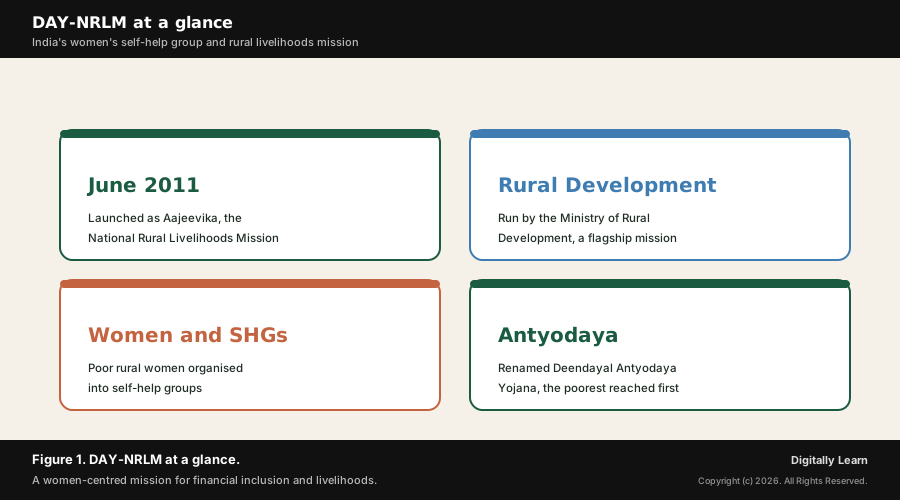
The Deendayal Antyodaya Yojana, National Rural Livelihoods Mission, almost always shortened to DAY-NRLM, is India's flagship programme to lift rural families out of poverty. It was launched in June 2011 by the Ministry of Rural Development as Aajeevika, the National Rural Livelihoods Mission, and it works by organising the poor, above all poor women, into their own self-help groups. The aim is not a one-time handout but a lasting institution that the women themselves own and run.
The mission did not appear from nowhere. It restructured an earlier scheme, the Swarnajayanti Gram Swarozgar Yojana, replacing a subsidy-led model with a model built on social mobilisation and steady support. It was designed with technical and investment help from the World Bank, which backed the linked National Rural Livelihoods Project, and it learned from successful state efforts, notably Kudumbashree in Kerala and the Society for Elimination of Rural Poverty in Andhra Pradesh, which had already shown how women's groups could change rural life.
Why it matters is captured in the name. The scheme was renamed Deendayal Antyodaya Yojana in 2015, after the thinker Pandit Deendayal Upadhyaya, and the word Antyodaya means the rise of the last person. It signals a clear rule of priority: the poorest household in the village is to be reached first, not last. The figure below sets out the mission at a glance before the briefing turns to why women's groups sit at its centre.
Breaking the Gender, Poverty and Malnutrition Cycle Through Women's Self-Help Groups
The self-reinforcing trap of gender inequality, poverty and malnutrition, how microfinancing of women SHGs can cut into it, and why credit alone is not enough
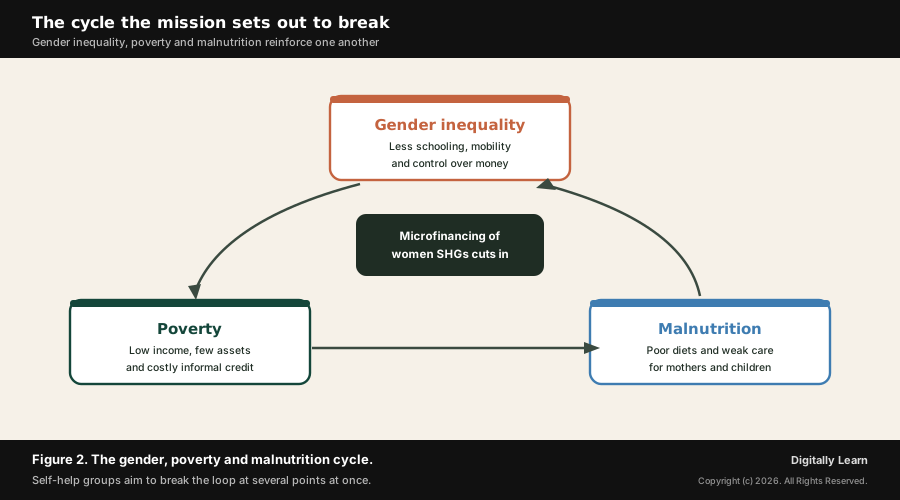
The mission's deepest purpose is to break a self-reinforcing trap that holds the rural poor woman down. Gender inequality limits a woman's schooling, her mobility and her control over money, which deepens household poverty. Poverty in turn forces poor diets and weak access to healthcare, which feed malnutrition in mothers and young children. An undernourished, unschooled girl then grows into a woman with even fewer choices, and the loop closes on itself. Self-help groups are designed to cut into this cycle at several points at once.
Microfinancing of women's groups attacks each link of the chain. On gender, the group gives women a regular meeting, a collective voice and a first experience of handling money and taking decisions together, which builds confidence and social standing. On poverty, pooled savings and small collateral-free loans let members meet emergencies, escape costly moneylenders and invest in tiny enterprises, raising household income. On malnutrition, income placed in a woman's hands, alongside group counselling on health and diet, tends to lift spending on food, schooling and care for the child.
Yet microfinance is necessary but not sufficient, and honesty requires naming its limits. Credit can finance daily consumption rather than a lasting livelihood, and without skills, markets and assured demand a loan may leave a family no better off. Pushed too hard, easy lending can tip poor borrowers into over-indebtedness, deepening rather than easing distress. Breaking the cycle therefore needs more than loans: it needs convergence with health, nutrition, sanitation and education, the very services that decide whether a child grows well. Self-help groups are a powerful lever, but only as one part of a wider effort.
The Social Mobilisation Model: From a Savings Group to a Sustainable Livelihood
How the mission identifies the poorest, forms self-help groups, builds savings and internal lending, and moves members towards diversified livelihoods
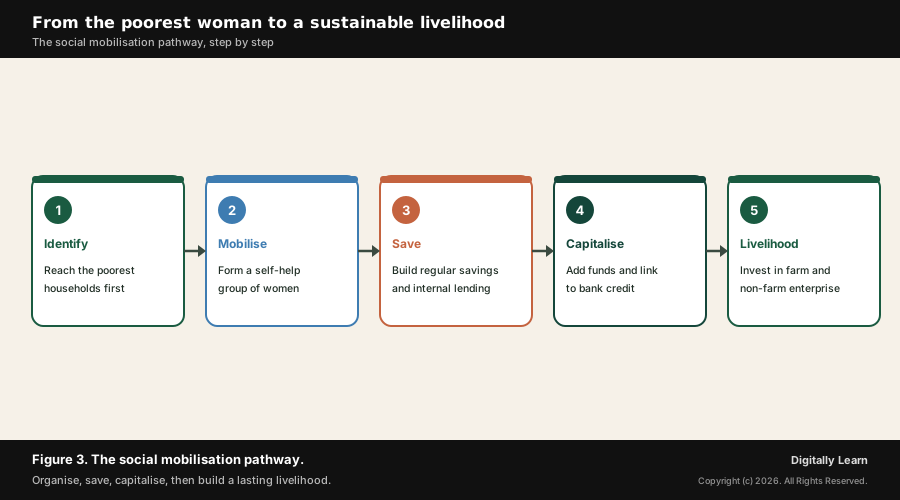
At its heart, DAY-NRLM is a social mobilisation programme rather than a loan window. It begins by identifying the poorest households in a village through a participatory process, so that the most deprived are not left out, and then brings their women together into a small group of about ten to twenty members. The group meets every week, and from the first meeting the members begin to save a tiny sum each, building a common pool that belongs to them.
This pooled saving is the seed of everything that follows. Members borrow from their own fund for small needs and repay with modest interest, which teaches the discipline of credit and creates a track record. As the group matures, the mission adds public money and links it to the banking system, so the women can borrow far larger sums for productive activity. The order is deliberate: organise first, save and lend internally, and only then bring in outside finance.
The final step is the move from coping to a real livelihood. With training and capital, members invest in agriculture, livestock, small manufacturing, shops and services, often spreading risk across more than one activity. The mission supports this diversification through dedicated sub-components and a trained local cadre, so that a woman who started by saving a few rupees a week can end up running an enterprise. The figure below traces this pathway from the poorest woman to a sustainable livelihood.
The Three-Tier Federated Architecture: SHG, Village Organisation and Cluster Level Federation
The self-help group as the base unit, the village organisation as the second tier and the cluster level federation as the apex of the community institutions
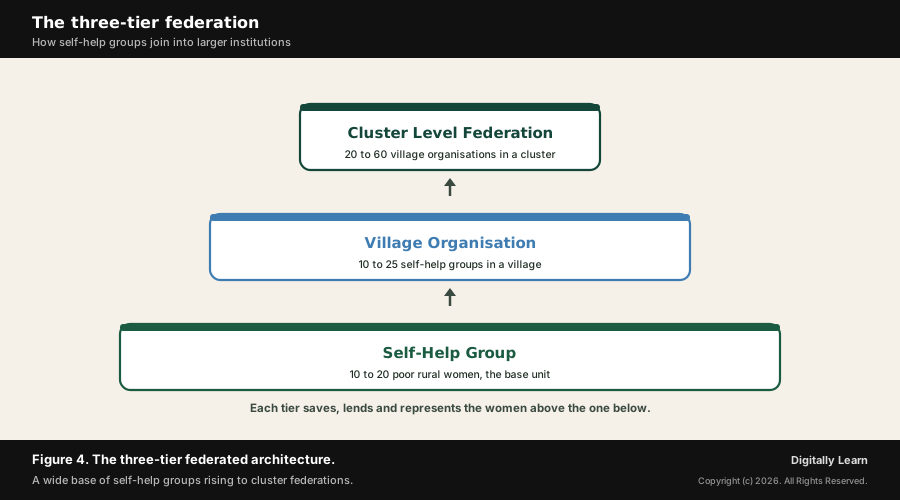
A single self-help group is small and can be fragile, so the mission binds the groups into a three-tier federation that gives them strength in numbers. The base unit is the Self-Help Group itself, ten to twenty poor women from the same neighbourhood who save and lend together. On its own a group can manage savings and small loans, but it cannot easily bargain with banks, markets or officials, which is why the higher tiers exist.
The second tier is the Village Organisation, which brings together the self-help groups of a village, often ten to twenty-five of them. It coordinates the groups, settles disputes, channels funds and lets the women act as a single body within the village. Above it sits the Cluster Level Federation, which federates the village organisations of a cluster of villages and can run larger services, negotiate with banks and support enterprises at a scale no single group could reach.
This pyramid matters because it turns scattered groups into a durable institution of the poor that can stand on its own. The federations hold and rotate funds, build the local cadre, link members to government schemes and give poor women a recognised collective voice. By owning institutions at three levels, the women gain bargaining power and continuity that outlast any single loan or project. The figure below sets out the three tiers and how each rests on the one below.
Financial Inclusion: SHG-Bank Linkage, the Revolving Fund, Community Investment Fund and Interest Subvention
The NABARD SHG-Bank Linkage Programme, the Revolving Fund, the Community Investment Fund and the interest subvention that lowers the cost of credit
The mission's strongest tool is financial inclusion, the steady opening of formal credit to women who once depended on moneylenders. Its foundation is the SHG-Bank Linkage Programme, pioneered by NABARD from a small pilot in 1992 and now the largest microfinance effort in the world. Under it, a mature group opens a bank account and becomes eligible for collateral-free loans, with the group's own discipline standing in place of the security a poor woman cannot offer.
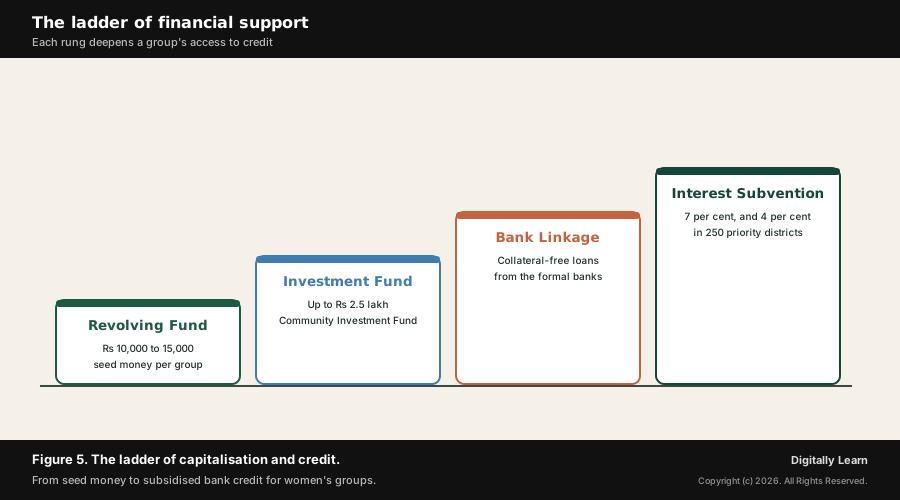
On top of this linkage the mission layers its own capitalisation. A new group receives a Revolving Fund of about ten to fifteen thousand rupees as seed money, which it lends and recovers within the group. A stronger group then gets a Community Investment Fund, of up to about two and a half lakh rupees routed through its federation, to finance members' livelihood plans. These funds stay with the women in perpetuity and are used again and again, multiplying their effect far beyond the original sum.
The mission also makes credit cheaper, not just available. Under the interest subvention, women's groups can take bank loans up to three lakh rupees at seven per cent a year, and in the poorest districts a further subsidy for prompt repayment brings the effective rate down to about four per cent. Cheap, reliable credit is what lets a member invest rather than merely survive, and it is the practical heart of the mission's promise of financial inclusion. The figure below shows this ladder of support.
The Community Cadre: Community Resource Persons, Bank Sakhi and BC Sakhi
How trained community resource persons drawn from the self-help groups, including Bank Sakhi, BC Sakhi, Krishi Sakhi and Pashu Sakhi, carry the mission to scale
A mission that reaches tens of millions of villages cannot be run by officials alone, so DAY-NRLM builds its own community cadre. These are Community Resource Persons, experienced self-help group women trained to go out and organise new groups, keep accounts, resolve problems and pass on what they have learned. Because they come from the same background as the families they serve, they are trusted in a way an outside officer rarely is, and they make the model spread on its own.
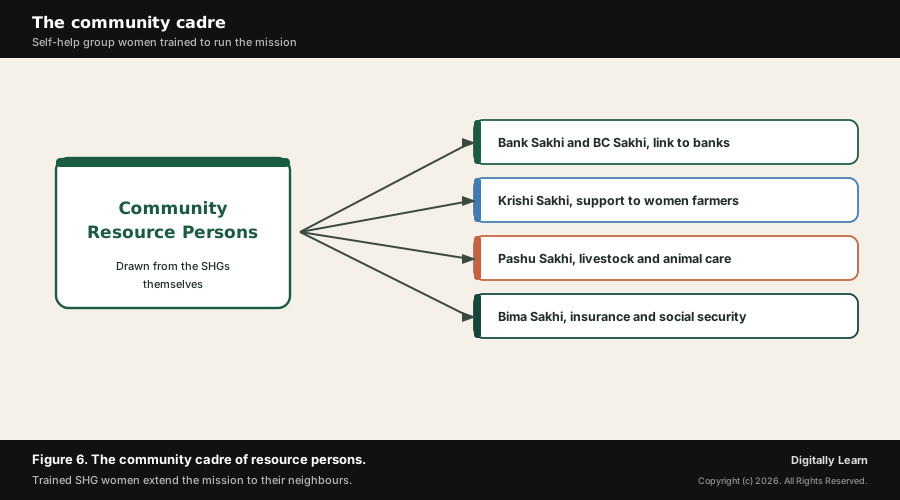
Specialised cadres handle specialised work. The Bank Sakhi and the Banking Correspondent Sakhi sit between the groups and the banks, helping women open accounts, complete paperwork and access credit, and bringing simple banking services to the doorstep. A Krishi Sakhi advises women farmers on better practice, while a Pashu Sakhi supports livestock and animal health and a Bima Sakhi helps members reach insurance and social security.
This cadre is what makes the mission both cheap to run and durable. Each trained woman earns a small income, gains standing in her village and creates the next generation of leaders, so the institutions can keep growing without a matching growth in government staff. By turning members into trainers and service providers, the mission converts a welfare scheme into a self-spreading movement owned by rural women. The figure below maps the main roles of the community cadre.
The Sub-Components: MKSP, SVEP and Aajeevika Grameen Express Yojana
Mahila Kisan Sashaktikaran Pariyojana for women farmers, the Start-up Village Entrepreneurship Programme for rural enterprise and the Aajeevika Grameen Express Yojana for rural transport
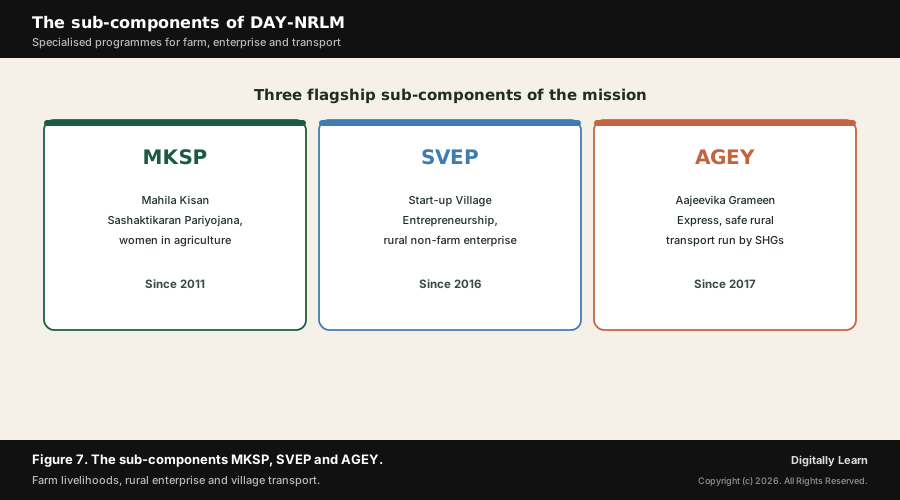
Around its core, the mission runs several sub-components aimed at particular livelihoods. The oldest is the Mahila Kisan Sashaktikaran Pariyojana, in place since 2011, which strengthens the position of women farmers. It invests in better farming practice, sustainable agriculture and collectives, recognising that women do much of the field work yet seldom own the land or get the training, and it tries to close that gap.
A second sub-component looks beyond the farm. The Start-up Village Entrepreneurship Programme, running since 2016, helps members set up small non-farm and off-farm enterprises, the village shops, workshops and services that diversify rural incomes. It offers business advice, mentoring and access to start-up finance, so that a member with a viable idea can build an enterprise rather than depend on farm work alone or migrate to a distant city.
A third sub-component tackles connectivity. The Aajeevika Grameen Express Yojana, launched in 2017, lets self-help groups operate safe and affordable rural transport on routes that private operators ignore, linking remote hamlets to markets, schools and health centres. It is at once a livelihood for the women who run the vehicles and a public service for the village. Together these sub-components show how the mission turns one platform into many livelihood pathways. The figure below sets them out.
Institutional Architecture: The Ministry, State Missions, Cost-Sharing and the Shift From SGSY
The Ministry of Rural Development at the centre, the autonomous State Rural Livelihood Missions, the centre-state cost-sharing pattern and the contrast with the erstwhile SGSY
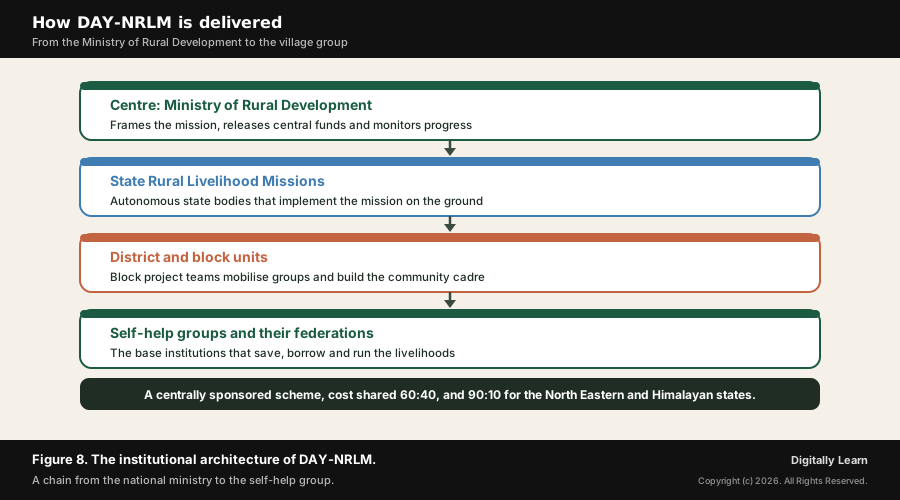
DAY-NRLM runs through a structure that reaches from the capital to the village group. At the top is the Ministry of Rural Development, which frames the mission, releases central funds and monitors progress against targets. The mission is implemented as a centrally sponsored scheme, with the cost shared between the centre and the states in a sixty to forty ratio, rising to ninety to ten for the North Eastern and Himalayan states whose finances and terrain are harder.
Day-to-day delivery rests with the states. Each runs an autonomous State Rural Livelihood Mission, a dedicated body with professional staff that mobilises groups, builds federations and manages funds within the state. Below it, district and block teams do the field work of forming groups and training the cadre. This use of a flexible, mission-style body, rather than ordinary line departments, was a deliberate choice meant to give the programme focus and professional capacity.
The design marks a sharp break from the scheme it replaced. The old Swarnajayanti Gram Swarozgar Yojana relied on one-time subsidies handed to selected beneficiaries, and it built few lasting institutions. DAY-NRLM instead pursues universal mobilisation of the rural poor into their own durable groups, backed by continuous capitalisation, bank linkage and a community cadre. The table contrasts the two approaches, and the figure shows the chain of delivery from the ministry to the group.
| Dimension | Erstwhile SGSY (until 2011) | DAY-NRLM (2011 onward) |
|---|---|---|
| Basic approach | One-time capital subsidy to selected beneficiaries | Continuous social mobilisation of the rural poor |
| Coverage | Limited and target-based selection | Universal mobilisation of poor households, women-centred |
| Institutions | Few durable community bodies | Three-tier SHG, Village Organisation and Cluster Level Federation |
| Credit model | Subsidy-linked one-time loan | Revolving Fund, Community Investment Fund and bank linkage |
| Frontline delivery | Mainly official staff | Community resource persons drawn from the SHGs |
The Current Push: Lakhpati Didi, Drone Didi and the Scale of Women Mobilised
The Lakhpati Didi target of making three crore women earn a lakh a year, the Namo Drone Didi initiative, and the scale of more than ten crore women in over ninety lakh self-help groups
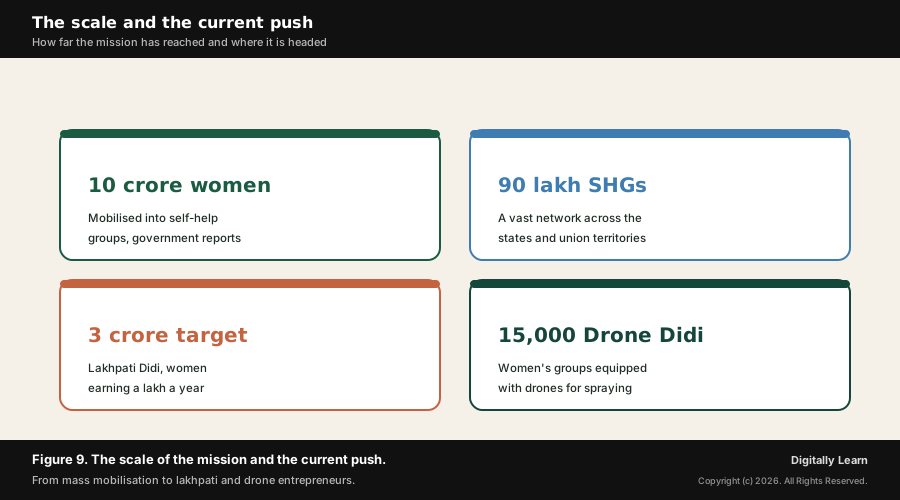
Two decades of mobilisation have built a network of remarkable size. Government reports put the reach at more than ten crore rural women, organised into over ninety lakh self-help groups across the states and union territories, one of the largest platforms of women-led institutions anywhere in the world. This scale is the base on which the mission now layers a more ambitious goal: not merely to include women in finance, but to raise their incomes sharply.
The flagship of this push is the Lakhpati Didi effort, which aims to help self-help group women each earn at least one lakh rupees a year from sustainable livelihoods. The government raised the target from two crore to three crore such women, to be achieved by combining several activities, better skills and market links. The idea reframes the mission's purpose from access to credit towards a measurable jump in household earnings.
Technology is part of the new ambition. Under the Namo Drone Didi initiative, run with the agriculture ministry, selected women's groups are equipped with drones to offer rental services to farmers for spraying fertiliser and pesticide, with a target of around fifteen thousand groups. It introduces women to advanced farm technology and a new income stream at once. These efforts show a mission moving from mass inclusion towards higher-value, technology-enabled livelihoods. The figure below sets out the scale and the current push.
Challenges: Uneven State Performance, Credit Gaps, Livelihood Sustainability and Over-Indebtedness
The wide gap between high-performing and lagging states, uneven access to bank credit, the fragility of many livelihoods and the risk of over-indebtedness
For all its scale, the mission faces real strains. The first is uneven performance across the country. A handful of states have built deep, confident federations, while in others the groups are thin and weak, poorly served by the cadre and slow to access funds. Because the mission depends on patient institution building, this gap means that the poorest women in the weakest states, the very people Antyodaya names first, are often the last to benefit.
A second challenge is the quality of credit and livelihoods. Banks in many areas remain slow to lend to groups, so the promised bank linkage is uneven, and the loans that do flow are often used for consumption or to repay old debt rather than for enterprise. Many livelihoods stay small and fragile, exposed to poor markets and weak skills, so a member can borrow and work hard yet still earn too little to escape poverty for good.
A third risk is over-indebtedness. Where several lenders, including private microfinance firms, chase the same poor borrower, a woman can take on more debt than her income can bear, and a shock such as illness or a failed crop can tip the household into distress. The mission also leans heavily on continued government capitalisation, which raises the question of whether the institutions can stand on their own. These gaps define the unfinished agenda rather than deny the achievement.
The Way Forward: Deepening Credit, Sustaining Livelihoods and Strengthening Convergence
Deepening bank linkage, moving members from subsistence loans to sustainable enterprise, strengthening convergence with health and nutrition, and guarding against over-indebtedness
The lesson of the mission so far is that organising women and lending to them is necessary, but not enough on its own. The harder task is to turn credit into lasting livelihoods and to make sure that higher incomes actually reach the child as better food and care. That calls for steady work on the supply of credit, on skills and markets, and on joining the mission to the wider welfare system rather than running it in isolation.
Equally important is to protect the women the mission was built to serve. Lending must be matched with financial literacy and prudent norms so that inclusion does not become a debt trap, and the weakest states need extra investment in the cadre and the federations so that they catch up. Above all, the community institutions should be helped to stand on their own as women-owned bodies. The measures below set out a balanced path.
- Deepen financial inclusion by linking every mature self-help group to a bank and lowering the cost of credit through interest subvention.
- Move members from subsistence loans to sustainable livelihoods through skills, market access and producer collectives.
- Strengthen convergence with health, nutrition, drinking water and sanitation so that higher incomes translate into better child nutrition.
- Guard against over-indebtedness through financial literacy, prudent lending norms and credit monitoring at the federation level.
- Close the gap between strong and lagging states by investing in the community cadre and institution building where groups are weak.
- Sustain the federations as women-owned institutions that can stand on their own beyond continued government capitalisation.
UPSC Relevance: Prelims Pointers, the Mains Framing and Linked Welfare Schemes
The GS-II governance and welfare fit with a GS-III financial inclusion crossover, the facts to remember, the women and microfinance framing and the related schemes to distinguish
For the examination, DAY-NRLM sits mainly in GS-II, under government schemes, welfare and the empowerment of women, with a clear crossover into GS-III on financial inclusion and rural livelihoods. The facts worth fixing for Prelims are the 2011 launch as Aajeevika, the Ministry of Rural Development as the nodal ministry, the three-tier SHG, Village Organisation and Cluster Level Federation structure, the renaming as Deendayal Antyodaya Yojana, and the sub-components MKSP, SVEP and AGEY.
For Mains, the mission is the worked example for answers on women's empowerment and on whether microfinance can break the cycle of gender inequality, poverty and malnutrition. It lets a student argue both sides: how women's self-help groups build credit, social capital and agency, and why credit alone falls short without livelihoods, market access and convergence. It also serves answers on financial inclusion, the role of community institutions, and the delivery of welfare through people's own organisations.
DAY-NRLM should be distinguished from the schemes that work alongside it. Its urban twin is the Deendayal Antyodaya Yojana, National Urban Livelihoods Mission, while the SHG-Bank Linkage Programme of NABARD provides the wider banking channel, and schemes such as Lakhpati Didi and Namo Drone Didi sit within it as recent pushes. Read together, these show DAY-NRLM as the rural arm of a broad effort to bank, organise and raise the incomes of poor women, the form in which it is most useful in the exam.
Previous Year UPSC-CSE Questions By the end you will be able to draft model answers for the following UPSC questions. Each question carries a collapsible framework showing how to approach it in the exam.
- UPSC Mains 2021 GS-IICan the vicious cycle of gender inequality, poverty and malnutrition be broken through microfinancing of women SHGs? Explain with examples.
How to structure the answer in the exam
Introduction: Open by defining the vicious cycle, that gender inequality deepens poverty, poverty feeds malnutrition, and malnutrition and lost schooling reproduce gender inequality, then introduce microfinancing of women self-help groups, as under DAY-NRLM, as a proposed way to break it.
Body (sub-themes to develop):
- Show how microfinance breaks the gender link: a self-help group gives women a collective voice, control over money and decision making, raising their status, with DAY-NRLM mobilising more than ten crore women into over ninety lakh groups.
- Show how it breaks the poverty link: pooled savings, collateral-free bank linkage, the Revolving Fund and Community Investment Fund, and interest subvention let women escape moneylenders and invest in livelihoods, lifting household income.
- Show how it breaks the malnutrition link: income in women's hands plus group counselling on health and diet tends to raise spending on food, schooling and child care, improving nutrition outcomes.
- Weigh the limits: credit can finance consumption not enterprise, livelihoods can stay fragile, and easy lending can cause over-indebtedness, so microfinance is necessary but not sufficient.
- Argue the balanced verdict: the cycle can be broken substantially only when microfinance is paired with skills, markets, and convergence with health, nutrition, sanitation and education.
Relevance to this topic. The article teaches the self-reinforcing trap of gender inequality, poverty and malnutrition, shows how microfinancing of women SHGs builds savings, collateral-free credit, social capital and agency, and is honest that credit is necessary but not sufficient without livelihoods and convergence, so a student can argue both sides.
Sources and Further Reading
- Ministry of Rural Development: Deendayal Antyodaya Yojana, National Rural Livelihoods Mission (DAY-NRLM)
- DAY-NRLM (Aajeevika): the three-tier community institutional architecture
- Press Information Bureau: more than ten crore women in over ninety lakh self-help groups under DAY-NRLM
- Press Information Bureau: Lakhpati Didi target enhanced from two crore to three crore
- NABARD: Status of Microfinance in India, the SHG-Bank Linkage Programme
- World Bank: the National Rural Livelihoods Project supporting DAY-NRLM
- NITI Aayog: empowerment of women through education, skilling and micro-financing
- DAY-NRLM Bank Linkage portal: interest subvention to women self-help groups
- Wikipedia: National Rural Livelihood Mission
- Wikipedia: Deen Dayal Upadhyaya Antyodaya Yojana
Editorial Disclaimer
This briefing is for UPSC preparation. Verify the figures against the official Ministry of Rural Development, DAY-NRLM and PIB sources before relying on them.


