


Overview
Grounds, exceptions, the Speaker and Kihoto Hollohan
The anti-defection law, set out in the Tenth Schedule of the Constitution, disqualifies a legislator who switches party or defies the party whip, balancing party discipline against the freedom of an elected member.
The anti-defection law is the body of rules in the Tenth Schedule of the Constitution that disqualifies a member of Parliament or of a State Legislature for defecting from the political party on whose ticket the member was elected. It was inserted by the 52nd Amendment Act, 1985 to curb the practice of legislators switching sides for office or gain, which had destabilised many governments. A member is disqualified on two grounds: voluntarily giving up party membership, or voting or abstaining against the party direction, the whip, without permission. A genuine merger of two-thirds of the legislature party is exempt. The Presiding Officer, the Speaker or Chairman, decides each case, and in Kihoto Hollohan v Zachillhu (1992) the Supreme Court made that decision subject to judicial review.
What the Anti-Defection Law Is and Why It Returns to Debate
The Tenth Schedule, defection and party discipline
The anti-defection law is the set of rules contained in the Tenth Schedule of the Constitution of India that disqualifies an elected member of a legislature for defection, that is, for abandoning the political party on whose symbol the member won the seat. Its purpose is to give Indian politics a measure of stability by deterring the floor-crossing that once toppled governments at will, while keeping parties cohesive enough to govern.
It helps to be precise about what the law does. It does not ban a member from ever leaving a party; it attaches the loss of the seat to a defection as the Schedule defines it. Nor does it punish honest disagreement within a party. It targets two specific acts, set out in paragraph 2: giving up party membership and breaking the party whip on a vote, the two ways a legislator can desert the side that elected the member.
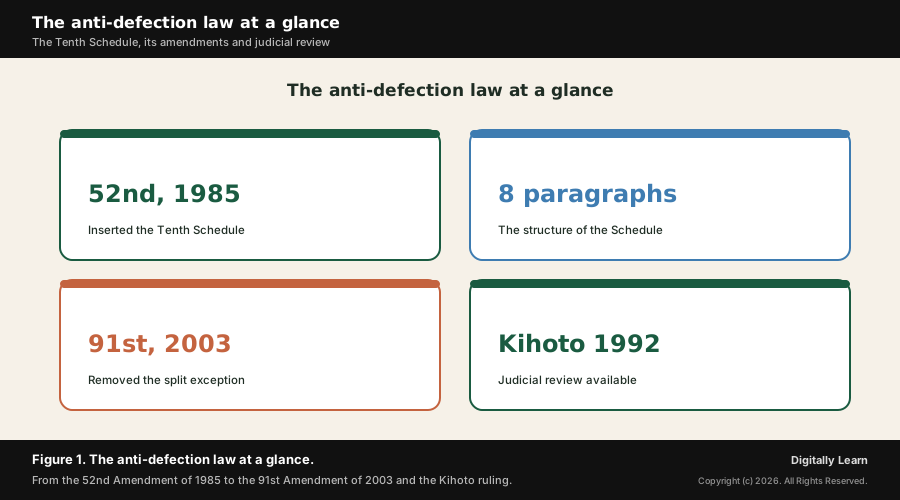
The law therefore sits at the meeting point of party discipline and the freedom of an individual representative. Because it changes the relationship between a member, the party and the House, the rules are written into the Constitution itself rather than an ordinary statute, and they are enforced not by a court in the first instance but by the Presiding Officer of the House. The figure below sets out the headline facts.
Why the anti-defection law is back in focus
Why it matters now is that the working of the law keeps returning to public debate whenever defections reshape a government or an Assembly. Episodes in which groups of legislators switch sides, resign their seats, or sit on petitions for months have repeatedly put the spotlight on how the Tenth Schedule actually operates, and on the Presiding Officer who decides each case. The recurring question is whether the law still serves the purpose for which it was made.
These controversies raise constitutional questions that the exam values. They concern the role of the Speaker and the long delays in some disqualification cases, the use of the resignation route to escape the law, and the proposals to move the deciding power to an independent body. For an aspirant, the anti-defection law is a settled part of the syllabus on the Constitution and Parliament that current events make vivid, which is exactly why it remains a live subject for study.
The 52nd Amendment and the Birth of the Tenth Schedule
The 1985 amendment, the Aaya Ram Gaya Ram problem and the Schedule's structure
The anti-defection law was created by the Constitution (Fifty-second Amendment) Act, 1985. The bill received the President's approval on 15 February 1985 and the Act came into effect on 18 March 1985. The amendment added the new Tenth Schedule to the Constitution and changed Articles 102 and 191, which list the disqualifications for membership of Parliament and of the State Legislatures, so that defection became a fresh ground for losing a seat.
The amendment answered a real problem. From the late 1960s, mass floor-crossing for office and money, captured in the phrase Aaya Ram Gaya Ram, had made and unmade governments in the states, sometimes within days. A legislator could be elected on one party's promise and then desert it for a ministership, hollowing out the voters' mandate. The Tenth Schedule was the constitutional response, intended to make a member's party loyalty count after the election as well as before it.
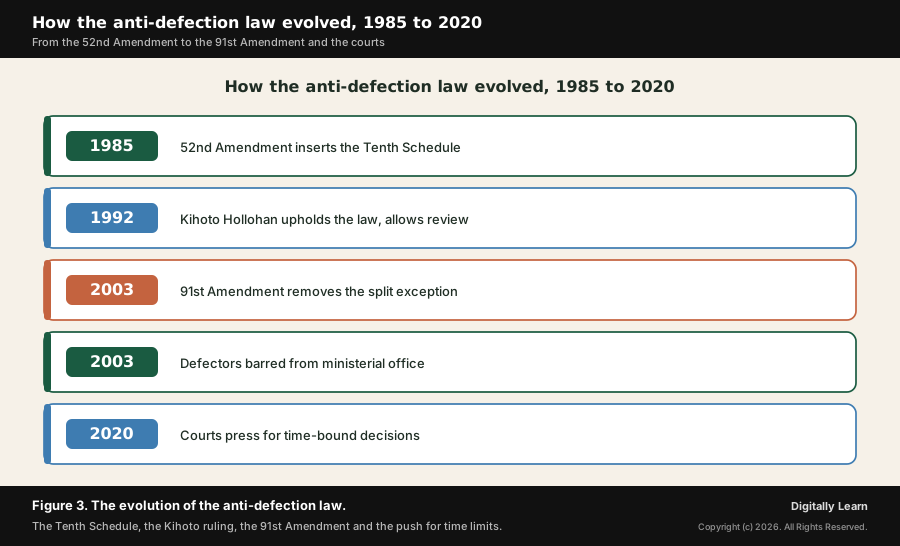
The Tenth Schedule is compact, running to eight paragraphs. They define the grounds of disqualification, the exception for a genuine merger, the authority who decides, and the rules of procedure. Over time the Schedule has been refined by a later amendment and reshaped by the courts, but its core design, written in 1985, has held. The figure later in this article traces how the law evolved from this beginning.
| Element | Provision | What it does |
|---|---|---|
| Amendment | 52nd Amendment Act, 1985 | Inserts the Tenth Schedule into the Constitution |
| Effect date | 18 March 1985 | The anti-defection law comes into force |
| Articles changed | Articles 102 and 191 | Defection added as a disqualification ground |
| Structure | Eight paragraphs | Grounds, exceptions, the deciding authority, procedure |
Reading the rows together shows the shape of the reform: a new Schedule, a clear date of effect, the two articles it amended, and a compact structure that the rest of this article unpacks paragraph by paragraph. The timeline below traces how the law has since evolved.
The Grounds of Disqualification: Switching Party and Defying the Whip
Voluntarily giving up membership and voting against the party direction
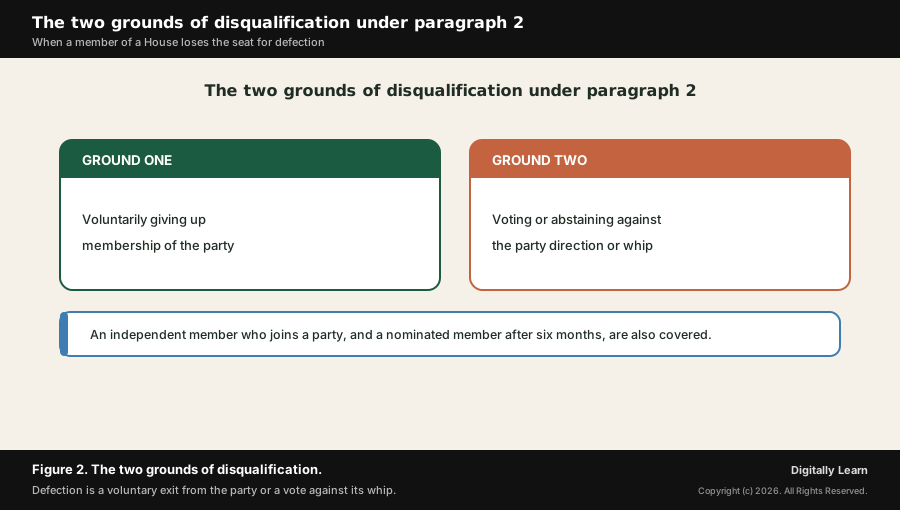
Paragraph 2 of the Tenth Schedule sets out the two grounds on which a member is disqualified. The first is that a member voluntarily gives up the membership of the political party on whose ticket the member was elected. The courts have read this widely: it is not limited to a formal letter of resignation from the party, and conduct that clearly shows a member has abandoned the party can amount to voluntarily giving up membership.
The second ground concerns the party whip. A member is disqualified if the member votes or abstains contrary to the direction issued by the political party, without first obtaining its permission, unless the party condones the act within a set period. This rule binds a legislator to vote with the party on a crucial division, and it is the part of the law most often debated for its effect on the conscience of an individual member.
The Schedule also covers independents and nominated members. An independent member who is elected without a party label is disqualified if the member joins a political party after the election. A nominated member is disqualified if the member joins a party after the expiry of six months from taking the seat, the window the Schedule allows a nominated member to choose a side. The figure below summarises the grounds.
The Merger Exception and the Changes Made by the 91st Amendment
The two-thirds merger exception and the deletion of the split provision
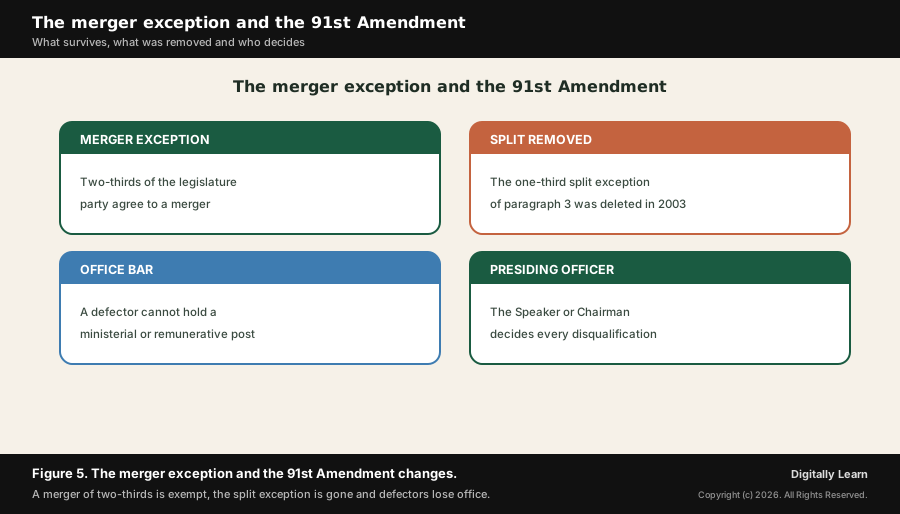
The Tenth Schedule was never meant to freeze every shift of allegiance, so it carries an exception. Under paragraph 4, the disqualification does not apply where a member's original party merges with another, provided not less than two-thirds of the legislature party agree to the merger. Those who go with the merged party, and those who stay as a separate group, are both protected, so a genuine, large-scale realignment is allowed while individual defection is not.
The Schedule as enacted in 1985 also contained a split exception in its original paragraph 3. This shielded a defection from disqualification where it was carried out by a faction of not less than one-third of the legislature party. In practice this one-third split escape was widely exploited: parties were broken up to engineer defections that the law was meant to prevent, which defeated the very purpose of the Tenth Schedule.
The remedy came through the Constitution (Ninety-first Amendment) Act, 2003. On the recommendation of a committee chaired by Pranab Mukherjee, which found the split exception grossly abused, the amendment deleted the one-third split provision from the Tenth Schedule. After 2003 only a genuine merger of two-thirds remains an exception, and a split, however large, no longer protects a defector. The figure below sets out the exception and the 2003 changes.
The bar on office and the cap on the council of ministers
The 91st Amendment did more than close the split loophole; it raised the cost of defection. It provided that a member disqualified for defection cannot be appointed a Minister, or hold any other remunerative political post, for the rest of the term of the House, unless the member is re-elected in the meantime. This removed the incentive that had driven much floor-crossing, since a legislator could no longer defect and be rewarded immediately with office.
The same amendment also limited the size of governments. It capped the total number of Ministers, including the Prime Minister or Chief Minister, at fifteen per cent of the strength of the House, with a floor of twelve in the smaller states. The two measures worked together: by curbing the temptation of office and shrinking the pool of ministerial berths, the 91st Amendment attacked both the supply of and the demand for defection, completing the reform begun in 1985.
The Presiding Officer as the Deciding Authority
The Speaker or Chairman, paragraph 6 and the procedure
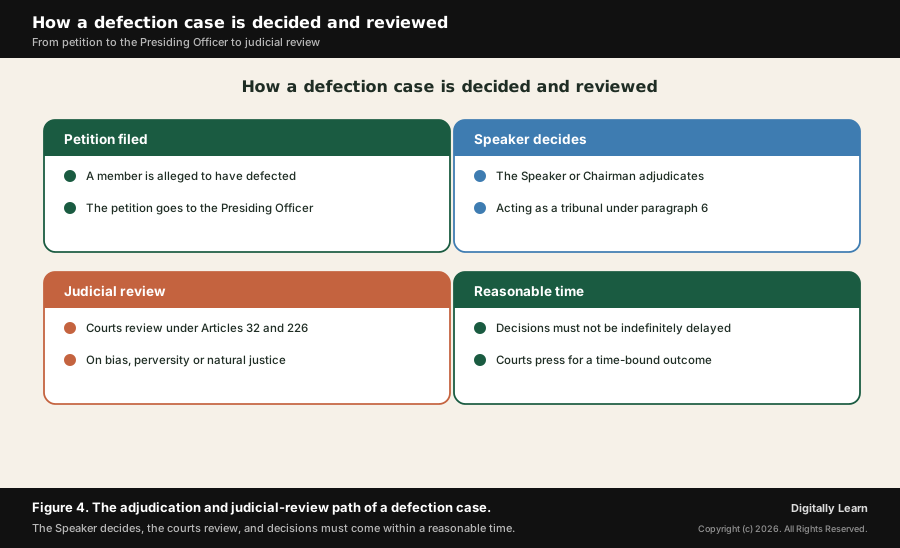
A central feature of the Tenth Schedule is who decides a defection case. Under paragraph 6, the question whether a member has been disqualified for defection is decided by the Presiding Officer, the Speaker of the Lok Sabha or a State Assembly, and the Chairman of the Rajya Sabha or a State Council. The Schedule makes that officer, and not a court or the Election Commission, the authority of first instance, with power to frame rules for handling petitions.
This design reflected a deliberate choice in 1985 to keep the matter within the House, treating defection as a question of legislative membership to be settled by the legislature's own presiding authority. The Presiding Officer hears the petition, gives the member an opportunity to be heard, and then decides whether the conduct amounts to a defection under paragraph 2 or falls within the merger exception. The decision determines whether the member keeps the seat.
It is this allocation of power that has drawn the sharpest criticism, because the Speaker is usually a member of the ruling party and the decision can shape which side commands a majority. Whether the Presiding Officer can act with the detachment of a judge, and how quickly, became the central controversy of the law, tested before the Supreme Court within a few years. The figure below traces how a case moves from petition to review.
Kihoto Hollohan v Zachillhu and the Question of Judicial Review
The 1992 judgment, paragraph 7 and the scope of review
The Tenth Schedule was first tested before the Supreme Court in Kihoto Hollohan v Zachillhu (1992), in which a Constitution Bench of five judges examined whether the new law was valid. The challenge focused on paragraph 7, which had tried to oust the courts altogether by barring any court from interfering in a disqualification decision under the Schedule. The case settled the basic constitutional standing of the anti-defection law.
The Court upheld the Tenth Schedule in the main, accepting that Parliament could attach disqualification to defection and that the Presiding Officer could be made the authority to decide. At the same time it struck down paragraph 7 as unconstitutional, holding that a provision purporting to completely exclude the jurisdiction of the courts touched the powers of the higher judiciary and needed, but lacked, ratification by the states. The bar on the courts therefore fell away.
The decisive holding was on judicial review. The Court ruled that the Speaker or Chairman, in deciding a defection case, acts as a tribunal, and that the decision is open to review by the courts under Articles 32 and 226. It limited that review to grounds such as a violation of constitutional mandate, mala fides, perversity and breach of natural justice, and held that courts should not normally intervene before the officer has decided. This remains the settled position today.
Criticisms and Loopholes: Speaker Delay, Resignation and the Whip
The Speaker's partisanship, delay and the resignation route
The most debated criticism concerns the Presiding Officer. Because the Speaker or Chairman is usually drawn from the ruling party and may have a political future tied to it, critics question whether the office can decide a defection case with full impartiality, especially where the result decides who holds power. Presented neutrally, the concern is structural: the law gives a politically affiliated authority a function that resembles a judicial one, and that tension is hard to remove.
A closely linked problem is delay. The Tenth Schedule sets no time limit for the Presiding Officer to decide, and petitions have remained undecided until the term of the House nearly ended, so the disqualification lost its effect. The Supreme Court has held that such petitions should be decided within a reasonable period, and has pressed Speakers to act in a time-bound way, but the absence of a fixed deadline remains a weakness.
Members have also used the resignation route to sidestep the law. By resigning the seat rather than openly defecting, a legislator can leave a government and contest a fresh election, often for the other side, without being caught by the disqualification, which attaches to a defection rather than to a resignation. Critics argue that this and the delay problem together let the spirit of the Tenth Schedule be evaded even where its letter is observed.
The whip, intra-party democracy and the chilling of debate
A different criticism targets the whip itself. Because a member can be disqualified for voting against the party direction, the law in effect compels a legislator to vote with the party on most matters, leaving little room to dissent on the merits of a bill. Critics argue that this weakens intra-party democracy and the independent voice of the individual member, turning the legislature into a body that ratifies the decisions of party leaderships rather than one that genuinely deliberates.
This concern reaches the quality of debate in the House. Where members cannot safely break the whip, the floor offers fewer real arguments and more predetermined votes, which observers see as a decline in the deliberative role of Parliament. Some suggest the whip should bite only on votes that decide the survival of a government, such as a confidence motion or a money bill, leaving members free on ordinary legislation. This narrower reading is a much-discussed reform idea.
Reform Proposals: An Independent Authority and Time-Bound Decisions
Shifting the decision, fixing time limits and narrowing the whip
The most prominent reform proposal is to take the deciding power away from the Presiding Officer. Several bodies, including the Dinesh Goswami Committee, the Election Commission and the National Commission to Review the Working of the Constitution, suggest that defection cases be decided by an authority outside the House, such as the President or Governor on the advice of the Election Commission, or the higher judiciary. The model already exists for other disqualifications under Articles 103 and 192.
A second proposal is a time limit. To cure the problem of delay, reformers have urged that the law fix a definite period, often suggested as around three months, within which a disqualification petition must be decided, so that the outcome arrives while it still matters. The Supreme Court has moved in this direction by insisting on a reasonable period, but a deadline written into the Schedule itself would make the duty clear and enforceable.
A third set of ideas would narrow the law's reach. Some reformers, and the Law Commission in its review of electoral laws, argue that the whip should apply only to votes that test the confidence of the government, and that a pre-election coalition be treated as a single party. The common thread is to keep the core aim, deterring opportunistic defection, while restoring some independence to the legislator and speed to the process. The table below gathers the main proposals.
| Reform idea | What it would change | Aim |
|---|---|---|
| Independent authority | President or Governor on Election Commission advice decides | Remove the partisanship concern over the Speaker |
| Time-bound decision | A fixed period to decide a petition | End indefinite delay in defection cases |
| Narrow the whip | Whip binds only on confidence and money votes | Protect debate and intra-party democracy |
| Recognise coalitions | Treat a pre-poll coalition as one party | Reflect how parties actually contest |
Reading the proposals together shows a shared direction: keep the deterrent against opportunistic floor-crossing, but make the deciding authority neutral, the process prompt, and the burden on the individual member lighter.
Understanding the Significance of the Anti-Defection Law
Stability, party discipline and the freedom of the elected member
What is the significance of the anti-defection law lies first in the stability it gives to governments. By disqualifying legislators who switch sides for office or gain, the Tenth Schedule deters the floor-crossing that once collapsed governments overnight, so that a government with a majority can usually expect to serve its term. This continuity is a real gain for governance and was the central purpose of the 1985 reform.
Its second significance is its effect on party discipline and the working of Parliament. The law strengthens the hold of parties over their members, which makes the legislature more predictable but, as critics note, can dampen genuine debate. The anti-defection law thus sits at the centre of a trade-off that defines parliamentary democracy in India, between cohesive, stable parties on one side and a deliberative House of independent members on the other.
Its third significance is constitutional. The law marks out the boundary between legitimate political realignment, protected through the merger exception, and the opportunistic desertion the Constitution now forbids, and through Kihoto Hollohan it defines how far the courts may oversee a decision of the Presiding Officer. For an aspirant it is a compact case study in how an amendment, a judgment and a reform debate together shape a working institution of democracy.
The Anti-Defection Law in Context: Parliament, Federalism and Reform
How the law sits among India's wider debates on Parliament and the courts
Contemporary linkages place the anti-defection law within the broader study of Parliament and its functioning. It connects to the role of the Speaker and the demand for the office to act with neutrality, to the institution of the party whip and the question of intra-party democracy, and to the wider agenda of electoral and parliamentary reform pursued by the Law Commission and the Election Commission over many years.
The law also links to the powers of the courts. Through Kihoto Hollohan it forms part of the law on judicial review of decisions taken inside the legislature, and it touches the boundary the Constitution draws between the legislature and the judiciary. It connects, too, to coalition politics and to the stability of governments in the states, where defections have most often reshaped power. These are the threads an aspirant should hold together when reading the topic:
- The office of the Speaker: The neutrality expected of the Presiding Officer, central to the debate over who should decide defection cases.
- The party whip: The instrument of party discipline that the law enforces, and its effect on the independence of a member.
- Judicial review: The power of the courts to review the Presiding Officer’s decision, settled by Kihoto Hollohan under Articles 32 and 226.
- Electoral and parliamentary reform: The long record of committee proposals to make the law fairer and faster, from the Dinesh Goswami Committee onward.
Taken together, these linkages show that the anti-defection law is not a narrow technical rule but a constitutional question that reaches into the working of Parliament, the role of the courts and the everyday conduct of Indian democracy.
The Way Forward for the Anti-Defection Law
Balancing stability, neutrality and the freedom to deliberate
A balanced way forward would keep the law's core purpose while curing its known defects. The deterrent against opportunistic defection remains valuable, so the answer is not to repeal the Tenth Schedule but to repair it. The most widely supported step is to move the deciding power to a neutral authority, such as the President or Governor on the advice of the Election Commission, or a judicial body, so the result does not depend on a politically affiliated officer.
A second step is to make the process prompt by writing a clear time limit into the law, so that a disqualification is decided while it can still affect the composition of the House. A third is to restore some space for the individual member by confining the whip to votes that decide the survival of a government, allowing genuine debate on ordinary legislation without inviting disqualification. Together these would protect intra-party democracy without reopening the door to floor-crossing.
The guiding aim is a careful balance. India needs stable governments and cohesive parties, which the anti-defection law helps secure, and it also needs a deliberative Parliament of representatives who can reason and dissent. A reformed Tenth Schedule, neutral in its adjudication, prompt in its decisions and narrow in the votes it binds, would serve both ends, which is the settled direction of the reform debate the exam expects an aspirant to present.
UPSC Relevance and Exam Focus
Where the anti-defection law fits in the UPSC-CSE syllabus
This topic maps most directly to General Studies Paper II: the Indian Constitution, its features, amendments and significant provisions, and the structure, functioning and conduct of business of Parliament and the State Legislatures. It also draws on the separation of powers, the role of the judiciary through Kihoto Hollohan, and the wider theme of electoral and parliamentary reform.
For Prelims, hold the high-yield facts: the anti-defection law is the Tenth Schedule, inserted by the 52nd Amendment Act of 1985; the two grounds are voluntarily giving up membership and voting against the whip; a merger of two-thirds is the surviving exception; the 91st Amendment of 2003 removed the one-third split exception and barred defectors from office; the Speaker or Chairman decides; and Kihoto Hollohan made that decision subject to judicial review under Articles 32 and 226.
For Mains, the recurring framing is to evaluate the law: weigh the stability and party discipline it secures against its effect on the freedom of the individual member and the quality of debate, and assess the criticisms of Speaker delay and partisanship and the proposals for reform. A strong answer treats the anti-defection law as a question of democratic design, uses Kihoto Hollohan and the committee proposals, and reaches a balanced judgment.
Recurring linked concepts an aspirant should keep in working memory:
- The Tenth Schedule and paragraph 2: The two grounds of disqualification for defection, the core of the law.
- The merger exception: The two-thirds rule of paragraph 4 and the deletion of the one-third split exception in 2003.
- The Presiding Officer: The Speaker or Chairman as the deciding authority under paragraph 6, and the neutrality debate.
- Kihoto Hollohan v Zachillhu: The judgment allowing judicial review of the Presiding Officer’s decision under Articles 32 and 226.
A common Prelims trap is to confuse the surviving exception with the one that was removed; hold that a merger of two-thirds is exempt while the one-third split exception was deleted by the 91st Amendment in 2003, and that the Speaker, not the Election Commission, decides under the present law.
A common Mains trap is to treat the law as an unqualified good or an unqualified evil. Its exam value lies in a balanced judgment: the genuine stability it brings set honestly against the cost to the independence of the member and the deliberative role of Parliament, with Kihoto Hollohan and the reform proposals supplying the constitutional frame.
Previous Year UPSC-CSE Questions By the end you will be able to draft model answers for the following UPSC questions. Each question carries a collapsible framework showing how to approach it in the exam.
- UPSC Mains 2013 GS-IIExamine how far the diminished role of individual MPs and the decline of constructive policy debate can be attributed to the anti-defection law, which was legislated with a different intention.
How to structure the answer in the exam
Body (sub-themes to develop):
- The original and different intention of the law: the 52nd Amendment of 1985 created the Tenth Schedule to stop the Aaya Ram Gaya Ram floor-crossing that toppled governments, not to silence debate.
- How the law diminishes the individual MP: the whip in paragraph 2 disqualifies a member who votes against the party direction, so members must vote with the party, dissent on the merits is risky, and the House tends to ratify leadership decisions rather than deliberate.
- The effect on constructive debate: with the whip binding most votes, the floor offers fewer genuine arguments on policy, which weakens the deliberative role of Parliament and the independent voice of the member.
- How far other factors matter: party structures, leadership control, the decline of legislative time and scrutiny and the conduct of business also reduce the role of the individual MP, so the law is one cause among several.
- The reform direction: confine the whip to confidence and money votes, move the deciding power to a neutral authority and fix a time limit, so the deterrent against defection survives while the freedom to deliberate is restored.
Sources and Further Reading
- Legislative Department, Ministry of Law and Justice: The Constitution (Fifty-second Amendment) Act, 1985
- India Code: The Constitution of India and the Tenth Schedule
- Election Commission of India: Disqualification on the ground of defection
- Law Commission of India: Reform of the Electoral Laws (170th Report, 1999)
- Press Information Bureau: Presidential assent for the Anti-Defection Bill
- Press Information Bureau: Year End Review, Legislative Department
- Wikipedia: Anti-defection law (India)
- Wikipedia: Aaya Ram Gaya Ram
Editorial Disclaimer
This briefing is for UPSC preparation. Verify the provisions of the Tenth Schedule against the official text of the Constitution and the relevant judgments before relying on them.
